

Patient leaflet - Oxynorm Dispersa 20 mg orodispersible tablets
1. What OxyNorm Dispersa tablets are and what they are used for
This medicine has been prescribed for you for the relief of moderate to severe pain.
It contains oxycodone which belongs to a class of medicines called opioids, which are “pain relivers”. This medicine has been prescribed for you and should not be given to anyone else. Opioids can cause addiction and you may get withdrawal symptoms if you stop taking it suddenly. Your prescriber should have explained how long you will be taking it for and when it is appropriate to stop, how to do this safely.
2. What you need to know before you take OxyNorm Dispersa tablets
Do not take OxyNorm Dispersa tablets if you:
- are allergic (hypersensitive) to oxycodone or any of the other ingredients of the tablets (listed in section 6 of this leaflet);
- have breathing problems, such as severe chronic obstructive lung disease, severe bronchial asthma or severe respiratory depression. Your doctor will have told you if you have any of these conditions. Symptoms may include breathlessness, coughing or breathing more slowly or weakly than expected;
- have a condition where the small bowel does not work properly (paralytic ileus), your stomach empties more slowly than it should (delayed gastric emptying) or you have severe pain in your abdomen;
- have a heart problem after long-term lung disease (cor pulmonale);
- have increased carbon dioxide levels in the blood. Symptoms may include dizziness, drowsiness, fatigue, shortness of breath and headache;
- have moderate to severe liver problems. If you have other long-term liver problems you should only take these tablets if recommended by your doctor;
- have ongoing problems with constipation;
- are under 18 years of age.
Warnings and precautions
Talk to your doctor or pharmacist before taking this medicine if you:
- or anyone in your family are or have ever been addicted to opioids, alcohol, prescription medicines or illegal drugs;
- are a smoker;
- have ever had problems with your mood (depression, anxiety or a personality disorder) or have been treated by a psychiatrist for other mental illnesses);
- have previously suffered from withdrawal symptoms such as agitation, anxiety, shaking or sweating, when you have stopped taking alcohol or drugs;
- feel you need to take more tablets to get the same level of pain relief, this may mean you are becoming tolerant to the effects of this medicine or are becoming addicted to it. Speak to your prescriber who will discuss your treatment and may change your dose or switch you to an alternative pain reliever;
- are elderly or weakened;
- have an under-active thyroid gland (hypothyroidism), as you may need a lower dose;
- have myxoedema (a thyroid disorder associated with dryness, coldness and swelling or puffiness of the skin affecting the face and limbs;
- know you are suffering from a brain injury or tumour, or you have a head injury, severe headache or feel sick as this may indicate that the pressure in your skull is increased;
- have low blood pressure (hypotension);
- have low blood volume (hypovolaemia). This can occur due to severe external or internal bleeding, severe burns, excessive sweating, severe diarrhoea or vomiting;
- feel very lightheaded or faint;
- have a mental disorder following use of certain medicines (toxic psychosis);
- have inflammation of the pancreas (which causes severe pain in the abdomen and back);
- have problems with your gall bladder or bile duct;
- have inflammatory bowel disease;
- have an enlarged prostate gland, which causes difficulty in passing urine (in men);
- have poor adrenal gland function (your adrenal gland is not working properly which may cause symptoms including weakness, weight loss, dizziness, feeling or being sick), for example due to Addison’s disease;
- have severely impaired lung function. Symptoms may include breathlessness and coughing;
- have long term pain unrelated to cancer;
- have a condition where your breathing stops for short periods whilst you are asleep, known as sleep apnoea;
- have kidney or liver problems.
Tolerance, dependence and addiction
- This medicine contains oxycodone which is an opioid medicine. Repeated use of opioid painkillers can result in the drug being less effective (you become accustomed to it, known as tolerance). Repeated use of OxyNorm Dispersa tablets can also lead to dependence, abuse, and addiction, which may result in lifethreatening overdose. The risk of these side effects can increase with a higher dose and longer duration of use.
- Dependence or addiction can make you feel that you are no longer in control of how much medicine you need to take or how often you need to take it. You might feel that you need to carry on taking your medicine, even when it doesn’t help to relieve your pain.
- The risk of becoming dependent or addicted varies from person to person. You may have a greater risk of becoming dependent or addicted on OxyNorm Dispersa tablets if:
- - You or anyone in your family have ever abused or been dependent on alcohol, prescription medicines or illegal drugs (“addiction”).
- - You are a smoker.
- - You have ever had problems with your mood (depression, anxiety or a personality disorder) or have
- been treated by a psychiatrist for other mental illnesses.
- If you notice any of the following signs whilst taking OxyNorm Dispersa tablets, it could be a sign that you have become dependent or addicted.
- – You need to take the medicine for longer than advised by your doctor
- – You need to take more than the recommended dose
- – You are using the medicine for reasons other than prescribed, for instance, ‘to stay calm’ or ‘help you sleep’
- – You have made repeated, unsuccessful attempts to quit or control the use of the medicine
- – When you stop taking the medicine you feel unwell, and you feel better once taking the medicine again (‘withdrawal effects’)
- If you notice any of these signs, speak to your doctor to discuss the best treatment pathway for you, including when it is appropriate to stop and how to stop safely (See section 3, If you stop taking OxyNorm Dispersa tablets).
•
Addiction can cause withdrawal symptoms when you stop taking this medicine. Withdrawal symptoms can include restlessness, difficulty sleeping, irritability, agitation, anxiety, feeling your heartbeat (palpitations), increased blood pressure, feeling or being sick, diarrhoea, loss of appetite, shaking, shivering or sweating. Your doctor will discuss with you how to gradually reduce your dose before stopping the medicine. It is important that you do not stop taking the medicine suddenly as you will be more likely to experience withdrawal symptoms.
Opioids should only be used by those they are prescribed for. Do not give your medicine to anyone else. Taking higher doses or more frequent doses of opioid may increase the risk of addiction. Overuse and misuse can lead to overdose and/or death.
Do not inject OxyNorm Dispersa. This can cause serious side effects including tissue death at the site of injection, infection, inflammation of the lungs and damage to the heart which may be fatal.
Sleep-related breathing disorders
OxyNorm Dispersa can cause sleep-related breathing disorders such as sleep apnoea (breathing pauses during sleep) and sleep related hypoxemia (low oxygen level in the blood). The symptoms can include breathing pauses during sleep, night awakening due to shortness of breath, difficulties to maintain sleep or excessive drowsiness during the day. If you or another person observe these symptoms, contact your doctor. A dose reduction may be considered by your doctor.
If you are going to have an operation, or have just had an operation, please tell the doctor at the hospital that you are taking these tablets. Your doctor may adjust your dose.
You may experience hormonal changes while taking these tablets. Your doctor may want to monitor these changes.
Other medicines and OxyNorm Dispersa tablets
Taking OxyNorm Dispersa at the same time as other medicines that slow down the central nervous system can cause slow or difficulty breathing (respiratory depression), severe sleepiness, loss of consciousness and death. These medicines include:
- other medicines used to treat , diarrhoea known as opioids (such as codeine or morphine);
- medicines used to treat epilepsy (gabapentinoids) such as pregabalin;
- medicines used to treat anxiety;
- medicines used to make you feel sleepy (such as benzodiazepines);
- medicines used to treat psychiatric or mental disorders (such as phenothiazines);
- anaesthetics;
- muscle relaxants;
- medicines used to treat high blood pressure;
- a type of medicine used to treat depression known as monoamine oxidase inhibitors (MAOIs), such as tranylcypromine, phenelzine and isocarboxazid. You should not take OxyNorm Dispersa if you are currently taking this type of medicine, or have taken this medicine in the last two weeks.
Because of this, your doctor will only prescribe OxyNorm Dispersa where there are no other treatment options, and only in small doses for short periods of time. If you or your friends, family or caregivers notice that you are having difficulty breathing or that you have become very sleepy or lost consciousness you (or they) should inform your doctor immediately.
Taking OxyNorm Dispersa with medicines used to treat depression known as Selective Serotonin Re-uptake Inhibitors (SSRIs) or Serotonin Norepinephrine Re-uptake Inhibitors (SNRIs) can cause a condition known as serotonin toxicity. The symptoms of this include agitation, seeing or hearing things that aren’t real (hallucinations), loss of consciousness, a fast heartbeat, blood pressure changes, increased body temperature, muscle twitching, lack of coordination, stiffness, feeling or being sick, or diarrhoea. If you are taking SSRI or SNRI medicines such as citalopram, duloxetine, escitalopram, fluoxetine, fluvoxamine, paroxetine, sertraline or venlafaxine your doctor may reduce your dose of OxyNorm Dispersa.
Please tell your doctor or pharmacist if you are taking, have recently taken or might take any other medicines, including medicines obtained without a prescription.
Tell your doctor or pharmacist if you are taking any of the following medicines, as they may need to adjust your dose:
- a type of medicine to treat depression known as tricyclic antidepressants, such as amitriptyline, clomipramine, imipramine, lofepramine or nortriptyline;
- medicines used to treat allergies, such as cetirizine, fexofenadine or chlorphenamine;
- medicines used to treat Parkinson’s disease;
- antibiotics such as clarithromycin, erythromycin or telithromycin;
- antifungal medicines such as ketoconazole, voriconazole, itraconazole and posaconazole;
- medicines used to treat HIV known as protease inhibitors, such as boceprevir, ritonavir, indinavir, nelfinavir or saquinavir;
- cimetidine, a medicine used to treat stomach ulcers;
- rifampicin, a medicine used to treat tuberculosis;
- medicines to treat seizures, fits or convulsions such as carbamazepine and phenytoin;
- a herbal remedy used to treat depression known as St. John’s Wort (also known as Hypericum perforatum);
- quinidine, a medicine used to treat an irregular heartbeat).
Taking OxyNorm Dispersa tablets with food, drink and alcohol
Drinking alcohol during your treatment with these tablets may make you sleepy or increase the risk of serious side effects such as shallow breathing with a risk of stopping breathing, and loss of consciousness. It is recommended not to drink alcohol while you are taking OxyNorm Dispersa tablets.
You should avoid drinking grapefruit juice during your treatment with this medicine.
Pregnancy and breastfeeding
Ask your doctor or pharmacist for advice before taking any medicine.
Pregnancy
Do not take OxyNorm Dispersa if you are pregnant or think you might be pregnant unless you have discussed this with your doctor and the benefits of treatment are considered to outweigh the potential harm to the baby. If you take OxyNorm Dispersa during pregnancy your baby may become dependent and experience withdrawal symptoms after the birth which may need to be treated.
Breast-feeding
Do not take OxyNorm Dispersa while you are breastfeeding as oxycodone passes into breast milk and will affect your baby.
Driving and using machines
These tablets may cause a number of side effects such as drowsiness or dizziness which may affect your ability to drive or use machinery (see section 4 “Possible side effects” for a full list of side effects). These are usually most noticeable when you first start taking the tablets, or when changing to a higher dose.
- Do not drive while taking this medicine until you know how it affects you.
- It is an offence to drive if this medicine affects your ability to drive.
However you would not be committing an offence if:
- The medicine has been prescribed to treat a medical or dental problem and
- You have taken it according to the instructions given by the prescriber or in the information provided with the medicine and;
- It was not affecting your ability to drive safely.
Talk to your doctor or pharmacist if you are not sure whether it is safe for you to drive while taking this medicine.
OxyNorm Dispersa tablets contain sucrose, maltodextrin and aspartame
- These tablets contain sucrose and maltodextrin. Maltodextrin is a form of glucose. Both sucrose and glucose are forms of sugar and may be harmful to your teeth. If you have been told by your doctor that you have an intolerance to some sugars, contact your doctor before taking these tablets. This medicine contains x mg aspartame in each tablet. Aspartame is a source of phenylalanine. It may be harmful if you have phenylketonuria (PKU), a rare genetic disorder in which phenylalanine builds up because the body cannot remove it properly
3. How to take OxyNorm Dispersa tablets
Always take these tablets exactly as your doctor has told you. Check with your doctor or pharmacist if you are not sure.
Before starting treatment and regularly during treatment, your doctor will discuss with you what you may expect from using OxyNorm Dispersa tablets, when and how long you need to take it, when to contact your doctor, and when you need to stop it (see also if you stop taking OxyNorm Dispersa tablets).
Adults (over 18 years of age)
The usual starting dose is one 5 mg tablet every 4 to 6 hours. However, your doctor will prescribe the dose required to treat your pain. If you find that you are still in pain whilst taking these tablets discuss this with your doctor.
Children
Children and adolescents under 18 years of age should not take the tablets.
Patients with kidney or liver problems
Please tell your doctor if you suffer from kidney or liver problems as they may prescribe a lower dose depending on your condition.
| Do not exceed the dose recommended by your doctor. You should check with your doctor or | |
| pharmacist if you are not sure. | |
| To remove a tablet from the blister strip: | |
| Diagram 1: | |
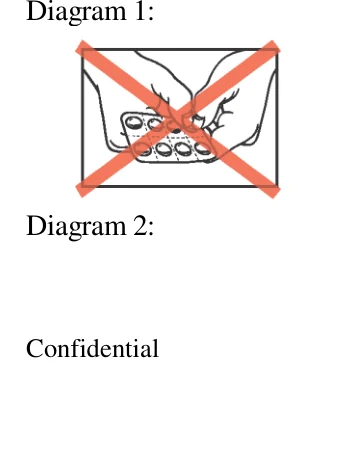
Do not press your tablet through the foil as this may damage it.
Diagram 2:
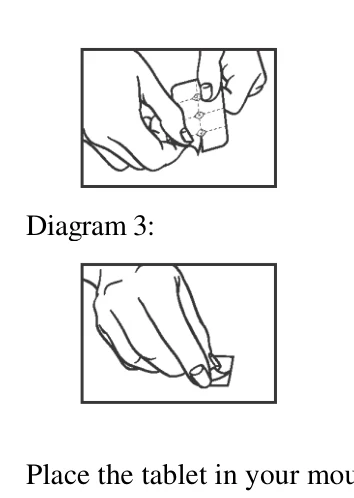
Detach a pocket containing one tablet from the blister strip by carefully tearing along the perforations.
Diagram 3: 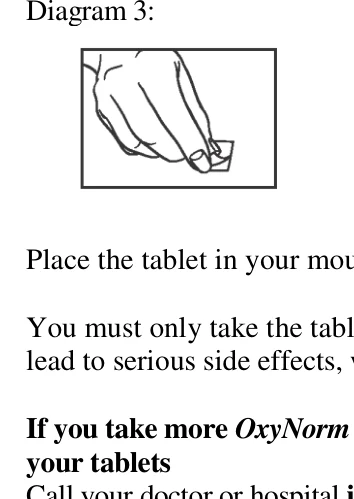
Peel back the corner of the foil where indicated with the arrow and gently remove the tablet.
Place the tablet in your mouth and allow to dissolve before swallowing.
You must only take the tablets by mouth. The tablets should never be crushed and injected as this may lead to serious side effects, which may be fatal (see section 2 “Warnings and precautions”).
If you take more OxyNorm Dispersa tablets than you should or if someone accidentally swallows your tablets
Call your doctor or hospital immediately. People who have taken an overdose may feel very sleepy, sick or dizzy, or have hallucinations. They may also have brain disorder (known as toxic leukoencephalopathy), breathing difficulties leading to unconsciousness or even death and may need emergency treatment in hospital. When seeking medical attention make sure that you take this leaflet and any remaining tablets with you to show to the doctor.
If you forget to take your OxyNorm Dispersa tablets
If you remember within 4 hours of the time your tablet was due, take your tablet straight away. Take your next tablet at your normal time. If you are more than 4 hours late, please call your doctor or pharmacist for advice. Do not take a double dose to make up for forgotten tablets.
If you stop taking OxyNorm Dispersa tablets
Do not suddenly stop taking this medicine. If you want to stop taking your tablets, discuss this with your doctor first. They will tell you how to do this, usually by reducing the dose gradually so that any unpleasant withdrawal effects are kept to a minimum. Withdrawal symptoms such as restlessness, difficulty sleeping, irritability, agitation, anxiety, feeling your heartbeat (palpitations), increased blood pressure, feeling or being sick, diarrhoea, shaking, shivering or sweating may occur if you suddenly stop taking this medicine.
If you have any further questions on the use of this medicine, ask your doctor or pharmacist.
4. Possible side effects
Like all medicines, these tablets can cause side effects, although not everybody gets them.
All medicines can cause allergic reactions, although serious allergic reactions are rare. Tell your doctor immediately if you get any sudden wheeziness, difficulties in breathing, swelling of the eyelids, face or lips, rash or itching especially those covering your whole body. These may be signs of a serious allergic reaction.
The most serious side effect is a condition where you breathe more slowly or weakly than usual (respiratory depression) and can lead to severe sleepiness and loss of consciousness. This side effect may affect up to 1 in 100 people and is more likely to occur when taking certain other medicines (see section 2 ‘Other medicines and OxyNorm Dispersa). Tell your doctor immediately if this happens to you. You may wish to ask your friends, family or caregivers to monitor you for these signs and symptoms.
Drug withdrawal
When you stop taking OxyNorm Dispersa you may experience drug withdrawal symptoms, which include restlessness, difficulty sleeping, irritability, agitation, anxiety, feeling your heartbeat (palpitations), increased blood pressure, feeling or being sick, diarrhoea, shaking, shivering or sweating.
How do I know if I am addicted?
If you notice any of the following signs whilst taking OxyNorm Dispersa it could be a sign that you have become addicted.
- You need to take the medicine for longer than advised by your prescriber;
- You feel you need to use more than the recommended dose;
- You are using the medicine for reasons other than prescribed;
- When you stop taking the medicine you feel unwell, and you feel better once taking the medicine again.
If you notice any of these signs it is important you talk to your doctor.
Very common side effects
(May affect more than 1 in 10 people)
- Constipation (your doctor can prescribe a laxative to overcome this problem).
- Feeling or being sick (this should normally wear off after a few days, however your doctor can prescribe an anti-sickness medicine if it continues to be a problem).
- Drowsiness (this is most likely when you start taking your tablets or when your dose is increased, but it should wear off after a few days).
- Dizziness.
- Headache.
- Itchy skin.
Common side effects
(May affect up to 1 in 10 people)
- Dry mouth, loss of appetite, indigestion, abdominal pain or discomfort, diarrhoea.
- Confusion, depression, a feeling of unusual weakness, shaking, lack of energy, tiredness, anxiety, nervousness, difficulty in sleeping, abnormal thoughts or dreams.
- Difficulty in breathing or wheezing, shortness of breath, decreased cough reflex.
- Rash.
- Sweating.
Uncommon side effects
(May affect up to 1 in 100 people)
- Withdrawal symptoms (see section ‘Drug withdrawal’);
- Difficulty in swallowing, belching, hiccups, wind, a condition where the bowel does not work properly (ileus), inflammation of the stomach, changes in taste or unpleasant taste;
- A feeling of dizziness or ‘spinning’ (vertigo), hallucinations, mood changes, unpleasant or uncomfortable mood, a feeling of extreme happiness, disorientation, restlessness, agitation, generally feeling unwell, loss of memory, difficulty in speaking, reduced sensitivity to pain or touch, tingling or numbness, seizures, fits or convulsions, blurred or impaired vision, fainting, unusual muscle stiffness or slackness, involuntary muscle contractions or spasms;
- Difficulty in passing urine, impotence, decreased sexual drive, low levels of sex hormones in the blood (‘hypogonadism’, seen in a blood test);
- Fast, irregular heart beat, flushing of the skin;
- Dehydration, thirst, chills, swelling of the hands, ankles or feet;
- Dry skin, severe flaking or peeling of the skin;
- Redness of the face, reduction in size of the pupils in the eye, high temperature;
A need to take increasingly higher doses of the tablets to obtain the same level of pain relief
(tolerance);
- Colicky abdominal pain or discomfort;
- A worsening of liver function tests (seen in a blood test).
Rare side effects
(May affect up to 1 in 1,000 people)
- Low blood pressure or feeling faint, especially on standing up;
- A raised, itchy rash (hives).
Frequency not known
(Frequency cannot be estimated from the available data)
- Dependence and addiction (see section ‘How do I know if I am addicted?’);
- An increased sensitivity to pain;
- Aggression;
- Tooth decay;
- Absence of menstrual periods;
- A blockage in the flow of bile from the liver (cholestasis). This can cause itchy skin, yellow skin, very dark urine and very pale stools;
- Sleep apnoea (breathing pauses during sleep);
- Long term use of OxyNorm Dispersa tablets during pregnancy may cause life-threatening withdrawal symptoms in the newborn. Symptoms to look for in the baby include irritability, hyperactivity and abnormal sleep pattern, high pitched cry, shaking, being sick, diarrhoea and not putting on weight.
Reporting of side effects
If you get any side effects, talk to your doctor, pharmacist or nurse. This includes any possible side effects not listed in this leaflet. You can also report side effects directly via the Yellow Card Scheme at: www.mhra.gov.uk/yellowcard or search for MHRA Yellow Card in the Google Play or Apple App Store.
By reporting side effects you can help provide more information on the safety of this medicine.
5. How to store OxyNorm Dispersa tablets
Keep this medicine out of the sight and reach of children. Store this medicine in a locked safe and secure storage space, where other people cannot access it. It can cause serious harm and be fatal to people when it has not been prescribed for them.
Do not use any tablets after the expiry date which is stated on the blister and carton. EXP 08 2020 means that you should not take the tablets after the last day of that month i.e. August 2020.
Do not store above 25°C.
Do not throw away any medicines via wastewater or household waste. Ask your pharmacist how to throw away medicines you no longer use. These measures will help to protect the environment.
6. Contents of the pack and other information
What OxyNorm Dispersa tablets contain
The active ingredient is oxycodone hydrochloride. Each tablet contains 5 mg, 10 mg or 20 mg of oxycodone hydrochloride.
The other ingredients are sucrose, maize starch, polyacrylate dispersion 30 %, hypromellose, mannitol, silicon dioxide, microcrystalline cellulose, crospovidone, aspartame, spearmint flavour (containing maltodextrin), magnesium stearate.
What OxyNorm Dispersa tablets look like and the contents of the pack
The tablets are white to off-white, round, flat, bevel edged, marked with O on one side and with the strength (5, 10 or 20) on the other.
In each box there are 14, 28 or 56 tablets.
Not all pack sizes may be marketed.
Marketing Authorisation Holder and Manufacturer
The tablets are made by Bard Pharmaceuticals Limited Cambridge Science Park, Milton Road, Cambridge CB4 0GW, UK for the marketing authorisation holder Ethypharm - 194, Bureaux de la Colline – Bâtiment D, 92213 Saint-Cloud cedex France.
This leaflet is also available in large print, Braille or as an audio CD. To request a copy, please call the RNIB Medicine Information line (free of charge) on:
0800 198 5000
You will need to give details of the product name and reference number.
These are as follows:
Product name: OxyNorm Dispersa orodispersible tablets
Reference number: 06934/0219
This leaflet was last revised in January 2023
® OxyNorm and OXYNORM DISPERSA are registered trade marks of Mundipharma AG. FLASHTAB and the ‘FLASHTAB TECHNOLOGY’ logo are registered trade marks of Ethypharm
S.A. and are used under licence.
© 2013-2015 Napp Pharmaceuticals Limited.