

Patient leaflet - Oxcarbazepine Medley 300 mg/ 5 ml oral suspension
1. What Oxcarbazepine Medley is and what it is used for
What Oxcarbazepine Medley is
The name of this medicine is Oxcarbazepine Medley 300 mg/5 ml oral suspension, and is referred to as Oxcarbazepine Medley throughout this leaflet.
Oxcarbazepine Medley contains the active ingredient oxcarbazepine. It belongs to a group of medicines called anticonvulsants or antiepileptics.
What Oxcarbazepine is used for
Medicines such as Oxcarbazepine Medley are the standard treatment for epilepsy. Epilepsy is a brain disorder that causes people to have recurring seizures and convulsions. Seizures (fits) happen because of a temporary fault in the brain’s electrical activity. Normally, the brain cells coordinate body movements by sending out signals through the nerves to the muscles in an organised, orderly way. In epilepsy, brain cells send out too many signals in a disorderly fashion. The result can be uncoordinated muscular activity that is called an epileptic seizure.
Oxcarbazepine Medley is used to treat partial seizures with or without secondarily generalised tonic- clonic seizures (affects both sides of the brain from the start). Partial seizures involve a limited area of the brain, but may spread to the whole brain and may cause a generalised tonic-clonic seizure. There are two types of partial seizures: simple and complex. In simple partial seizures, the patient remains conscious, whereas in complex partial seizures, patients consciousness is altered.
Oxcarbazepine Medley works by keeping the brain’s “overexcitable” nerve cells under control. This suppresses or reduces the frequency of such seizures.
Oxcarbazepine Medley can be used alone or in combination with other antiepileptic medicines.
Usually, your doctor will try to find the one medicine that works best for you or for your child. However, with more severe epilepsy, a combination of two or more medicines may be needed to control seizures.
Oxcarbazepine Medley is for use in adults and in children of 6 years of age and above.
If you have any questions about how Oxcarbazepine Medley works or why this medicine has been prescribed for you, ask your doctor.
2. What you need to know before you take Oxcarbazepine Medley
Do not take Oxcarbazepine Medley
- if you are allergic to oxcarbazepine or any of the other ingredients of this medicine (listed in section 6) or if you are allergic to eslicarbazepine.
If this applies to you, tell your doctor before taking Oxcarbazepine Medley. If you think you may be allergic, ask your doctor for advice.
Warnings and precautions
Talk to your doctor, pharmacist or nurse before taking Oxcarbazepine Medley:
- if you have ever shown unusual sensitivity (rash or any other signs of allergy) to carbamazepine or to any other medicines. If you are allergic to carbamazepine, the chances are approximately 1 in 4 (25 %) that you could also have an allergic reaction to oxcarbazepine.
- if you have kidney disease.
- if you have serious liver disease.
- if you are taking diuretics (medicines used to help the kidneys get rid of salt and water by increasing the amount of urine produced).
- if you have heart disease, shortness of breath and/or swelling of the feet or legs due to fluid build-up.
- if your blood level of sodium is low as shown by blood tests (see section 4 Possible side effects).
- if you are a woman taking a hormonal contraceptive (such as “the birth-control pill”), Oxcarbazepine Medley may stop your contraceptive from working. Use a different or extra (non-hormonal) method of contraception while taking Oxcarbazepine Medley. This should help to prevent an unwanted pregnancy. Tell your doctor immediately if you get irregular vaginal bleeding or spotting. If you have any questions about this, ask your doctor.
- If you are of Han Chinese or Thai origin, a blood test can help predict whether you might have a bad reaction to carbamazepine or similar medicines. Your doctor should be able to advise if a blood test is necessary before taking oxcarbazepine.
If you develop any of the following symptoms after starting Oxcarbazepine Medley, tell your doctor immediately or go to the emergency department at your nearest hospital:
- if you experience an allergic reaction after starting Oxcarbazepine Medley. Symptoms include swelling of lips, eyelids, face, throat, mouth, or sudden breathing problems, fever with swollen glands, rash or skin blistering.
- if you notice symptoms of hepatitis, such as jaundice (yellowing of skin or the whites of the eyes).
- if you experience an increase in the frequency of seizures. This is particularly important for children but may also occur in adults.
- if you notice possible symptoms of blood disorders such as tiredness, being short of breath when exercising, looking pale, headache, chills, dizziness, frequent infections leading to fever, sore throat, mouth ulcers, bleeding or bruising more easily than normal, nose bleeds, reddish or purplish patches, or unexplained blotches on the skin.
- a small number of people being treated with antiepileptics such as Oxcarbazepine Medley have had thoughts of harming or killing themselves. If at any time you have these thoughts, immediately contact your doctor.
- if you have a fast or unusually slow heartbeat.
Monitoring during your treatment with Oxcarbazepine Medley
Before and during your treatment with Oxcarbazepine Medley, your doctor may perform blood tests to determine the dose for you. Your doctor will tell you when to have the tests.
Children and adolescents
Oxcarbazepine Medley can be taken by children aged 6 years or above. In these cases, your doctor may recommend thyroid function monitoring before therapy and during therapy.
Other medicines and Oxcarbazepine Medley
Tell your doctor, pharmacist or nurse if you are taking, have recently taken or might take any other medicines.
This applies especially to:
- Hormonal contraceptives, such as the pill (see Warnings and precautions).
- Other antiepileptic medicines and enzyme inducing medicines, such as carbamazepine, phenobarbital, phenytoin or lamotrigine and rifampicin.
- Medicines that reduce the level of sodium in your blood, such as diuretics (used to help the kidneys get rid of salt and water by increasing the amount of urine produced), desmopressin and non-steroidal anti-inflammatory medicines, such as indometacin.
- Lithium and monoamine oxidase inhibitors (medicines used to treat mood swings and some types of depression).
- Medicines that control the body’s immune system, such as ciclosporin and tacrolimus.
Oxcarbazepine Medley with food and alcohol
Oxcarbazepine Medley can be taken with or without food.
Alcohol may increase the sedative effects of Oxcarbazepine Medley. Avoid alcohol as much as possible and ask your doctor for advice.
Pregnancy and breast-feeding
Pregnancy
If you are pregnant, think you may be pregnant or are planning to have a baby, ask your doctor, pharmacist or nurse for advice before taking this medicine.
It is important to control epileptic seizures during pregnancy. However, there may be a risk
to your baby if you take antiepileptic medicines during pregnancy.
Birth defects
Studies have not shown an increased risk of birth defects associated with oxcarbazepine use during pregnancy, however, a risk of birth defects for your unborn child cannot be completely ruled out.
Neurodevelopmental disorders
Some studies have shown that exposure to oxcarbazepine in the womb negatively affects the development of brain function (neurodevelopment) in children, while other studies have not found such an effect. The possibility of an effect on neurodevelopment cannot be ruled out.
Birth weight
If you use Oxcarbazepine Medley during pregnancy, your child may be smaller and weigh less than expected at birth [born small for gestational age (SGA)]. Among women with epilepsy, in one study, around 15 out of every 100 children born to mothers who had taken oxcarbazepine during pregnancy were smaller and weighed less than expected at birth, compared to around 11 out of every 100 children born to women not taking anti-seizure medication during pregnancy.
Your doctor will tell you the benefits and potential risks involved and help you to decide whether you should take Oxcarbazepine Medley.
Do not stop your treatment with this medicine during pregnancy without first checking with your doctor.
Breastfeeding
If you are taking this medicine, ask your doctor for advice before starting breastfeeding. The active substance in Oxcarbazepine Medley passes into breast milk. Although available data suggest that the amount of oxcarbazepine that passes to a breastfed baby is low, a risk of side effects for the baby cannot be ruled out. Your doctor will discuss with you the benefits and potential risks of breastfeeding while taking Oxcarbazepine Medley.
If you are breastfeeding while taking Oxcarbazepine Medley and you think your baby is having side effects such as excessive sleepiness or poor weight gain, tell your doctor immediately.
Driving and using machines
Oxcarbazepine Medley may make you feel sleepy or dizzy, or may cause blurred vision, double vision, lack of muscle coordination or a depressed level of consciousness, especially when starting treatment or increasing the dose.
It is important to discuss with your doctor whether you can drive a vehicle or operate machines while taking this medicine.
Oxcarbazepine Medley contains sorbitol (E 420), propylene glycol (E 1520), methyl parahydroxybenzoate (E 218), propyl parahydroxybenzoate (E 216), benzyl alcohol (E1519) and sodium
Oxcarbazepine Medley oral suspension contains:
Sorbitol (E 420): This medicine contains 175 mg sorbitol in each 1 ml of oral suspension.
Sorbitol is a source of fructose. If your doctor has told you that you (or your child) have an intolerance to some sugars or if you have been diagnosed with hereditary fructose intolerance (HFI), a rare genetic disorder in which a person cannot break down fructose, talk to your doctor before you (or your child) take or receive this medicine. Sorbitol may cause gastrointestinal discomfort and mild laxative effect.
- Propylene glycol (E 1520): This medicine contains 25.8 mg propylene glycol in each 1 ml of oral suspension.
- Methyl parahydroxybenzoate (E 218): may cause allergic reactions (possibly delayed).
- Propyl parahydroxybenzoate (E 216): may cause allergic reactions (possibly delayed).
- Benzyl alcohol (E 1519): This medicine contains 0.4 mg benzyl alcohol in each 5ml which is equivalent to 0.08 mg/ml. Benzyl alcohol may cause allergic reactions. Ask your doctor or pharmacist for advice if you are pregnant, breast-feeding, have a liver or kidney disease. This is because large amounts of benzyl alcohol can build-up in your body and may cause side effects (called “metabolic acidosis”).
- Sodium: This medicine contains less than 1 mmol sodium (23 mg) per 1 ml, that is to say essentially 'sodium-free'.
3. How to take Oxcarbazepine Medley
Always take this medicine exactly as your doctor, pharmacist or nurse has told you, even if this differs from the information given in this leaflet. Check with your doctor, pharmacist or nurse if you are not sure.
Your dose must be given in millilitres (ml)
The dose your doctor prescribes you must be given in millilitres (ml) and not in milligrams (mg). This is important because the oral dosing syringe used to withdraw the correct dose from the bottle is marked in ml. If your prescription is in mg, do not take your medicine and contact as soon as possible your nurse, pharmacist or doctor for advice.
Dosage
Use in adults
- The usual starting dose of Oxcarbazepine Medley for adults (including elderly patients) is 10 ml oral suspension (600 mg oxcarbazepine) per day.
- Take one 5 ml dose oral suspension (300 mg oxcarbazepine) twice daily.
- Your doctor may increase the dose gradually to find the best dose for you. The best results are usually with doses between 10 ml and 40 ml oral suspension (600 mg to 2,400 mg oxcarbazepine) per day.
- If you take another antiepileptic medicine, the dose is the same.
- If you have kidney disease (with impaired kidney function), the starting dose is half the usual starting dose.
- If you have severe liver disease, your doctor may adjust your dose.
Use in children and adolescents
The dosage for children will be calculated by your doctor, and depends on your child's weight.
- The starting dose is 8 to 10 milligrams per kilogram of bodyweight per day given in two divided doses. For example, a 30 kg child would start treatment with one 150 mg dose (2.5 ml oral suspension) twice daily.
- Your doctor may increase the dose gradually to find the best dose for your child. The best results are usually with a dose of 30 milligrams per kilogram of bodyweight per day. The maximum dose for a child is 46 milligrams per kilogram of bodyweight per day.
How to take Oxcarbazepine Medley
For full instructions on how to take Oxcarbazepine Medley, see section Instructions for use at the end of this leaflet.
When and for how long to take Oxcarbazepine Medley
Take Oxcarbazepine Medley twice a day, every day, at about the same time of day, unless the doctor tells you otherwise. This will have the best effect on controlling epilepsy. It will also help you to remember when to take the oral suspension.
Your doctor will tell you how long your or your child’s treatment with Oxcarbazepine Medley will last. The length of treatment will depend on your or your child’s seizure type. Treatment may be needed for many years to control the seizures. Do not change the dose or stop treatment without talking to your doctor.
If you take more Oxcarbazepine Medley than you should
If you have taken more oral suspension than your doctor prescribed, contact the nearest hospital or your doctor immediately. Symptoms of overdose with Oxcarbazepine Medley may include:
- drowsiness, dizziness, problems with coordination and/or involuntary movement of the eyes, muscular twitching or significant worsening of convulsions, headache, loss of consciousness, coma,
- feeling sick (nausea), being sick (vomiting), increased uncontrolled movements,
- lethargy, double vision, narrowing of black part of the eye, blurred vision,
- tiredness,
- short and shallow breathing (respiratory rate depression),
- irregular heart beat (QTc prolonged interval),
- trembling, headache, coma, decreased consciousness, uncontrollable movements of mouth, tongue, and limbs,
- aggression, agitation, confusion,
- low blood pressure,
- breathlessness.
If you forget to take Oxcarbazepine Medley
If you have forgotten one dose, take it as soon as you remember. However, if it is time for your next dose, do not take the missed dose. Go back to your regular dosing timetable. Do not take a double dose to make up for a forgotten dose.
If you are not sure or have forgotten to take several doses, contact your doctor.
Back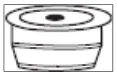
 If you stop taking Oxcarbazepine Medley
- Do not stop taking your medicine unless your doctor tells you to.
- To prevent sudden worsening of your seizures, never discontinue your medicine abruptly.
- If your treatment is stopped, it should be done gradually as instructed by your doctor.
If you have any further questions on the use of this medicine, ask your doctor, pharmacist or nurse.
4. Possible side effects
Like all medicines, this medicine can cause side effects, although not everybody gets them.
Tell your doctor immediately or go to the emergency department at your nearest hospital if you get any of the following side effects:
The following are signs of potentially serious side effects that may require urgent medical treatment. The doctor will also decide whether Oxcarbazepine Medley has to be stopped immediately and how to continue further medical care.
Uncommon (may affect up to 1 in 100 people):
- Weight gain, tiredness, hair loss, muscle weakness, feeling cold (signs of under active thyroid gland).
- Fall
Rare (may affect up to 1 in 1,000 people):
- Swelling of the lips, eyelids, face, throat or mouth, accompanied by difficulty in breathing, speaking or swallowing (signs of anaphylactic reactions and angioedema).
- Skin rash and/or fever which may be signs of DRESS (Drug Rash with Eosinophilia and Systemic Symptoms), AGEP (Acute Generalized Exanthematous Pustulosis).
- Tiredness, shortness of breath when exercising, looking pale, headache, chills, dizziness, frequent infections leading to fever, sore throat, mouth ulcers, bleeding or bruising more easily than normal, nose bleeds, reddish or purplish patches, or unexplained blotches on the skin (signs of a decrease in the number of blood platelets or decrease in the number of blood cells).
- Lethargy, confusion, muscle twitching or significant worsening of convulsions (possible symptoms of low sodium levels in the blood due to inappropriate ADH secretion) (see Warnings and precautions).
Very rare (may affect up to 1 in 10,000 people):
- Signs of allergic reactions such as skin rash, fever and pain in the muscles and joints.
- Severe blistering of the skin and/or mucous membranes of the lips, eyes, mouth, nasal passages or genitals (signs of serious allergic reaction including Lyell’s syndrome, Stevens-Johnson syndrome and erythema multiforme).
- Red blotchy rash mainly on face which may be accompanied by fatigue, fever, feeling sick (nausea) or loss of appetite (signs of systemic lupus erythematosus).
- Flu-like symptoms with jaundice (yellowing of the skin or the whites of the eyes) (signs of hepatitis).
- Severe upper stomach (abdominal) pain, being sick (vomiting), loss of appetite (signs of pancreatitis).
Tell your doctor as soon as possible if you get any of the following side effects, they may require medical attention:
Common (may affect up to 1 in 10 people):
- trembling; coordination problems; involuntary movement of the eyes; anxiety and nervousness; depression, mood swing; rash.
Very rare (may affect up to 1 in 10,000 people):
- irregular heart beat or a very fast or slow heart rate.
Other side effects:
These are usually mild to moderate side effects of Oxcarbazepine Medley. Most of these effects are transient and usually diminish over time.
Very common (may affect more than 1 in 10 people):
- tiredness; headache; dizziness; drowsiness; feeling sick (nausea); being sick (vomiting); double vision.
Common (may affect up to 1 in 10 people):
- weakness; memory disturbances; impaired concentration; apathy; agitation; confusion; blurred vision; visual disturbance; constipation; diarrhoea; stomach (abdominal) pain; acne; hair loss, balance disturbances; weight increased; Speech disorder.
Uncommon (may affect up to 1 in 100 people):
- high blood pressure; hives.
- you may also have raised levels of liver enzymes while taking Oxcarbazepine Medley.
Rare (may affect up to 1 in 1,000 people):
- there have been reports of bone disorders including osteopenia and osteoporosis (thinning of the bone) and fractures. Check with your doctor, pharmacist or nurse if you are on long-term antiepileptic medication, have a history of osteoporosis or take steroids.
Reporting of side effects
If you get any side effects, talk to your doctor, pharmacist or nurse. This includes any possible side effects not listed in this leaflet. You can also report side effects directly via Yellow Card Scheme, Website: www.mhra.gov.uk/yellowcard, or search for MHRA Yellow Card in the Google Play or Apple App Store. By reporting side effects you can help provide more information on the safety of this medicine.
5. How to store Oxcarbazepine Medley
Keep this medicine out of the sight and reach of children.
Store below 25°C. Store in original package to protect from light.
Do not use this medicine after the expiry date which is stated on the outer carton and the bottle. The expiry date refers to the last day of that month.
Use within 7 weeks after first opening the bottle.
After 7 weeks, return any unused oral suspension to your pharmacy for safe disposal.
Do not use this medicine if you notice that the pack is damaged or shows signs of tampering.
Do not throw away any medicines via wastewater or household waste. Ask your pharmacist how to throw away medicines you no longer use. These measures will help protect the environment.
6. Contents of the pack and other information
What Oxcarbazepine Medley contains
- The active substance of Oxcarbazepine Medley is oxcarbazepine. Each 5 ml of the oral suspension contains 300 mg of oxcarbazepine.
- The other ingredients are: ascorbic acid, microcrystalline cellulose and carmellose sodium, macrogol stearate, propylene glycol (E 1520), methyl parahydroxybenzoate (E 218), propyl parahydroxybenzoate (E 216), saccharin sodium, sorbic acid, sorbitol (E 420) solution 70 (per cent) (non-crystallising), plum flavour (contains propylene glycol (E 1520) and benzyl alcohol (E 1519)), purified water, xanthan gum.
What Oxcarbazepine Medley looks like and contents of the pack
Oxcarbazepine Medley Oral Suspension is supplied as an off-white to slightly reddish brown suspension. Discoloration of the oral suspension to a slightly reddish brown colour is normal and does not affect the quality of the product.
Oxcarbazepine Medley Oral Suspension is supplied in 250 ml amber coloured, round glass bottle with polypropylene (PP) child resistant closure with EPE liner.
The bottle is supplied with a 10 ml dosing syringe (graduations of 0.25 ml each) with a body of polypropylene (PP), pusher of high-density polyethylene (HDPE) and adaptor of linear low-density polyethylene (LLDPE).
Marketing Authorisation Holder and Manufacturer
Medley Pharma Limited
Unit 2A, Olympic Way,
Sefton Business Park,
Bootle, Merseyside,
L30 1RD, United Kingdom
This leaflet was last revised in May 2026.
Other sources of information
To request a copy of this leaflet in large print, braille or audio, please call +441515214527 (UK only).
Please be ready to give the following information:
| Product Name Reference Number | |
| Oxcarbazepine Medley 300 mg/5 ml Oral Suspension | PL 43870/0081 |
INSTRUCTIONS FOR USE
Read these instructions carefully so that you know how to use this medicine.
How to use the medicine kit
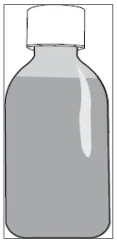
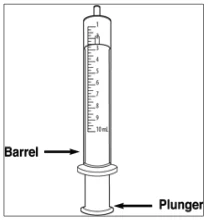
There are three parts to the medicine kit:
- 1.
A plastic adaptor that you push into the neck of the bottle the first time that you open the bottle.
The adaptor must always stay in the bottle.
- 2.
A bottle containing 250 ml of the medicine, with a child-resistant cap.
Always replace the cap after use.
- 3. A 10 ml oral dosing syringe that fits into the plastic adaptor to withdraw the prescribed dose of medicine from the bottle.
How to fit the plastic adaptor into a new bottle of medicine
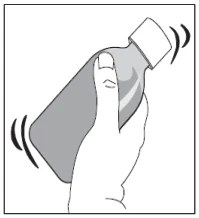
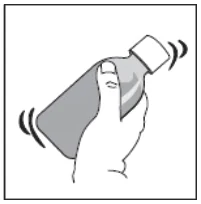
- 1. Shake the bottle of medicine for at least 10 seconds.
- 2. Remove the child-resistant cap by pushing it firmly down and turning it counter clockwise – to the left (as shown on the top of the cap).
Note: Keep the cap nearby to close the bottle after each use.
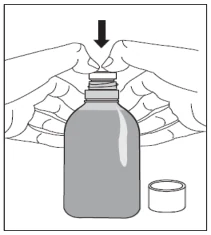
- 3. Hold the open bottle upright on a table and push the plastic adaptor firmly into the neck of the bottle as far as you can.
Note: You may not be able to push the adaptor fully down, but it will be forced into the bottle when you screw the cap back on.
To dispense a dose, please follow all the instructions in Preparing a dose of this medicine.
Preparing a dose of this medicine
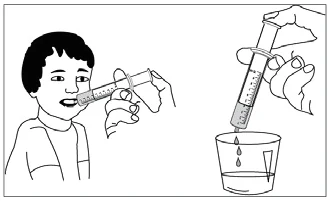
This medicine can be swallowed directly from the oral syringe, or mixed in a small glass of water.
- 1. Shake the bottle vigorously for at least 10 seconds. Prepare the dose immediately afterwards.
- 2. Push and turn the child resistant cap to open the bottle. (Always replace the cap after use)
- 3. Check that the plunger is all the way down inside the barrel of the oral syringe.
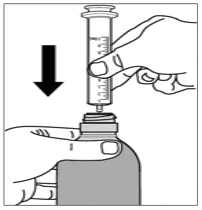
- 4. Keep the bottle upright and push the syringe firmly into the plastic adaptor.
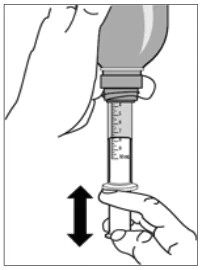
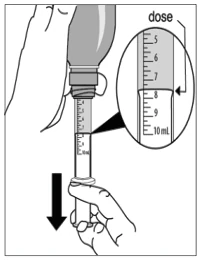
- 5. Hold the syringe in place and carefully turn the bottle upside down.
- 6. Slowly pull the plunger out so that the syringe fills with some medicine. Push the plunger back in just far enough to completely push out any large air bubbles that may be trapped in the oral syringe.
- 7. Withdrawing the prescribed dose: Slowly pull the plunger down. Pull until the top edge of the plunger is exactly level with the marker on the oral syringe barrel that indicates the prescribed dose.
Note: If the prescribed dose is more than 10 ml, withdraw the prescribed dose in two steps. Firstly, fill the syringe to 10 ml mark, and take the 10 ml. Then reload the oral syringe to the required level to take the remaining amount.
Ask your pharmacist if you are unsure.
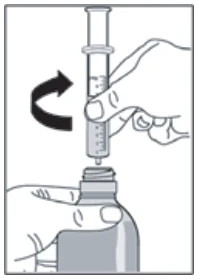
- 8.
Carefully turn the bottle the right way up. Disconnect the oral syringe by gently twisting it out of the plastic adaptor.
- 9. The dose of medicine can be swallowed directly from the oral syringe. The patient must be sitting upright and the plunger must be pushed slowly to allow the patient to swallow. Alternatively, the dose can be mixed in a small glass of water just prior to administration. Stir and drink the entire mixture right away.
- 10. Replace the child resistant cap after use, leaving the adaptor in place.
- 11. Cleaning: After use, wipe the outside of the syringe with a dry, clean tissue.