

Patient leaflet - Optivate 100 IU/ml A powder for solution for injection
1. What Optivate is and what it is used for
Optivate contains a high purity factor VIII and von Willebrand factor concentrate, proteins that are needed for blood to clot. The factor VIII and von Willebrand factor concentrate in Optivate is extracted from human blood plasma (the liquid part of blood).
Optivate is used to prevent and treat bleeding in patients of all age groups with haemophilia A (a congenital factor VIII deficiency in the blood).
2. What you need to know before you use Optivate
Take special care with Optivate and talk to your doctor or haemophilia nurse if:
- you have heart or vascular disease
- you experience an allergic reaction to this medicine (see section 4)
- your or your child’s bleeding is not being controlled with your usual dose of this medicine. The formation of inhibitors (antibodies) is a known complication that can occur during treatment with all factor VIII medicines. These inhibitors, especially at high levels, stop the treatment working properly and you or your child will be monitored carefully for the development of these inhibitors. Your doctor or nurse will check the level of factor VIII and antibodies in your blood before and after treatment, especially for your first injection.
- you require a central venous access device (CVAD) for the administration of Optivate. You may be at risk of complications including local infections, bacteria in the blood (bacteraemia) and the blood clot at the catheter site. Virus safety
When medicines are made from human blood or plasma, certain measures are put in place to prevent infections being passed on to patients. These include:
- careful selection of blood and plasma donors to make sure those at risk of carrying infections are excluded – the testing of each donation and pools of plasma for signs of virus/infections
- the inclusion of steps in the processing of the blood or plasma that can inactivate or remove viruses. Despite these measures, when medicines prepared from human blood or plasma are administered, the possibility of passing on infection cannot be totally excluded. This also applies to any unknown or emerging viruses or other types of infections.
The measures taken are considered effective for enveloped viruses such as human immunodeficiency virus (HIV), hepatitis
B virus and hepatitis C virus, and for the non-enveloped hepatitis A virus. The measures taken may be of limited value against non-enveloped viruses such as parvovirus B19.
Parvovirus B19 infection may be serious for pregnant women (foetal infection) and for individuals whose immune system is depressed or who have some types of anaemia (e.g. sickle cell disease or haemolytic anaemia). It is strongly recommended that every time you receive a dose of Optivate, the name and batch number of the product are recorded to maintain a record of the batches used.
Your doctor may recommend that you consider vaccination against hepatitis A and B if you regularly or repeatedly receive human plasma-derived factor VIII products.
Children and adolescents
The listed warnings and precautions apply to both adults and children.
Other medicines and Optivate
Tell your doctor if you are using, have recently used or might use any other medicines.
Pregnancy, breast-feeding and fertility
If you are pregnant or breast-feeding, think you may be pregnant or planning to have a baby, ask your doctor for advice before taking this medicine.
Driving and using machines
Optivate does not affect your ability to drive or operate machines.
FVGEN8 Package leaflet: Information for the user Optivate 100 IU/ml powder and solvent for solution for injection
high purity human coagulation factor VIII & human von Willebrand factor concentrate  Optivate contains sodium and polysorbate
Sodium
This medicine contains approximately 7.4 mg sodium (main component of cooking/table salt) in each ml. This is equivalent to 0.4% of the recommended maximum daily dietary intake of sodium for an adult. Polysorbate
Optivate 250 IU contains 5 mg of polysorbate 20 in each 2.5 ml which is equivalent to 2 mg/ml. Optivate 500 IU contains 10 mg of polysorbate 20 in each 5 ml which is equivalent to 2 mg/ml. Optivate 1000 IU contains 20 mg of polysorbate 20 in each 10 ml which is equivalent to 2 mg/ml. Polysorbates may cause allergic reactions. Tell your doctor if you have or your child has any known allergies.
3. How to use Optivate
Do not use Optivate
- if you are allergic (hypersensitive) to human coagulation factor VIII or von Willebrand factor concentrate or any of the other ingredients of this medicine (listed in section 6).
Warnings and precautions
Always use this medicine exactly as your doctor has told you. Check with your doctor or pharmacist if you are not sure.
Optivate should be injected directly in a vein.
Before injecting this medicine, you should have received training by your healthcare professional on how to do this. Use only the recommended injection equipment provided with your medicine.
Your doctor will explain how much you should use and when you should use it.
Your doctor will tell you your dose in terms of the number of full vials nearest to the dose most suited to you. If further treatment is needed, doses may be repeated. Your doctor will advise you if this is necessary.
The amount of Optivate you or your child need and the duration of treatment will depend on several factors, such as your body weight, the severity and nature of your condition, the site and intensity of the bleeding or the need to prevent bleeding during an operation or medical procedure.
When to inject Optivate
Optivate can be used to stop bleeding, when it occurs, or to prevent bleeding from happening.
When to inject Optivate to stop bleeding:
- The medicine should be injected when the first sign of bleeding occurs.
- The injection should be repeated as necessary to stop the bleeding.
- Each individual bleed should be judged on its own severity.
- If you are using this product for the first time, your doctor will supervise you.
If you are using Optivate to prevent bleeding from happening, your doctor will tell you when to inject your medicine. Dissolving your medicine before use
Your medicine must only be dissolved in the sterile water provided with the product.
Quantity of Optivate Volume of Water Supplied
250 IU 2.5 ml or 5 ml
500 IU 5 ml
1000 IU 10 ml
- 1. Before you remove the cap, make sure that the vials of Optivate and water for injections supplied are both at room temperature (between 20°C and 30°C).
There are two ways of continuing to make up Optivate for injection by the use of a filter needle or Mix2Vial™ transfer device – only one of these options will be provided in your pack. Ensure the correct method below is utilised for the transfer device supplied:
Using the Filter Needle (where supplied):
- 1. If the Water for Injections is in a plastic ampoule, break open the top and draw up the volume of water needed with a sterile needle and syringe (not the filter needle).
- 2.
If the Water for Injections is in a glass vial remove the “flip-off” top and clean the top of the stopper with an alcohol swab.
- 3. If using a double spiked needle (only for use with the correct volume of water for injection in glass vials), remove the cover guard from one end of the double-ended transfer needle (which your doctor can provide) and insert the needle through the stopper into the vial of water.
- 4. Remove the other end of the needle guard, turn it upside down over the vial of Optivate and push the needle through the Optivate stopper.
- 5. On piercing the stopper of the Optivate vial, the water will be drawn in as the vial is sealed under vacuum. A small amount of water will remain in the water vial, which can be discarded. Continue from point 8 below.
- 6. If using a transfer needle, transfer the water to the vial of Optivate by pushing the needle through the stopper of the vial. The water in the syringe will be drawn into the vial, which is under vacuum, so there is no need to push the plunger of the syringe. Note: The filter needle provided must not be used to draw up the Water for Injections.
- 7. Gently swirl the Optivate vial (do not shake) and then remove the syringe from the needle to release the vacuum in the vial.
- 8. Continue to swirl the Optivate vial gently until the powder is dissolved (usually in about 2 to 21/2 minutes).
- 9. When dissolved, draw up the solution using the filter needle attached to a syringe. Use a new filter needle for each vial of Optivate if your dose is more than one vial.
- 10. Disconnect the filter needle from the syringe.
- 11. The product is now ready for administration. Follow the normal safety practices for administration. Use the product immediately after reconstitution, the product must not be stored.
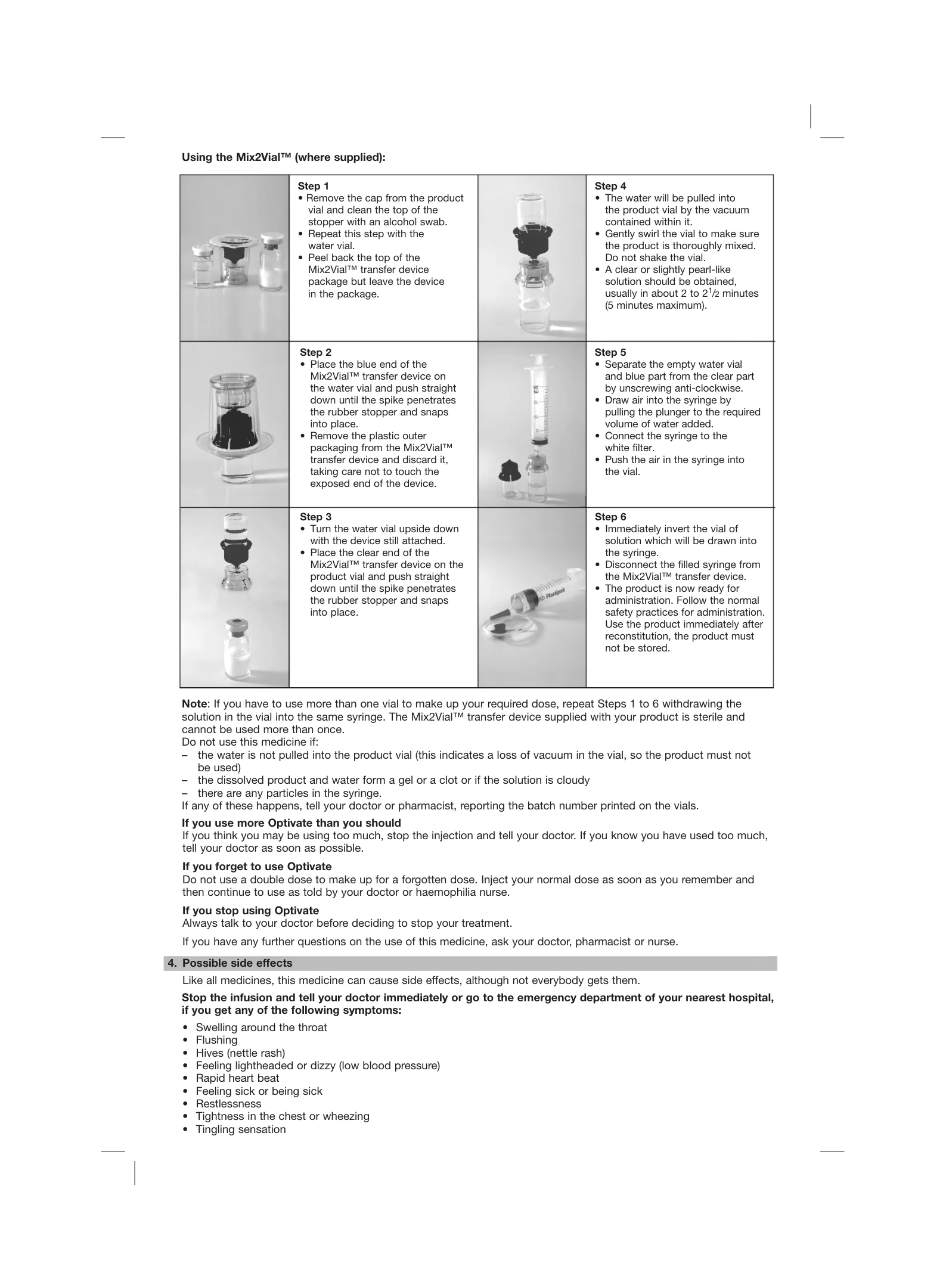 Using the Mix2Vial™ (where supplied):
Note: If you have to use more than one vial to make up your required dose, repeat Steps 1 to 6 withdrawing the solution in the vial into the same syringe. The Mix2Vial™ transfer device supplied with your product is sterile and cannot be used more than once.
Do not use this medicine if:
- the water is not pulled into the product vial (this indicates a loss of vacuum in the vial, so the product must not be used)
- the dissolved product and water form a gel or a clot or if the solution is cloudy
- there are any particles in the syringe.
If any of these happens, tell your doctor or pharmacist, reporting the batch number printed on the vials. If you use more Optivate than you should
If you think you may be using too much, stop the injection and tell your doctor. If you know you have used too much, tell your doctor as soon as possible.
If you forget to use Optivate
Do not use a double dose to make up for a forgotten dose. Inject your normal dose as soon as you remember and then continue to use as told by your doctor or haemophilia nurse.
If you stop using Optivate
Always talk to your doctor before deciding to stop your treatment.
If you have any further questions on the use of this medicine, ask your doctor, pharmacist or nurse.
4. Possible side effects
Like all medicines, this medicine can cause side effects, although not everybody gets them. Stop the infusion and tell your doctor immediately or go to the emergency department of your nearest hospital, if you get any of the following symptoms:
- Swelling around the throat
- Flushing
- Hives (nettle rash)
- Feeling lightheaded or dizzy (low blood pressure)
- Rapid heart beat
- Feeling sick or being sick
- Restlessness
- Tightness in the chest or wheezing
Tingling sensation
Step 1
- Remove the cap from the product vial and clean the top of the stopper with an alcohol swab.
- Repeat this step with the water vial.
Peel back the top of the Mix2Vial™ transfer device package but leave the device in the package.
Step 4
- The water will be pulled into the product vial by the vacuum contained within it.
- Gently swirl the vial to make sure the product is thoroughly mixed. Do not shake the vial.
- A clear or slightly pearl-like solution should be obtained, usually in about 2 to 21/2 minutes (5 minutes maximum).
Step 2
- Place the blue end of the Mix2Vial™ transfer device on the water vial and push straight down until the spike penetrates the rubber stopper and snaps into place.
Remove the plastic outer packaging from the Mix2Vial™ transfer device and discard it, taking care not to touch the exposed end of the device.
Step 5
- Separate the empty water vial and blue part from the clear part by unscrewing anti-clockwise.
- Draw air into the syringe by pulling the plunger to the required volume of water added.
- Connect the syringe to the white filter.
- Push the air in the syringe into the vial.
Step 3
- Turn the water vial upside down with the device still attached.
Place the clear end of the Mix2Vial™ transfer device on the product vial and push straight down until the spike penetrates the rubber stopper and snaps into place.
Step 6
- Immediately invert the vial of solution which will be drawn into the syringe.
- Disconnect the filled syringe from the Mix2Vial™ transfer device.
- The product is now ready for administration. Follow the normal safety practices for administration. Use the product immediately after reconstitution, the product must not be stored.
 These symptoms may worsen into severe shock. The above allergic-type reactions are very rare (may affect up to 1 in 10,000 people).
Other known side effects include:
Common (may affect more than 1 in 100 people):
- Headache
- Sleepiness, lethargy or feeling unwell
- Feeling that everything is moving, spinning round or tilting (vertigo)
- Itching, skin rash
- Local site reaction where the medicine was injected (redness, rash, pain)
- Sudden shivering and feeling cold, fever
- Swelling in the extremities of the body
- Stiffness in muscles and joints
Not known (frequency cannot be estimated from the available data):
- Cough, sneezing, throat irritation
- Abdominal pain
For children not previously treated with Factor VIII medicines, inhibitor antibodies (see section 2) may form very commonly (more than 1 in 10 patients); however, for patients who have received previous treatment with Factor VIII (more than 150 days of treatment) the risk is uncommon (less than 1 in 100 patients). If this happens, your or your child’s medicines may stop working properly and you or your child may experience persistent bleeding. If this happens, you should contact your doctor immediately.
Reporting of side effects
If you get any side effects, talk to your doctor or pharmacist. This includes any possible side effects not listed in this leaflet.
You can also report side effects directly via the Yellow Card Scheme: Website: www.mhra.gov.uk/yellowcard or search for MHRA Yellow Card in the Google Play or Apple App Store. By reporting side effects you can help provide more information on the safety of this medicine.
5. How to store Optivate
Keep this medicine out of the sight and reach of children.
Do not use this medicine after the expiry date which is stated on the containers after “EXP”. The expiry date refers to the last day of that month.
Do not store above 25°C. Do not freeze.
Keep the vials in the outer carton in order to protect from light.
Do not use this medicine if you notice small bits in the dissolved product. Once reconstituted, Optivate must be used immediately or within 1 hour of reconstitution.
Do not throw away any medicines via wastewater or household waste. Ask your pharmacist or doctor how to throw away medicines you no longer use. These measures will help protect the environment.
6. Contents of the pack and other information
What Optivate contains
- The active substance is human coagulation factor VIII with associated von Willebrand factor. – The excipients are: sodium chloride, sodium citrate, calcium chloride, polysorbate 20 and trehalose. – Solvent: water for injections
What Optivate looks like and contents of the pack
Optivate is a white or pale yellow powder in quantities of 250 IU (International Units), 500 IU or 1000 IU in glass vials. These vials are closed with a rubber stopper under vacuum, held with a tamper-evident cap. Optivate should only be reconstituted with the water for injections which is supplied with Optivate in vials. Optivate is provided with either one Filter Needle device or one Mix2VialTM transfer device. Marketing Authorisation Holder
Bio Products Laboratory Limited
Dagger Lane
Elstree
Hertfordshire
WD6 3BX
United Kingdom
tel: +44 (0) 20 8957 2255
e-mail: medinfo@bpl.co.uk
Manufacturer
Bio Products Laboratory Limited
Dagger Lane
Elstree
Borehamwood
WD6 3BX
United Kingdom
This leaflet was last revised in October 2024.
bpL
Bio Products Laboratory