

Summary of Product Characteristics (SmPC) - Omidria 10 mg / ml + 3 mg / ml concentrate for solution for Intraocular Irrigation
1 NAME OF THE MEDICINAL PRODUCT
Omidria 10 mg/mL + 3 mg/mL concentrate for solution for intraocular irrigation
2 QUALITATIVE AND QUANTITATIVE COMPOSITION
Each 4 mL of concentrate for solution in the vial contains phenylephrine hydrochloride equivalent to 40.6 mg (10.2 mg/mL) of phenylephrine and ketorolac trometamol equivalent to 11.5 mg (2.88 mg/mL) of ketorolac.
After dilution in 500 mL of irrigation solution, the solution contains 0.081 mg/mL of phenylephrine and of 0.023 mg/mL ketorolac.
For the full list of excipients, see section 6.1.
3 PHARMACEUTICAL FORM
Concentrate for solution for intraocular irrigation.
Clear, colourless to slightly yellow, solution with a pH: 6.3 ±0.3.
4 CLINICAL PARTICULARS
4.1 Therapeutic indications
Omidria is indicated in adults for maintenance of intraoperative mydriasis, prevention of intraoperative miosis and reduction of acute postoperative ocular pain in intraocular lens replacement surgery.
4.2 Posology and method of administration
Omidria must be administered in a controlled surgical setting by a qualified ophthalmological surgeon experienced in intraocular lens replacement surgery.
Posology
The recommended dose is 4.0 mL of Omidria concentrate for solution diluted in 500 mL of irrigation solution administered by intraocular irrigation to the affected eye during surgery.
For instructions on dilution of the medicinal product before administration, see section 6.6.
Special populations
Elderly
The elderly population has been studied in clinical studies. No dose adjustment is required.
Renal or hepatic impairment
No formal studies have been conducted with Omidria in patients with renal or hepatic impairment. No dose adjustment or special considerations are anticipated for patients with renal or hepatic impairment (see section 5.2).
Paediatric population
The safety and efficacy of Omidria in children aged below 18 years have not been established. No data are available.
Method of administration
Intraocular use (after dilution).
Single use only.
Omidria has not been evaluated in the absence of standard preoperative mydriatic and anesthetic agents. Preoperative antibiotic, anaesthetics, corticosteroid, mydriatic, and non-steroidal anti-inflammatory drugs (NSAID) eye drops may be administered at the discretion of the treating ophthalmologist.
Before administering the medicinal product
Omidria must be diluted into 500 mL of irrigation solution before use. For dilution instructions, see section 6.6.
The Omidria-containing irrigation solution is intended to be used during the surgical procedure in the same manner that the standard irrigation solution would be used.
4.3 Contraindications
Hypersensitivity to the active substances or to any of the excipients listed in section 6.1.
Patients with narrow-angle glaucoma.
4.4 Special warnings and precautions for use
This medicinal product must be diluted before intraocular use.
Omidria is indicated for addition to irrigation solution used during intraocular lens replacement procedures only.
Omidria is not indicated for undiluted use, intravitreal injection, general topical ophthalmic use, or non-ocular systemic use.
The safety and efficacy of Omidria have not been evaluated in patients with a history of uveitis, iris trauma, or alpha-adrenergic antagonist use.
The following warnings and precautions related to topical ophthalmic use of phenylephrine and ketorolac should be considered with the use of Omidria:
Cardiovascular reactions
There have been reports of serious cardiovascular reactions, including ventricular arrhythmias and myocardial infarctions, in patients using ophthalmic phenylephrine. These episodes, some fatal, have usually occurred in patients with pre-existing cardiovascular diseases.
Significant elevations in blood pressure have been reported following instillation of topical ocular phenylephrine. Anticipated systemic exposure is minimal and transient, however, caution should be used in treating patients with poorly controlled hypertension. The risk of blood pressure elevations may be increased in patients requiring prolonged surgery.
Hyperthyroidism and unstable cardiovascular disease should be addressed prior to surgery.
Cross-sensitivity
There is the potential for cross-sensitivity to acetylsalicylic acid, phenylacetic acid derivatives, and other NSAIDs. There have been reports of bronchospasm or exacerbation of asthma associated with the use of ketorolac ophthalmic solution in patients who either have a known hypersensitivity to acetylsalicylic acid/NSAIDs, or a past medical history of asthma. Therefore, use Omidria with caution in individuals who have previously exhibited sensitivities to these active substances.
Cardiovascular reactions and cross-sensitivity reactions are known to occur with topical ophthalmic use of phenylephrine and ketorolac when used as monotherapy at higher concentration levels than present in Omidria.
The use of Omidria during intraocular lens replacement surgery may cause vision to be temporarily affected. (see section 4.7).
4.5 Interaction with other medicinal products and other forms of interaction
No interaction studies have been performed.
Intraocular metabolic interactions are unlikely because phenylephrine and ketorolac are removed from the anterior chamber by irrigation during the surgical procedure and by normal aqueous humour circulation postoperatively. The magnitude of the mydriatic effect of Omidria may be altered in patients who concurrently receive medicinal products that can affect pupil size, such as opioids (miotics) or non-sedating antihistamines (mydriatics).
Concomitant use of phenylephrine and atropine may enhance pressor effects and induce tachycardia in some patients. Phenylephrine may potentiate the cardiovascular depressant effects of some inhalation anesthetic medicinal products. In a pharmacokinetic study evaluating Omidria, systemic exposure to each of phenylephrine and ketorolac was minimal and transient. Therefore, no interaction is expected.
4.6 Fertility, Pregnancy and lactation
Women of childbearing potential
Omidria is not recommended in women of childbearing potential not using contraception.
Pregnancy
There are no or limited amount of data from the use of phenylephrine hydrochloride and/or ketorolac trometamol in pregnant women. Omidria is not recommended during pregnancy.
Breast-feeding
It is unknown whether phenylephrine is excreted in human milk. Ketorolac is excreted in human milk after systemic administration. A risk to the newborns/infants cannot be excluded. Omidria should not be used during breast-feeding.
Fertility
There are no or limited amount of data from the use of phenylephrine hydrochloride and/or ketorolac trometamol on fertility in humans.
4.7 Effects on ability to drive and use machines
Omidria has major influence on the ability to drive and use machines. As vision may be temporarily affected following intraocular lens replacement in patients who receive Omidria, patients should be advised not to drive or use machines until vision is clear. See section 4.8 for further details regarding possible visual disturbances.
4.8 Undesirable effects
−
Summary of the safety profile
The safety profile of Omidria is based on data from 459 adult patients collected during clinical development obtained in randomised controlled studies. Adverse reactions reported in patients receiving Omidria were typical postoperative findings and most were mild to moderate in intensity and resolved without intervention or any residual effects. The most frequently reported adverse reactions were, eye pain (4.8%), anterior chamber inflammation (3.9%), conjunctival hyperaemia (2.2%), photophobia (1.7%), corneal oedema (1.3%) and inflammation (1.3%). Each of these same findings was reported at a similar frequency in patients receiving placebo.
Following post-marketing exposure to Omidria, primarily in the Unites States of America (USA), there have been very few suspected adverse reactions. The most common adverse reactions are a small number of cases with corneal oedema which were mostly non-serious and self-limiting. The overall safety profile of Omidria on the market is similar to the clinical study experience with this medicinal product.
Tabulated list of adverse reactions
The frequency of adverse reactions is defined as follows: very common (≥ 1/10); common (≥ 1/100 to < 1/10); uncommon (≥ 1/1,000 to < 1/100); rare (≥ 1/10,000 to < 1/1,000); very rare (< 1/10,000), not known (cannot be estimated from the available data).
| System organ class | Common | Uncommon |
| Nervous system disorders | Headache. | |
| Eye disorders | Eye pain; Anterior chamber inflammation; Conjunctival hyperaemia; Corneal oedema; Photophobia. | Ocular discomfort; Eye inflammation; Eye irritation; Conjunctival oedema; Corneal disorder; Mydriasis; Vision blurred; Visual acuity reduced; Vitreous floaters; Eye pruritus; Eyelid pain; Foreign body sensation in eyes; Glare; Intraocular pressure increased. |
| Gastrointestinal disorders | Nausea. | |
| General disorders and administration site conditions | Inflammation. | Pain. |
Description of specific adverse reactions
Cardiovascular reactions and cross-sensitivity reactions are known adverse reactions associated with topical ophthalmic use of phenylephrine and ketorolac when used as monotherapy at higher concentraton levels than present in Omidria.
Reporting of suspected adverse reactions
Reporting suspected adverse reactions after authorisation of the medicinal product is important. It allows continued monitoring of the benefit/risk balance of the medicinal product. Healthcare professionals are asked to report any suspected adverse reactions via the Yellow Card Scheme Website: www.mhra.gov.uk/yellowcard or search for MHRA Yellow Card in the Google Play or Apple App Store.
4.9 Overdose
In case of accidental intracameral injection of the concentrated solution, the anterior chamber should be evacuated immediately and irrigated with standard ophthalmological irrigation solution.
Systemic overdose of phenylephrine may cause a rapid rise in blood pressure. It may also cause headache, anxiety, nausea, and vomiting, and ventricular arrhythmias. In the event of phenylephrine overdose, prompt injection of a rapidly acting alpha-adrenergic blocking agent, such as phentolamine, has been recommended.
5 PHARMACOLOGICAL PROPERTIES
5.1 Pharmacodynamic properties
Pharmacotherapeutic group: Ophthalmologicals, Sympathomimetics excl. antiglaucoma preparations. ATC code: S01FB51
Mechanism of action
The phenylephrine and ketorolac in Omidria act by distinct mechanisms, to maintain intraoperative mydriasis, to prevent intraoperative miosis, and to reduce acute postoperative pain.
Phenylephrine is an α1-adrenergic receptor agonist and acts as a mydriatic agent by contracting the radial muscle of the iris, dilating the pupil with little or no cycloplegia. Vasoconstriction occurs in the conjunctival circulation and in other ocular vessels to the extent that they are exposed to medicinal product.
Ketorolac is an NSAID that inhibits both cyclooxygenase enzymes (COX1 and COX2), reducing pain and inflammation by decreasing tissue concentrations of prostaglandins resulting from surgical trauma. Ketorolac, by inhibiting prostaglandin synthesis secondary to ocular surgical insult or direct mechanical stimulation of the iris, may also contribute to the prevention of surgically induced miosis.
Clinical efficacy and safety
The efficacy and safety of Omidria was evaluated in two Phase 3, randomised, multicentre, double-masked, placebo-controlled clinical studies in 808 adult patients undergoing intraocular lens replacement. The population in the studies was 26 to 90 years of age (59% female, 41% male; 80% white, 12% black and 8% other race). Nineteen percent of cataracts were LOCS II Nuclear Grade 2 or 3. Fifty-three percent of patients had brown irides, 28% had blue irides, and 19% had irides of other colours.
Patients were randomised to either Omidria or placebo (1:1). All patients were treated with standardised preoperative topical mydriatic and anaesthetic agents. Pupil diameter was measured throughout the surgical procedure. Postoperative pain was evaluated by a self-administered 0-100 mm visual analogue scale (VAS).
Statistical tests for the change from baseline in pupil diameter (mm) during surgery were carried out with the Cochran-Mantel-Haenszel (CMH) test adjusted for the randomisation strata. In Study 1, the CMH weighted mean difference (Omidria – placebo) in the mean area under the curve (AUC) was 0.58 mm [95% confidence interval: 0.48, 0.68] (P < 0.0001). In Study 2, the CMH weighted mean difference (Omidria – placebo) in the mean AUC was 0.59 mm [95% confidence interval: 0.49, 0.69] (P < 0.0001).
Mydriasis was maintained in the Omidria-treated groups, while the placebo-treated groups experienced progressive constriction of the pupil (see Figure 1.).
Figure 1. Intraoperative pupil diameter (mm) change from baseline 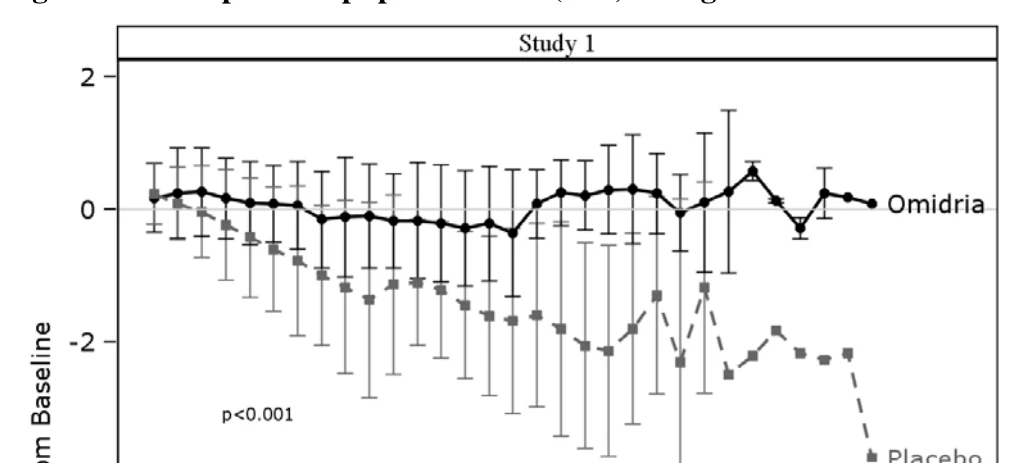
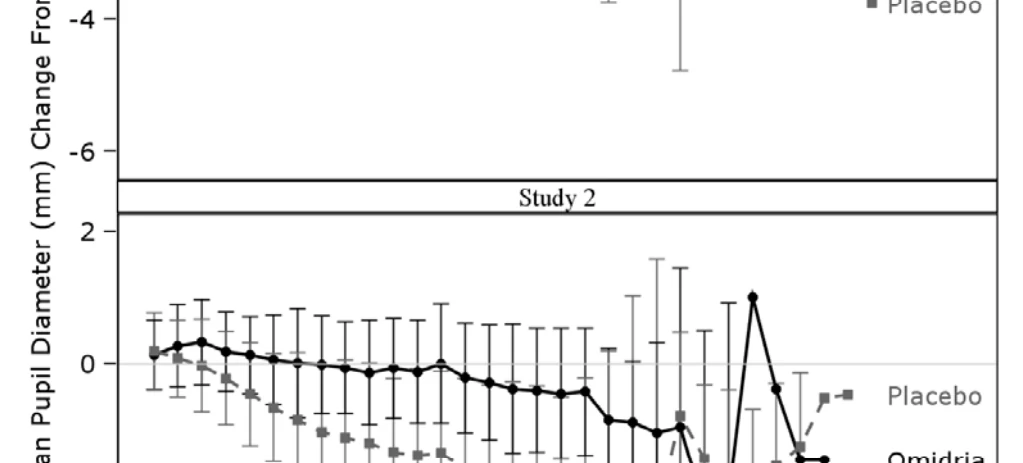
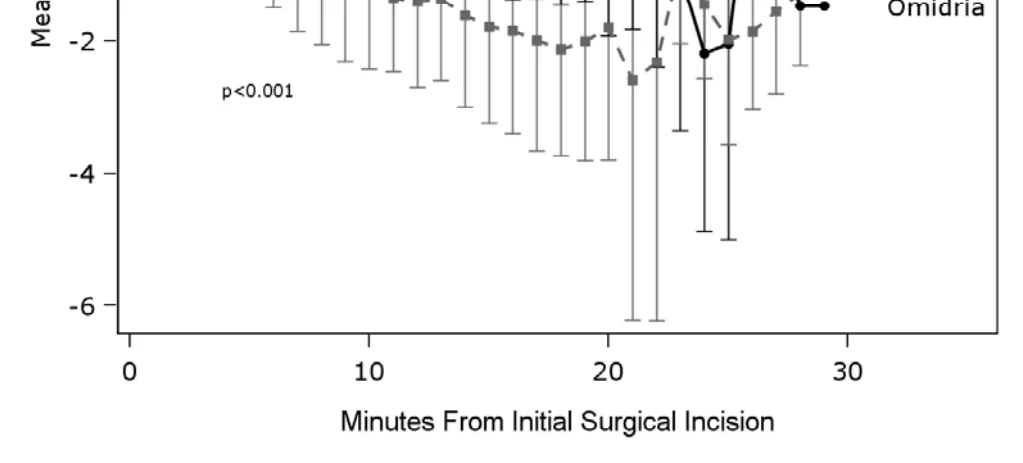
Prevention of miosis was confirmed in a categorical analysis. In Study 1, only 4% of patients in the Omidria group compared to 23% of patients in the placebo group had a pupil diameter < 6 mm at the time of cortical clean-up, and 3% of patients in the Omidria group compared to 28% of patients in the placebo group had a pupil constriction ≥2.5 mm (P < 0.0001 in both instances, Chi-Square test). In Study 2, only 4% of patients in the Omidria group compared to 23% of patients in the placebo group had a pupil diameter < 6 mm at cortical clean-up, and 1% of patients in the Omidria group compared to 27% of patients in the placebo group had a pupil constriction ≥ 2.5 mm (P < 0.0001, Chi-Square test).
| Placebo | Omidria | |
Study 1 Analysis set (n) | N=201 (n=180) | N=201 (n=184) |
| AUC change from baseline in pupil diameter (mm) during surgery (co-primary endpoint) [mean (SD)] | -0.5 (0.58) | 0.1 (0.41) |
| Diameter < 6 mm at any time | 85 (47%) | 19 (10%) |
| Diameter < 6 mm at cortical clean-up | 41 (23%) | 7 (4%) |
| ≥ 2.5 mm pupillary constriction | 50 (28%) | 6 (3%) |
Study 2 Analysis set (n) | N=204 (n=200) | N=202 (n=195) |
| AUC change from baseline in pupil diameter (mm) during surgery (co-primary endpoint) [mean (SD)] | -0.5 (0.57) | 0.1 (0.43) |
| Diameter < 6 mm at any time | 76 (38%) | 18 (9%) |
| Diameter < 6 mm at cortical clean-up | 46 (23%) | 8 (4%) |
| ≥ 2.5 mm pupillary constriction | 53 (27%) | 2 (1%) |
A significant reduction in ocular pain during the initial 10-12 hours postoperatively was also demonstrated. Statistical tests for pain as determined from the 100-mm VAS were carried out with a CMH test adjusted for the randomisation strata. In Study 1, the CMH weighted mean difference (Omidria
- placebo) in the mean AUC was -5.20 mm [95% confidence interval: -7.31, -3.09] (P < 0.001). In Study 2, the CMH weighted mean difference (Omidria – placebo) in the mean AUC was -4.58 mm [95% confidence interval: -6.92, -2.24] (P < 0.001).
| Placebo | Omidria | |
Study 1 Analysis set (n) | N=201 (n=201) | N=201 (n=201) |
| AUC 12 hour ocular pain VAS score (co-primary endpoint) [mean±SD] | 9.2±12.9 | 4.1±8.07 |
| Subjects with VAS = 0 at all times | 28 (14%) | 48 (24%) |
| Subjects with VAS ≥ 40 at any time | 30 (15%) | 13 (7%) |
Study 2 Analysis set (n) | N=204 (n=202) | N=202 (n=202) |
| AUC 12 hour ocular pain VAS score (co-primary endpoint) [mean±SD] | 8.9±15.19 | 4.3±8.75 |
| Subjects with VAS = 0 at all times | 41 (20%) | 56 (28%) |
| Subjects with VAS ≥ 40 at any time | 27 (13%) | 16 (8%) |
Histologic examination in non-clinical toxicology studies demonstrated no treatment-related effects on the cornea and, in clinical studies with Omidria, no detrimental effects were observed on best-corrected visual acuity (BCVA). Endothelial cell counts were not conducted during the clinical studies.
Paediatric Population
The European Medicines Agency has deferred the obligation to submit the results of studies with Omidria in one or more subsets of the paediatric population in lens therapeutic procedures (see section 4.2 for information on paediatric use).
5.2 Pharmacokinetic properties
In a pharmacokinetic study evaluating Omidria, systemic exposure to both phenylephrine and ketorolac was minimal and transient.
Absorption
Detectable phenylephrine plasma concentrations were observed in only one of 14 patients. The maximum concentration observed in this patient was 1.7 ng/mL, occurring after instillation of topical preoperative phenylephrine drops and prior to exposure to Omidria.
Ketorolac plasma concentrations were detected in 11 of 14 patients. The maximum ketorolac concentration seen was 4.2 ng/mL.
5.3 Preclinical safety data
Non-clinical data reported in the literature for the individual components in Omidria revealed no special hazard for humans based on conventional studies of safety pharmacology, repeated dose toxicity, genotoxicity, carcinogenic potential, toxicity to reproduction and development.
A single-dose toxicology study was conducted in African green monkeys exposed to ocular irrigation solutions containing the combination of phenylehphrine and ketorolac used during lens replacement surgery. No drug-related adverse reactions or pathological findings were observed, with combinations of phenylephrine and ketorolac in irrigation solution administered at concentrations up to 7200 µM phenylephrine and 900 µM ketorolac. These concentrations are over 10-fold higher than the concentration of each agent administered clinically in patients receiving Omidria.
6 PHARMACEUTICAL PARTICULARS
6.1 List of excipients
Citric acid monohydrate
Sodium citrate dihydrate
Sodium hydroxide (for pH adjustment)
Hydrochloric acid (for pH adjustment)
Water for injection
6.2 Incompatibilities
This medicinal product must not be mixed with other medicinal products except those mentioned in section 6.6.
6.3 Shelf life
Unopened: 5 years
Once opened the medicinal product should be diluted immediately.
After dilution, chemical and physical in-use stability has been demonstrated for 6 hours at
25 ˚C. Use within 6 hours of dilution. From a microbiological point of view, the medicinal product should be used immediately. If not used immediately, in-use storage times and conditions prior to use are the responsibility of the user.
6.4 Special precautions for storage
Do not store above 25 ˚C.
Keep the vial in the outer carton in order to protect from light.
Following dilution do not store above 25 ˚C.
6.5 Nature and contents of container
Colourless 5 mL type I glass vial closed with a butyl rubber stopper and a polypropylene flip-off cap. Each single-use vial is packaged in a cardboard carton.
Pack size: multipack containing 10 (1 pack of 10) single-use vials.
6.6 Special precautions for disposal
To prepare Omidria for intraocular irrigation, dilute 4.0 mL (the content of 1 vial) of concentrate for solution in 500 mL of standard ophthalmological irrigation solution.
The following instructions must be adhered to:
- The vial should be visually inspected for particulate matter. Only a clear, colourless to slightly yellow concentrate for solution without visible particles should be used.
- Using aseptic technique, withdraw 4.0 mL of concentrate for solution using an appropriate sterile needle.
4.0 mL of concentrate for solution should be injected into a 500 mL bag/bottle of irrigation solution.
- The bag/bottle should be gently inverted in order to mix the solution. The solution should be used within 6 hours of preparation.
- The bag/bottle must be visually inspected for particulate matter. Only a clear, colourless solution without visible particles should be used.
- No other medicinal products should be added to the prepared irrigation solution.
Any unused medicinal product or waste material should be disposed of in accordance with local requirements.
7 MARKETING AUTHORISATION HOLDER
Rayner Pharmaceuticals Limited
10 Dominion Way,
Worthing,
West Sussex BN14 8AQ,
United Kingdom
tel +44 (0) 1903 258 900
fax +44 (0) 1903 258 901
email Pharma-ra@rayner.com
8 MARKETING AUTHORISATION NUMBER(S)
PLGB 47069/0004
9 DATE OF FIRST AUTHORISATION/RENEWAL OF THE
AUTHORISATION
06/01/2025
10 DATE OF REVISION OF THE TEXT
06/01/2025