

Patient leaflet - Omeprazole 10 mg oral solution
1. What Omeprazole is and what it is used for
Omeprazole oral solution contains the active substance omeprazole. It belongs to a group of medicines called ‘proton pump inhibitors’. They work by reducing the amount of acid that your stomach produces.
Omeprazole is used to treat the following conditions:
In adults:
- ‘Gastro-esophageal reflux disease’ (GERD). This is where acid from the stomach escapes into the gullet (the tube which connects your throat to your stomach) causing pain, inflammation and heartburn.
- Ulcers in the upper part of the intestine (duodenal ulcer) or stomach (gastric ulcer).
- Ulcers which are infected with bacteria called ‘Helicobacter pylori’. If you have this condition, your doctor may also prescribe antibiotics to treat the infection and allow the ulcer to heal.
- Ulcers caused by medicines called NSAIDs (Non-Steroidal Anti-Inflammatory Drugs). Omeprazole can also be used to stop ulcers from forming if you are taking NSAIDs.
In children:
Children over 1 month of age:
‘Gastro-esophageal reflux disease’ (GERD) and reflux esophagitis. This is where acid from the stomach escapes into the gullet (the tube which connects your throat to your stomach) causing pain, inflammation and heartburn. In children, the symptoms of the condition can include the return of stomach contents into the mouth (regurgitation), being sick (vomiting) and poor weight gain.
Children over 4 years of age and adolescents:
- Ulcers which are infected with bacteria called ‘Helicobacter pylori’. If your child has this condition, your doctor may also prescribe antibiotics to treat the infection and allow the ulcer to heal.
2. What you need to know before you take Omeprazole
Do not take Omeprazole:
- If you are allergic to omeprazole or any of the other ingredients of this medicine (listed in section 6).
- If you are allergic to medicines containing other proton pump inhibitors (e.g. pantoprazole, lansoprazole, rabeprazole, esomeprazole).
- If you are taking a medicine containing nelfinavir (for HIV infection).
Do not take Omeprazole if any of the above apply to you. If you are not sure, talk to your doctor or pharmacist before taking Omeprazole.
Warnings and precautions
Talk to your doctor or pharmacist before taking Omeprazole.
Serious skin reactions including Stevens-Johnson syndrome, toxic epidermal necrolysis, drug reaction with eosinophilia and systemic symptoms (DRESS) and acute generalized exanthematous pustulosis (AGEP) have been reported in association with Omeprazole treatment. Stop using Omeprazole and seek medical attention immediately if you notice any of the symptoms related to these serious skin reactions described in section 4.
Omeprazole may hide the symptoms of other diseases. Therefore, if any of the following happen to you before you start taking Omeprazole or while you are taking it, talk to your doctor straight away:
- You lose a lot of weight for no reason and have problems swallowing.
- You get stomach pain or indigestion.
- You begin to vomit food or blood.
- You pass black stools (blood-stained faeces).
- You experience severe or persistent diarrhoea, as omeprazole has been associated with a small increase in infectious diarrhoea.
- You have severe liver problems.
- You have ever had a skin reaction after treatment with a medicine similar to Omeprazole that reduces stomach acid.
- You are due to have a specific blood test (Chromogranin A).
If you take Omeprazole on a long-term basis (longer than 1 year) your doctor will probably keep you under regular surveillance. You should report any new and exceptional symptoms and circumstances whenever you see your doctor.
Taking a proton pump inhibitor like Omeprazole, especially over a period of more than one year, may slightly increase your risk of fracture in the hip, wrist or spine. Tell your doctor if you have osteoporosis or if you are taking corticosteroids (which can increase the risk of osteoporosis).
If you get a rash on your skin, especially in areas exposed to the sun tell your doctor as soon as you can, as you may need to stop your treatment with Omeprazole. Remember to also mention any other ill- effects like pain in your joints.
This medicine may affect the way that your body absorbs vitamin B12, particularly if you need to take
it for a long time. Please contact your doctor if you notice any of the following symptoms, which
could indicate low levels of vitamin B12:
- Extreme tiredness or lack of energy
- Pins and needles
- Sore or red tongue, mouth ulcers
- Muscle weakness
- Disturbed vision
- Problems with memory, confusion, depression
When taking omeprazole, inflammation in your kidney may occur. Signs and symptoms may include decreased volume of urine or blood in your urine and/or hypersensitivity reactions such as fever, rash, and joint stiffness. You should report such signs to the treating physician.
Children
Some children with chronic illnesses may require long-term treatment although it is not recommended. Do not give this medicine to children under 1 month of age.
Other medicines and Omeprazole
Tell your doctor or pharmacist if you are taking, have recently taken, or might take any other medicines. This includes medicines that you buy without a prescription. This is because Omeprazole can affect the way some medicines work and some medicines can have an effect on Omeprazole.
Do not take Omeprazole if you are taking a medicine containing nelfinavir (used to treat HIV infection).
Tell your doctor or pharmacist if you are taking any of the following medicines:
- Ketoconazole, itraconazole, posaconazole or voriconazole (used to treat infections caused by a fungus)
- Digoxin (used to treat heart problems)
Diazepam (used to treat anxiety, relax muscles or in epilepsy)
- Phenytoin (used in epilepsy). If you are taking phenytoin, your doctor will need to monitor you when you start or stop taking Omeprazole
- Medicines that are used to thin your blood, such as warfarin or other vitamin K blockers. Your doctor may need to monitor you when you start or stop taking Omeprazole
- Rifampicin (used to treat tuberculosis)
- Atazanavir (used to treat HIV infections)
- Tacrolimus (in cases of organ transplantation)
- St John’s wort (Hypericum perforatum) (used to treat mild depression)
- Cilostazol (used to treat intermittent claudication)
- Saquinavir (used to treat HIV infection)
- Clopidogrel (used to prevent blood clots (thrombi))
- Erlotinib (used to treat cancer)
- Methotrexate (a chemotherapy medicine used in high doses to treat cancer) – if you are taking a high dose of methotrexate, your doctor may temporarily stop your Omeprazole treatment.
If your doctor has prescribed the antibiotics amoxicillin and clarithromycin as well as Omeprazole to treat ulcers caused by Helicobacter pylori infection, it is very important that you tell your doctor about any other medicines you are taking.
Omeprazole with food and drink
Please refer to Section 3, Taking this medicine, for information on how to take this medicine with regards to meals.
Prеgnancy, breast-feeding and fertility
Omeprazole can be used during pregnancy. However, if you are pregnant or breast-feeding, think you may be pregnant or are planning to have a baby, ask your doctor or pharmacist for advice before taking this medicine.
Omeprazole is excreted in breast milk but is not likely to influence the child when therapeutic doses are used. Your doctor will decide whether you can take Omeprazole if you are breast-feeding.
Driving and using machines
Omeprazole is not likely to affect your ability to drive or use any tools or machines. Side effects such as dizziness and visual disturbances may occur (see section 4). If affected, you should not drive or operate machinery.
Omeprazole contains propylene glycol.
Omeprazole 10 mg oral solution contains 8.9 mg propylene glycol in 15 ml, which is equivalent to 0.593 mg/ml.
Omeprazole 20 mg oral solution contains 6.7 mg propylene glycol in 15 ml, which is equivalent to 0.447 mg/ml.
Omeprazole contains sodium.
Both Omeprazole 10 mg and 20 mg oral solutions contain 9.14 mg sodium (main component of cooking/table salt) in each ml or 137 mg sodium per 15 ml dose. This 15 ml dose is equivalent to 6.85% of the recommended maximum daily dietary intake of sodium for an adult.
3. How to take Omeprazole
Always take this medicine exactly as your doctor or pharmacist has told you. Check with your doctor or pharmacist if you are not sure.
Your doctor will tell you how much solution to take and how long to take it for. This will depend on your condition and how old you are.
The recommended dose is given below:
Use in adults
To treat symptoms of GERD such as heartburn and acid regurgitation:
- If your doctor has found that your food pipe (gullet) has been slightly damaged, the recommended dose is 20 mg once a day for 4-8 weeks. Your doctor may tell you to take a dose of 40 mg for a further 8 weeks if your gullet has not yet healed.
- The recommended dose once the gullet has healed is 10 mg once a day.
- If your gullet has not been damaged, the usual dose is 10 mg once a day.
To treat ulcers in the upper part of the intestine (duodenal ulcer):
- The recommended dose is 20 mg once a day for 2 weeks. Your doctor may tell you to take the same dose for a further 2 weeks if your ulcer has not yet healed.
- If the ulcer does not fully heal, the dose can be increased to 40 mg once a day for 4 weeks.
To treat ulcers in the stomach (gastric ulcer):
- The recommended dose is 20 mg once a day for 4 weeks. Your doctor may tell you to take the same dose for a further 4 weeks if your ulcer has not yet healed.
- If the ulcer does not fully heal, the dose can be increased to 40 mg once a day for 8 weeks.
To prevent the duodenal and stomach ulcers from coming back:
- The recommended dose is 10 mg or 20 mg once a day. Your doctor may increase the dose to 40 mg once a day.
To treat duodenal and stomach ulcers caused by NSAIDs (Non-Steroidal Anti-Inflammatory Drugs):
- The recommended dose is 20 mg once a day for 4 to 8 weeks.
To prevent duodenal and stomach ulcers if you are taking NSAIDs:
- The recommended dose is 20 mg once a day.
To treat ulcers caused by Helicobacter pylori infection and to stop them coming back:
- The recommended dose is 20 mg Omeprazole twice a day for one week.
- Your doctor will also tell you to take two antibiotics among amoxicillin, clarithromycin and metronidazole.
Use in children and adolescents
To treat symptoms of GERD and reflux esophagitis such as heartburn and acid regurgitation:
- Children over 1 month of age may take Omeprazole. The dose for children is based on the child’s weight and the doctor will decide the correct dose based on the following:
| Age | Weight | Dose |
| 1 month to 1 year of age | - | 1 mg/kg once daily. |
| ≥ 1 year of age | 10-20 kg | 10 mg once daily. The dose can be increased to 20 mg once daily if needed. |
| ≥ 2 years of age | > 20 kg | 20 mg once daily. The dose can be increased to 40 mg once daily if needed. |
For children aged 1 month to 1 year, the Omeprazole 10 mg is suitable. Your doctor will prescribe you the right dose.
Dosing for children below 1 year of age and weighing ≤ 10 kg using Omeprazole 10 mg is presented below:
| Weight in kg | Recommended dose of omeprazole | Volume in ml of the prepared |
| Omeprazole 10 mg oral solution | ||
| 3 kg | 3 mg | 4.5 ml |
| 4 kg | 4 mg | 6 ml |
| 5 kg | 5 mg | 7.5 ml |
| 6 kg | 6 mg | 9 ml |
| 7 kg | 7 mg | 10.5 ml |
| 8 kg | 8 mg | 12 ml |
| 9 kg | 9 mg | 13.5 ml |
| 10 kg | 10 mg | 15 ml |
To treat ulcers caused by Helicobacter pylori infection and to stop them coming back:
- Children aged over 4 years may take Omeprazole. The dose for children is based on the child’s weight and the doctor will decide the correct dose.
- Your doctor will also prescribe two antibiotics called amoxicillin and clarithromycin for your child.
Package leaflet: Information for the patient
Omeprazole 10 mg oral solution
Omeprazole 20 mg oral solution
Taking this medicine
- Omeprazole 10 mg should be used for children aged 1 month to 1 year and for doses of 10mg. For doses of 20 mg or 40 mg, Omeprazole 20 mg is suitable.
- Take this medicine by mouth.
- It is recommended that you take this medicine in the morning.
- This medicine should be taken on an empty stomach, at least 30 minutes before a meal.
- Use the dosing pipette provided with the 10 mg/15 ml strength to measure the correct dose for children from 1 month to 1 year of age (see Preparing and taking the oral solution).
- This medicine can also be administered via nasogastric (NG) or percutaneous endoscopic gastrostomy (PEG) tubes.
Instructions for use via NG or PEG tube:
- 1)
Ensure that the enteral feeding tube is free from obstruction
before administration.
- 2) Flush the enteral tube with 5ml of water.
- 3)
Administer the required dose of Omeprazole with a suitable
measuring device within 20 minutes from the preparation of the ready to use solution.
- 4) Flush the enteral tube with at least 20ml of water. This product can be used with Polyurethane nasogastric (NG) and percutaneous endoscopic gastrostomy (PEG) tubes of size 6 Fr to 15 Fr. For the smallest diameter tubes (6 Fr) a smaller flush volume of 3ml may be used in very young children where fluid intake restriction may be of relevance.
- 1)
Preparing and taking the oral solution
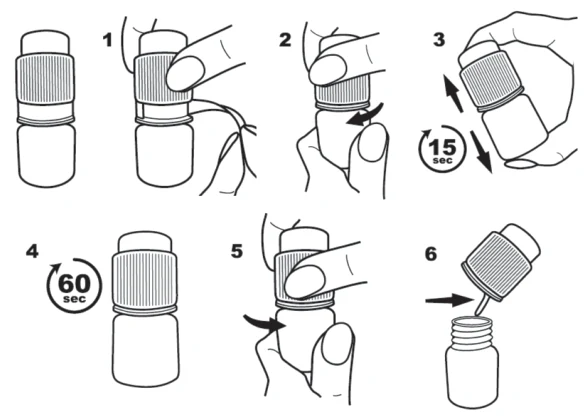
The container is two compartment system containing solution both in the cap and in the bottle. The two solutions first need to be combined (mixed) and are then to be taken by the patient. After opening the bottle, the oral solution is ready to use. No additional dilution of the product is required.
The product must be used within 20 minutes after mixing.
Instructions for preparing of the ready to use oral solution
- 1. Remove the safety ring.
- 2. Press down and twist the cap clockwise until the end of the screw neck.
- 3. Shake well for at least 15 seconds to mix the solutions.
- 4. Leave the oral solution to settle for 60 seconds.
- 5. Remove plastic cap by turning counterclockwise.
- 6. Assure that the bottom surface of the cap has been pierced and has opened.
- 7. Take/give the solution directly from the bottle.
 Omeprazole 10 mg: The final solution ready to use will be off white to pale yellow viscous solution, with menthol odour. Omeprazole 20 mg: The final solution ready to use will be off white to pale yellow viscous solution, with menthol and lemon odour.
For doses ≤10 mg (used for children below 1 year of age and weighing ≤ 10 kg) use the available pipette with the 10 mg strength:
- 1. Remove the safety ring.
- 2.
Press down and twist the cap clockwise until the end of the
screw neck.
- 3. Shake well for at least 15 seconds to mix both solutions.
- 4.
Leave the oral solution to settle for 5 minutes, before using the
pipette.
- 5. Remove the cap from the pipette.
- 6.
While the bottle is sitting on a firm, flat surface, insert the
pipette into the bottle.
- 7.
Slowly pull back the plunger of the pipette up to the graduation
mark on the pipette corresponding to the quantity in millilitres (ml) prescribed by your doctor.
- 8. Remove the pipette from the bottle.
- 9. Make sure your child is supported in an upright position.
- 10.
Place the tip of the pipette into the child’s mouth and slowly
press the plunger of the pipette down to gently release the medicine.
- 11. Allow your child some time to swallow the medicine.
- 12. After use wash the pipette with warm water and let it dry.
- 13. Dispose of the used bottle with any of the remaining solution.
If you take more Omeprazole than you should
If you take more Omeprazole than prescribed by your doctor, talk to your doctor or pharmacist straight away.
If you forget to take Omeprazole
If you forget to take a dose, take it as soon as you remember it. However, if it is almost time for your next dose, skip the missed dose. Do not take a double dose to make up for a forgotten dose.
If you stop taking Omeprazole
Do not stop taking Omeprazole without first talking to your doctor or pharmacist.
If you have any further questions on the use of this medicine, ask your doctor or pharmacist.
4. Possible side effects
Like all medicines, this medicine can cause side effects, although not everybody gets them.
If you notice any of the following rare (may affect up to 1 in 1000 people) or very rare (may affect up to 1 in 10 000 people) but serious side effects, stop taking Omeprazole and contact a doctor immediately:
- Sudden wheezing, swelling of your lips, tongue and throat or body, rash, fainting or difficulties in swallowing (severe allergic reaction) (rare).
- Reddening of the skin with blisters or peeling. There may also be severe blisters and bleeding in the lips, eyes, mouth, nose and genitals. This could be ‘Stevens-Johnson syndrome’ or ‘toxic epidermal necrolysis’ (very rare).
- Widespread rash, high body temperature and enlarged lymph nodes (DRESS syndrome or drug hypersensitivity syndrome) (rare).
- A red, scaly widespread rash with bumps under the skin and blisters accompanied by fever. The symptoms usually appear at the initiation of treatment (acute generalized exanthematous pustulosis) (rare).
- Yellow skin, dark urine and tiredness which can be symptoms of liver problems (rare).
Other side effects include:
Common side effects (may affect up to 1 in 10 people)
- Headache.
- Effects on your stomach or gut: diarrhoea, stomach pain, constipation, wind (flatulence).
- Feeling sick (nausea) or being sick (vomiting).
- Benign polyps in the stomach.
Uncommon side effects (may affect up to 1 in 100 people)
- Swelling of the feet and ankles.
- Disturbed sleep (insomnia).
- Dizziness, tingling feelings such as “pins and needles”, feeling sleepy.
- Spinning feeling (vertigo).
- Changes in blood tests that check how the liver is working.
- Skin rash, lumpy rash (hives) and itchy skin.
- Fracture of the hip, wrist or spine.
- Generally feeling unwell and lacking energy.
Rare side effects (may affect up to 1 in 1 000 people)
- Blood problems such as a reduced number of white cells or platelets. This can cause weakness, bruising or make infections more likely.
- Low levels of sodium in the blood. This may cause weakness, being sick (vomiting) and cramps.
- Feeling agitated, confused or depressed.
- Taste changes.
- Eyesight problems such as blurred vision.
Suddenly feeling wheezy or short of breath (bronchospasm).
- Dry mouth.
- An inflammation of the inside of the mouth.
- An infection called “thrush” which can affect the gut and is caused by a fungus.
- Liver problems, including jaundice which can cause yellow skin, dark urine, and tiredness.
- Hair loss (alopecia).
- Skin rash on exposure to sunshine.
- Joint pains (arthralgia) or muscle pains (myalgia).
- Severe kidney problems (interstitial nephritis).
- Increased sweating.
Very rare side effects (may affect up to 1 in 10 000 people)
- Changes in blood count including agranulocytosis (lack of white blood cells).
- Aggression.
- Seeing, feeling or hearing things that are not there (hallucinations).
- Severe liver problems leading to liver failure and inflammation of the brain.
- Erythema multiforme.
- Мuscle weakness.
- Enlarged breasts in men.
Not known (frequency cannot be estimated from the available data)
- Inflammation in the gut (leading to diarrhoea).
- If you are on Omeprazole for more than three months it is possible that the levels of magnesium in your blood may fall. Low levels of magnesium can be seen as fatigue, involuntary muscle contractions, disorientation, convulsions, dizziness or increased heart rate. If you get any of these symptoms, please tell your doctor promptly. Low levels of magnesium can also lead to a reduction in potassium or calcium levels in the blood. Your doctor may decide to perform regular blood tests to monitor your levels of magnesium.
- Rash, possibly with pain in the joints.
Omeprazole may in very rare cases affect the white blood cells leading to immune deficiency. If you have an infection with symptoms such as fever with a severely reduced general condition or fever with symptoms of a local infection such as pain in the neck, throat or mouth or difficulties in urinating, you must consult your doctor as soon as possible so that a lack of white blood cells (agranulocytosis) can be ruled out by a blood test. It is important for you to give information about your medicine at this time.
Reporting of side effects
If you get any side effects, talk to your doctor, pharmacist or nurse. This includes any possible side effects not listed in this leaflet. You can also report side effects directly via the Yellow Card Scheme Website: www.mhra.gov.uk/yellowcard or search for MHRA Yellow Card in the Google Play or Apple App Store. By reporting side effects you can help provide more information on the safety of this medicine.
5. How to store Omeprazole
Keep this medicine out of the sight and reach of children. Do not use this medicine after the expiry date which is stated on the label and carton after EXP. The expiry date refers to the last day of that month.
Store in a refrigerator (2ºC – 8ºC).
Store in the original package to protect from light. The unopened product may be removed from the refrigerator (2°C – 8°C) and stored for up to 28 days below 25°C. After mixing, the product must be used within 20 minutes. During this time, it should be kept out of the sight and reach of children. Any unused contents should be discarded.
Do not throw away any medicines via wastewater or household waste. Ask your pharmacist how to throw away medicines you no longer use. These measures will help protect the environment.
6. Contents of the pack and other information
What Omeprazole contains
The active substance is omeprazole.
Omeprazole 10 mg: After mixing, each 15 ml of oral solution contains 10 mg of omeprazole.
Omeprazole 20 mg: After mixing, each 15 ml of oral solution contains 20 mg of omeprazole.
The other ingredients are: glycerol (E422), xanthan gum (E415), polysorbate 80, disodium edetate, acetylcysteine, sodium dihydrogen phosphate dihydrate, sodium hydroxide, carmellose sodium (E468), emulsion simethicone 30%, sucralose (E955), sodium hydrogen carbonate, domiphen bromide, water purified, menthol flavor, taste masking flavor (contains propylene glycol (E1520)), lemon flavor (for 20 mg/15ml).
What Omeprazole looks like and contents of the pack
Omeprazole 10 mg oral solution is off white to pale yellow viscous solution, with menthol odour.
Discard and do not take a solution that is dark in color or has deposits.
Omeprazole 20 mg oral solution is off white to pale yellow viscous solution, with menthol and lemon odour.
Discard and do not take a solution that is dark in color or has deposits.
The dual-chamber primary packaging for Omeprazole 10 mg, 15 ml is composed of assembled:
- HDPE Cap with tamper evident ring, with PP plunger and PE membrane filled with 5 ml of omeprazole 2 mg/ml solution
- HDPE Bottle with neck filled with 10 ml of diluent for Omeprazole 10 mg oral solution.
The dual-chamber primary packaging for Omeprazole 20 mg, 15 ml is composed of assembled:
- HDPE Cap with tamper evident ring, with PP plunger and PE breakable membrane filled with 5 ml of omeprazole 4 mg/ml solution
- HDPE Bottle with neck filled with 10 ml of diluent for Omeprazole 20 mg oral solution.
Cardboard box containing 14 single-dose, dual-chamber HDPE bottles located on PVC saucer and an instruction leaflet inside. Omeprazole 10 mg contains dosing pipette of 15 ml capacity with PS plunger, LDPE body and cap, with 0.5 ml graduation marks.
Marketing Authorisation Holder
INN-FARM d.o.o.
Maleševa 14
1000 Ljubljana
Slovenia
Manufacturer
ALKALOID-INT d.o.o.
Šlandrova ulica 4
1231 Ljubljana-Crnuce
Slovenia