

Patient leaflet - Nitrofurantoin 50 mg/5 ml oral suspension
1. WHAT NITROFURANTOIN ORAL
SUSPENSION IS AND WHAT IT IS USED FOR
Nitrofurantoin (the active substance in Nitrofurantoin Oral Suspension) is an antibiotic.
It is used to prevent and treat infections of the bladder, kidney and other parts of the urinarytract.
2. WHAT YOU NEED TO KNOW BEFORE YOU TAKE NITROFURANTOIN ORAL SUSPENSION
DO NOT TAKE Nitrofurantoin Oral Suspension:
if you are allergic to Nitrofurantoin, other medicines
containing nitrofurantoin or to any of the other ingredients of this medicine (listed in Section 6) - if you have a disease of the kidneys which is
severely affecting the way they work (ask your doctor if you are not sure)
if you are in the final stages of pregnancy (labour or
delivery) as there is a risk that it might affect the baby
if you suffer from a blood disorder called porphyria - if you are deficient in an enzyme called G6PD
(glucose-6-phosphate dehydrogenase) - if your child is under three months of age. Tell your doctor if you are not sure about any of the above.
Warnings and precautions
Talk to your doctor, pharmacist or nurse before taking with Nitrofurantoin Oral Suspension:
If you have disease of the lungs.
This medicine can also cause lung disease in patients with no previous medical history affecting their lungs. Lung disease can occur in patients on short-term or long-term treatment. Talk to your doctor if you experience trouble breathing, shortness of breath, a lingering cough, coughing up blood or mucus, or pain or discomfort when breathing These may be symptoms of side effects affecting the lungs.
- if you have diabetes
- if you are suffering from any illness causing severe weakness
- if you have anaemia (a decrease in red blood cells causing pale skin, weakness and breathlessness); or a lack of vitamin B or abnormal levels of salts in your blood (your doctor will be able to advise you) - if you have a history of allergic reactions - if you have any problems with your kidneys. The above conditions may increase the chance of developing a side effect which results in damage to the nerves, causes altered sense of feeling pins and needles
- if you lack an enzyme (body chemical) called glucose-6-phosphate dehydrogenase, which causes your red blood cells to be more easily damaged (this is more common in black people and people of Mediterranean, Middle Eastern or Asian origin. Your doctor will know)
- if you have any disease of the lungs, liver or nervous system. If you need to take Nitrofurantoin Oral Suspension for a number of months, your doctor may want to regularly check how your lungs and liver are working.
as this medicine may interfere with urine tests for glucose, causing the test to give a “false positive” result. That is, the test may say that glucose is present in the urine even if it is not. This medicine may also cause your urine to turn yellow or brown. - If you experience fatigue, yellowing of the skin or eyes, itching, skin rashes, joint pain, abdominal
discomfort, nausea, vomiting, loss of appetite, dark urine, and pale or gray-colored stools. It may be symptoms of liver disorder.
Other medicines and Nitrofurantoin Oral Suspension:
Tell your doctor or pharmacist if you are taking, have recently taken or might take any other medicines, including medicines obtained without a prescription.
If they are taken with Nitrofurantoin Oral Suspension their effect or the effect of Nitrofurantoin Oral Suspension may be changed.
In particular, tell your doctor or pharmacist if you are taking any of the following medicines:
- Antacids for indigestion (e.g. magnesium trisilicate) - Typhoid vaccine
- Medicines for gout (e.g. probenecid or sulfinpyrazone);
- Medicines which slow the passage of food through the stomach (e.g. atropine, hyoscine)
- Medicines for raised pressure in the eye (glaucoma), such as carbonic anhydrase inhibitors (e.g. acetazolamide)
Medicines which make the urine less acidic (e.g.
potassium citrate mixture)
- Medicines for infections, known as quinolones. - If you are in doubt about any of these medicines ask your doctor or pharmacist.
Nitrofurantoin Oral Suspension with food and drink:
Nitrofurantoin Oral Suspension should always be taken with food or milk. Taking this medicine with food or milk makes it work more effectively. This will help to avoid stomach upset and also to help the absorption.
Pregnancy and breast-feeding and fertility:
If you are pregnant or breast-feeding, think you may be pregnant or are planning to have a baby, ask your doctor or pharmacist for advice before taking this medicine.
As far as it is known Nitrofurantoin Oral Suspension may be used in pregnancy. However, it should not be used during labour or delivery because there is a possibility that use at this stage may affect the baby. If you want to breast feed, please consult your doctor first.
Driving and using machines:
Nitrofurantoin Oral Suspension may cause dizziness and drowsiness. You should not drive or operate machinery if you are affected this way until such symptoms go away.
Nitrofurantoin Oral Suspension contains:
Methyl parahydroxybenzoate (E218) and Propyl parahydroxybenzoate (E216) which may cause allergic reactions (possibly delayed)
This medicine contains less than 1mmol sodium (23mg) per dose, i.e. essentially sodium free.
3. HOW TO TAKE NITROFURANTOIN ORAL SUSPENSION
Always take this medicine exactly as your doctor or pharmacist has told you. Check with your doctor or pharmacist if you are not sure.
The recommended dose is:
Adults:
The normal dosage depends on the type of infection you have and instructions should be written on the label provided by the pharmacist. Consult your pharmacist or doctor if these instructions are not clear. The usual doses are:
- For treatment of infections: two to four 5ml spoonful four times a day for seven days.
- For prevention of further infections: two to four 5ml spoonful to be taken once a day.
- For prevention of infections during surgery: two 5ml spoonful four times a day on the day of the operation and three days thereafter.
Use in children and infants aged over three months:
The dose depends on the weight of the child and will be provided by your doctor. Follow your doctor’s instructions exactly.
Children below 3 months of age should not take Nitrofurantoin Oral Suspension.
Medical Checks:
Your doctor will watch carefully for any effects on the liver, lungs, blood or nervous system.
Nitrofurantoin Oral Suspension may interfere with the results of some tests for glucose in the urine.
Method of administration:
Nitrofurantoin Oral Suspension should always be taken with food or milk. Taking this medicine with food or milk makes it work more effectively.
Cutting Area Print Area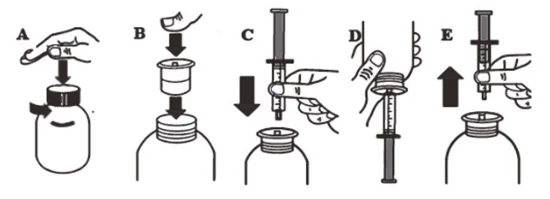
165.00 mm
Back
Instructions for the use of syringe:
For oral administration.
A 5 ml graduated oral syringe with intermediate graduations of 0.1 ml and a “Press-In” Bottle Adapter (PIBA) are provided with the product.
- 1. Open the bottle and at first use insert the “Press-In” Bottle Adapter (PIBA) (see pictures A-B). 2. Insert the syringe into the PIBA and draw out the required volume from the inverted bottle (see pictures C-D).
- 3. Remove the filled syringe from the bottle in the upright position (see picture E).
- 4. Discharge the syringe contents into the mouth. Repeat steps 2 to 4 as needed to achieve the required dose.
- 5. Rinse the syringe and replace the cap on the bottle (PIBA remains in place).
If you take more Nitrofurantoin Oral Suspension than you should:
Consult your doctor or pharmacist immediately or go to the emergency department of the nearest hospital. Always take any leftover medicine with you, as well as the container and label, so that the medical staff knows what you have taken.
If you forget to take Nitrofurantoin Oral Suspension:
Do not worry. If you remember later on that day, take that day’s dose as usual. If you miss a whole day’s dose take the normal dose on the next day. Do not take a double dose to make up for a forgotten dose. If you are not sure ask your doctor or pharmacist.
If you stop taking Nitrofurantoin Oral Suspension:
Your doctor will tell you how long to take the treatment. Do not stop earlier than you are told, even if you feel better.
If you have any further questions on the use of this medicine, ask your doctor, pharmacist or nurse.
4. POSSIBLE SIDE EFFECTS
Like all medicines, this medicine can cause side effects, although not everybody gets them. Most of them are mild and disappear when you stop taking Nitrofurantoin Oral Suspension.
All medicines can cause allergic reactions although serious allergic reactions are rare. If you notice any sudden wheeziness, difficulty in breathing, swelling of the eyelids, face or lips, rash or itching (especially affecting your whole body) STOP TAKING your medicine and go to a doctor immediately.
If you notice any of the following side effects consult your doctor immediately:
- Problems with your lungs. This can happen quickly, within one week after the start of treatment, or very slowly, especially in the elderly and can lead to fever, shivering, coughing and shortness of breath associated with pneumonia and/or tissue damage. - Jaundice (inflammation of the liver causing yellowing of the skin or whites of the eyes).
- The nerves outside the spinal cord may be affected causing changes to the sense of feeling and the use of muscles. In addition headache, extreme changes of mood or mental state, confusion, weakness, blurred vision may occur. These effects may be severe and in some instances permanent.
- Raised pressure in the skull (causing severe headaches).
- Severe reduction in blood cells which can cause weakness, bruising or make infections more likely - Blue or purple coloration of the skin due to low oxygen levels. A condition known as cyanosis. - Symptoms of fever, flu, abdominal pain, diarrhea, blood in your stool and weakness. These could be signs of a condition known as cutaneous vasculitis. - Symptoms of fatigue, abdominal pain, joint pain and swelling. These could be signs of a condition known as hepatitis. In rare cases, it may cause liver failure which may be fatal.
Please note that while taking Nitrofurantoin Oral Suspension your urine may become dark yellow or brown coloured. This is quite normal and not a reason to stop taking the medicine.
Other side effects include:
Rare (may affect up to 1 in 1,000 people)
- Loss of consciousness (collapse)
- Damage to bone marrow causing deficiency of the red blood cells (Anaemia).
Not known (frequency cannot be estimated from the available data)
- Feeling sick (nausea) and headache.
Diarrhoea
- Loss of appetite, stomach ache, and being sick (vomiting).
- Dizziness, drowsiness.
- Blood cells have been affected in some patients. This may result in bruising, delayed clotting of the blood, sore throat, fever, anaemia, and a susceptibility to colds or persistent cold.
- A variety of skin rashes or reactions have occurred in some patients. These may appear as flaking skin, a red rash or fever accompanied by rapid heart rate and severe rash with blistering.
Other reactions may include inflammation of salivary glands (causing facial pains), inflammation of the pancreas gland (causing severe abdominal pain) and joint pains.
- Short-term hair loss.
- Urinary infection by germs which are not sensitive to Nitrofurantoin Oral Suspension.
- Inflammation of small blood vessel walls, causing skin lesions
- Liver inflammation due to turn of immune system against liver cells
- Inflammation of kidney tissue surrounding tubules, causing renal impairment
Reporting of side effects
If you get any side effects, talk to your doctor, pharmacist or nurse. This includes any possible side effects not listed in this leaflet. You can also report side effects directly via the MHRA yellow card scheme website: www.mhra.gov.uk/yellowcard or search for MHRA Yellow Card in the Google Play or Apple App Store.
By reporting side effects you can help provide more information on the safety of this medicine.
5. HOW TO STORE NITROFURANTOIN ORAL SUSPENSION
Unopened (25mg/5ml):Store below 25°C.
Unopened (50mg/5ml): This product does not require any special temperature storage conditions. Keep the bottle in the outer carton in order to protect from light. Do not freeze.
After first opening: use within 3 months (90 days) and do not store above 25°C.
Nitrofurantoin suspension should be protected from light, as exposure will cause darkening of the active principle. Because of this, amber bottles should be used in dispensing.
Do not use Nitrofurantoin Oral Suspension after the expiry date which is stated on the pack. The expiry date refers to the last day of that month.
Medicines should not be disposed of via wastewater or household waste. Ask your pharmacist how to dispose of medicines no longer required. These measures will help to protect the environment.
6. CONTENTS OF THE PACK AND OTHER INFORMATION
What Nitrofurantoin Oral Suspension contains:
The active substance is Nitrofurantoin monohydrate. Nitrofurantoin 25 mg/5 ml Oral Suspension: Each 5 ml contains 25 mg nitrofurantoin monohydrate.
Nitrofurantoin 50 mg/5 ml Oral Suspension: Each 5 ml contains 50 mg nitrofurantoin monohydrate.
The other ingredients are glycerol, polysorbate 20, carbomer, Sucralose, methyl parahydroxybenzoate (E218), propyl parahydroxybenzoate (E216), sodium hydroxide, Lemon flavour LF-902-616-8, Apricot Flavour RB-714-458-5 and purified water.
What Nitrofurantoin Oral Suspension looks like and contents of the pack:
Nitrofurantoin Oral Suspension is an opaque yellow liquid with a lemon and apricot characteristic odour supplied in an 300ml amber glass bottle made of soda lime silica, with a child resistant screw-cap made of polypropylene, along with a dosing syringe with an adaptor made of low density polyethylene. Dosing syringe is supplied with 0.1ml graduation mark.
Marketing Authorisation Holder
Lyrus Life Sciences Limited,
C/O Thakur-Chabert 7a Vine Street
Uxbridge
United Kingdom
UB8 1QE
Manufacturer
Wave Pharma Limited
Ground Floor, Cavendish House,
369 Burnt Oak Broadway,
Edgware, HA8 5AW,
United Kingdom.
This leaflet was last revised in April 2025.
POM
| Nitrofurantoin 25mg/5ml Oral Suspension Nitrofurantoin 50mg/5ml Oral Suspension | |||||
| UK | |||||
| 165 x 480 mm (Front & Back) | Leaflet | ||||
| 1 | |||||
| Printed on 40 - 45 GSM News print paper | |||||
| Font Name | Main Headings - Myriad Pro (Bold) | 14 pts | |||
| Font Name | Sub Headings - Myriad Pro (Bold) | ||||
| Font Name | Content - Myriad Pro | ||||
| Text Line Spacing | |||||
Remarks
| 25mg/ 5ml & 50mg/ 5ml | |||||
| 10 pts | |||||
| 9 pts | |||||
| 12.8 pts | |||||