

Patient leaflet - Neorecormon 10000 IU solution for injection in Pre-filled syringe
1. What NeoRecormon is and what it is used for
NeoRecormon is a clear, colourless solution for injection under the skin (subcutaneously) or into a vein (intravenously). It contains a hormone called epoetin beta, which stimulates the production of red blood cells. Epoetin beta is produced by a specialised genetic technology and works in exactly the same way as the natural hormone erythropoietin. You must talk to your doctor if you do not feel better or if you feel worse.
NeoRecormon is indicated for:
Treating symptomatic anaemia caused by
chronic kidney disease (renal anaemia) in patients on dialysis, or not yet on dialysis. ● Preventing anaemia in premature infants
(weighing 750 to 1500 g and born at less than 34 weeks).
- Treating anaemia with related symptoms in adult cancer patients receiving chemotherapy
Treating people donating their own blood
before surgery. The injections of epoetin beta will increase the amount of blood that can be taken from your body before surgery and given back during or after the operation (this is an autologous transfusion).
2. What you need to know before you use NeoRecormon
Do not use NeoRecormon
if you are allergic to epoetin beta or
any of the other ingredients of this medicine (listed in section 6)
if you have blood pressure problems that
cannot be controlled
if you are donating your own blood before surgery, and:
you had a heart attack or stroke in the
month before your treatment
you have unstable angina pectoris –
new or increasing chest pain
you are at risk of blood clots in the
veins (deep venous thrombosis) – for example, if you have had clots before. If any of these apply to you, or might apply, tell your doctor at once.
Warnings and precautions
Talk to your doctor before using NeoRecormon ● if your baby needs treatment with
NeoRecormon, your baby will be carefully monitored for any potential effects on the eye
if your anaemia does not improve with
epoetin treatment
if you are low in certain B vitamins
(folic acid or vitamin B12)
if you have very high levels of aluminium
in your blood
- if your blood platelet count is high ● if you have chronic liver disease ● if you have epilepsy
if you have developed anti-erythropoietin antibodies and pure red cell aplasia
(reduced or stopped production of red blood cells) during prior exposure to any erythropoietic substance. In this case you should not be switched to NeoRecormon.
Take special care with other products that stimulate red blood cell production:
NeoRecormon is one of a group of products that stimulate the production of red blood cells like the human protein erythropoietin does. Your doctor will always record the exact product you are using.
Serious skin reaction including Stevens-Johnson syndrome (SJS) and toxic epidermal necrolysis (TEN) have been reported in association with epoetin treatment.
SJS/TEN can appear initially as reddish target-like spots or circular patches often with central blisters on the trunk. Also, ulcers of mouth, throat, nose, genitals and eyes (red and swollen eyes) can occur. These serious skin rashes are often preceded by fever and/or flu-likes symptoms. The rashes may progress to widespread peeling of the skin and life-threatening complications.
If you develop a serious rash or another of these skin symptoms, stop taking NeoRecormon and contact your doctor or seek medical attention immediately.
Special Warning:
During treatment with NeoRecormon
If you are a patient with chronic kidney disease, and particularly if you do not respond properly to NeoRecormon, your doctor will check your dose of NeoRecormon because repeatedly increasing your dose of NeoRecormon if you are not responding to treatment may increase the risk of having a problem of the heart or the blood vessels and could increase risk of myocardial infarction, stroke and death.
If you are a cancer patient, you should be aware that NeoRecormon may act as a blood cell growth factor and in some circumstances may have a negative impact on your cancer. Depending on your individual situation, a blood transfusion may be preferable. Please discuss this with your doctor.
If you are a nephrosclerotic patient and you are not on dialysis, your doctor will decide whether treatment is right for you. This is because one cannot rule out a possible acceleration of progression of kidney disease with absolute certainty.
Your doctor may do regular blood tests to check: ● your potassium levels. If you have high or rising
potassium levels your doctor may reconsider your treatment
your blood platelet count. The number of
platelets can rise slightly to moderately during epoetin treatment, and this can cause changes in blood clotting.
If you are a kidney patient under haemodialysis, your doctor may adjust your dose of heparin. This should avoid a blockage in the tubing of the dialysis system.
If you are a kidney patient under haemodialysis and at risk of shunt thrombosis, blood clots (thromboses) may form in your shunt (vessel used for connection to the dialysis system). Your doctor might prescribe acetylsalicylic acid or modify the shunt.
If you are donating your own blood before surgery, your doctor will need to:
check that you are capable of giving blood,
especially if you weigh less than 50 kg ● check that you have a sufficient level of red
blood cells (haemoglobin of at least 11 g/dL) ● make sure that only 12% of your blood will be
donated at once.
Do not misuse NeoRecormon:
Misuse of NeoRecormon by healthy people may lead to an increase in blood cells and consequently thicken the blood. This can in turn lead to life-threatening complications of the heart or blood vessels.
Other medicines and NeoRecormon
Tell your doctor or pharmacist if you are taking, have recently taken or might take any other medicines, including medicines obtained without a prescription.
Pregnancy, breast-feeding and fertility
There is not much experience with NeoRecormon in pregnant women or women who are breast-feeding. Ask your doctor or pharmacist for advice before taking any medicine.
NeoRecormon has not shown evidence of impaired fertility in animals. The potential risk for humans is unknown.
Driving and using machines
No effects on ability to drive or use machines have been observed.
NeoRecormon contains phenylalanine and sodium
This medicine contains phenylalanine. May be harmful for people with phenylketonuria. If you have phenylketonuria, talk to your doctor about your treatment with NeoRecormon.
This medicine contains less than 1 mmol sodium (23 mg) per dose, that is to say essentially ‘sodium- free’.
3. How to use NeoRecormon
Always use this medicine exactly as your doctor has told you. Check with your doctor or pharmacist if you are not sure.
Your doctor will use the lowest effective dose to control the symptoms of your anaemia.
If you do not respond adequately to NeoRecormon, your doctor will check your dose and will inform you if you need to change doses.
Treatment must be started under the supervision of your doctor.
Further injections are given by your doctor or, after you have been trained, you can inject NeoRecormon yourself (see instructions at the end of this leaflet.)
NeoRecormon can be injected under the skin in the abdomen, arm or thigh, or into a vein. Your doctor will decide which is best for you.
Your doctor will carry out regular blood tests to monitor how your anaemia is responding to treatment by measuring your haemoglobin level.
NeoRecormon dosing
The dose of NeoRecormon depends on your disease condition, the way the injection is given (under the skin or into a vein) and your body
weight. Your doctor will work out the right dose for you. Your doctor will use the lowest effective dose to control the symptoms of your anaemia.
If you do not respond adequately to NeoRecormon, your doctor will check your dose and will inform you if you need to change doses of NeoRecormon.
- Symptomatic anaemia caused by chronic kidney disease
Your injections are given under the skin or into a vein. If the solution is given into your vein it should be injected over about 2 minutes, e.g. people on haemodialysis will receive the injection via the arteriovenous fistula at the end of dialysis. People who are not on haemodialysis will usually have injections under the skin.
Treatment with NeoRecormon is divided into two stages:
- a) Correcting the anaemia
The initial dose for injections under the skin is 20 IU per injection for every 1 kg of your body weight, given three times per week.
After 4 weeks, the doctor will do tests and, if the treatment response is not sufficient, your dose may be raised to 40 IU/kg per injection, given three times per week. The doctor may continue to increase your dose at monthly intervals if necessary.
The weekly dose can also be divided into daily doses. The initial dose for injections into veins is 40 IU per injection for every 1 kg of your body weight, given three times per week.
After 4 weeks, the doctor will do tests and, if the treatment response is not sufficient, your dose may be raised to 80 IU/kg per injection, given three times per week. The doctor may continue to increase your dose at monthly intervals if necessary.
For both types of injection, the maximum dose should not exceed 720 IU for every 1 kg of your body weight per week.
- b) Maintaining sufficient red blood cell levels The maintenance dose: Once your red blood cells reach an acceptable level, the dose is reduced to half the dose used to correct the anaemia. The weekly dose can be given once per week or divided into three or seven doses per week. If your red blood cell level is stable on a once weekly dosing regimen, your dose may be switched to once every two weeks administration. In this case dose increases may be necessary. Every one or two weeks, the doctor may adjust your dose to find your individual maintenance dose. Children will start by following the same guidelines. In trials, children usually needed higher doses of NeoRecormon (the younger the child, the higher the dose).
Treatment with NeoRecormon is normally a long-term therapy. However, it can be interrupted at any time, if necessary.
- Anaemia in premature infants
Injections are given under the skin.
The initial dose is 250 IU per injection for every 1 kg the infant weighs, three times a week.
Premature infants who have been transfused before the start of treatment with NeoRecormon are not likely to benefit as much as untransfused infants.
The recommended treatment duration is 6 weeks.
- Adults with symptomatic anaemia receiving chemotherapy for cancer
Injections are given under the skin.
Your doctor may initiate treatment with NeoRecormon if your haemoglobin level is 10 g/dL or less. After initiation of therapy, your doctor will maintain your haemoglobin level between 10 and 12 g/dL.
The initial weekly dose is 30,000 IU. This may be given as one injection per week, or in divided doses as 3 to 7 injections per week. Your doctor will take regular blood samples. He or she may raise or lower your dose or interrupt your treatment according to the test results. The haemoglobin values should not exceed a value of 12 g/dL.
The therapy should be continued for up to 4 weeks after the end of chemotherapy.
The maximum dose should not exceed 60,000 IU per week.
- People donating their own blood before surgery
Injections are given into a vein over 2 minutes, or under the skin.
The dose of NeoRecormon depends on your condition, red blood cell levels and how much blood will be donated before surgery.
The dose worked out by your doctor will be given twice per week for 4 weeks. When you donate blood, NeoRecormon will be given to you at the end of a donation session.
The maximum dose should not exceed ● for injections into veins: 1600 IU for every 1 kg
of your body weight per week
for injections under the skin: 1200 IU for every
1 kg of your body weight per week.
If you inject too much NeoRecormon
Do not increase the dose your doctor has given you. If you think you have injected more NeoRecormon than you should, contact your doctor. It is unlikely to be serious. Even at very high blood levels, no symptoms of poisoning have been observed.
If you forget to use NeoRecormon
If you have missed an injection, or injected too little, talk to your doctor.
Do not take a double dose to make up for any forgotten doses.
If you have any further questions on the use of this medicine, ask your doctor or pharmacist.
4. Possible side effects
Like all medicines, this medicine can cause side effects, although not everybody gets them.
Side effects which can affect any patient ● Most people (very common may affect more
than 1 in 10 people) get lower levels of iron in their blood. Almost all patients have to be treated with iron supplements during their NeoRecormon therapy.
Rarely (may affect up to 1 in 1,000 people),
allergies or skin reactions, such as rash or hives, itching or reactions around the injection site have occurred.
Very rarely (may affect up to 1 in 10,000
people) a severe form of allergic reaction has occurred, especially just after an injection. It needs to be treated at once. If you get unusual wheezing or difficulty breathing; swollen tongue, face or throat, or swelling around the injection site; if you feel light-headed or faint or if you collapse, call your doctor at once.
Very rarely (may affect up to 1 in 10,000
people) people experienced flu-like symptoms, especially when they just started treatment. These include fever, chills, headaches, pain in the limbs, bone pain and/or feeling generally unwell. These reactions were usually mild to moderate and went away within a few hours or days.
- Serious skin rashes including Stevens-Johnson syndrome and toxic epidermal necrolysis have been reported in association with epoetin treatment. These can appear as reddish target-like macules or circular patches often with central blisters on the trunk, skin peeling, ulcers of mouth, throat, nose, genitals and eyes and can be preceded by fever and flu-like symptoms. Stop using NeoRecormon if you develop these symptoms and contact your doctor or seek medical attention immediately. See also section 2.
Additional side effects in people with chronic kidney disease (renal anaemia)
- Increase in blood pressure, worsening of existing high blood pressure and headaches are the most common side effects (very common may affect more than 1 in 10 people). Your doctor will regularly check your blood pressure, particularly at the beginning of therapy. Your doctor may treat the high blood pressure with drugs or temporarily interrupt your NeoRecormon therapy. ● Call a doctor at once if you get headaches, especially sudden, stabbing, migraine-like headaches, confusion, speech disturbance, unsteady walking, fits or convulsions. These may be signs of severely elevated blood pressure (hypertensive crisis), even if your blood pressure is usually normal or low. It needs to be treated at once. ● If you have low blood pressure or shunt complications, you may be at risk of shunt thrombosis (a blood clot in the vessel used for connection to the dialysis system).
- Very rarely (may affect up to 1 in 10,000 people), patients have had rising levels of potassium or phosphates in the blood. This can be treated by your doctor.
- Pure red cell aplasia (PRCA) caused by neutralising antibodies has been observed during erythropoietin therapy, including in isolated cases during therapy with NeoRecormon. PRCA means that the body stopped or reduced the production of red blood cells. This causes severe anaemia, symptoms of which would include unusual tiredness and a lack of energy. If your body produces neutralising antibodies, your doctor will discontinue therapy with NeoRecormon, and determine the best course of action to treat your anaemia.
Additional side effects in adults receiving chemotherapy for cancer
- Increase in blood pressure and headaches may occasionally occur. Your doctor may treat the high blood pressure with drugs. ● An increase in the occurrence of blood clots has been observed.
Additional side effects in people donating their own blood before surgery
- A slight increase in the occurrence of blood clots has been observed.
Reporting of side effects
If you get any side effects, talk to your doctor or pharmacist. This includes any possible side effects not listed in this leaflet. You can also report side effects directly via the Yellow Card Scheme Website: www.mhra.gov.uk/yellowcard or search for MHRA Yellow Card in the Google Play or Apple App Store.
By reporting side effects you can help provide more information on the safety of this medicine.
5. How to store NeoRecormon
- Keep this medicine out of the sight and reach of children.
- Do not use NeoRecormon after the expiry date which is stated on the carton and label. ● Store in a refrigerator (2°C – 8°C).
The syringe can be removed from the
refrigerator and left at room temperature for a single period of maximum 3 days (but not above 25°C).
Keep the pre-filled syringe in the outer carton,
in order to protect from light.
Medicines should not be disposed of via
wastewater or household waste. Ask your pharmacist how to dispose of medicines no longer required. These measures will help protect the environment.
If the medicine becomes discolored or shows any other signs of deterioration, you should seek the advice of your pharmacist who will tell you what to do.
6. Contents of the pack and other information
What NeoRecormon contains
The active substance is epoetin beta. One
pre-filled syringe contains 10,000 (international units) epoetin beta in 0.6 ml solution. ● The other ingredients are:
urea, sodium chloride, polysorbate 20, sodium dihydrogen phosphate dihydrate, disodium phosphate dodecahydrate, calcium chloride dihydrate, glycine, L-Leucine, L-Isoleucine, L-Threonine, L-Glutamic acid, and L-Phenylalanine and water for injections (see section 2 “NeoRecormon contains phenylalanine and sodium”).
What NeoRecormon looks like and contents of the pack
NeoRecormon is a solution in a pre-filled syringe for injection
The solution is colourless, clear to slightly opalescent. NeoRecormon 10,000 IU: Each pre-filled syringe contains 0.6 ml solution.
NeoRecormon is provided in the following pack-size: NeoRecormon 10,000 IU 6 pre-filled syringes with 6 needles (27G1/2)
Manufacturer
Roche Pharma AG, Emil-Barell-Strasse 1, D-79639 Grenzach-Wyhlen, Germany
Procured from within the EU and repackaged for the PL Holder:
Abacus Medicine Ltd., Abbey House,
282 Farnborough Road, Farnborough, GU14 7NA, United Kingdom
NeoRecormon 10.000 IU solution for injection - pre-filled syringe:
PL 45763/0690
PL 45763/0691
PL 45763/0692
NeoRecormon® is a registered trademark of F. Hoffmann-La Roche AG.
For any information about this medicine, please contact the local representative of the Product Licence Holder: Abacus Medicine Ltd.
(tel: +44(0)2036301244)
email: MedInfo@abacusmedicine.co.uk or drugsafetyuk@abacusmedicine.co.uk
This leaflet was last revised on 25-07-2025.
Blind or partially sighted? Is this leaflet hard to see or read?
Call 02036301310 or write to info@ abacusmedicine.com to obtain the leaflet in a format suitable for you.
NeoRecormon® pre-filled syringe
Instructions for Use
The following instructions explain how to give an injection of NeoRecormon. Be sure that you read, understand and follow the Instructions for Use as well as the package leaflet before injecting NeoRecormon. Your healthcare provider will show you how to prepare and inject NeoRecormon properly before you use it for the first time.
Do not inject yourself unless you have received training. Consult your healthcare provider if you require further information.
Always follow all directions in these Instructions for Use as they may differ from your experiences. These instructions will minimize risk such as accidental needle stick and prevent incorrect use.
NeoRecormon can be administered through 2 manners, your doctor will decide which way is right for you:
Intravenous administration (into the vein or
vein port), only to be performed by healthcare professionals.
- Subcutaneous administration (under the skin).
Before you begin
Do not take the needle cap off until you are
ready to inject NeoRecormon.
- Do not try to take the syringe apart at any time. ● Do not reuse the same syringe.
Do not use if the syringe has been dropped or
damaged.
Do not leave the syringe unattended. ● Keep the syringe and needle and the
puncture-resistant or sharps disposal container out of reach of children. ● Contact your healthcare professional if you
have any questions.
Storage Instructions
Keep your unused syringe(s) and needles in
the original carton and store in a refrigerator at 2˚C to 8˚C.
Keep your syringe and needle out of direct
sunlight.
- Do not freeze.
- Do not use if the syringe has been frozen. ● Always keep the syringe and needle dry.
Supplies needed to give your injection Included in the carton:
- NeoRecormon Pre-filled syringe(s).
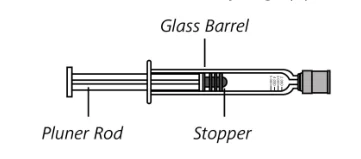 Injection needle(s) (27G or 30G (depending
on the prescribed strengths of the medicine) with safety shield (used for priming, setting the dose and injecting the medicine).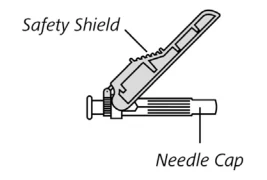
Note: Each NeoRecormon carton contains either 1 syringe/1 needle, 4 syringes/4 needles or 6 syringes/6 needles.
- Instructions for Use and a package leaflet.
Not included in the carton:
- 1 alcohol swab.
- 1 dry sterile pad.
1 puncture-resistant container or sharps
container for safe disposal of rubber cap, needle cap and used syringe.
Preparing for injection
1 Find a well lit, clean, flat, working surface.
●Take the carton with the syringe(s) and needle(s) out of the refrigerator
A)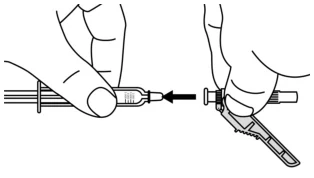
2 Check the carton, the perforations on the front
of the carton and the seal. Also check the expiration date.
B)
C) 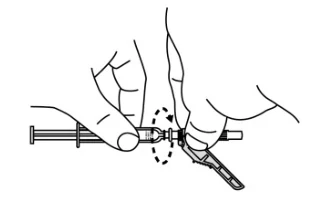
●Do not use if the expiration date has passed, or if the carton looks damaged. In this case, proceed to step 20 and contact your healthcare provider.
●Do not use if the perforations or the seal are broken. In this case, proceed to step 20 and contact your healthcare provider.
8 Place the syringe on a clean, flat surface until
ready for use.
3 Open the carton by pushing through the
9 Wash your hands with soap and water.
perforation around the seal.
4 Take one syringe out of the carton and one
10 Choose an injection site:
needle from the needle box. Be careful when taking out the syringe. Make sure you always hold the syringe as shown in the picture below. ●Do not flip the carton upside down to remove the syringe.
●The recommended injection sites are the top of your thigh or the lower part of your abdomen below the belly button. ●Do not inject within the 5 cm (2 inches) area directly around your belly button. ●Choose a different injection site for each new injection.
●Do not handle the syringe by holding the plunger or needle cap.
Remark: If you have a multipack, put the carton with the remaining syringe(s) and needle(s) back into the refrigerator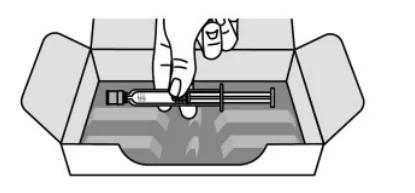
●Do not inject into moles, scars, bruises, or areas where the skin is tender, red, hard or not intact.
●Do not inject into vein or into a muscle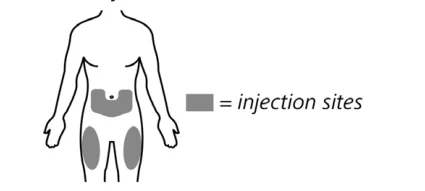
5 Inspect the syringe and needle closely
11 Wipe the injection site with an alcohol swab
●Check the syringe and needle for any damage. Do not use the syringe if you have dropped the syringe or if any part of the syringe appears to be damaged.
and let it air dry for 10 seconds.
●Do not fan or blow on the cleaned area. ●Do not touch the injection site again before giving the injection.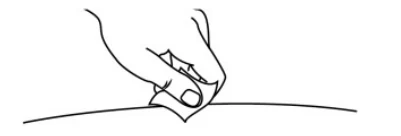
●Check the expiration date on the syringe and the needle. Do not use the syringe or the needle if the expiration date has passed. ●Check the liquid in the syringe. The liquid should be clear and colourless.
Do not use the syringe if the liquid is cloudy, discoloured, or has particles.
Administering the subcutaneous injection 12 Move the safety shield away from the needle
6 Place the syringe on a clean, flat surface.
in the direction towards the syringe barrel.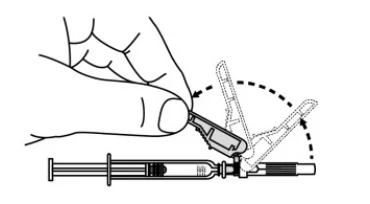
●Set aside the syringe for 30 minutes so it can warm up on its own to room temperature. Leave the needle cap on while it warms up. ●Do not speed up the warming process in any way, and do not put the syringe in a microwave or in warm water.
Remark: If the syringe does not reach room temperature, this could cause the injection to feel uncomfortable and make it hard to push the plunger.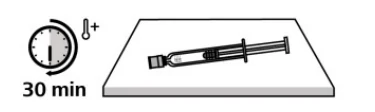
13 Hold the syringe and needle tightly at the hub
and carefully pull the injection needle cap away from the syringe. Use the syringe within 5 minutes of removing the cap; otherwise, the needle may clog.
7 Attach the needle to the syringe.
●Do not hold the plunger while you remove the needle cap.
●Remove the needle from its blister. ●Pull the rubber cap off the end of the syringe (A). ●Dispose of the rubber cap in a puncture-resistant or sharps container immediately. ●Do not touch the tip of the syringe. ●Do not push or pull the plunger.
●Do not touch the needle after removing the needle cap.
●Do not re-cap the needle.
●Do not straighten needle if needle is bent or damaged.
●Hold the syringe by the barrel and push the needle onto the syringe (B).
Throw away the needle cap in a sharps container immediately.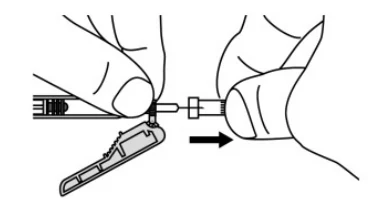
●Gently twist until it is fully attached (C)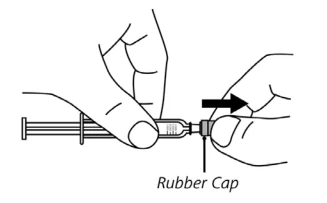
14 Hold the syringe with the needle pointing
up. Remove the larger air bubbles by gently tapping the syringe barrel with your fingers until the air bubbles rise to the top of the syringe. Then, slowly push the plunger up to push the air bubbles out of the syringe.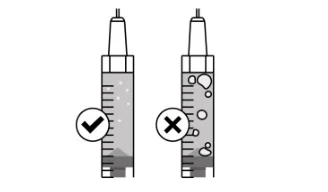
15 Adjust to your prescribed dose by slowly
pushing the plunger.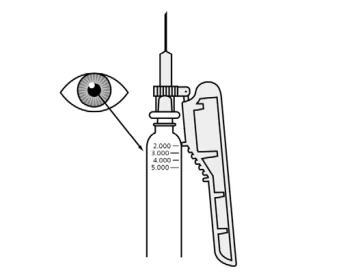
16 Pinch the selected injection site and fully insert
the needle at a 45° to 90° angle with a quick, firm action.
●Do not touch the plunger while inserting the needle into the skin
●Do not insert the needle through clothing. Once the needle is inserted, release the pinch and hold the syringe tightly in place.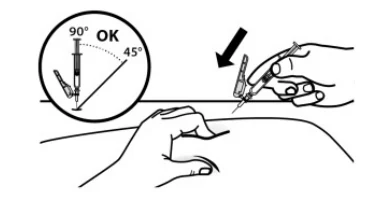
17 Slowly inject your prescribed dose by gently
pushing the plunger all the way down ●Remove the needle and syringe from the injection site at the same angle as inserted.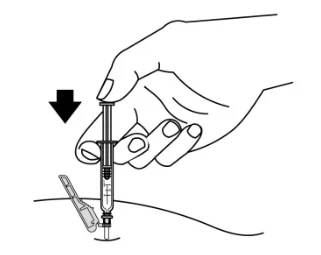
After the injection
18 There may be a little bleeding at the injection
site. You can press a dry sterile pad over the injection site. Do not rub the injection site. ●If needed, you may cover the injection site with a small bandage.
●In case of skin contact with medicine, wash the area that touched the medicine with water.
19 Move the safety shield forward 90°, away from
the syringe barrel (A).
Holding the syringe with one hand, press the safety shield down against a flat surface with a firm, quick motion until you hear a “click” (B). ●If you do not hear a click, look to see that the needle is fully covered by the safety shield. ●Keep your fingers behind the safety shield and away from the needle at all times.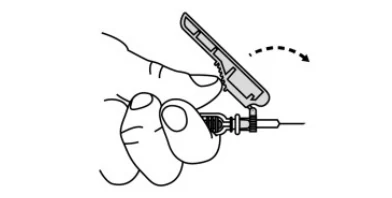
A)
After the injection: follow steps 18 to 20 of subcutaneous injection (above).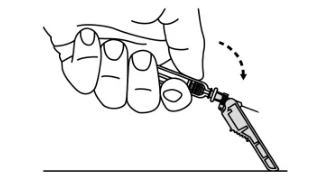
B)
20 Put your used syringe in a sharps disposal container right away after use.
●Do not try to remove the used injection needle from the used syringe.
●Do not recap the injection needle with the cap. ●Do not throw away (dispose of) the syringe in your household trash.
Important: Always keep the sharps disposal container out of the reach of children.
<----------------------------------------------------------------->
Instructions for Use for intravenous injection, intended for healthcare professional only
The following Instructions for Use explain how to give an intravenous injection of NeoRecormon. Be sure that you read, understand and follow the Instructions for Use as well as the package leaflet before injecting NeoRecormon.
Administering the intravenous injection (healthcare professional only)
Preparing for injection: follow steps 1 to 9 of subcutaneous injection (above).
10 Select a vein. Change vein with each injection to prevent soreness in one spot.
●Do not inject into a red or swollen area. ●Do not inject into a muscle.
Clean the skin above the vein with an alcohol swab and let dry.
●Do not fan or blow on the cleaned area. ●Do not touch the injection site again before giving the injection.
11 Prepare the syringe and needle: follow steps
12 to 15 of subcutaneous injection (above).
16 Insert the needle into the vein.
●Do not hold or push on the plunger while inserting needle.
17 Slowly inject the prescribed dose by gently pushing the plunger all the way down. Remove the needle and syringe from the injection site at the same angle as inserted.
After the injection: follow steps 18 to 20 of subcutaneous injection (above).
Administering the intravenous injection via injection port (healthcare professional only)
Preparing for injection: follow steps 1 to 9 of subcutaneous injection (above).
10 Clean the skin above the injection port with an alcohol swab and let dry. Clean the injection port as instructed by the provider. ●Do not fan or blow on the cleaned area. ●Do not touch the injection site again before giving the injection.
11 Prepare the syringe and needle: follow steps
12 to 15 of subcutaneous injection (above).
16 Insert the needle into the injection port (follow the instruction of the injection port provider) ●Do not hold or push on the plunger while inserting needle.
17 Slowly inject the prescribed dose by gently pushing the plunger all the way down. Remove the needle and syringe from the injection port at the same angle as inserted.