

Patient leaflet - Nasolam 5 mg nasal spray, solution in single-dose Container
1. WHAT NASOLAM IS AND WHAT IT IS USED FOR
NASOLAM contains midazolam as active ingredient, which belongs to the group of medicines known as benzodiazepines.
NASOLAM is used for:
- Conscious sedation, an awake but relaxed state of calm or drowsiness during a medical test or procedure
- Premedication to cause relaxation, calm and drowsiness before an anaesthetic
This medicine must only be given by healthcare professionals for conscious sedation or premedication.
- Stopping sudden prolonged, convulsive seizures
This medicine must only be given by parents or caregivers where the patient has been diagnosed with epilepsy.
NASOLAM is for adults and children of 12 kg and more and of 2 years and older.
2. WHAT YOU NEED TO KNOW BEFORE YOU USE NASOLAM
Do not use NASOLAM if the patient has:
- An allergy to midazolam, to any benzodiazepine (such as diazepam) or any of the ingredients of the medicine (listed in 6)
- A disease of the nerves and muscles causing muscles weakness (myasthenia gravis)
- Severe difficulty breathing at rest (NASOLAM can make breathing difficulties worse)
- An illness causing frequent interruption of breathing during sleep (sleep apnoea syndrome)
- Severe liver problems
- Sudden increase in eye pressure (acute angle glaucoma)
- Problems with heart structure present since birth resulting in low levels of oxygen (cyanogen congenital heart disease)
- Serious bacterial infection in the bloodstream or body tissues (severe sepsis)
You must not be using NASOLAM if any of the above applies to you. If you are not sure, talk to your doctor before using this medicine.
Warning and precautions
Talk to your doctor before using NASOLAM if you or your child has:
- A kidney, liver or heart condition
- A lung condition that causes difficulty breathing on a regular basis
This medicine may cause you to forget what happened after they have been given it. You should be observed carefully after being given the medicine.
This medicine should be avoided in patients with a medical history of alcohol or drug abuse.
Serious incidents occur more often in patients with breathing difficulties or heart problems, especially when higher doses of NASOLAM are given.
Children
NASOLAM should not be given to children under 12 kg and younger than 2 years, since there is not enough information in this age group.
Other medicines and NASOLAM
Tell your doctor if you or your child are taking or recently have taken or might take any other medicines, including medicines obtained without a prescription and herbal medicines. This is extremely important, as using more than one medicine at the same time can strengthen or weaken the effect of the medicines involved.
The effects of NASOLAM may be intensified by medicines such as:
- antibiotics, e.g. erythromycin and clarithromycin
- anti-fungals, e.g. ketoconazole, voriconazole, fluconazole, itraconazole
- medicines used to treat blood pressure, e.g. diltiazem, verapamil
- some medicines to treat HIV and AIDS, e.g. saquinavir, lopinair/ritonavir combination
- medicines for hepatitis C (protease inhibitors), e.g. boceprevir, telaprevir
- narcotic analgesics (very strong pain killers), e.g. buprenorfine, codeine, fentanyl, hydromorfon, (nico-)morfine, tapentadol, oxycodone and tramadol
- medicines used to reduce fat in the blood, e.g. atorvastatin
- medicines for cough relief (antitussive)
- medicines used to treat dependence on opiate drugs that contain opioids
- sleep inducing medicines (hypnotics)
- sedative antidepressants (medicines used to treat depression that make you sleepy)
- sedatives (medicine that relax you)
- anaesthetics (for pain relief)
- medicines to treat allergies (antihistamines)
The effect of NASOLAM may be reduced by medicines such as:
- rifampicin (used to treat tuberculosis)
- St. John’s Wort (a herbal medicine). Patients treated with NASOLAM must not use St. John’s Wort
Concomitant use of NASOLAM and opioids (in strong pain killers and in some cough medicines) increases the risk of drowsiness, difficulties in breathing (respiratory depression), coma and may be life-threatening. Because of this, concomitant use should only be considered when other treatment options are not possible. However, if your doctor does prescribe NASOLAM together with opioids the dose and duration of concomitant opioid treatment should be limited by your doctor.
Please tell your doctor about all opioid medicines you are taking, and follow your doctor’s dose recommendation closely. It could be helpful to inform friends or relatives to be aware of the signs and symptoms stated above. Contact your doctor when noticing such symptoms.
Talk to your doctor about medicines you should avoid whilst taking NASOLAM.
NASOLAM with food and drinks and alcohol
You must not drink alcohol while taking NASOLAM. Alcohol may increase the effects of this medicine and make them very sleepy.
Pregnancy and breast-feeding
Pregnancy
If you are pregnant, or breast-feeding, think you may be pregnant, or are planning to have a baby, ask your doctor for advice before taking this medicine.
Given frequent or high doses of midazolam during the last 3 months of pregnancy or during childbirth can cause problems for the baby; these can include abnormal heart rhythms, low body temperature (hypothermia), poor suckling, breathing difficulties and poor muscle tone at birth. The infant may also develop dependence if the mother chronically uses the product. The medicine may however be used if considered necessary. The doctor will decide if this medicine is suitable for you.
Breast-feeding
Even though small amounts of NASOLAM may pass into breast milk, it may not be necessary to stop breast-feeding. The doctor will advise if you should breast-feed after being given this medicine.
Driving and using machines
NASOLAM may take you sleepy, forgetful or affect their concentration and co-ordination. This may affect their performance at tasks such as driving, riding a bicycle or using machines. After administration of this medicine, the patient should not drive a vehicle, ride a bicycle or operate a machine, until she/he has completely recovered. Please discuss with your doctor if you need further advice.
NASOLAM contains propylene glycol
This product contains 7.8 mg (for NASOLAM 2.5 mg nasal spray, solution in single dose container), 11.7 mg (for NASOLAM 3.75 mg nasal spray, solution in single dose container) or 15.6 mg (for NASOLAM 5 mg nasal spray, solution in single dose container) propylene glycol per dosage unit.
3. How to use NASOLAM
Always use this medicine exactly as your doctor has told you. Check with your doctor if you are not sure.
It is recommended that your family members or carers are also instructed in the correct use of NASOLAM.
NASOLAM is for administration in the nose only.
Dosage
The dose of NASOLAM is dependent on the indication and on your age/weight..
Recommended dose for CONSCIOUS SEDATION and PREMEDICATION is (table 1):
| Age/Body weight range | First dose | Second dose At least 10 min after first dose | Maximum dose |
|---|---|---|---|
| 12 kg to less than 43 kg | 1 spray of 2.5 mg | 1 spray of 2.5 mg | 5 mg |
44 kg and more, and less than 60 years | 1 spray of 5 mg | 1 spray of 2.5 mg or 5 mg* | 10 mg |
| 60 years and older | 1 spray of 2.5 mg | 1 spray of 2.5 mg | 5 mg |
* depending on desired level and duration of sedation
- NASOLAM must only be administered by a healthcare professional for conscious sedation and premedication,
- The first dose indicated in Table 1 should be administered into one nostril.
- Close and continuous monitoring of the person after administration for conscious sedation or premedication is mandatory as sensitivity varies from person to person.
- If a second dose is needed, this dose must be administered into the other nostril, at least 10 minutes after the initial dose.
- This medicine starts working circa 4 - 8 minutes after the administration into the nose. This may vary per person depending on the physical status of the patient
- The administration of a second NASOLAM dose may result in prolonged sedation.
- Children 12 kg to 43 kg that require sedation and are chronically ill or persons with difficulties in breathing or with renal-, hepatic- or cardiac impairment should only be administered NASOLAM in an environment that has the equipment needed to monitor the patient and to treat any side effects.
- Persons 44 kg and less than 60 years of age that require sedation and are chronically ill or patients with difficulties in breathing or with renal-, hepatic- or cardiac impairment should start with a dose of 2.5 mg NASOLAM. If required, a second dose of 2.5 mg may be administered into the other nostril of the first dose, at least 10 minutes after the initial dose.
- Persons 60 years of age and older, that require sedation and are chronically ill or patients with difficulties in breathing or with renal-, hepatic- or cardiac impairment should only be administered NASOLAM in an environment that has the equipment needed to monitor the patient and to treat any side effects.
- If after administration of the recommended doses of midazolam (see table 1), the level of sedation is not sufficient, no further intranasal midazolam doses should be administered. Other midazolam options should be considered.
Recommended dose to STOP a SUDDEN, PROLONGED, ACUTE SEIZURE (table 2):
| Age/Body weight range | First dose | Second dose Only upon guidance of 112/emergency number/ medical advice and at least 10 min after first dose | Maximum dose |
|---|---|---|---|
| 12 kg to 18 kg | 1 spray of 2.5 mg | 1 spray of 2.5 mg | 5 mg |
| 19 kg to 39 kg | 1 spay of 3.75 mg | 1 spay of 3.75 mg | 7.5 mg |
40 kg and more or 12 years to less than 60 years | 1 spray of 5 mg | 1 spray of 5 mg | 10 mg |
| 60 years and older | 1 spray of 3.75 mg | 1 spray of 3.75 mg | 7.5 mg |
- NASOLAM must only be administered by parents/care givers to stop a sudden, prolonged, acute seizure, where the persons have been diagnosed with epilepsy
- Always have 2 unused nasal devices available for administration, in case a second dose is required
- The first dose indicated in Table 2 should be administered in one nostril.
- If the patient has trouble breathing or if there is excessive sedation that is uncharacteristic of the patient during a seizure, [call 112/emergency number/seek medical advice] immediately (see after Method of administration).
- Carers should only administer a single dose of midazolam. If the seizure has not stopped within 10 minutes after administration of midazolam, emergency medical assistance must be sought to obtain guidance if a second dose should be given, and the empty single-dose container should be given to the healthcare professional to provide information on the dose received by the patient.
- A second or repeat dose when seizures do not stop or re-occur should not be given without prior medical advice. In particular, young children, patients with respiratory impairment and elderly patients should receive a second dose only in the presence of a health care professional.
- This second dose should NOT be administered if the patient has trouble breathing or if there is excessive sedation that is uncharacteristic of the patient during a seizure - in these cases seek medical advice immediately. (see after Method of administration).
- A second dose must be administered into the other nostril than the first dose.
- After administration of NASOLAM, you should be kept under supervision by a carer who remains with the patient
Instructions how to use NASOLAM
- NASOLAM is for use in the nose only.
- NASOLAM can be administered in any position, including lying or sitting patients
- Each NASOLAM nasal spray is a pre-filled nasal spray in a single dose container, with just one dose and is intended for single use only in a single nostril.
- Do NOT test the product; it can only be used once.
- If another spray is needed, use a new single-dose container and administer this second spray in the other nostril than the previous one.
- Do not give more than the amount of medicine prescribed by a doctor for the patient
Method of administration
- 1. Remove the nasal spray from the blister.
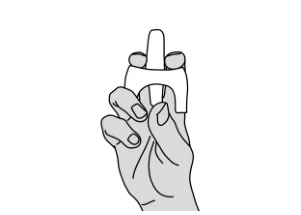
- 2. Hold the nasal spray by placing your thumb on the plunger of the device and your index- and middle finger on both sides of the nozzle.
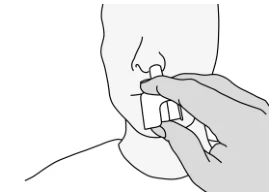
- 3. Insert the nozzle into one nostril until your fingers on the finger-grip touch the nose.
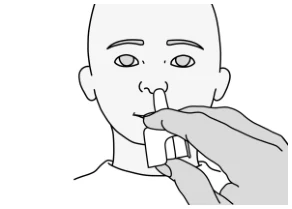
In small children, it may be possible that the nozzle cannot be inserted into the nostril. In that case, place the end of the nozzle on the nostril (it will always enter the nostril to some extent due to the spherical shaped top) and make sure that the nozzle seals the nostril before administration.
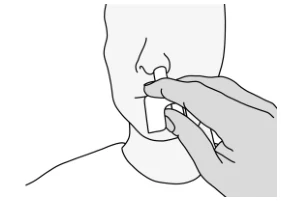
- 4. Press the plunger firmly with your thumb.
- 5.
Remove the nozzle from the nose.
The nasal spray is now empty.
- 6.
In case of seizure treatment, if possible, roll the patient on their side - you may need to wait until the seizure movements have ceased. See instructions A – E below.
Once rolled over, the patient’s mouth should be wide open pointing towards the ground and their head tilted back.
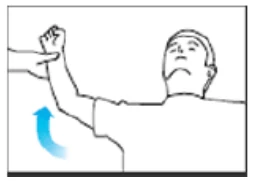
How to roll patient on their side
A. Place nearest arm at right angle to body, with arm bent
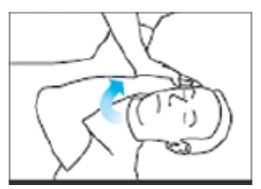
B. Bring other arm across chest. Place back of patient’s hand against cheek
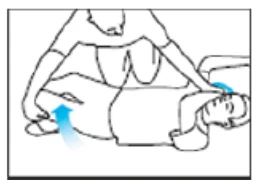
C. Grasp far leg just above knee. Roll patient towards you, onto their side. Support head, keeping back of hand against cheek
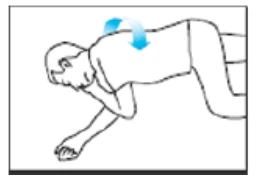
D. Open the mouth (if possible) and point towards the ground, tilt the head slightly back.
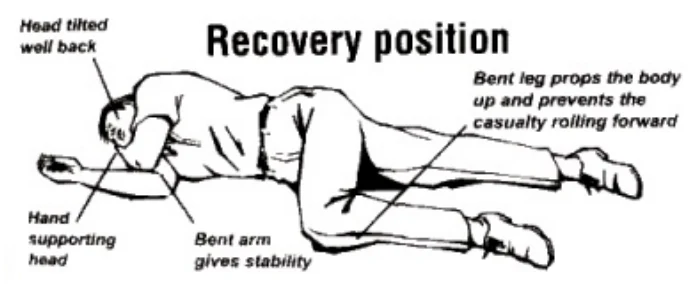
E. Final position; hand supports head
- 7. If another spray is needed, use a new single-dose container and follow the instructions again from step 1 to 5, but administer the second spray in the other nostril than the one that was used for administering the first NASOLAM nasal spray. The second NASOLAM nasal spray may only be administered to stop a sudden acute prolonged seizure, if the first spray has been administered at least 10 minutes ago and the seizure did not stop or re-occurred AND you have obtained medical advice [e.g. by calling 112/emergency number/prescribing physician] to do so. Young children, elderly and patients with respiratory impairment should only get a second dose in the presence of a health care professional.
- •
ALWAYS call an ambulance /emergency number 112 or seek medical advice immediately, when:
- The seizure does not stop within 10 minutes after the recommended dose (see table 2) of NASOLAM; show the empty devices to the healthcare professionals who can assess how much NASOLAM was administered
- The patient has not received the full dose because you were unable to empty the nasal device or you have spilled some of the content
- The patient’s breathing slows down or stops, e.g. slow or shallow breathing or blue lips
- The patient shows excessive sleepiness (more than characteristic during a seizure)
- The patient is sick (vomits) and the seizure does not stop within 10 minutes.
- You observe signs of a heart attack, which may include chest pain or pain that spreads to the neck and shoulders and down the left arm or when there is no pulse
You gave too much NASOLAM and there are signs of overdose, which may include:
- Drowsiness, tiredness, fatigue
- Confusion or feeling disorientated
- Absence of knee reflex or a response to a pinch
- Breathing difficulties (slow or shallow)
- Low blood pressure (giddiness or feeling faints)
- Coma
Children
NASOLAM should not be used in children under 12 kg and younger than the age of 2 years.
If the patient has taken more NASOLAM than it should
See section above ‘ALWAYS call an ambulance/the emergency number 112 or seek medical advice immediately’.
If you have any further questions on the use of this medicine, ask your doctor.
4. POSSIBLE SIDE EFFECTS
Like all medicines, this medicine can cause side effects, although not everybody will get them.
Serious side effects
Seek medical advice immediately or call an ambulance/the emergency number 112, if the patient experiences the following:
- Severe breathing difficulties (respiratory arrest; its frequency is very rare) e.g. slow down or shallow breathing, or blue lips. In very rare cases breathing might stop
- Heart attack (cardiac arrest; its frequency is very rare). Signs may include chest pain, which may spread to the patient’s neck and shoulders and down their left arm
- Swelling of the face, lips, tongue or throat which makes it difficult to swallow or breathe, or a pale skin, a weak and rapid pulse, or feeling of loss of consciousness. You may be having a serious allergic reaction.
Other side effects
Common side effects (may affect up to 1 in 10 people):
- Sleepiness or sleep attacks,
- Depressed levels of, or losing consciousness, decreased alertness
- Feeling and being sick
- Respiratory depression
- Nasal congestion or dryness
- Itching nose, runny nose
- Sneezing, cough, yawning
Uncommon side effects (may affect up to 1 in 100 people)
- Rash, hives (lumpy rash), itchiness
Very rare side effects (may affect up to 1 in 10,000 people):
- Agitation, restlessness, hostility, rage or aggression, confusion or hallucinations
- Constipation
- Dizziness
- Dry mouth
- Euphoric mood
- Fits (convulsions)
- Headache
- Low blood pressure, slow heart rate or redness of face and neck
- Muscle spasms and muscle tremors, difficulty coordinating muscles
- Temporary memory loss
- Hiccups
- Fatigue
Unknown (frequency cannot be estimated from the available data):
- Double or blurred vision, excessive blinking
- Falling and breaking bones. Patients taking benzodiazepine medicines are at risk of falling and breaking bones. This risk is increased in the elderly and those taking other sedatives (including alcohol).
- Feeling disoriented
- Changes in emotions or mood
- Decreased sexual interest
- Drug dependence
- Excitation
- Withdrawal syndrome
- Abuse
Reporting of side effects
If you or your child gets any side effects, talk to your doctor. This includes any possible side effects not listed in this leaflet. You can also report side effects directly via the Yellow Card Scheme Website: www.mhra.gov.uk/yellowcard or search for MHRA Yellow Card in the Google Play of Apple App Store. By reporting side effects you can help provide more information on the safety of this medicine.
5. HOW TO STORE NASOLAM
This medical product does not require any special storage conditions.
Keep this medicine out of the sight and reach of children.
Do not use this medicine after the expiry date (EXP) printed on the outer and inner pack. The expiry date refers to the last day of that month.
Do not throw away any medicines via wastewater or household waste. Ask your pharmacist how to throw away medicines you no longer use. These measures will help to protect the environment.
6. CONTENTS OF THE PACK AND OTHER INFORMATION
What NASOLAM contains
The active substance is midazolam (as midazolam hydrochloride). The other ingredients are ethanol, propylene glycol and water.
NASOLAM 2.5 mg: 1 dose (50 microliters) contains midazolam hydrochloride, equivalent to 2.5 mg midazolam.
NASOLAM 3.75 mg: 1 dose (75 microliters) contains midazolam hydrochloride equivalent to 3.75 mg midazolam.
NASOLAM 5 mg: 1 dose (100 microliters) contains midazolam hydrochloride equivalent to 5 mg midazolam.
What does NASOLAM look like and contents of the pack
NASOLAM is a pre-filled nasal spray in a single-dose container, which holds a clear solution, packed in a glass vial, placed in a white plastic sprayer. NASOLAM is per single-dose container packed in a blister. One carton contains 4 blisters.
Marketing Authorisation Holder and Manufacturer
Marketing Authorisation Holder:
Medir Europe BV
Dorpsstraat 5
3941 JJ Doorn
The Netherlands
Manufacturer:
TIOFARMA BV
Hermanus Boerhaavestraat 1
3261 ME Oud-Beijerland
The Netherlands
This medicine is authorised in the Member States of the European Economic Area and the United Kingdom under the following names:
The Netherlands:
NASOLAM 2,5 mg neusspray, oplossing in verpakking voor eenmalig gebruik
NASOLAM 3,75 mg neusspray, oplossing in verpakking voor eenmalig gebruik
NASOLAM 5 mg neusspray, oplossing in verpakking voor eenmalig gebruik
Germany:
NASOLAM 2,5 mg Nasenspray, Lösung im Einzeldosisbehältnis
NASOLAM 3,75 mg Nasenspray, Lösung im Einzeldosisbehältnis
NASOLAM 5 mg Nasenspray, Lösung im Einzeldosisbehältnis
Denmark:
Midazolam FrostPharma 2,5 mg næsespray, opløsning i enkeltdosisbeholder
Midazolam FrostPharma 3,75 mg næsespray, opløsning i enkeltdosisbeholder
Midazolam FrostPharma 5 mg næsespray, opløsning i enkeltdosisbeholder
Finland:
Midazolam FrostPharma 2.5 mg nenäsumute, liuos, kerta-annospakkaus
Midazolam FrostPharma 3.75 mg nenäsumute, liuos, kerta-annospakkaus
Midazolam FrostPharma 5 mg nenäsumute, liuos, kerta-annospakkaus
Ireland:
Medirax 2.5 mg nasal spray, solution in single-dose container
Medirax 3.75 mg nasal spray, solution in single-dose container
Medirax 5 mg nasal spray, solution in single-dose container
The United Kingdom:
Medirax 2,5 mg nesespray, oppløsning i endosebeholder
Medirax 3,75 mg nesespray, oppløsning i endosebeholder
Medirax 5 mg nesespray, oppløsning i endosebeholder
Sweden:
Midazolam FrostPharma 2,5 mg nässpray, lösning i endosbehållare
Midazolam FrostPharma 3,75 mg nässpray, lösning i endosbehållare
Midazolam FrostPharma 3,75 mg nässpray, lösning i endosbehållare
Norway:
Midazolam FrostPharma 2,5 mg nesespray, oppløsning i endosebeholder
Midazolam FrostPharma 3,75 mg nesespray, oppløsning i endosebeholder
Midazolam FrostPharma 5 mg nesespray, oppløsning i endosebeholder
This leaflet was last revised in January 2026