

Summary of Product Characteristics (SmPC) - Nanotop 0.5 mg kit for Radiopharmaceutical Preparation
1 NAME OF THE MEDICINAL PRODUCT
Nanotop 0.5 mg Kit for radiopharmaceutical preparation
2. QUALITATIVE AND QUANTITATIVE COMPOSITION
Each vial contains 0.5 mg nanocolloidal human albumin.
At least 95 % of human albumin colloidal particles have a diameter ≤ 80 nm.
Nanotop is prepared from human serum albumin derived from human blood donations tested according to the EC Regulations.
The radionuclide is not part of the kit.
Excipient(s) with known effect:
Sodium: 0.009 mmol (0.2 mg) per vial.
For the full list of excipients, see section 6.1.
3 PHARMACEUTICAL FORM
Kit for radiopharmaceutical preparation
White or almost white lyophylisate
Powder for suspension for injection
For radiolabelling with Sodium (99mTc)pertechnetate solution
4.1 Therapeutic indications
This medicinal product is for diagnostic use only. Nanotop is indicated for adults and for the paediatric population. After radiolabelling with Sodium pertechnetate (99mTc) solution, the suspension of nanocolloidal technetium (99mTc) albumin obtained is indicated for:
- Lymphoscintigraphy to demonstrate the integrity of the lymphatic system and to differentiate venous from lymphatic obstruction.
- Preoperative imaging and intraoperative detection of sentinel lymph nodes in melanoma, breast carcinoma, penile carcinoma, squamous cell carcinoma of the oral cavity and vulvar carcinoma.
4.2 Posology and method of administration
The medicinal product should only be administered by trained healthcare professionals with technical expertise in performing and interpreting sentinel lymph node mapping procedures.
Posology
Adults and elderly population
Recommended activities are as follows:
- Lymphatic scanning: The recommended activity by single or multiple injections by subcutaneous (interstitial) is from 20 - 110 MBq per injection site.
Sentinel node detection:
The dose depends on the time interval between injection and the image acquisition or the surgery.
- Melanoma: 10 - 120 MBq in several doses by intradermal peritumoural injection.
- Breast carcinoma: 5 - 200 MBq in several doses each from 5 - 20 MBq to be administered by intradermal or subdermal or periareolar injection (superficial tumours) and by intratumoural or peritumoral injection (deep tumours).
- Penile carcinoma: 40 - 130 MBq in several doses each of 20 MBq to be administered intradermally around the tumour.
- Squamous cell carcinoma of the oral cavity: 15 - 120 MBq to be administered by single or multiple peritumoural injections
- Vulvar carcinoma: 60 - 120 MBq to be administered by peritumoural injection.
Renal impairment/Hepatic impairment
Careful consideration of the activity to be administered is required since an increased radiation exposure is possible in these patients.
Pediatric population
The activities to be administered to children and adolescents is recommended to be calculated according the recommended range of adult activity adjusted to the body weight. The Paediatric Task Group of the European Association of Nuclear Medicine (EANM 1990) recommends calculating the administered activity from the body weight according to the following table .
| Body weight (kg) | Part of adult dose | Body weight (kg) | Part of adult dose |
| 3 | 0.1 | 32 | 0.65 |
| 4 | 0.14 | 34 | 0.68 |
| 6 | 0.19 | 36 | 0.71 |
| 8 | 0.23 | 38 | 0.73 |
| 10 | 0.27 | 40 | 0.76 |
| 12 | 0.32 | 42 | 0.78 |
| 14 | 0.36 | 44 | 0.80 |
| 16 | 0.40 | 46 | 0.82 |
| 18 | 0.44 | 48 | 0.85 |
| 20 | 0.46 | 50 | 0.88 |
| 22 | 0.50 | 52 - 54 | 0.90 |
| 24 | 0.53 | 56 - 58 | 0.92 |
| 26 | 0.56 | 60 - 62 | 0.96 |
| 28 | 0.58 | 64 - 66 | 0.98 |
| 30 | 0.62 | 68 | 0.99 |
For use in children, it is possible to dilute the product before administration, see section 12.
Method of Administration
For multidose use.
- Lymphoscintigraphy: The product is given by single or multiple subcutaneous injections, depending on the anatomical areas to be investigated and upon the time interval between injection and imaging. The injected volume should not exceed 0.2 - 0.3 ml. A volume more than 0.5 ml per injection site must not be applied. The subcutaneous injection should be given after checking by aspiration that a blood vessel has not been inadvertently punctured.
Detection of sentinel lymph nodes:
- Melanoma: the activity is administered in four doses surrounding the tumor/scar, by injecting volumes of 0.1 - 0.2 ml.
- Breast carcinoma: a single injection in small volume (0.2 ml) is recommended. Multiple injections may be used in particular circumstances/conditions. When using superficial injections, large volumes of injectate may interfere with normal lymphatic flow; therefore, volumes of 0.05 - 0.5 ml are recommended. With peritumoral injections, larger volumes (e.g. 0.5 - 1.0 ml) may be used.
- Penile carcinoma: the dose should be administered thirty minutes after local spray anaesthesia by intradermal injection into three or four depots of 0.1 ml around the tumour (in total 0.3 - 0.4 ml). For large tumours not restricted to the glans, the product can be administered in the prepuce.
Squamous cell carcinoma of the oral cavity: the activity is administered in two to four doses surrounding the tumor/scar in a total volume of 0.1
- 1.0 ml.
- Vulvar carcinoma: the activity is administered in four peritumoural doses in a total volume of 0.2 ml.
Precautions to be taken before handling or administration of the medicinal product This medicinal product should be reconstituted before administration to the patient. For instructions on extemporaneous preparation of the medicinal product before administration, see section 12.
For patient preparation, see section 4.4.
Nanotop is not intended for regular or continuous administration.
Shake the radiolabelled injection suspension (nanocolloidal technetium (99mTc) albumin) immediately before withdrawal of the patient dose from the vial. Swivel the syringe several times before the injection.
Image acquisition
- Lymphatic scanning: The injection is given subcutaneously, after checking by aspiration, that a blood vessel has not been inadvertently punctured. When imaging the lower limbs, dynamic pictures are taken immediately following injection and static imaging 30 - 60 minutes later. In parasternal lymph scanning, repeated injections and additional images may be required.
Sentinel node detection:
- Melanoma: Lymposcintigraphic images are acquired starting after injection and regularly thereafter until the sentinel lymph node is visualized.
- Breast carcinoma: Scintigraphic images of breast and axillary region can be acquired by early detections (15 - 30 min) and late detections (3 hours) after injection.Penile carcinoma: dynamic imaging can be performed immediately after injection and followed by static imaging at 30 minutes, 90 minutes, and 2 hours post-injection by using dual-head gamma camera.
Squamous cell carcinoma of the oral cavity: dynamic acquisition for 20 -
30 minutes starting immediately after injection. Two or three simultaneous static images from one or both sides in the anterior and lateral projections are recommended. Static images can be repeated at 2 hours, 4 - 6 hours, or just before surgery. SPECT imaging may improve the identification of sentinel lymph nodes, especially close to the injection site. Repeat injection and imaging may be considered; however, proceeding to neck dissection is preferred in order to avoid a false-negative sentinel lymph node.
Vulvar carcinoma: image acquisition is to be obtained starting after the injection and every 30 min thereafter until the sentinel node(s) is visualized. The injection and images can be carried out the day before surgery or on the day of surgery. Planar images acquisition for 3 - 5 minutes in anterior and lateral views, and subsequent SPECT/CT images, are recommended.
4.3 Contraindications
Hypersensitivity to the active substance(s) or to any of the excipients listed in section 6.1 or to any of the components of the labelled radiopharmaceutical.
In particular, the use of nanocolloidal technetium (99mTc) albumin is contraindicated in persons with a history of hypersensitivity to products containing human albumin.
In patients with complete lymph obstruction lymph node scintigraphy is not advisable because of the danger of radiation necroses at the site of injection.
During pregnancy, lymphoscintigraphy involving the pelvis is strictly contraindicated due to the accumulation in pelvic lymph nodes.
4.4 Special warnings and precautions for use
Potential for hypersensitivity or anaphylactic reactions
The possibility of hypersensitivity including serious, life-threatening, fatal anaphylactic/ anaphylactoid reactions should always be considered. If hypersensitivity or anaphylactic reactions occur, the administration of the medicinal product must be discontinued immediately and intravenous treatment initiated, if necessary. To enable immediate action in emergencies, the necessary medicinal products and equipment such as endotracheal tube and ventilator must be immediately available.
Individual benefit/risk justification
For each patient, the radiation exposure must be justifiable by the likely benefit. The activity administered should in every case be as low as reasonably achievable to obtain the required diagnostic information.
Renal impairment/Hepatic impairment
Careful consideration of the benefit risk ratio in these patients is required since an increased radiation exposure is possible in these patients (see section 4.2).
Paediatric population
For information on the use in paediatric population, see section 4.2.
Careful consideration of the benefits and risks is required since the effective dose per MBq is higher than in adults (see section 11).
Patient preparation
The patient should be well hydrated before the start of the examination and urged to void as often as possible during the first hours after the examination in order to reduce radiation.
After the procedure
Close contact with infants and pregnant women should be restricted during the initial 24 hours following the injection.
Specific warnings
It is strongly recommended that every time that Nanotop 0.5 mg is administered to a patient, the name and batch number of the product are recorded in order to maintain a link between the patient and the batch of the product.
Standard measures to prevent infections resulting from the use of medicinal products prepared from human blood or plasma include selection of donors, screening of individual donations and plasma pools for specific markers of infection, and the inclusion of effective manufacturing steps for the inactivation/removal of viruses. Despite this, when medicinal products prepared from human blood or plasma are administered, the possibility of transmitting infective agents cannot be totally excluded.
This also applies to unknown or emerging viruses and other pathogens.
There are no reports of virus transmissions with albumin manufactured to European Pharmacopoeia specifications by established processes.
Lymphoscintigraphy is not advised in patients with total lymphatic obstruction because of the potential radiation hazard at injection sites. The subcutaneous injection must be made without pressure into loose connective tissue.
This medicinal product contains less than 1 mmol sodium (23 mg) per vial, i.e. essentially ‘sodium-free’.
For precautions with respect to environmental hazard, see section 6.6.
4.5 Interaction with other medicinal products and other forms of interactions
No interactions studies have been performed in adults or children.
Iodinated contrast media used in lymphoangiography may interfere with lymphatic scanning using nanocolloidal technetium (99mTc) albumin.
4.6 Fertility, pregnancy and lactation
Women of childbearing potential
When an administration of radiopharmaceuticals to a woman of childbearing potential is intended, it is important to determine whether or not she is pregnant. Any woman who has missed a period should be assumed to be pregnant until proven otherwise. If in doubt about her potential pregnancy (if the woman has missed a period, if the period is very irregular, etc.), alternative techniques not using ionising radiation (if there are any) should be offered to the patient.
Pregnancy
Radionuclide procedures carried out on pregnant women also involve radiation dose to the foetus. Only essential investigations should therefore be carried out during pregnancy, when the likely benefit far exceeds the risk incurred by the mother and foetus.
During pregnancy, lymphoscintigraphy involving the pelvis is strictly contraindicated, due to the accumulation in pelvic lymph nodes (see section 4.3).
Breast-feeding
Before administering radiopharmaceuticals to a mother who is breast-feeding consideration should be given to the possibility of delaying the administration of radionuclide until the mother has ceased breast-feeding, and to what is the most appropriate choice of radiopharmaceuticals, bearing in mind the secretion of activity in breast milk.
If the administration is considered necessary, breast-feeding should be interrupted for 24 hours and the expressed feeds discarded.
Close contact with infants should be restricted during the initial 24 hours following injection.
Fertility
No studies on fertility have been performed.
4.7 Effects on ability to drive and use machines
Nanotop has no or negligible influence on the ability to drive and use machines.
4.8 Undesirable effects
The following table presents how the frequencies are reflected in this section:
Very common (≥ 1/10)
Common (≥ 1/100 to < 1/10)
Uncommon (≥ 1/1,000 to < 1/100)
Rare (≥ 1/10,000 to < 1/1,000)
Very rare (< 1/10,000)
not known (cannot be estimated form the available data)
Immune system disorders
Frequently not known: Protein allergic (hypersensitive) reaction, and hypersensitivity reactions (including very rare life-threatening anaphylaxis).
Very rare: local reactions, rash, itching, vertigo, hypotension
Other disorders
Exposure to ionisation radiation is linked with cancer induction and a potential for development of hereditary defects. As the effective dose is 0.4 mSv when the maximum recommended activity of 200 MBq is administered for sentinel node detection in breast carcinoma these adverse reactions are expected to occur with a low probability.
Reporting of suspected adverse reactions
Reporting suspected adverse reactions after authorisation of the medicinal product is important. It allows continued monitoring of the benefit/risk balance of the medicinal product. Healthcare professionals are asked to report any suspected adverse reactions via Yellow Card Scheme, website: www.mhra.gov.uk/yellowcard or search for MHRA Yellow Card in the Google Play or Apple App Store.
For safety with respect to transmissible agents see section 4.4.
4.9 Overdose
In the event of administration of a radiation overdose with nanocolloidal technetium (99mTc) albumin no practical measure can be recommended to satisfactorily diminish tissue exposure as the 99mTc nano-sized albumin colloid is poorly eliminated in urine and faeces.
5 PHARMACOLOGICAL PROPERTIES
5.1 Pharmacodynamic properties
Pharmacotherapeutic group: Technetium (99mTc) nanocolloid, ATC code: V09DB01
Pharmacodynamic effects
At the chemical concentrations used for diagnostic examinations, nanocolloidal technetium (99mTc) albumin does not appear to have any pharmacodynamic activity.
5.2 Pharmacokinetic properties
Distribution
After subcutaneous injection into connective tissue, 30 - 40 % of the administered nanocolloidal technetium (99mTc) albumin particles are filtered into lymphatic capillaries. The technetium (99mTc) albumin nanosized colloidal particles are then transported along the lymphatic vessels to regional lymph nodes and main lymphatic vessels, and are finally trapped into the reticular cells of functionary lymph nodes.
Elimination
A fraction of the injected dose is phagocytised by histiocytes at the injection site. Another fraction appears in the blood and accumulates mainly in the reticuloendothelial system (RES) of the liver, spleen and bone marrow; faint traces are eliminated via the kidneys.
5.3 Preclinical safety data
Toxicological studies with mice and rats have demonstrated that with a single intravenous injection of 800 mg and 950 mg, respectively, no deaths and no gross pathological changes at necropsy were observed. No local reactions were observed in either mice or rats following subcutaneously injection of 1 g nanocolloidal albumin particles /kg body weight with 0.9 % saline injection.
These doses correspond to the contents of 50 vials per kg body weight, which is the 3,500-fold compared to the maximum human dose.
This medicinal product is not intended for regular or continuous administration.
Mutagenicity studies and long-term carcinogenicity studies have not been carried out.
Studies of toxicity to reproduction are not available.
6 PHARMACEUTICAL PARTICULARS
6.1 List of excipients
Stannous chloride, dihydrate
Glucose
Poloxamer 238
Disodium phosphate dihydrate, E339
Sodium phytate
6.2 Incompatibilities
This medicinal product must not be mixed with other medicinal products except those mentioned in section 12.
6.3 Shelf life
24 months
After radiolabelling: 12 hours. Do not store above 25°C after radiolabelling.
Chemical and physical in-use stability has been demonstrated for 12 hours at 25 °C. From a microbiological point of view, unless the method of opening/radiolabeling/dilution, precludes the risk of microbiological contamination, the product should be used immediately.
If not used immediately, in use storage times and conditions are the responsibility of the user.
6.4 Special precautions for storage
Do not store above 25 °C.
Keep the vials in the outer carton in order to protect from light.
For storage conditions after radiolabelling of the medicinal product, see section 6.3.
Storage of radiopharmaceuticals should be in accordance with national regulation on radioactive materials.
6.5 Nature and contents of container
10 ml nominal capacity, multi-dose borosilicate glass vials (Type I Ph. Eur.) sealed with a synthetic rubber stopper and an aluminium crimp cap.
Pack size: 5 vials
6.6 Special precautions for disposal and other handling
General warnings
Radiopharmaceuticals should be received, used and administered only by authorised persons in designated clinical settings. Their receipt, storage, use, transfer and disposal are subject to the regulations and/or appropriate licences of the competent official organisation.
Radiopharmaceuticals should be prepared in a manner which satisfies both radiation safety and pharmaceuticals quality requirements. Appropriate aseptic precautions should be taken.
Contents of the vial are intended only for use in the preparation of nanocolloidal technetium (99mTc) albumin and are not to be administered directly to the patient without first undergoing the preparative procedure.
For instructions on extemporaneous preparation of the medicinal product before administration, see section 12.
If at any time in the preparation of this product the integrity of this vial is compromised it should not be used.
Administration procedures should be carried out in a way to minimise risk of contamination of the medicinal product and irradiation of the operators. Adequate shielding is mandatory.
The content of the kit before extemporaneous preparation is not radioactive. However, after sodium pertechnetate (99mTc), Ph. Eur. is added, adequate shielding of the final preparation must be maintained.
The administration of radiopharmaceuticals creates risks for other persons from external radiation or contamination from spill of urine, vomiting or any other biological fluids. Radiation protection precautions in accordance with national regulations must therefore be taken.
Any unused medicinal product or waste material should be disposed in accordance with local requirements.
7 MARKETING AUTHORISATION HOLDER
ROTOP Pharmaka GmbH
Bautzner Landstrasse 400
01328 Dresden
Germany
8 MARKETING AUTHORISATION NUMBER(S)
PL 45925/0002
9 DATE OF FIRST AUTHORISATION/RENEWAL OF THE
AUTHORISATION
28/02/2014 / 29/06/2022
10 DATE OF REVISION OF THE TEXT
19/08/2022
11. DOSIMETRY
Technetium (99mTc) is produced by means of a (99Mo/99mTc) generator and decays with the emission of gamma radiation with a mean energy of 141 keV and a half-life of 6.02 hours to technetium (99Tc) which, in view of its long half-life of 2.13 x 10⁵ years can be regarded as quasi stable.
Radiation exposure
Lymphoscintigraphy
The radiation dose estimation is based on the MIRD method.
The radiation doses absorbed by a patient weighing 70 kg, after subcutaneous injection of 99mTc-human albumin colloidal particles, are reported hereafter. The data listed below is based on MIRD reference man and MIRD S values, and has been calculated from biological data of organ uptake and blood clearance.
| Organ | Absorbed dose (μGy/MBq) |
| Injection site | 12000 |
| Lymph nodes | 590 |
| Liver | 16 |
| Urinary bladder (wall) | 9.7 |
| Spleen | 4.1 |
| Bone marrow (red) | 5.7 |
| Ovaries | 5.9 |
| Testes | 3.5 |
| Whole body | 4.6 |
The effective dose resulting from the subcutaneous administration of a maximal recommended activity of 110 MBq for an adult weighing 70 kg is about 0.44 mSv.
For an administered activity of 110 MBq the typical radiation dose to the target organ (lymph nodes) is 65 mGy and the typical radiation dose to the critical organ (injection site) is 1320 mGy.
Sentinel node detection
In the case of subcutaneous administration for sentinel node detection it is assumed that the dose to the injection site, which varies greatly with location, injected volume, number of injections and retention, can be ignored due to the relatively low radiosensitivity of skin and the small contribution this makes to the overall effective dose.
In the case of sentinel node detection of breast carcinoma the data listed below (ICRP 106) assumes no leakage occurs and the absorbed dose to the remaining breast is equal to the dose to the lungs.
| Absorbed dose per unit activity administered | ||||
| (mGy/MBq) | ||||
| 6 hours to removal | 18 hours to removal | |||
| Organs | ||||
| Adult | 15 years | Adult | 15 years | |
| Adrenals | 0.00079 | 0.00093 | 0.0014 | 0.0016 |
| Bladder wall | 0.000021 | 0.000039 | 0.000036 | 0.000068 |
| Bone surfaces | 0.0012 | 0.0015 | 0.0021 | 0.0026 |
| Brain | 0.000049 | 0.000058 | 0.000087 | 0.00010 |
| Breast | 0.0036 | 0.0039 | 0.0064 | 0.0069 |
| Gall bladder wall | 0.00053 | 0.00072 | 0.00093 | 0.0013 |
| Gastrointestinal tract. | ||||
| Stomach | 0.00092 | 0.0013 | 0.0016 | 0.0023 |
| SI | 0.00011 | 0.00015 | 0.0002 | 0.00027 |
| Colon | 0.000083 | 0.00019 | 0.00014 | 0.00033 |
| Intestinal wall upper colon | 0.00012 | 0.00028 | 0.00020 | 0.00049 |
| Intestinal wall, lower colon | 0.000038 | 0.00007 | 0.000066 | 0.00012 |
| Heart | 0.0041 | 0.0052 | 0.0071 | 0.0091 |
| Kidneys | 0.00031 | 0.00042 | 0.00054 | 0.00073 |
| Liver | 0.0011 | 0.0014 | 0.0019 | 0.0024 |
| Lung | 0.0036 | 0.0039 | 0.0064 | 0.0069 |
| Muscles | 0.00066 | 0.00083 | 0.0012 | 0.0015 |
| Oesophagus | 0.0036 | 0.0050 | 0.0062 | 0.0087 |
| Ovaries | 0.000041 | 0.000048 | 0.000071 | 0.000083 |
| Pancreas | 0.00097 | 0.0011 | 0.0017 | 0.0020 |
| Red bone marrow | 0.00086 | 0.00092 | 0.0015 | 0.0016 |
| Skin | 0.0012 | 0.0014 | 0.0021 | 0.0024 |
| Spleen | 0.00068 | 0.00083 | 0.0012 | 0.0015 |
| Thymus | 0.0036 | 0.0050 | 0.0062 | 0.0087 |
| Thyroid | 0.00047 | 0.00062 | 0.00082 | 0.0011 |
| Uterus | 0.000041 | 0.000064 | 0.000071 | 0.00011 |
| Remaining organs | 0.00066 | 0.00083 | 0.0012 | 0.0015 |
| Effective Dose per unit activity | 0.0012 | 0.0020 | 0.0024 | |
| administered (mSv/MBq) | 0.0014 |
The effective dose resulting from the subcutaneous administration of a maximal recommended activity of 200 MBq with the removal of the injection site 18 hours post-injection for an adult weighing 70 kg is about 0.4 mSv.
12. INSTRUCTIONS FOR PREPARATION OF
RADIOPHARMACEUTICALS
Withdrawals should be performed under aseptic conditions. The vials must not be opened before disinfecting the stopper. The solution should be withdrawn via the stopper using a single dose syringe fitted with suitable protective shielding and a disposable sterile needle or using an authorised automated application system.
If the integrity of this vial is compromised, the product should not be used.
Method of preparation
Nanotop does not contain preservatives.
Aseptic preparation and the attention of the radiation protection are necessary.
The formation of the nanocolloidal technetium (99mTc) albumin depends on a sufficient content of tin in the reduced state. Oxidation can affect the quality of the preparation. Air inlet has to be avoided strictly.
The specific activity of the applied nanocolloidal technetium (99mTc) albumin should be as high as possible, since only approx. 1 - 2 % of the activity is enriched in lymph nodes after subcutaneous administration. Therefore, it is recommended to use fresh eluate of a generator eluted shortly before the radiolabelling. Labelling should be accomplished with the highest possible activity shortly before administration.
For use in children, it is possible to dilute the product up to 1:50 with 0.9 % sodium chloride injection.
Radiolabelling / preparation of an injection suspension
- 1. Place the vial in a suitable lead shield.
- 2.
Add 185 - 5,550 MBq in 1 - 5 ml of sodium pertechnetate (99mTc) solution into the vial using a sterile syringe.
Then withdraw the same volume of nitrogen from the vial using the same syringe for pressure compensation. Do not use a venting needle.
- 3. Dissolve the dry substance by repeated swiveling; allow standing for 10 min at room temperature.
- 4. Gently shake the injection suspension immediately before withdrawing a dose from the vial. Shake the syringe several times before injection.
Characteristics of the ready to use suspension
Volume 1 - 5 ml
Colour clear, colourless
Particles more than 95 % smaller than 80 nm Radiolabelled colloid ≥ 95 %
pH-value 7 - 8
Test for labelling yield
The radiochemical purity of the ready to use injection suspension can be controlled by thin layer chromatography.
Method A:
TLC plate Silica gel 60
Solvent Acetone
Running distance 10 - 15 cm
Development time 15 - 20 minutes
Detector a suitable detector
Nanocolloidal technetium (99mTc) albumin remains at the start, free [99mTc]pertechnetate can be found near the solvent front.
The ready to use injection suspension should not contain more than 5 % free [99mTc]pertechnetate and must be used within 12 hours.
(Alternative) Method B:
TLC plate ITLC-SA 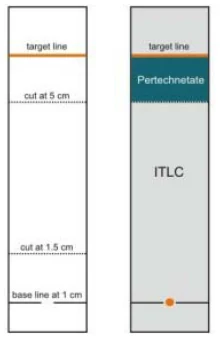
Solvent Methyl ethyl ketone
(MEK)
Running distance 5 cm
Development time 5 - 10 minutes
Detector a suitable detector
Nanocolloidal technetium (99mTc) albumin remains at the start, free [99mTc]pertechnetate can be found near the solvent front.
The ready to use injection suspension should not contain more than 5 % free [99mTc]pertechnetate and must be used within 12 hours.
Detection by radio activity counters without spatial resolution: After development remove the strip from the chromatographic chamber, dry in air and cut it at the prescribed position. Measure radioactivity of
both parts separately. Relate activity of upper part to total activity.
Detection by radio-scanner:
After development remove the strip from the chromatographic chamber, dry in air and measure the activity distribution and display them in a chromatogram. Calculate the percentages of the single peaks.

Impurity [%] = × 100% 