


Patient leaflet - Multibic 2 mmol/l Potassium solution for Haemofiltration
1. What multiBic 2 mmol/l potassium is and what it is used for
multiBic 2 mmol/l potassium is a continuous renal replacement therapy solution for removal of waste products from the body in people with kidney disease. It is used in patients with kidney injury and also for the treatment of poisoning. The type of solution you are given depends on the amount of potassium (a salt) in your blood. Your doctor will check your potassium levels regularly.
2. What you need to know before you use multiBic 2 mmol/l potassium
Do not use multiBic 2 mmol/l potassium if
you are allergic to any of the active substances or any of the other ingredients of this medicine
(listed in section 6)
- you have hypokalaemia (your potassium level is very low)
- you have metabolic alkalosis (a condition where there is too much bicarbonate in the blood)
- you cannot achieve a sufficient blood flow through the haemofilter (filter used in the blood filtration)
- you have a high risk of bleeding related to medications required to prevent clotting in the haemofilter
Warnings and precautions
Talk to your doctor before using multiBic 2 mmol/l potassium.
Must be used only after mixing the two solutions in the double chamber (two-compartment)
bag.
- Must not be used under any circumstances below room temperature.
The tubing lines used to apply the ready-to-use solution should be inspected every 30 minutes.
If precipitate (solid matter) is observed within these tubing lines, bag and tubing lines must be replaced immediately and the patient carefully monitored.
- Your doctor will check your hydration status (the amount of water in your body), the levels of potassium, sodium, other salts, certain waste products, and your blood sugar levels. Your doctor also might advise you about your diet.
Children
Use of multiBic 2 mmol/l potassium has not been established in children.
Other medicines
Tell your doctor if you are taking, have recently taken or might take any other medicines. Following interactions are conceivable:
- toxic effects of digitalis (medicine for treatment of heart disease)
- electrolyte substitutions, parenteral nutrition (intravenous feeding) and other infusions treatment. Their effect on blood serum concentration and fluid status must be considered when using this therapy
- This therapy may reduce the blood concentration of medicinal products. Dose adjustment may be required.
Pregnancy and breast-feeding
If you are pregnant or breast-feeding, think you may be pregnant or are planning to have a baby, ask your doctor for advice before starting treatment with this medicine.
There are no or limited amount of data on the use of multiBic 2 mmol/l potassium during pregnancy and breast-feeding.
This medicine should only be used during pregnancy if your doctor considers treatment necessary.
Breast-feeding is not recommended during treatment with multiBic 2 mmol/l potassium.
3. How to use multiBic 2 mmol/l potassium
multiBic 2 mmol/l potassium will be given in a hospital or clinic. Your doctor will know how to use this medicine.
If you have any further questions on the use of this medicine, ask your doctor.
4. Possible side effects
Like all medicines, this medicine can cause side effects, although not everybody gets them.
The side effects of multiBic 2 mmol/l potassium include:
- nausea (feeling sick)
- vomiting (being sick)
- muscle cramps
- changes in blood pressure
Some side effects might be caused by too much or too little fluid. These are:
- shortness of breath
- swelling of the ankles and legs
- dehydration (e.g. dizziness, muscle cramps, feeling thirsty)
- blood disorders (e.g. abnormal salt concentrations in your blood)
The exact frequency of such events is not known (cannot be estimated from the available data).
Reporting of side effects
If you get any side effects, talk to your doctor or nurse. This includes any possible side effects not listed in this leaflet. You can also report side effects directly via:
[the national reporting system listed in Appendix V]
By reporting side effects you can help provide more information on the safety of this medicine.
5. How to store multiBic 2 mmol/l potassium
Keep this medicine out of sight and reach of children.
Do not store below +4 °C.
Storage conditions after mixing of the two compartments:
The ready-to-use solution should not be stored above +30 °C and must be used within a maximum of 48 hours.
Do not use this medicine after the expiry date which is stated on the label after EXP. The expiry date refers to the last day of that month.
6. Content of the pack and other information
What multiBic 2 mmol/l potassium contains
- The active substances are potassium chloride, sodium chloride, sodium hydrogen carbonate, calcium chloride dihydrate, magnesium chloride hexahydrate, glucose monohydrate.
- The other ingredients are water for injections, hydrochloric acid 25 %, carbon dioxide and sodium dihydrogen phosphate dihydrate.
What multiBic 2 mmol/l potassium looks like and contents of the pack
multiBic 2 mmol/l potassium is delivered in a double chamber bag (two-compartments containing different solutions). Mixing of the solutions in both compartments results in the ready-to-use solution.
Each bag contains 5000 ml solution in total. The ready-to-use solution is clear and colourless.
Each bag is equipped with a HF-connector, a Luer-lock-connector and an injection port, and is covered by a protective foil.
Pack size:
2 bags of 5000 ml
Marketing Authorisation Holder and Manufacturer
Marketing Authorisation Holder
Fresenius Medical Care Deutschland GmbH, Else-Kröner-Straße 1, 61352 Bad Homburg v.d.H., Germany
Manufacturer
Fresenius Medical Care Deutschland GmbH, Frankfurter Straße 6-8, 66606 St. Wendel, Germany
Local representative:
[To be completed nationally]
This leaflet was last revised in {MM/YYYY}.
Information for healthcare professionals only see end of this multilingual package leaflet.
------------------------------------------------------------------------------------------------------------------------
The following information is intended for healthcare professionals only:
1000 ml of the ready-to-use solution contain:
| Potassium chloride | 0.1491 g |
| Sodium chloride | 6.136 g |
| Sodium hydrogen carbonate | 2.940 g |
| Calcium chloride dihydrate | 0.2205 g |
| Magnesium chloride hexahydrate | 0.1017 g |
| Glucose monohydrate | 1.100 g |
| (Glucose) | (1.000 g) |
| K+ | 2.0 mmol/l |
| Na+ | 140 mmol/l |
| Ca2+ | 1.5 mmol/l |
| Mg2+ | 0.50 mmol/l |
| Cl- | 111 mmol/l |
| HCO3- | 35 mmol/l |
| Glucose | 5.55 mmol/l |
pH ≈ 7.4
Theoretical osmolarity (Theor. osmolar.) 296 mOsm/l
Do not use unless the ready-to-use solution is clear and colourless and the bag and connectors are undamaged.
For single use only. Any unused solution must be discarded.
Must be used by means of metering pumps.
Instructions for use
The solution for haemodialysis/haemofiltration should be administered in three steps:
- 1. Removal of the protective foil and careful inspection of the bag
The protective foil should only be removed immediately before administration. Plastic containers may occasionally be damaged during transport from the manufacturer to the clinic or within the clinic itself. This can lead to contamination and microbiological or fungal growth in the solutions. Therefore, careful visual inspection of the bag and of the solutions before use is necessary. Particular attention should be paid to even the slightest damage to the closure of the bag, the welded seam and the corners of the bag.
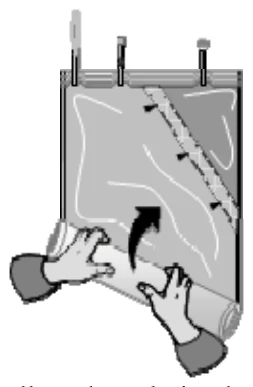
- 2. Mixing of the two compartments
The two solutions should be mixed immediately before use to produce a ready-to-use solution.
A) B) C)

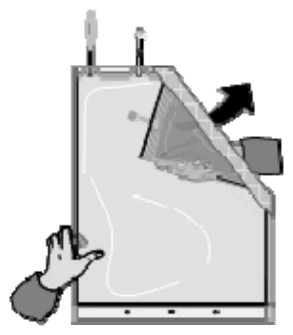
Unfold the small
compartment.
Roll up the solution bag
starting from the corner
opposite the small
compartment…
… until the peel seam between both compartments has opened along its entire length and the solutions from both compartments are mixed.
After mixing both compartments, it must be checked, that the peel seam is completely open, that the mixed solution is clear and colourless and that the bag is not leaking.
- 3. Application of the ready-to-use solution
The ready-to-use solution must be used immediately, but within a maximum of 48 hours after mixing.
Any admixture to the ready-to-use solution must only be done after the ready-to-use solution has been thoroughly mixed. After such an admixture, the ready-to-use solution must again be thoroughly mixed prior to use.
Admixtures of sodium chloride solution (up to 30%) or alternatively water for injection are compatible with this medicinal product and can be used to adjust the sodium concentration if needed in order to limit the speed of sodium concentration changes in case of severe hyper- or hyponatremia. For details please refer to the Summary of Product Characteristics.
If not otherwise prescribed, the ready-to-use solution should be warmed immediately before infusion into the patient to 36.5 °C – 38.0 °C. The exact temperature must be selected depending on clinical requirements and the technical equipment used.