

Patient leaflet - Moxifloxacin 0.5 % w/v eye drops solution
What this medicine is and what it is used for
This medicine contains the active substance moxifloxacin. Moxifloxacin belongs to a class of antibiotics called fluoroquinolones used to treat bacterial infections of the eye.
Moxifloxacin eye drops are used for the treatment of infections of the eye (conjunctivitis) when caused by bacteria.
What you need to know before you use this medicine
Do not use this medicine
If you are allergic (hypersensitive) to moxifloxacin, to other quinolones, or any of the other ingredients of this medicine (listed in section 6).
Warnings and precautions
Talk to your doctor, pharmacist or nurse: y If you experience an allergic reaction to this
medicine. Allergic reactions occur uncommonly and serious reactions occur rarely. If you experience any allergic (hypersensitivity) reaction or any side effect please refer to section 4.
y If you wear contact lenses, stop wearing your
lenses if you have any signs or symptoms of an eye infection. Wear your glasses instead. Do not start wearing your lenses again until the signs and symptoms of the infection have cleared and until you have stopped using the medicine. y Tendon swelling and rupture have happened
in people taking oral or intravenous fluoroquinolones, particularly in older patients and in those treated concurrently with corticosteroids. Stop taking this medicine if you develop pain or swelling of the tendons (tendinitis).
As with any antibiotic, use of this medicine for a long time may lead to other infections.
Other medicines and Moxifloxacin 0.5% w/v eye drops, solution
Tell your doctor, pharmacist or nurse if you are taking, have recently taken, or might take any other medicines, including medicines obtained without a prescription.
Pregnancy, breast-feeding and fertility
If you are pregnant or breast-feeding, think you may be pregnant or are planning to have a baby, ask your doctor, pharmacist or nurse before using this medicine.
Driving and using machines
You may find that your vision is blurred for a short time just after you use this medicine. Do not drive or use machines until this has worn off.
How to use this medicine
Always use this medicine exactly as your doctor, pharmacist or nurse has told you.
Check with your doctor, pharmacist or nurse if you are not sure.
The recommended dose is:
Adults, including the elderly, and children:
1 drop in the affected eye or eyes, 3 times a day (in the morning, in the afternoon and at night). This medicine can be used in children, in patients over 65 years of age and patients with kidney or liver problems. There is only very limited information on the use of this medicine in the newborn and its use is not recommended in the newborn.
Only use the medicine in both eyes if your doctor told you to. Only use this medicine for dropping in your eyes.
The infection normally improves within 5 days. If no improvement is seen, contact your doctor. You should continue to use the drops for a further 2 - 3 days or as long as your doctor told you to.
Instructions for use:
y Get the medicine bottle and stand in front of a mirror.
y Wash your hands.
y Before using this medicine for the first time, be sure the tamper evident ring between the bottle and the cap is unbroken. You must not use the bottle if the tamper evident ring on the bottle neck is broken.
y To open the bottle, remove the cap by turning it in the counter-clockwise direction.
y After the cap is removed, if tamper evident snap collar is loose, remove before using the product. y Hold the bottle, pointing down, between your thumb and fingers.
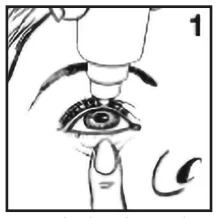
y Tilt your head back. Pull down your eyelid with a clean finger, until there is a ‘pocket’ between the eyelid and your eye. The drop will go in here (picture 1).
y Bring the bottle tip close to the eye. Use the mirror if it helps.
y Do not touch your eye or eyelid, surrounding areas or other surfaces with the dropper. It could infect the drops.
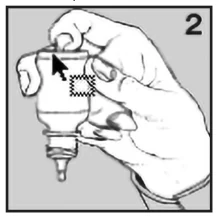
y Gently press the bottom of the bottle to release one drop of medicine at a time (picture 2).
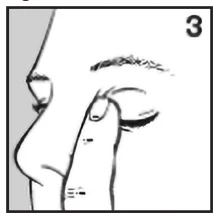
After using this medicine, press a finger into the corner of your eye, by the nose for 2 - 3 minutes (picture 3). This helps to stop the medicine getting into the rest of the body and is important in young children.
y If you are using the drops in both eyes, wash your hands before you repeat the steps for your other eye. This will help prevent spreading the infection from one eye to the other. y Close the bottle cap firmly immediately after use. y If a drop misses your eye, try again. y If you use more medicine than you should, rinse it all out with warm water. Do not put in any more drops until it is time for your next regular dose.
y If you accidentally swallow this medicine contact your doctor, pharmacist or nurse for advice.
y If you forget to use the medicine, continue with the next dose as planned. Do not use a double dose to make up for a forgotten dose. y If you are using other eye drops, leave at least
5 minutes between putting in this medicine and the other drops. Eye ointments should be administered last.
y If you have any further questions on the use of this medicine, ask your doctor, pharmacist or nurse.
Possible side effects
Like all medicines this medicine can cause side effects although not everybody gets them. You can usually carry on taking the drops, unless the effects are serious or if you suffer a severe allergic reaction.
If you experience a severe allergic reaction and any of the following happen, stop taking this medicine immediately and tell your doctor immediately: swelling of the hands, feet, ankles, face, lips, mouth or throat which may cause difficulty in swallowing or breathing, rash or hives, large fluid-filled blisters, sores and ulceration.
Common side effects
(May affect up to 1 in 10 people)
Effects in the eye: eye pain, eye irritation.
Uncommon side effects
(May affect up to 1 in 100 people)
Effects in the eye: dry eye, itchy eye, redness of the eye, eye surface inflammation or scarring, broken blood vessel in eye, abnormal eye sensation, eyelid abnormality, itching, redness or swelling. General side effects: headache and bad taste.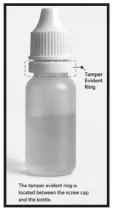
 Rare side effects
(May affect up to 1 in 1,000 people)
Effects in the eye: corneal disorder, blurred or reduced vision, inflammation or infection of the conjunctiva, eye strain, eye swelling.
General side effects: vomiting, nose discomfort, feeling of a lump in the throat, decreased iron in blood, abnormal liver blood tests, abnormal skin sensation, pain, throat irritation.
Not known
(Frequency cannot be estimated from the available data)
Effects in the eye: infection in the eye, eye surface becomes cloudy, corneal swelling, deposits on the eye surface, increased pressure in eye, scratch on surface of eye, eye allergy, eye discharge, increased tear production, sensitivity to light.
General side effects: shortness of breath, irregular heart rhythm, dizziness, increased allergic symptoms, itching, rash, skin redness, nausea and urticaria.
Reporting of side effects
If you get any side effects, talk to your doctor, pharmacist or nurse. This includes any possible side effects not listed in this leaflet. You can also report side effects directly via the Yellow Card Scheme, Website: www.mhra.gov.uk/yellowcard, or search for MHRA Yellow Card in the Google Play or Apple App Store. By reporting side effects, you can help provide more information on the safety of
this medicine.
How to store this medicine
Keep this medicine out of the sight and reach of children.
Do not use this medicine after the expiry date which is stated on the bottle and the carton after ‘Exp’. The expiry date refers to the last day of that month. This medicine does not need any special storage conditions.
Stop using the bottle 4 weeks after first opening. This is to prevent infections.
Do not throw away any medicines via wastewater or household waste. Ask your pharmacist how to throw away medicines you no longer use. These measures will help to protect the environment
Contents of the pack and other information
What this medicine contains
The active substance is moxifloxacin.
Each ml of solution contains 5.45mg moxifloxacin hydrochloride equivalent to 5mg moxifloxacin. Each drop of solution contains moxifloxacin hydrochloride equivalent to 0.19mg moxifloxacin. The other ingredients are: sodium chloride, boric acid (E284), water for injection. Tiny amounts of sodium hydroxide may be added to keep acidity levels (pH levels) normal.
CMO Codes
What this medicine looks like and the contents of the pack
The medicine is a liquid (a clear, greenish–yellow solution free from foreign particles) supplied in a pack containing one 5ml plastic bottle with a screw cap.
Marketing Authorisation Holder and Manufacturer
Marketing Authorisation Holder
Aspire Pharma Limited
Unit 4, Rotherbrook Court
Bedford Road
Petersfield
GU32 3QG
United Kingdom
Manufacturer
Pharmathen S.A.
Dervenakion 6
Pallini Attiki, 153 51
Greece
Famar Anonymous Industrial Single Member Company of Pharmaceuticals and Cosmetics Alimos Plant
Agiou Dimitriou Street 63
Alimos, 174 56
Greece
The text only version may be available in large print, Braille or audio CD. For further information call emc accessibility on 0800 198 5000. The product code for this leaflet is: PL 35533/0287.
This leaflet was last revised in August 2026.
1010828 - P1.10
PL/PA no: PL35533/0287
Type: Leaflet
Date of revision: 7.8.26
Colours: As swatches
Font(s): Strada Pro
A/W software: