

Patient leaflet - Midazolam QBD Group 1 mg/ml solution for injection/infusion
1.What Midazolam QbD Group is and what it is used for
Midazolam QbD Group contains the active substance midazolam, which belongs to a class of medicines called benzodiazepines (sedatives). It is a short-acting medicine that is used to induce sedation (a state of calm, drowsiness or sleep) and relieves anxiety and muscle tension. This drug is used for:
- Conscious sedation (an awake but very relaxed state of calm or drowsiness during a medical test or procedure in adults and children.
- Sedation of adults and children , in intensive care units.
-Anaesthesia in adults (premedication before induction, induction of anaesthesia, as a sedative component with other medicines for maintenance of anaesthesia). Premedication (medicine used to cause relaxation, calm and drowsiness before an anaesthetic) in adults and children.
2.What you need to know before you are given Midazolam QbD Group
You should not be given Midazolam QbD Group:
- if you are allergic to midazolam or any of the other ingredients of this medicine (listed in section 6)
- if you are allergic to other benzodiazepine medicines, such as diazepam or nitrazepam,
-for conscious sedation, if you have severe breathing difficulties.
You must not be given midazolam if any of the above apply to you. If you are not sure, talk to your doctor or nurse before you are given this medicine.
Warnings and precautions
Children and babies
If your child is going to be given this medicine:
- It is particularly important to tell your doctor or nurse if your child has cardiovascular disease (heart problems). Your child will be carefully monitored and the dose will be adjusted specially.
Children must be carefully monitored. For infants and babies under 6 months this will include monitoring of breathing and oxygen levels.
Adults
Talk to your doctor or nurse before you are given Midazolam QbD Group if: - You are over 60 years of age,
- You have a long-term illness ( such as breathing problems, kidney, liver or heart diseases),
- You are debilitated (have an illness that makes you feel very weak, run down and short of energy),
- You have a condition called 'sleep apnoea syndrome' (where your breathing stops while you are sleeping), so you may be closely monitored.
You have myasthenia gravis (a neuromuscular disease causing muscle weakness), - You regularly drink large amounts of alcohol or you have had problems with alcohol use in the past. Alcohol can increase the effects of Midazolam QbD Group, possibly leading to severe sedation that could result in coma or death. - You regularly take recreational drugs or you have had problems with drug use in the past.
You are pregnant or think you may be pregnant (see 'Pregnancy and breast-feeding ').
If any of the above apply to you , or if you are not sure, talk to your doctor or nurse before you are given midazolam.
Other medicines and Midazolam QbD Group
Tell your doctor or nurse if you are taking , have recently taken or might take any other medicines.
This includes medicines obtained without a prescription and herbal medicines. This is extremely important, as using more than one medicine at the same time can strengthen or weaken the effect of the medicines involved.
In particular, tell your doctor or nurse if you are using any of the following medicines: - tranquilisers (for anxiety or to help you sleep),
- sedatives (to make you feel calm or sleepy),
- hypnotics (sleep medicines),
- antidepressants (medicines for depression, e.g. nefazodone), - narcotic analgesics (very strong pain killers, e.g. fentanyl),
- anaesthetics (e.g. propofol),
- some antihistamines (allergy drugs),
- antifungal medicines (ketoconazole, voriconazole, fluconazole, itraconazole, posaconazole),
- antibiotics (erythromycin, clarithromycin, telithromycin , roxithromycin) , - blood pressure drugs, calcium channel blocker like diltiazem, verapamil , - medicines for HIV (human immunodeficiency virus) (efavirenz or saquinavir, lopinavir and other protease inhibitors),
- medicines for treatment of hepatitis C virus (simeprevir, boceprevir and telaprevir), - medicines for epilepsy (carbamazepine, phenytoin or valproic acid), - atorvastatin (used to treat high cholesterol) ,
rifampicin (used to treat mycobacterial infections such as tuberculosis),
- ticagrelor (used to prevent heart attack),
- aprepitant, netupitant, casoprepitant (used to stop you feeling or being sick), - some medicines to treat cancer (e.g. imatinib, lapatinib, idelalisib, vermurafenib), - everolimus, ciclosporin (used to prevent organ transplant rejection), - propiverine (used for urinary incontinence),
- herbal medicines (e.g. St John's Wort, Ginkgo biloba or ginseng).
If any of the above apply to you, or if you are not sure, talk to your doctor or nurse before you are given midazolam.
Concomitant use of midazolam and opioids (strong pain killers, medicines for substitution therapy and some cough medicines) increases the risk of drowsiness, difficulties in breathing (respiratory depression), coma and may be life-threatening. Because of this, concomitant use should only be considered when other treatment options are not possible.
However, if your doctor does prescribe midazolam together with opioids the dose and duration of concomitant treatment should be limited by your doctor. Please tell your doctor about all opioid medicines you are taking and follow your doctor's dose recommendation closely. It could be helpful to inform friends or relatives to be aware of the signs and symptoms stated above. Contact your doctor when experiencing such symptoms.
Operations
If you are going to have an inhaled anaesthetic (one that you breathe in) for an operation or for dental treatment, it is important to tell your doctor or dentist that you have been given Midazolam QbD Group.
Midazolam QbD Group with alcohol
Do not drink alcohol if you have been given this medicine. This is because alcohol can increase the sedative (calming) effect of this medicine and may cause problems with your breathing.
Pregnancy and breast-feeding
If you are pregnant or breast-feeding , think you may be pregnant or are planning to have a baby, ask your doctor for advice before this medicine is given to you . Your doctor will decide if this medicine should be given to you or not.
If you have been given this medicine for a long time during late pregnancy, your baby may become dependent and could experience withdrawal symptoms after birth.
After you have been given Midazolam QbD Group, do not breastfeed for 24 hours. This is because midazolam may pass into your breast milk.
Driving and using machines
This medicine may make you sleepy, dizzy, forgetful or affect your concentration and co-ordination.
Do not drive while taking this medicine until you know how it affects you. This may affect your performance at skilled tasks, such as driving or using machines. Do not drive or use machinery until completely recovered. Your doctor should advise you when you can start these again.
- Talk to your doctor or pharmacist if you are not sure whether it is safe for you to drive while taking this medicine. Lack of sleep or alcohol consumption may further impair your alertness.
- You should always be taken home by a responsible adult after your treatment.
Midazolam QbD Group contains sodium
This medicinal product contains less than 1 mmol sodium (23mg) per dose, that is to say essentially 'sodium free'.
3.How Midazolam QbD Group is given
This medicine should be given only by experienced healthcare professionals (doctor or nurse). It should be given in a place (hospital, clinic or surgery) equipped to monitor and support the patient's breathing, heart and circulation.
How much Midazolam QbD Group is given
Your doctor will decide on a suitable dose for you. The dose you are given will depend on why you are being treated and the type of sedation needed. Your weight, age, your state of health, how you respond to this medicine and whether other medicines are needed at the same time will also influence the dose that you are given.
If you need strong painkillers, you will be given these first and then be given midazolam. Your doctor will decide on a suitable dose for you.
How Midazolam QbD Group is given
Midazolam QbD Group will be given to you in one of the following ways:
- by slow injection into a vein (intravenous injection),
- through a drip into one of your veins (intravenous infusion),
- by injecting into a muscle (intramuscular injection),
- into your back passage (rectum).
You should always be taken home by a responsible adult after your treatment. Use in children and babies
- In babies under 6 months of age this medicine is only recommended for sedation in intensive care units. The dose will be given gradually into a vein .
- Children 12 years and under will usually be given this medicine into a vein. When this medicine is used for premedication (to cause relaxation, calm and drowsiness before an anaesthetic) it may be given into the back passage (rectum).
If you are given more Midazolam QbD Group than you should Your medicine will be given by a doctor or nurse. This means it is unlikely that too much medicine will be given. However, if too much is given by mistake, you may notice the following:
- Feeling sleepy.
- Lose your coordination and reflexes.
- Low blood pressure. This may make you feel dizzy or lightheaded.
- Slowing or stopping of your breathing or heartbeat and being unconscious (coma).
If you stop using Midazolam QbD Group
If you are given long term treatment with this medicine, such as intensive care, you  size: 21 Ox325mm
may get withdrawal symptoms when you stop treatment suddenly or lower the dose too quickly. Your doctor will reduce your dose gradually to avoid these effects happening from you.
Withdrawal symptoms
These include:
- headache,
- muscle pain,
- mood changes,
- diarrhoea,
- problems with sleeping (insomnia),
- feeling very worried (anxious), tense, restless, confused or bad-tempered (irritable),
- hallucinations (seeing and possibly hearing things that are not there),
- fits (convulsions).
If you have any further questions on the use of this medicine, ask your doctor, pharmacist or nurse.
4.Possible side effects
Like all medicines, this medicine can cause side effects, although not everybody gets them.
Stop receiving this medicine and tell your doctor straight away if you notice any of the following side effects. They can be life-threatening, and you may need urgent medical treatment:
-Anaphylactic shock (a life-threatening allergic reaction) . Signs may include a sudden rash, itching or lumpy rash (hives) and swelling of the face, lips, tongue or other parts of the body. You may also have shortness of breath, wheezing or trouble breathing.
- Heart attack (cardiac arrest). Signs may include chest pain which may spread to your neck and shoulders and down your left arm.
- Breathing problems or complications (sometimes causing the breathing to stop). -Choking and sudden blockage of the airway (laryngospasm).
Life-threatening side effects are more likely to occur in adults over 60 years of age and those who already have breathing difficulties or heart problems, particularly if the injection is given too fast or at a high dose.
Other possible side effects:
Not known: (frequency cannot be estimated from the available data)
- reduced alertness
- confusion, disorientation
- feeling very happy or excited (euphoria)
- hyperactivity
- emotional and mood disturbances
- changes in sexual drive
- feeling restless, agitated, irritable
- hostility, anger or aggression
- difficulty coordinating muscles. You may also have muscle spasms and muscle tremors (shaking of your muscles that you cannot control).
- feeling tired or sleepy or being sedated for a long time
- hallucinations (seeing or possibly hearing things that are not really there)
- fits (convulsions) in premature and newborn babies
- temporary memory loss. How long this occurs depends on how much midazolam was given to you. In isolated cases this has lasted for a long time.
- abuse
- drug dependence. You should see your doctor if you feel that you are becoming dependent on the medicine or that you have become tolerant to its effects and need to increase dose.
- fainting
- slow heart rate
- redness of the face and neck (flushing)
- low blood pressure
- hiccups
- shortness of breath
- feeling sick (nausea) or being sick (vomiting)
- constipation
- dry mouth
- feeling itchy
- rash , including hives (lumpy rash}
- tiredness (fatigue)
- redness
- blood cloth or swelling of the skin where the injection was given
- pain at the injection site
- falls and fractures. The risk is increased if you take other medicines at the same time which cause drowsiness (including alcohol}.
Elderly patients
- Older people taking benzodiazepines have a higher risk of falling and breaking
 bones.
- Life-threatening side effects are more likely to occur in adults over 60 years of age and those who already have breathing difficulties or heart problems, particularly when the injection is given too quickly or at a high dose.
Reporting of side effects
If you get any side effects, talk to your anaesthetist or other doctor. This includes any possible side effects not listed in this leaflet. You can also report side effects directly via Yellow Card Scheme Website: www.mhra.gov.uk/yellowcard or search for MHRA Yellow Card in the Google Play or Apple App Store. By reporting side effects you can help provide more information on the safety of this medicine.
5.How to store Midazolam QbD Group
Keep this medicine out of sight and reach of children.
Do not use this medicine after the expiry date which is stated on the label and carton after "EXP". The expiry date refers to the last day of the month.
Your doctor or pharmacist is responsible for storing this medicine and disposing any unused medicine correctly.
This medicine does not require any special temperature storage conditions.
Unopened ampoules
Keep the ampoules in the outer carton in order to protect from light.
Once opened the product should be used immediately.
Do not throw away any medicines via wastewater or household waste. Ask your pharmacist how to throw away medicines you no longer use. These measures will help protect the environment.
6.Contents of the pack and other information
What Midazolam QbD Group contains
- The active substance is midazolam (as hydrochloride).
There are two strengths of this product containing either 1 mg or 5 mg of midazolam hydrochloride in each millilitre (ml} of liquid.
- The other ingredients are sodium chloride, hydrochloric acid (for pH adjustment), sodium hydroxide (for pH adjustment) and water for injections. (see section 2 Midazolam QbD Group contains sodium)
What Midazolam QbD Group looks like and contents of the pack Midazolam QbD Group is a clear, colorless solution for injection/infusion supplied in clear glass ampoules.
Pack sizes
Midazolam QbD Group 1 mg/ml:
5 ampoules containing 5 ml solution
Midazolam QbD Group 5 mg/ml:
5 ampoules containing 2 ml solution
1 O ampoules containing 2 ml solution
5 ampoules containing 10 ml solution
Not all pack sizes may be marketed.
Marketing Authorisation Holder
QbD Group Ltd
Unit 59a, Monument Business Park
Warpsgrove Lane, Chalgrove, Oxford
OX44 7RW, United Kingdom
Manufacturer
Quercus Labo NV
Wijmenstraat 21 P
B-9030 Mariakerke
Belgium
This leaflet was last revised in August 2026.
The following information is intended for healthcare professionals only:
Instructions for use
Midazolam QbD Group is compatible with the following solutions for infusion: - Sodium chloride 0.9 % solution
- Dextrose 5 % solution
- Dextrose 1 O % solution
- Dextrose 4 % solution with sodium chloride 0.18% solution
- Ringer solution
- Laevulose 5 % solution
For intravenous infusion, the content of Midazolam QbD Group ampoules may be diluted with one of the solution mentioned above. For the 1 mg/ml strength, midazolam injection solution may be diluted in the range of 0.01 to 0.2 mg per ml. For the 5 mg/ml strength, midazolam injection solution may be diluted in the range of 0.01 to 1 mg per ml.
Midazolam QbD Group solution for injection/infusion must not be diluted with Macrodex 6% solution in glucose.
Midazolam QbD Group solution for injection/infusion must not be mixed with alkaline solutions for injection. Midazolam precipitates in solutions containing hydrogen carbonate.
To avoid potential incompatibility, Midazolam QbD Group solution for injection/infusion must not be mixed with other solutions except those mentioned above.
Midazolam QbD Group solution for injection/infusion is intended for single use. The solution should be examined visually before administration. Only clear solution without visible particles may be used.
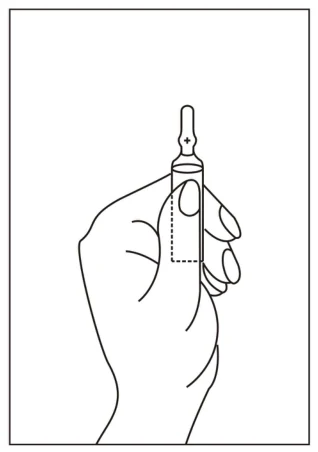
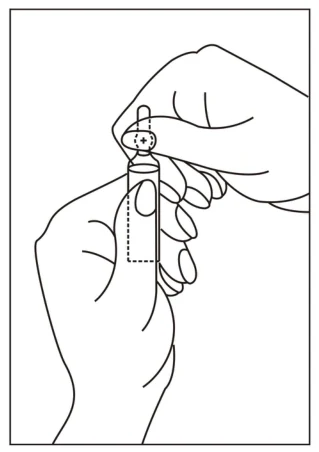
Instruction of ampoule opening:
- 1) Turn the ampoule with coloured point up. If there is any solution in the upper part of the ampoule, gently tap with your finger to get all the solution to the lower part of the ampoule.
- 2) Use both hands to open; while holding the lower part of the ampoule in one hand, use the other hand to break off the upper part of the ampoule in the direction away from the coloured point (see the pictures below).