

Patient leaflet - Memantine Hydrochloride 10 mg / ml oral solution
1. What Memantine hydrochloride oral solution is and what it is used for
The name of this medicine is Memantine hydrochloride 10 mg/ml oral solution, and is referred to as Memantine hydrochloride oral solution throughout this leaflet.
How does Memantine hydrochloride oral solution work
Memantine hydrochloride oral solution contains the active substance memantine hydrochloride. It belongs to a group of medicines known as anti-dementia medicines.
Memory loss in Alzheimer’s disease is due to a disturbance of message signals in the brain. The brain contains so-called N-methyl-D-aspartate (NMDA)-receptors that are involved in transmitting nerve signals important in learning and memory. Memantine hydrochloride belongs to a group of medicines called NMDA-receptor antagonists. Memantine hydrochloride acts on these NMDA-receptors improving the transmission of nerve signals and the memory.
What is Memantine hydrochloride oral solution used for
Memantine hydrochloride is used for the treatment of patients with moderate to severe Alzheimer’s disease.
2. What you need to know before you take Memantine hydrochloride oral solution
Do not take Memantine hydrochloride oral solution:
- if you are allergic to memantine hydrochloride or any of the other ingredients of this medicine (listed in section 6).
Warnings and precautions
Talk to your doctor or pharmacist before taking Memantine hydrochloride oral solution:
- if you have a history of epileptic seizures
- if you have recently experienced a myocardial infarction (heart attack), or if you are suffering from congestive heart failure or from an uncontrolled hypertension (high blood pressure).
In these situations the treatment should be carefully supervised, and the clinical benefit of Memantine hydrochloride oral solution reassessed by your doctor on a regular basis.
If you suffer from renal impairment (kidney problems), your doctor should closely monitor your kidney function and if necessary adapt the Memantine hydrochloride oral solution doses accordingly. Your doctor may also need to adjust your dose if you suffer from renal tubulary acidosis (RTA), where the kidneys do not remove acids from the blood into the urine as they should, or have a severe urinary tract infection.
The use of medicinal products called amantadine (for the treatment of Parkinson´s disease), ketamine (a substance generally used as an anaesthetic), dextromethorphan (generally used to treat a cough) and other NMDA-antagonists at the same time should be avoided.
Children and adolescents
Memantine hydrochloride oral solution is not recommended for children and adolescents under the age of 18 years.
Other medicines and Memantine hydrochloride oral solution
Tell your doctor or pharmacist if you are taking, have recently taken or might take any other medicines.
In particular, Memantine hydrochloride oral solution may change the effects of the following medicines and their dose may need to be adjusted by your doctor:
- amantadine, ketamine, dextromethorphan
- dantrolene, baclofen
- cimetidine, ranitidine, procainamide, quinidine, quinine, nicotine
- hydrochlorothiazide (or any combination with hydrochlorothiazide)
- anticholinergics (substances generally used to treat movement disorders or intestinal cramps)
- anticonvulsants (substances used to prevent and relieve seizures)
- barbiturates (substances generally used to induce sleep)
- dopaminergic agonists (substances such as L-dopa, bromocriptine)
- neuroleptics (substances used in the treatment of mental disorders)
- oral anticoagulants
If you go into hospital, let your doctor know that you are taking Memantine hydrochloride oral solution.
Memantine hydrochloride oral solution with food and drink
You should inform your doctor if you have recently changed, or intend to change, your diet substantially (e.g. from normal diet to strict vegetarian diet) as your doctor may need to adjust the dose of your medicine.
Pregnancy and breast-feeding
If you are pregnant or breast-feeding, think you may be pregnant or are planning to have a baby, ask your doctor or pharmacist for advice before taking this medicine.
Pregnancy
The use of Memantine hydrochloride oral solution in pregnant women is not recommended.
Breast-Feeding
Women taking Memantine hydrochloride oral solution should not breast-feed.
Driving and using machines
Your doctor will tell you whether your illness allows you to drive and to use machines safely.
Also, Memantine hydrochloride oral solution may change your reactivity, making driving or operating machinery inappropriate.
Memantine hydrochloride oral solution contains sorbitol (E 420)
This medicine contains 70 mg sorbitol in each millilitre (ml). Sorbitol is a source of fructose. If your doctor has told you that you have an intolerance to some sugars or if you have been diagnosed with hereditary fructose intolerance (HFI), a rare genetic disorder in which a person cannot break down fructose, talk to your doctor before you take or receive this medicine.
3. How to take Memantine hydrochloride oral solution
Always take this medicine exactly as your doctor has told you. Check with your doctor or pharmacist if you are not sure.
Dosage
This medicine contains 10 mg memantine hydrochloride in each millilitre (1 ml) oral solution. 0.5 ml oral solution contains 5 mg memantine hydrochloride.
The recommended dose of Memantine hydrochloride oral solution for adults and elderly patients is 2 ml, equivalent to 20 mg memantine hydrochloride, once a day.
In order to reduce the risk of side effects this dose is achieved gradually by the following daily treatment scheme:
| week 1 | 0.5 ml once a day |
|---|---|
| week 2 | 1 ml once a day |
| week 3 | 1.5 ml once a day |
week 4 and beyond | 2 ml once a day |
The usual starting dose is 0.5 ml (1 x 5 mg) once a day for the first week. This dose is increased in the second week to 1 ml once a day (1 x 10 mg), and in the third week to
1.5 ml once a day (1 x 15 mg). From the fourth week the recommended dose is 2 ml once a day (1 x 20 mg).
Dosage in patients with impaired kidney function
If you have impaired kidney function, your doctor will decide upon a dose that suits your condition. In this case, monitoring of your kidney function should be performed by your doctor at specified intervals.
Administration
Memantine hydrochloride oral solution should be administered orally once a day. To benefit from your medicine you should take it regularly every day at the same time of the day. The solution can be taken with or without food.
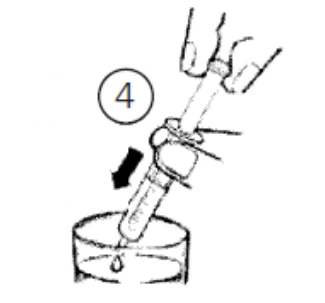
The solution must not be poured directly into the mouth from the bottle or oral syringe. Transfer the dose onto a spoon or into a glass of water.
Instruction for proper use
- Opening the bottle: Press down on the screw closure and twist it anticlockwise.
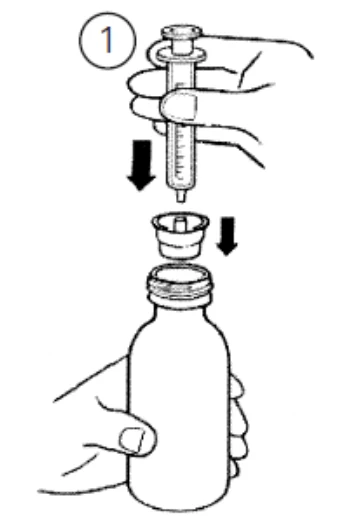
- Insert the oral syringe adapter into the bottle neck (Fig. 1). Make sure that the adapter is tightly fitted.
- Take the oral syringe and insert it into the adapter opening (Fig. 1).
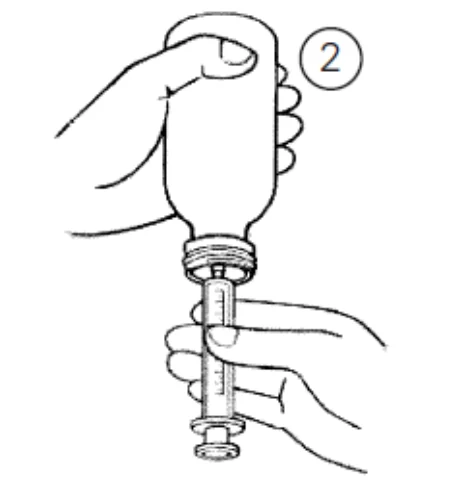
- Turn the bottle upside down (Fig. 2).
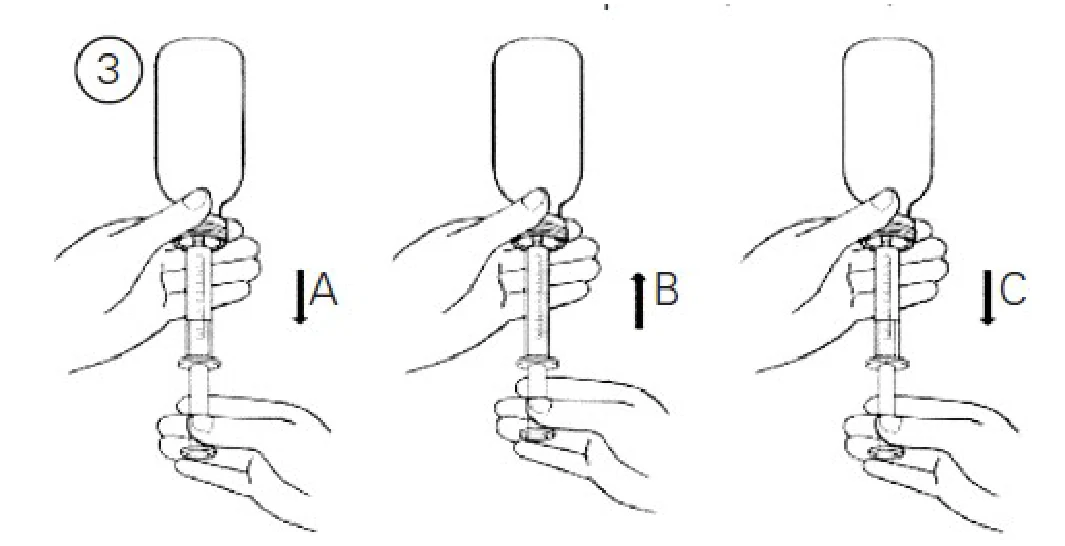
Fill the oral syringe with a small amount of solution, by slightly pulling out the plunger (Fig. 3A). Then, press the plunger back in to remove any air bubbles (Fig. 3B). Next,
pull the plunger up to the mark in millilitres (ml) corresponding to the dose prescribed by the doctor (Fig. 3C).
- Turn the bottle the right way up. Remove the oral syringe from the adapter.
- Empty the contents of the oral syringe onto a spoon or into a glass of water, by pushing the plunger as far as it will go into the oral syringe (Fig. 4).
- Drink the entire contents of the glass or spoon.
- Rinse out the oral syringe with water only (Fig. 5).
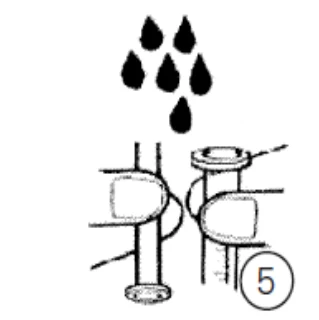
- Close the bottle with the screw closure.
Duration of treatment
Continue to take this medicine for as long as it is of benefit to you. Your doctor should assess your treatment on a regular basis.
If you take more Memantine hydrochloride oral solution than you should
- In general, taking too much Memantine hydrochloride oral solution should not result in any harm to you. You may experience increased symptoms as described in section 4 ‘Possible side effects’.
- If you take a large overdose of Memantine hydrochloride oral solution, contact your doctor or get medical advice, as you may need medical attention.
If you forget to take Memantine hydrochloride oral solution
- If you find you have forgotten to take your dose of Memantine hydrochloride oral solution, wait and take your next dose at the usual time.
- Do not take a double dose to make up for a forgotten dose.
If you have any further questions on the use of this product, ask your doctor or pharmacist.
4. Possible side effects
Like all medicines, this medicine can cause side effects, although not everybody gets them.
In general, the observed side effects are mild to moderate.
Common (may affect up to 1 in 10 people)
- Headache, sleepiness, constipation, elevated liver function tests, dizziness, balance disorders, shortness of breath, high blood pressure and drug hypersensitivity
Uncommon (may affect up to 1 in 100 people)
- Tiredness, fungal infections, confusion, hallucinations, vomiting, abnormal gait, heart failure and venous blood clotting (thrombosis/thromboembolism)
Very Rare (may affect up to 1 in 10,000 people)
- Seizures
Not known (frequency cannot be estimated from the available data)
- Inflammation of the pancreas, inflammation of the liver (hepatitis) and psychotic reactions
Alzheimer's disease has been associated with depression, suicidal ideation and suicide. These events have been reported in patients treated with memantine hydrochloride.
Reporting of side effects
If you get any side effects, talk to your doctor, pharmacist or nurse. This includes any possible side effects not listed in this leaflet. You can also report side effects directly via the Yellow Card Scheme, Website: www.mhra.gov.uk/yellowcard, or search for MHRA Yellow Card in the Google Play or Apple App Store. By reporting side effects, you can help provide more information on the safety of this medicine.
5. How to store Memantine hydrochloride oral solution
Keep this medicine out of the sight and reach of children.
Do not use this medicine after the expiry date which is stated on the carton and the bottle label after ‘EXP’. The expiry date refers to the last day of that month.
This medicinal product does not require any special storage conditions. Once opened, the contents of the bottle should be used within 3 months.
Do not throw away any medicines via wastewater or household waste. Ask your pharmacist how to throw away medicines you no longer use. These measures will help protect the environment.
6. Contents of the pack and other information
What Memantine hydrochloride oral solution contains
The active substance is memantine hydrochloride.
1 ml solution contains 10 mg memantine hydrochloride which is equivalent to 8.31 mg memantine.
0.5 ml solution contain 5 mg memantine hydrochloride which is equivalent to 4.15 mg memantine.
The other ingredients are potassium sorbate, sorbitol liquid 70% (non-crystallising) (E 420), purified water.
What Memantine hydrochloride oral solution looks like and contents of the pack
Memantine hydrochloride oral solution is a clear, colourless to slightly pale yellow solution.
It is presented in an amber glass bottle containing 30 ml, 50 ml or 100 ml solution, together with a graduated oral syringe (0.5 ml graduations) and a bottle adapter for the oral syringe.
Not all pack sizes may be marketed.
Marketing Authorisation Holder
Neuraxpharm UK Limited
First Floor, Building 1410, Arlington Business Park,
Theale, Reading,
Berkshire RG7 4SA
United Kingdom
Manufacturer
neuraxpharm Arzneimittel GmbH Elisabeth-Selbert-Str. 23
40764 Langenfeld Germany