

Patient leaflet - Memantine Glenmark 10 mg / ml oral solution
1. What Memantine oral solution is and what it is used for
How does Memantine oral solution work
Memantine oral solution belongs to a group of medicines known as anti-dementia medicines. Memory loss in Alzheimer’s disease is due to a disturbance of message signals in the brain. The brain contains so-called N-methyl-D-aspartate (NMDA)-receptors that are involved in transmitting nerve signals important in learning and memory.
Memantine oral solution belongs to a group of medicines called NMDA-receptor antagonists. Memantine oral solution acts on these NMDA-receptors improving the transmission of nerve signals and the memory.
What is Memantine oral solution used for
Memantine oral solution is used for the treatment of patients with moderate to severe Alzheimer’s disease.
2. What you need to know before you take Memantine oral solution
Do not take Memantine oral solution
if you are allergic to memantine hydrochloride
or any of the other ingredients of this medicine (listed in section 6).
Warnings and precautions
Talk to your doctor before taking Memantine oral solution
- if you have a history of epileptic seizures;
if you have recently experienced a myocardial
infarction (heart attack), or if you are suffering from congestive heart failure or from an uncontrolled hypertension (high blood pressure).
In these situations the treatment should be carefully supervised, and the clinical benefit of Memantine oral solution reassessed by your doctor on a regular basis.
If you suffer from renal impairment (kidney problems), your doctor should closely monitor your kidney function and if necessary adapt the Memantine doses accordingly.
The use of medicinal products called amantadine (for the treatment of Parkinson’s disease), ketamine (a substance generally used as an anaesthetic), dextromethorphan (generally used to treat cough) and other NMDA-antagonists at the same time should be avoided.
Children and adolescents
Memantine oral solution is not recommended for children and adolescents under the age of 18 years.
Other medicines and Memantine oral solution
Tell your doctor or pharmacist if you are taking or have recently taken or might take any other medicines, including medicines obtained without a prescription.
In particular, Memantine oral solution may change the effects of the following medicines and their dose may need to be adjusted by your doctor:
- amantadine, ketamine, dextromethorphan;
- dantrolene, baclofen;
cimetidine, ranitidine, procainamide,
quinidine, quinine, nicotine;
hydrochlorothiazide (or any combination with
hydrochlorothiazide);
anticholinergics (substances generally used to
treat movement disorders or intestinal cramps);
anticonvulsants (substances used to prevent
and relieve seizures);
barbiturates (substances generally used to
induce sleep);
dopaminergic agonists (substances such as
L-dopa, bromocriptine);
neuroleptics (substances used in the treatment
of mental disorders);
- oral anticoagulants.
If you go into hospital, let your doctor know that you are taking Memantine oral solution. Memantine oral solution with food and drink
Inform your doctor if you have recently changed or intend to change your diet substantially (e.g. from normal diet to strict vegetarian diet) or if you are suffering from states of renal tubulary acidosis (RTA, an excess of acid-forming substances in the blood due to renal dysfunction (poor kidney function) or severe infections of the urinary tract (structure that carries urine), as your doctor may need to adjust the dose of your medicine.
Pregnancy and breast-feeding
Ask your doctor or pharmacist for advice before taking any medicine.
If you are pregnant or breast-feeding, think you may be pregnant or are planning to have a baby, ask your doctor or pharmacist for advice before taking any medicine.
The use of memantine in pregnant women is not recommended.
Women taking Memantine oral solution should not breast-feed.
Driving and using machines
Your doctor will tell you whether your illness allows you to drive and to use machines safely. Also, Memantine oral solution may change your reactivity, making driving or operating machinery inappropriate.
Memantine oral solution contains sorbitol and potassium
This medicinal product contains sorbitol. If you have been told by your doctor that you have an intolerance to some sugars, contact your doctor before taking this medicinal product. Your doctor will advise you. Furthermore, this medicine contains potassium, less than 1 mmol (39 mg) per dose, that is, essentially potassium-free.
3. How to take Memantine oral solution
Always take Memantine oral solution exactly as your doctor has told you. Check with your doctor or pharmacist if you are not sure.
Dosage
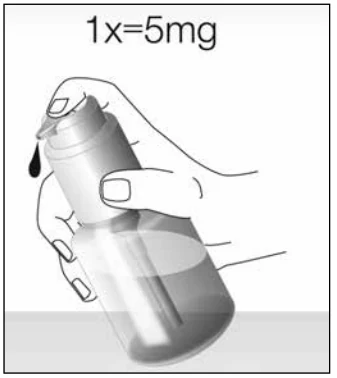
One pump actuation contains 5 mg memantine hydrochloride.
The recommended dose of Memantine oral solution for adults and elderly patients is four pump actuations, equivalent to 20 mg once a day. In order to reduce the risk of side effects this dose is achieved gradually by the following daily treatment scheme:
| week 1 | one pump actuation |
| week 2 | two pump actuations |
| week 3 | three pump actuations |
| week 4 and beyond | Four pump actuations |
The usual starting dose is one pump actuation once daily (1x 5 mg) for the first week. This dose is increased in the second week to two pump actuations once daily (1 x 10 mg), and in the third week to three pump actuations once daily (1 x 15 mg). From the fourth week the recommended dose is four pump actuations once daily (1x 20 mg).
Dosage in patients with impaired kidney function
If you have problems with the way your kidneys work (impaired kidney function), your doctor will decide upon a dose that suits your condition. In this case, monitoring of your kidney function should be performed by your doctor at specified intervals.
Administration
Memantine oral solution should be administered orally once a day. To benefit from your medicine you should take it regularly every day at the same time of the day. The solution should be taken with a little water. The solution can be taken with or without food.
For detailed instructions on the preparation and handling of the product see end of this leaflet (“Instructions for proper use of the pump”) Duration of treatment
Continue to take Memantine oral solution as long as it is of benefit to you. Your doctor should assess your treatment on a regular basis. If you take more Memantine oral solution than you should
- In general, taking too much Memantine oral solution should not result in any harm to you. You may experience increased symptoms as described in section 4. “Possible side effects”.
- If you take a large overdose of Memantine oral solution, contact your doctor or get medical advice, as you may need medical attention.
If you forget to take Memantine oral solution
- If you find you have forgotten to take your dose of Memantine oral solution, wait and take your next dose at the usual time.
- Do not take a double dose to make up for a forgotten dose.
If you have any further questions on the use of this medicine, ask your doctor or pharmacist.
4. Possible side effects
Like all medicines, this medicine can cause side effects, although not everybody gets them. In general, the observed side effects are mild to moderate.
Common (may affect 1 to 10 users in 100):
- Headache, sleepiness, constipation, elevated liver function tests, dizziness, balance disorders, shortness of breath, high blood pressure and drug hypersensitivity Uncommon (may affect 1 to 10 users in 1,000):
- Tiredness, fungal infections, confusion, hallucinations, vomiting, abnormal gait, heart failure and venous blood clotting (thrombosis/ thromboembolism)
Very Rare (may affect less than 1 user in 10,000):
- Seizures
Not known (frequency cannot be estimated from the available data):
- Inflammation of the pancreas, inflammation of the liver (hepatitis) and psychotic reactions Alzheimer’s disease has been associated with depression, suicidal thoughts and suicide. These events have been reported in patients treated with memantine.
If you get any side effects, talk to your doctor or pharmacist. This includes any possible side effects not listed in this leaflet.
Reporting of side effects
If you get any side effects, talk to your doctor or pharmacist. This includes any possible side effects not listed in this leaflet. You can also report side effects directly via the Yellow Card Scheme, Website: www.mhra.gov.uk/yellowcard. By reporting side effects you can help provide more information on the safety of this medicine.
5. How to store Memantine oral solution
Keep this medicine out of the sight and reach of children.
Do not use Memantine oral solution after the expiry date which is stated on the carton and the bottle label after EXP. The expiry date refers to the last day of that month.
Do not store above 30 °C.
Once opened, the contents of the bottle should be used within 3 months.
The bottle with the mounted pump must be kept and transported in an upright position only. Do not throw away medicines via wastewater or household waste. Ask your pharmacist how to throw away medicines you no longer use. These measures will help protect the environment.
6. Contents of the pack and other information
What Memantine oral solution contains
- The active substance is memantine hydrochloride. Each pump actuation delivers 0.5 ml of solution which contains 5 mg of memantine hydrochloride which is equivalent to 4.16 mg memantine.
- The other ingredients are potassium sorbate, sorbitol, hydrochloric acid for pH adjustment and purified water.
What Memantine oral solution looks like and contents of the pack
Memantine oral solution is presented as a clear, colourless to light yellowish solution. Memantine oral solution is available in bottles of 50 ml, 100 ml or 10 x 50 ml.
Not all pack sizes may be marketed.
Marketing Authorisation Holder
Glenmark Pharmaceuticals Europe Limited Laxmi House, 2B Draycott Avenue
Kenton, Middlesex, HA3 0BU
United Kingdom
Manufacturer
ONE PHARMA S.A.
60th km. N.N.R Athinon-Lamias
Sximatari Voiotias, 32009
Greece
VIANEX S.A. PLANT A
12 Km National Road Athens - Lamia 1444 51 Metamorfossi
Greece
This leaflet was last revised in 09/2024
Package leaflet: Information for the user Memantine Glenmark 10 mg/ml oral solution
Memantine hydrochloride Instructions for proper use of the pump
The solution must not be poured or pumped directly into the mouth from the bottle or pump. Measure the dose onto a spoon or into a glass of water, using the pump.
- 1. Take the screw cap off the bottle:
The cap must be turned anticlockwise, unscrewed completely and removed (figure 1).
Figure 1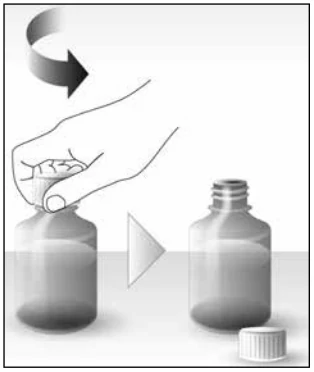
- 2. Mounting the dosing pump on the bottle:
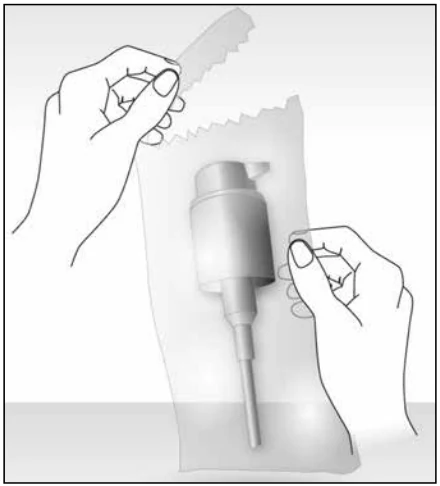
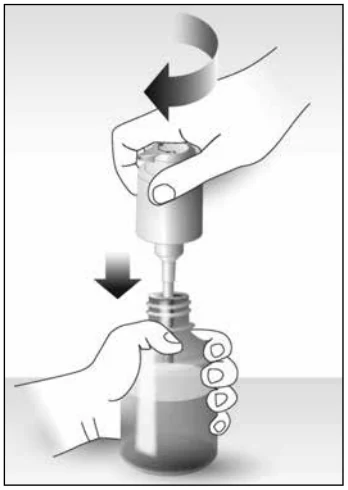
Take the dosing pump out of the plastic bag (figure 2) and place it on top of the bottle. Slide the plastic dip tube carefully into the bottle. Hold the dosing pump onto the neck of the bottle and screw it clockwise until it fits firmly (figure 3). The dosing pump is only screwed on once when starting the use, and should never be unscrewed.
Figure 2
- 3.
 How the dosing pump works:
The dosing pump head has two positions and is easy to turn:
- anticlockwise to unlock and
- clockwise to lock.
The dosing pump head should not be pushed down while in the locked position. The solution may only be dispensed in the unlocked position. To unlock, turn the pump head in the direction of the arrow until it cannot be turned any further (figure 4). The dosing pump is then ready for use.
Figure 4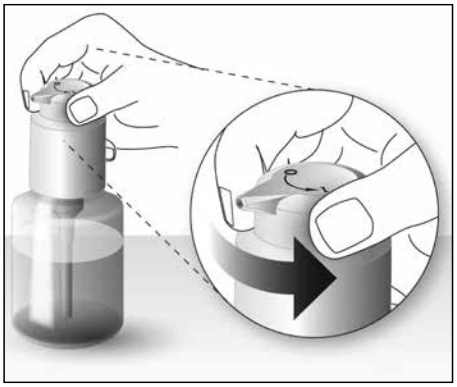
- 4. Preparing the dosing pump:
When used for the first time, the dosing pump does not dispense the correct amount of oral solution. Therefore, the pump must be prepared (primed) by pushing the dosing pump head down completely six times in succession (figure 5).
Figure 5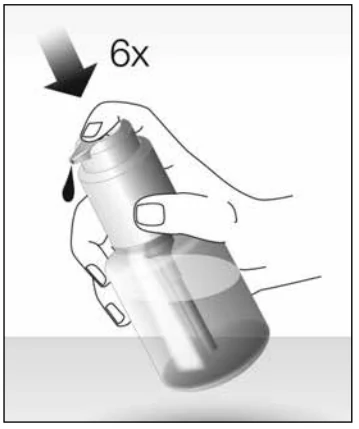
The solution thus dispensed is discarded. The next time the dosing pump head is pushed downwards completely (equivalent to one pump actuation), it dispenses the correct dose (figure 6).
Figure 6
- 5.
 Correct use of the dosing pump:
Hold the bottle in a slightly tilted position.
Hold a glass with a little water or a spoon below the nozzle. Push down the dosing pump head in a firm but calm and steady manner - not too slowly (figure 7, figure 8).
Figure 7 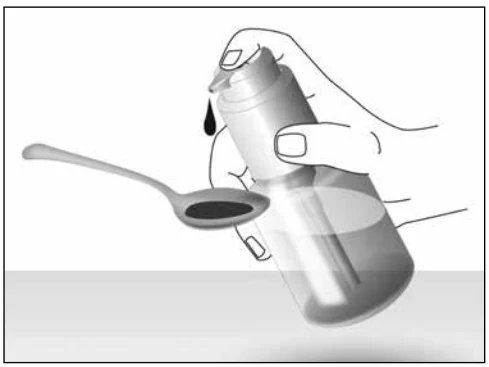
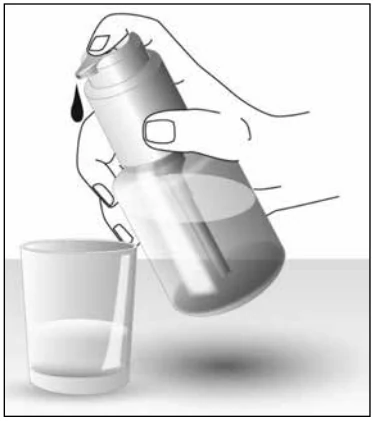 The dosing pump head can then be released and is ready for the next pump actuation. The dosing pump must only be used with the Memantine oral solution in the bottle provided, not for other substances or containers. If the pump does not function properly, consult your doctor or a pharmacist. Lock the dosing pump after using Memantine oral solution.
Figure 3
Figure 8 PRODUCT: Amends: Approval:
Indesign CS 5
GM262
Memantine 10 mg/ml oral solu-tion (Memantine hydrochloride)
Combined PIL UK
19-2-15
150x560 mm
6
11.9.24
Leaflet (PIL)
Y
Times New Roman ALL 9 pts body copy (min)
Internal proof approval
External proof approval Signed (digitally)
Signed (digitally)
off (digitally):