

Patient leaflet - Magnaspartate 243 mg powder for oral solution
1. What MAGNASPARTATE is and what it is used for
Magnaspartate is a mineral preparation and contains the active ingredient magnesium aspartate dihydrate equivalent to 243 mg (10 mmol) of magnesium.
Magnaspartate is used in the treatment and prevention of magnesium deficiency in adults and children aged 2 years and above.
You must talk to a doctor if you do not feel better or if you feel worse after taking this medicine.
2. What you need to know before you take MAGNASPARTATE
Do not take MAGNASPARTATE:
if you are allergic to magnesium aspartate dihydrate or any of
the other ingredients of this medicine (listed in section 6). • if you have severe kidney problems
- if you have a very slow heart rhythm (called ‘bradycardia’)
Warnings and precautions
Talk to your doctor or pharmacist before taking Magnaspartate: If you have switched from another magnesium medicine to ensure that treatment with Magnaspartate does not make you feel unwell and that you can continue to receive the correct dose of magnesium.
Other medicines and MAGNASPARTATE
Tell your doctor or pharmacist if you are taking, have recently taken or might take any other medicines. This is because Magnaspartate can affect the way some other medicines work. Also, some other medicines can affect the way Magnaspartate works.
In particular, you must allow a time interval of 2-3 hours between the taking MAGNASPARTATE and the following medicines. • Cellulose sodium phosphate, used to prevent kidney stones • EDTA, used in hospital for high calcium levels • Flourides, used for preventing tooth decay
Tetracyclines, Nitrofurantoin, Nitroxoline, antibiotic to treat
infections
- Aminoquinolines, medicines to treat malaria
Quinidine and quinidine derivatives, medicines to treat heart
rhythm disorders
- Penicillamine, medicine used to treat severe rheumatoid arthritis and used in Wilson's disease
- Iron, to treat anemia
- Bisphosphonates, to treat osteoporosis
- Eltrombopag, to correct bleeding deficiency
The following medicines may cause magnesium deficiency. Your doctor may decide to adjust your daily dose of magnesium. • Aminoglycosides, antibiotics used to treat infections e.g.
gentamicin, streptomycin and neomycin
Certain medicines used to treat cancer such as cisplatin and
EGF-receptor antagonists such as cetuximab and erlotinib • Ciclosporins, medicines used to suppress the body’s immune system e.g. following an organ transplant
- Water tablets (Diuretics), medicines used to treat blood pressure or heart failure e.g. thiazide, furosemide, bumetanide • Proton Pump Inhibitors, medicines used to treat high acid in the stomach or oesophagus. e.g. omeprazole, pantoprazole • Amphotericin B, antibiotic that fights fungal infections in the body
- Rapamycin, medicine used to suppress the body’s immune system e.g. following an organ transplant
- Pentamidine, medicine to treat infections such as pneumonia • Foscarnet, an antiviral medication
MAGNASPARTATE with drinks
Magnaspartate can be taken with water, tea or orange juice.
Pregnancy, breast-feeding and fertility
Magnaspartate can be used during pregnancy and during breast-feeding without concerns.
Based on long-term experience, no effects of magnesium on male and female fertility are anticipated.
Driving and using machines
Magnaspartate has no or negligible influence on the ability to drive and use machines.
MAGNASPARTATE contains sucrose and sodium.
If you have been told by your doctor that you have an intolerance to some sugars, contact your doctor before taking this medicine. Contains 2.706 g of sucrose per sachet. This should be taken into account in patients with diabetes mellitus.
In case of frequent/and or permanent use, may be harmful to the teeth.
This medicine contains less than 1 mmol sodium (23 mg) per sachet, that is to say essentially ‘sodium-free’.
3. How to take MAGNASPARTATE
Always take this medicine exactly as your doctor or pharmacist has told you. Check with your doctor or pharmacist if you are not sure.
Package leaflet: Information for the user Magnaspartate® 243 mg powder for oral solution magnesium
Read all of this leaflet carefully before you start taking this medicine because it contains important information for you.
Keep this leaflet. You may need to read it again. • If you have any further questions, ask your doctor,or pharmacist. • This medicine has been prescribed for you only. Do not pass it on to others. It may harm them, even if their
signs of illness are the same as yours.
If you get any side effects, talk to your doctor or pharmacist. This includes any possible side effects not listed
in this leaflet. See section 4.
Product: Magnaspartate 243 mg powder for oral solution | Origination: 16/03/20 Update: 20/03/20 Update: 22/04/20 Update: 23/06/20 Update: 29/06/20 Update: 07/07/20 Update: 17/04/24 | Registration: | ||
| Spec Code: 228-02 | ||||
KORA HEALTHCARE Client: | ||||
| Dimensions: 210x310mm | Date: | |||
| Typefont: Arial 9.75 point |
Magnaspartate_PIL_93-02_Kora_228-02 UK-mockup-pil-hoganas 19/04/2024 13:53 Page 1
210 mm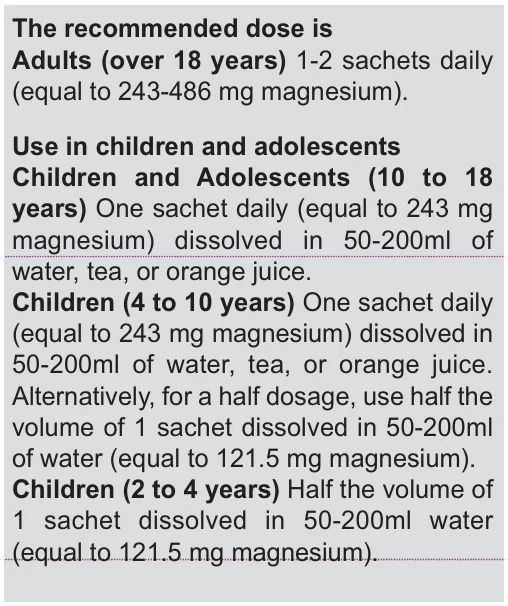
Renal patients:
No dose adjustment is required in mild to moderate renal failure.
The blood magnesium levels of children and adolescents (12 to 18 years) and renal patients need to be monitored at regular intervals.
The duration of magnesium supplementation will depend upon the
clinical needs of each patient.
If you take more MAGNASPARTATE than you should
No side effects are expected, if your kidneys work properly. Any excessive amount of magnesium will be excreted through your kidneys.
If you have taken more of this medicine than directed, or if a person with severe kidney problems or if a child accidentally has taken this medicine, please contact your doctor or local hospital casualty department for judgement of the risk and advice.
If you forget to take MAGNASPARTATE
Do not take a double dose to make up for a forgotten dose. If you have any further questions on the use of this medicine, ask your doctor or pharmacist.
4. Possible side effects
Like all medicines, this medicine can cause side effects, although not everybody gets them.
Uncommon (may affect 1 to 10 users in 1,000):
Soft stools to diarrhoea at the beginning of treatment (harmless and will usually decrease in frequency as the treatment advances).
Very rare (may affect less than 1 user in 10,000):
Fatigue if Magnaspartate is used for a longer period of time.
If you get any side effects such as diarrhoea, you should temporarily interrupt the treatment. After the symptoms improve you can restart treatment, with a reduced dosage.
Reporting of side effects
If you get any side effects, talk to your doctor or pharmacist. This includes any possible side effects not listed in this leaflet. You can also report side effects directly via (see details below).
United Kingdom (Northern Ireland)
Yellow Card Scheme
Website: www.mhra.gov.uk/yellowcard
or search for MHRA Yellow Card in the Google Play or Apple App Store
By reporting side effects, you can help provide more information on the safety of this medicine.
5. How to store MAGNASPARTATE
Do not store above 25°C.
When Magnaspartate has been dissolved in water, orange juice or tea, the solution should be consumed immediately or within 24 hours when dissolved in bottled water and stored below 25°C. Keep this medicine out of the sight and reach of children.
Do not use this medicine after the expiry date which is stated on the sachet and carton after EXP. The expiry date refers to the last day of that month.
Do not throw away any medicines via wastewater or household waste. Ask your pharmacist how to throw away medicines you no longer use. These measures will help protect the environment.
6. Contents of the pack and other information
What MAGNASPARTATE contains
The active substance is magnesium. One sachet (6.5 g)
contains magnesium aspartate dihydrate 3246 mg; magnesium content: 243 mg.
- The other ingredients are sucrose, citric acid monohydrate, peach/apricot flavour, saccharin sodium, silica, colloidal anhydrous
What MAGNASPARTATE looks like and contents of the pack
White powder with a peach/apricot-like flavour.
Magnaspartate is available in packs of 10 or 20 sachets. Not all pack sizes may be marketed.
Marketing Authorisation Holder
Kora Corporation Ltd t/a Kora Healthcare
20 Harcourt Street, Dublin 2, D02 H364, Ireland.
Manufacturer
Recipharm Höganäs AB, Sporthallsvägen 6, Höganäs, 26335, Sweden
This medicine is authorised in the Member States of the European Economic Area and in the United Kingdom under the following names:
United Kingdom (NI&GB):
Magnaspartate 243 mg powder for oral solution Belgium, Netherlands, Ireland:
Magnence 243 mg powder for oral solution.
This leaflet was last revised in April 2024
Directions for use:
Dissolve one sachet of Magnaspartate in 50-200ml water, tea or orange juice. Stir until the solution in water is cloudy to transparent. In orange juice or tea inactive particles will be visible.
Drink immediately or within 24 hours if made with bottled water and stored below 25°C.
If you are unable to swallow and have a gastric, duodenal or nasal feeding tube, Magnaspartate in 200ml water can be administered through the tube immediately after preparation or within 24 hours if made with bottled water and stored below 25°C.
228-02 79015202
The recommended dose is
Adults (over 18 years) 1-2 sachets daily (equal to 243-486 mg magnesium).
Use in children and adolescents Children and Adolescents (10 to 18 years) One sachet daily (equal to 243 mg magnesium) dissolved in 50-200ml of
water, tea, or orange juice.
Children (4 to 10 years) One sachet daily (equal to 243 mg magnesium) dissolved in 50-200ml of water, tea, or orange juice. Alternatively, for a half dosage, use half the volume of 1 sachet dissolved in 50-200ml of water (equal to 121.5 mg magnesium). Children (2 to 4 years) Half the volume of 1 sachet dissolved in 50-200ml water
(equal to 121.5 mg magnesium).
Magnaspartate_PIL_93-02_Kora_228-02 UK-mockup-pil-hoganas 19/04/2024 13:53 Page 2