

Patient leaflet - Lyumjev 200 units/ml KwikPen solution for injection in Pre-filled pen
1. What Lyumjev 200 units/mL KwikPen is and what it is used for
Lyumjev 200 units/mL KwikPen solution for injection in pre-filled pen contains the active ingredient insulin lispro. Lyumjev is used to treat diabetes in adults. It is a mealtime insulin that works more quickly than other medicines containing insulin lispro. Lyumjev contains ingredients that speed up absorption of insulin lispro into the body.
Diabetes is a condition in which your body does not make enough insulin or does not use insulin effectively, which results in effects such as high levels of sugar in the blood. Lyumjev is an insulin medicine that is used in the treatment of diabetes and so controls blood sugar. Effective treatment of diabetes, with good control of blood sugar, prevents long-term complications from your diabetes.
Treatment with Lyumjev helps to control blood sugar in the long term and prevent complications from your diabetes. Lyumjev has its maximum effect 1 to 3 hours after injection and the effect lasts for up to 5 hours. You should use Lyumjev at the start of the meal, or up to 20 minutes after starting the meal.
Your doctor may tell you to use Lyumjev as well as a longer- or intermediate-acting insulin. Do not change your insulin unless your doctor tells you to.
Lyumjev 200 units/mL KwikPen is a disposable pre-filled pen containing 3 mL (600 units, 200 units/mL) of insulin lispro. One KwikPen contains multiple doses of insulin. The KwikPen dials 1 unit at a time. The number of units are displayed in the dose window, always check this before your injection. You can give from 1 to 60 units in a single injection. If your dose is more than 60 units, you will need to give yourself more than one injection.
2. What you need to know before you use Lyumjev 200 units/mL KwikPen
Do NOT use Lyumjev 200 units/mL KwikPen
if you think your blood sugar is dropping (hypoglycaemia). Further
on this leaflet tells you how to deal with low blood sugar (see section 3 under “If you use more Lyumjev than you should”).
if you are allergic to insulin lispro or any of the other ingredients of this
medicine (listed in section 6).
Warnings and precautions
The Lyumjev 200 units/mL solution for injection in your pre-filled pen (the KwikPen) should ONLY be injected with this pre-filled pen. Do not transfer the insulin lispro from your
Lyumjev 200 units/mL KwikPen to a syringe. The markings on the insulin syringe will not measure your dose correctly. A severe overdose can result, causing low blood sugar which may put your life in danger. Do not transfer insulin from your Lyumjev 200 units/mL KwikPen to any other insulin delivery devices like insulin infusion pumps.
Talk to your doctor, pharmacist or nurse before using Lyumjev.
If you cannot see very well you will need help from someone who has been trained to give injections.
- Low blood sugar (hypoglycaemia).
Low blood sugar can be serious and untreated hypoglycaemia may even lead to death.
Lyumjev starts to lower blood sugar faster than some other mealtime insulins. If hypoglycaemia occurs, you may experience it earlier after an injection of Lyumjev. If you often have hypoglycaemia or have difficulty recognising it, please discuss this with your doctor or nurse. If your blood sugar levels are well controlled by your current insulin therapy or after long duration of diabetes, you may not feel the warning symptoms when your blood sugar is falling too low. Warning signs are listed later in this leaflet. For symptoms please see “Common problems of diabetes”.
You must think carefully about when to have your meals, how often to exercise and how much to do. You must also keep a close watch on your blood sugar levels by testing your blood sugar often.
Making changes to the types of insulin you use may cause your blood sugar to rise or fall too much.
It may be necessary to increase the frequency of blood sugar testing if you are at risk of low blood sugars. Your doctor may need to change the doses of your other diabetes medicines.
- High blood sugar (hyperglycaemia).
Stopping or not taking enough insulin may lead to high blood sugar (hyperglycaemia) and diabetic ketoacidosis, serious conditions that can even lead to death. For symptoms please see “Common problems of diabetes”.
If your insulin treatment is being combined with one of a class of
diabetes medicines called thiazolidinediones or glitazones, such as pioglitazone, tell your doctor as soon as possible if you get signs of heart failure such as unusual shortness of breath or rapid increase in weight or localised swelling caused by fluid retention (oedema).
If you have a serious allergic reaction to insulin or any of the ingredients
in Lyumjev, stop using this medicine and contact emergency medical services straight away.
Always check the pack and the label for the name and type of the
insulin when you get it from your pharmacy. Make sure you get the Lyumjev that your doctor has told you to use.
Keep the carton, or keep a note of the batch number on the carton.
If you have a side effect you can then provide that number when you report the side effect, see “reporting of side effects”.
Always use a new needle for each injection to prevent infections and
blocked needles. If a needle is blocked replace it with a new needle.
- Skin changes at the injection site.
The injection site should be rotated to prevent skin changes such as lumps under the skin. The insulin may not work well if you inject into a lumpy area (see “How to use Lyumjev 200 units/ml KwikPen”). Contact your doctor if you are currently injecting into a lumpy area before you start injecting into a different area. Your doctor may tell you to check your blood sugar more closely, and to adjust your insulin or your other antidiabetic medications dose.
Children and adolescents
This medicine should not be used in children or adolescents, since there is no experience with this medicine in children and adolescents under 18 years of age.
Other medicines and Lyumjev
Tell your doctor, nurse or pharmacist if you are taking, have recently taken or might take any other medicines. Some medicines affect your blood sugar level - this may mean your insulin dose has to change.
Your blood sugar levels may fall (hypoglycaemia) if you take:
- other medicines for diabetes (oral and injectable)
- sulphonamide antibiotics (for infections)
- acetylsalicylic acid (for pain and mild fever and to prevent blood clotting)
some antidepressants (monoamine oxidase inhibitors or selective
serotonin reuptake inhibitors)
some angiotensin converting enzyme (ACE) inhibitors (for example
captopril, enalapril) (for some heart problems or high blood pressure)
- angiotensin II receptor blockers (for high blood pressure or heart problems)
somatostatin analogues (such as octreotide, which are used to treat
a rare condition involving too much growth hormone)
Your blood sugar levels may rise (hyperglycaemia) if you take:
- danazol (for endometriosis)
- the contraceptive pill (birth control pills)
- thyroid hormone replacement therapy (for thyroid problems)
- human growth hormone (for growth hormone deficiency)
diuretics (for high blood pressure or if you have a build-up of water in
your body)
sympathomimetic agents (for serious allergic reactions or used in some
cold remedies)
- corticosteroids (to treat asthma or autoimmune conditions)
Beta-blockers (used for high blood pressure, arrhythmia or angina) make it harder to recognise the warning signs of low blood sugar.
Lyumjev with alcohol
Your blood sugar levels may either rise or fall if you drink alcohol. Therefore the amount of insulin needed may change. You should therefore monitor your blood sugar level more often than usual.
Pregnancy and breast-feeding
If you are planning to have a baby, think you may be pregnant, are pregnant or breast-feeding, ask your doctor, nurse or pharmacist for advice before taking this medicine. The amount of insulin you need usually falls during the first 3 months of pregnancy and increases for the remaining 6 months. After you have had your baby your insulin requirements will likely return to how much you needed before your pregnancy.
There are no restrictions on treatment with Lyumjev during breast-feeding. If you are breast-feeding, you may need to alter your insulin intake or diet.
Driving and using machines
Your ability to concentrate and react may be reduced if you have hypoglycaemia. Please keep this possible problem in mind in all situations where you might put yourself and others at risk (e.g. driving a car or using machines). You should contact your doctor about driving if you have:
- frequent episodes of hypoglycaemia
- reduced or absent warning signs of hypoglycaemia
Lyumjev 200 units/mL KwikPen contains sodium
This medicine contains less than 1 mmol sodium (23 mg) per dose, that is to say essentially ‘sodium-free’.
3. How to use Lyumjev 200 units/mL KwikPen
Always use this medicine exactly as described in this leaflet or as your doctor, pharmacist or nurse has told you. Check with them if you are not sure.
They will have told you exactly how much Lyumjev to use, when to use it, and how often. They will also tell you how often to visit your diabetes clinic.
To prevent the possible transmission of disease, each pen must be used by you only, even if the needle is changed.
Do not use Lyumjev 200 units/mL KwikPen solution for injection in an insulin infusion pump.
You should always have spare insulin and another injection device in case you need them.
If you are blind or visually impaired you will need help from someone to make your injections.
Your doctor may tell you to use Lyumjev as well as a longer- or intermediate-acting insulin. Inject them separately. Lyumjev should not be mixed with any other insulin.
When to inject Lyumjev
Lyumjev is a mealtime insulin. You should use Lyumjev when you start to eat, or a minute or two before the meal; you also have the option to inject up to 20 minutes after starting the meal.
How much insulin to use
Your doctor will work out your dose based on your blood sugar and body weight and explain:
- How much Lyumjev you need at each meal.
- How and when to check your blood sugar level.
- How to change your insulin dose depending on your blood sugar levels.
- What to do if you change your diet, or change how much you exercise, if you are ill or if you are using other medicines.
- If you change the type of insulin you use, you may have to take more or less than before. This might just be for the first injection or it may be a gradual change over several weeks or months.
Do not use Lyumjev
- If it does not look like water. Lyumjev must be clear, have no colour and no solid pieces in it. Check each time you inject yourself.
If Lyumjev has not been stored correctly (see section 5 “How to store
Lyumjev”).
- If the pen is damaged in any way, do not use.
Getting the Lyumjev 200 units/mL KwikPen ready to use (Please see instructions for use)
- First wash your hands.
- Read the instructions on how to use your pre-filled insulin pen. Please follow the instructions carefully. Here are some reminders.
- Use a new needle. (Needles are not included).
- Prime your Lyumjev 200 units/mL KwikPen before each use. This checks that insulin comes out and clears the air bubbles from your Lyumjev 200 units/mL KwikPen. There may still be some small air bubbles left in the pen. Small air bubbles are normal and will not affect your dose.
- The number of units are displayed in the dose window, always check this before your injection.
NL259FSAA00
Injecting Lyumjev
- Before you make an injection, clean your skin.
Inject under the skin (subcutaneous injection), as you were taught by
your physician or nurse.
After your injection, leave the needle in the skin for 5 seconds to make
sure you receive the full dose. Make sure you inject at least 1 cm from the last injection and that you ‘rotate’ the places you inject (upper arm, thigh, buttocks or abdomen).
If you do not have enough insulin in the pen to complete your dose,
make a note of how much you still need to take. Prime a new pen and inject the remaining dose.
If you need to inject another insulin at the same time as Lyumjev, use
a different injection site.
- Do not inject directly into a vein.
After injecting
As soon as you have done the injection, unscrew the needle from the
Lyumjev 200 units/mL KwikPen using the outer needle cap. This will keep the insulin sterile and stop it leaking. It also stops air entering the pen and your needle clogging. Do not share your needles. Do not share your pen. Replace the cap on your pen.
If you are unsure how much you have injected then check your blood
sugar levels before deciding if you need another injection.
Further injections
Every time you use a Lyumjev 200 units/mL KwikPen you must use
a new needle. Before every injection, clear any air bubbles. You can see how much insulin is left by holding the Lyumjev 200 units/mL KwikPen with the needle pointing up.
- Once the Lyumjev 200 units/mL KwikPen is empty, do not use it again.
If you use more Lyumjev than you should
If you inject too much Lyumjev, or are unsure how much you have injected, a low blood sugar may occur. Check your blood sugar.
If your blood sugar is low (hypoglycaemia) and you can treat yourself, eat glucose tablets, sugar or drink a sugary drink. Then eat fruit, biscuits, or a sandwich, as your doctor or nurse has advised you and have some rest. This will often get you over a low blood sugar or a minor insulin overdose. Check your blood sugar again after 15-20 mins until blood sugar is stabilised.
If you are unable to treat yourself (severe hypoglycaemia) because you feel too dizzy, weak, confused, have difficulty talking, lose consciousness or have a seizure you may need to be treated with glucagon. This can be given by someone who knows how to use it. Eat glucose or sugar after the glucagon. If glucagon does not work, you will have to go to hospital or call emergency services. Ask your doctor to tell you about glucagon.
Tell everyone you spend time with that you have diabetes. Tell them what could happen if your blood sugar gets too low, including the risk of passing out. Let them know that if you pass out, they must: turn you on your side to avoid choking, get medical help straight away and not give you any food or drink because you may choke.
If you forget to use Lyumjev
If you forget to use your insulin or you use less than you should, or are unsure how much you have injected, your blood sugar may get too high (hyperglycaemia). Check your blood sugar level to decide if an insulin dose is needed. Resume your usual dosing schedule at your next meal.
If you stop using Lyumjev
Do not stop or change your insulin unless your doctor tells you to. If you use less Lyumjev than you should, a high blood sugar may occur.
If high blood sugar (hyperglycaemia) is not treated it can be very serious and cause headaches, nausea, vomiting, abdominal pain, dehydration, unconsciousness, coma or even death (see section 4).
Three simple steps to reduce your risk of hypoglycaemia or hyperglycaemia are:
Always keep a spare pen in case you lose your Lyumjev 200 units/mL
KwikPen or it gets damaged.
- Always carry something to show you are diabetic.
- Always carry sugar with you.
If you have any further questions on the use of this medicine, ask your doctor or pharmacist or nurse.
4. Possible side effects
Like all medicines, this medicine can cause side effects, although not everybody gets them.
Low blood sugar (hypoglycaemia) is very common with insulin treatment (may affect more than 1 in 10 people). It can be very serious. If your blood sugar level falls too much you may become unconscious. Serious hypoglycaemia may cause brain damage and may be life-threatening. If you have symptoms of low blood sugar, act immediately to increase your blood sugar level. See section 3 under ‘If you use more Lyumjev than you should’.
Allergic reactions are common (may affect up to 1 in 10 people). They may be severe and they may include the following symptoms:
rash and itching over the whole
body
- difficulty in breathing
wheezing
- blood pressure dropping
- heart beating fast
- sweating
If you have a serious allergic reaction (including an anaphylactic attack) to insulin or any of the ingredients in Lyumjev, stop using this medicine and contact emergency medical service straight away.
Other side effects include
Common (may affect up to 1 in 10 people)
Injection site reactions. Some people get redness, pain, swelling or itching around the area of the insulin injection. This usually clears up in a few minutes to a few weeks without needing to stop Lyumjev. If you have injection site reactions, tell your doctor.
Uncommon (may affect up to 1 in 100 people)
Skin changes at the injection site: If you inject insulin too often at the same place, the fatty tissue may either shrink (lipoatrophy) or thicken (lipohypertrophy). Lumps under the skin may also be caused by the build-up of a protein called amyloid (cutaneous amyloidosis). The insulin may not work very well if you inject into a lumpy area. Change the injection site with each injection to help prevent these skin changes.
Other potential side effects
Swelling in arms or ankles due to fluid retention (oedema) particularly at the start of insulin therapy or during a change in your diabetes medicines.
Reporting of side effects
If you get any side effects, talk to your doctor or pharmacist. This includes any possible side effects not listed in this leaflet. You can also report side effects directly via the Yellow Card Scheme, website:
www.mhra.gov.uk/yellowcard or search for MHRA Yellow Card in the Google Play or Apple App Store. By reporting side effects you can help provide more information on the safety of this medicine.
Common problems of diabetes
Low blood sugar
Low blood sugar (hypoglycaemia) means there is not enough sugar in the blood. This can be caused if:
- you take too much Lyumjev or other insulin;
- you miss or delay meals or change your diet;
- you exercise or work too hard just before or after a meal;
- you have an infection or illness (especially diarrhoea or vomiting);
there is a change in your need for insulin for example if you lose weight;
or you have trouble with your kidneys or liver which gets worse. See section ‘If you use more Lyumjev than you should'
The first symptoms of low blood sugar usually come on quickly and include the following:
- tiredness
- rapid heart beat
- nervousness or shakiness
- feeling sick
- headache
- cold sweat
If you are not confident about recognising your warning symptoms, avoid situations such as driving a car, in which you or others would be put at risk by hypoglycaemia.
High blood sugar (hyperglycaemia) and diabetic ketoacidosis Hyperglycaemia (too much sugar in the blood) means that the levels of glucose in your body are too high. Hyperglycaemia can be brought about by:
- not taking your insulin;
- using less insulin than your body needs;
an imbalance between the amount of carbohydrates you eat and the
insulin you take; or
- fever, infection or emotional stress.
The early symptoms of hyperglycaemia are:
- being very thirsty
- headache
- feeling sleepy
- urinating more often
Hyperglycaemia can lead to diabetic ketoacidosis. The first symptoms come on slowly over many hours or days. Additional symptoms include the following:
- nausea and/or vomiting
- abdominal pain
- rapid pulse
- heavy breathing
moderate or large amounts of urine ketones. Ketones are produced
when your body burns fat for energy instead of glucose.
If you have any of these symptoms and high sugars get medical help immediately.
See section ‘If you forget to use Lyumjev’.
Illness
If you are ill, especially if you feel sick or are sick, the amount of insulin you need may change. Even when you are not eating normally, you still need insulin. Test your urine or blood, follow your ‘sick rules’, and tell your doctor.
5. How to store Lyumjev 200 units/mL KwikPen
Keep this medicine out of the sight and reach of children.
Do not use this medicine after the expiry date which is stated on the label and the carton. The expiry date refers to the last day of that month.
Keep in the outer carton in order to protect from light.
Before first use
Store in a refrigerator (2 °C – 8 °C).
Do not freeze.
After first use
Do not store above 30 °C.
Do not freeze.
Do not refrigerate.
The Lyumjev 200 units/mL KwikPen should not be stored with the needle attached. Keep the cap on the pen in order to protect from light. Discard after 28 days even if some of the solution remains.
Do not throw away any medicines via wastewater or household waste. Ask your pharmacist how to throw away medicines you no longer use. These measures will help to protect the environment.
6. Contents of the pack and other information
What Lyumjev 200 units/mL KwikPen solution for injection contains
The active substance is insulin lispro. Each mL solution contains
200 units of insulin lispro. One Lyumjev 200 units/mL KwikPen contains 600 units of insulin lispro in 3 mL solution.
- The other ingredients are metacresol, glycerol, magnesium chloride hexahydrate, sodium citrate dihydrate, treprostinil sodium, zinc oxide, water for injections. Sodium hydroxide or hydrochloric acid may have been used to adjust the pH (see the end of section 2 under ‘Lyumjev 200 units/ml KwikPen contains sodium’).
What Lyumjev 200 units/mL KwikPen looks like and contents of the pack
Lyumjev 200 units/ml KwikPen solution for injection is a clear, colourless, aqueous solution in a pre-filled pen.
Each pre-filled pen contains 600 units (3 millilitres).
Pack sizes of 2 or 5 or a multipack of 10 (2 x 5) pre-filled pens.
Not all pack sizes may be marketed.
The Lyumjev 200 units/ml KwikPen is taupe. The dose knob is taupe with raised ridges on side. The label is white with a blue colour bar and checkerboard design. On the carton and label the insulin strength is highlighted in a box with a yellow background.
The yellow warning label on cartridge holder reminds you to “Use only in this pen, or severe overdose can result.”
Each Lyumjev 200 units/ml KwikPen delivers 1 to 60 units in steps of 1 unit in a single injection.
Marketing Authorisation Holder
Eli Lilly Nederland B.V.
Orteliuslaan 1000,
3528 BD Utrecht,
The Netherlands
Manufacturer
Lilly France
Rue du Colonel Lilly
67640 Fegersheim
France
For any information about this medicine, please contact the local representative of the Marketing Authorisation Holder:
United Kingdom
Eli Lilly and Company Limited
Tel: + 44-(0) 1256 315000
This leaflet was last revised in March 2026.
NL259FSAA00
Instructions for Use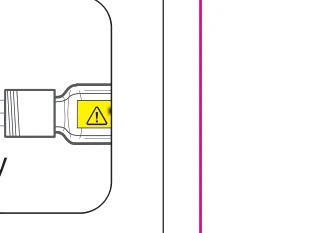
PLEASE READ THESE INSTRUCTIONS BEFORE USE
USE ONLY IN THIS PEN, OR
SEVERE OVERDOSE CAN RESULT
Read the instructions for use before you start taking Lyumjev and each time you get another Lyumjev KwikPen. There may be new information. This information does not take the place of talking to your healthcare professional about your medical condition or your treatment. Do not share your Lyumjev KwikPen with other people, even if the needle has been changed. Do not reuse or share needles with other people. You may give other people a serious infection or get a serious infection from them.
Lyumjev 200 units/mL KwikPen (“Pen”) is a disposable pre-filled pen containing 3 mL (600 units, 200 units/mL) of insulin lispro solution for injection.
- Your healthcare professional will tell you how many units to give as your dose and how
to inject your prescribed dose of insulin.
- You can give yourself more than 1 dose from the Pen.
- Each turn of the dose knob dials 1 unit of insulin. You can give from 1 to 60 units in
a single injection.
If your dose is more than 60 units, you will need to give yourself more than 1 injection.
Always check the number in the dose window to make sure you dialled the correct dose.
- The plunger only moves a little with each injection, and you may not notice that it
moves. The plunger will only reach the end of the cartridge when you have used all 600 units in the Pen.
This Pen is designed to allow you to give more doses than other pens you may have used in the past. Dial your usual dose as instructed by your healthcare professional. Lyumjev KwikPen is available in two strengths, 100 units/mL and 200 units/mL. 
 Inject Lyumjev 200 units/mL only with your Pen. Do not transfer insulin from your Pen to another insulin delivery device. Syringes and insulin pumps will not measure 200 units/mL of insulin correctly. A severe overdose can result, causing very low blood sugar which may put your life in danger.
People who are blind or have vision problems should not use the Pen without help from a person trained to use the Pen.
Lyumjev KwikPen Parts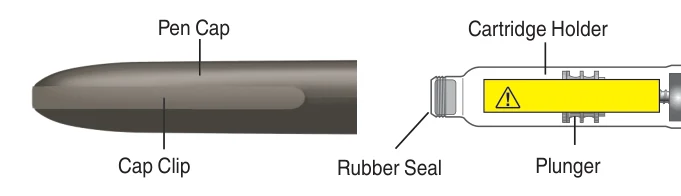
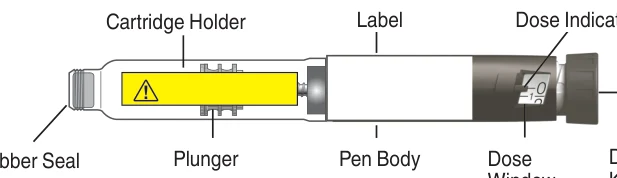
Pen Cap
Cap Clip Rubber Seal
Cartridge Holder Label Dose Indicator
Dose Knob Dose
Window Pen Body
Plunger

Outer
Needle
Shield
Inner
Needle
Shield
Paper Tab
Needle
Pen Needle Parts
(Needles Not Included)
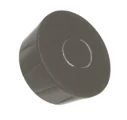
Dose Knob
How to recognize your Lyumjev KwikPen
- Pen colour: Taupe
- Dose Knob: Taupe, with raised ridges on side
Label: White with a blue colour bar and checkerboard design.
Yellow warning on cartridge holder.
Supplies needed to give your injection
- Lyumjev KwikPen
KwikPen compatible needle (BD [Becton, Dickinson and Company]
Pen needles recommended)
- Swab or gauze
Preparing your Pen
- Wash your hands with soap and water.
Check the Pen to make sure you are taking the right type of insulin. This is especially
important if you use more than 1 type of insulin.
Do not use your Pen past the expiry date printed on the label or for more than
28 days after you first start using the Pen.
Always use a new needle for each injection to help prevent infections and blocked
needles.
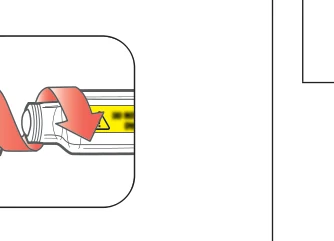
Pull the Pen cap straight off.
- Do not remove the Pen label.
Wipe the rubber seal with a swab.
USE ONLY IN THIS PEN, OR SEVERE OVERDOSE CAN RESULT
- Check the liquid in the Pen.
Lyumjev should look clear and
colourless. Do not use if it is cloudy,
coloured, or has particles or clumps
in it.
- Select a new needle.
Pull off the paper tab from the outer
needle shield.
Push the capped needle straight
onto the Pen and twist the needle on
until it is tight.
Pull off the outer needle shield.
Do not throw it away.
Pull off the inner needle shield and throw it away.
Keep Throw Away
Priming your Pen
Prime before each injection.
- Priming your Pen means removing the air from the needle and cartridge that may collect during normal use and ensures that your Pen is working correctly.
If you do not prime before each injection, you may get too much or too little insulin.
- To prime your Pen, turn the dose knob to select 2 units.
Hold your Pen with the needle pointing up.
Tap the cartridge holder gently to collect air bubbles at the top.
Continue holding your Pen with the needle pointing up. Push the dose knob in until it stops and “0” is seen in the dose window.
Hold the dose knob in and count to
5 slowly.
You should see insulin at the tip of the Needle.
- If you do not see insulin, repeat priming steps 6 to 8, but not more than 8 times.
- If you still do not see insulin, change the needle and repeat priming steps 6 to 8.
Small air bubbles are normal and will not affect your dose.
PA030FSAA02
Selecting your dose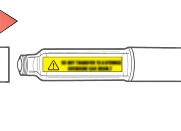
This Pen has been designed to deliver the dose that is shown in the dose window. Dial your usual dose as instructed by your healthcare professional.
- You can give from 1 to 60 units in a single injection.
- If your dose is more than 60 units, you will need to give more than 1 injection.
If you need help dividing up your dose the right way, ask your healthcare
professional.
Use a new needle for each injection and repeat the priming steps.
Turn the dose knob to select the number of
units you need to inject. The dose indicator
should line up with your dose.
- The Pen dials 1 unit at a time.
- The dose knob clicks as you turn it.
Do not dial your dose by counting the
clicks. You may dial the wrong dose. This
may lead to getting too much insulin or not
enough insulin.
The dose can be corrected by turning
the dose knob in either direction until
the correct dose lines up with the dose
indicator.
The even numbers are printed on the dial.
The example to the right shows 12 units.
The odd numbers, after the number 1, are
shown as full lines between the numbers.
The example to the right shows 25 units.
Always check the number in the dose window to make sure you have dialled the correct dose.
Example: 12 units shown in the
dose window
Example: 25 units shown in the
dose window
- The Pen will not let you dial more than the number of units left in the Pen.
If you need to inject more than the number of units left in the Pen, you may either:
- inject the amount left in your Pen and then use a new Pen to give the rest of your dose, or
- get a new Pen and inject the full dose.
It is normal to see a small amount of insulin left in the Pen that you cannot inject.
Do not transfer this to a syringe. Severe overdose can result.
Giving your injection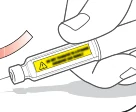


- Inject your insulin as your healthcare professional has shown you.


- Change (rotate) your injection site for each injection.


Do not try to change your dose while injecting.
- Choose your injection site.
Lyumjev is injected under the skin 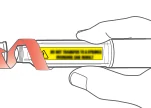
(subcutaneously) of your stomach area,
buttocks, upper legs or upper arms.
Wipe your skin with a swab, and let your skin
dry before you inject your dose.
- Insert the needle into your skin.
- Push the dose knob all the way in.
Continue to hold the dose knob
in and slowly count to 5 before
removing the needle.
Do not try to inject your insulin by turning the dose knob. You will not receive your insulin by turning the dose knob.
Pull the needle out of your skin.
A drop of insulin at the needle tip is
normal. It will not affect your dose.
Check the number in the dose window.
If you see “0” in the dose window, you
have received the full amount you dialled.
If you do not see “0” in the dose window,
you did not receive your full dose. Do not redial. Insert the needle into your skin and finish your injection.
If you still do not think you received
the full amount you dialled for your injection, do not start over or repeat that injection. Monitor your blood glucose as instructed by your healthcare professional.
If you normally need to give 2 injections
for your full dose, be sure to give your second injection.
The plunger only moves a little with each injection, and you may not notice that it moves. If you see blood after you take the needle out of your skin, press the injection site lightly with a piece of gauze or a swab. Do not rub the area.
5 sec
After your injection
- Carefully replace the outer needle shield.
Unscrew the capped needle and dispose
of it as described below (see “Disposing of Pens and needles” section).
Do not store the Pen with the needle
attached to prevent leaking, blocking the needle, and air from entering the Pen.
- Replace the Pen cap by lining up the cap clip with the dose indicator and pushing straight on.
Disposing of Pens and needles
Put used needles in a sharps container or a hard plastic container with a secure lid.
Do not throw needles directly into your household waste.
- Do not recycle the filled sharps container.
- Ask your healthcare professional about options to dispose of the Pen and the sharps container properly.
- The directions regarding needle handling are not intended to replace local, healthcare professional or institutional policies.
Troubleshooting
- If you cannot remove the Pen cap, gently twist the cap back and forth, and then pull the cap straight off.
If the dose knob is hard to push:
- pushing the dose knob more slowly will make it easier to inject.
- your needle may be blocked. Put on a new needle and prime the Pen.
- you may have dust, food, or liquid inside the Pen. Throw the Pen away and get a new Pen.
If you have any questions or problems with your Lyumjev 200 units/mL KwikPen, call your healthcare professional for help or contact your local Lilly affiliate. Document Revision Date: December 2024
PA030FSAA02