


Summary of Product Characteristics (SmPC) - Lynavoy 40 mg film coated tablets
1 NAME OF THE MEDICINAL PRODUCT
Lynavoy 40 mg film-coated tablets
2 QUALITATIVE AND QUANTITATIVE COMPOSITION
Each film-coated tablet contains 40 mg linerixibat.
For the full list of excipients, see section 6.1.
3 PHARMACEUTICAL FORM
Film-coated tablet
Purple, round, biconvex film-coated tablets (9 mm in diameter), debossed with “GS 3JG” on one side.
4 CLINICAL PARTICULARS
4.1 Therapeutic indications
Lynavoy is indicated for the treatment of cholestatic pruritus in adult patients with primary biliary cholangitis (PBC).
4.2 Posology and method of administration
Posology
The recommended dose of Lynavoy is 40 mg twice daily.
Concomitant administration with bile acid binding resins
It is recommended that Lynavoy is taken at least 4 hours before or 4 hours after taking a bile acid binding resin (see sections 4.5 and 5.2).
Missed doses
If a dose is missed, it may be taken as soon as possible. However, a double dose must not be taken to make up for a missed dose.
Special populations
Elderly
No dose adjustment is required for patients 65 years of age or older (see section 5.2).
Renal impairment
No dose adjustment is required for patients with renal impairment (see section 5.2).
Hepatic impairment
No dose adjustment is required for patients with mild or moderate (Child-Pugh A or B) hepatic impairment (see section 5.2). Prior to initiation of treatment with linerixibat the patient's hepatic status must be known. Whether the patient has decompensated cirrhosis (including Child-Pugh Class C) or has had a prior decompensation event should be determined prior to initiation of treatment. Linerixibat is not recommended in patients with severe hepatic impairment. No data are available for patients with severe hepatic impairment (Child-Pugh C).
Paediatric population
The safety and efficacy of Lynavoy have not been established in children and adolescents less than 18 years of age. No data are available.
Method of administration
Oral use.
It is recommended that Lynavoy is swallowed whole and taken approximately 30 minutes before any food or beverage (other than water) (see section 5.2).
4.3 Contraindications
Hypersensitivity to the active substance or to any of the excipients listed in section 6.1.
4.4 Special warnings and precautions for use
Transaminase elevations
In clinical studies, treatment emergent transaminase elevations were observed in some patients receiving linerixibat (see section 4.8). It is recommended that baseline transaminase (alanine aminotransferase [ALT] and aspartate aminotransferase [AST]) levels are obtained prior to initiating treatment with linerixibat and transaminases monitored at a frequency aligned with standard clinical practice for PBC patients. For transaminase elevations, more frequent monitoring may be required. If transaminase elevations persist, weigh the potential risks against the benefit of continuing treatment.
Obeticholic acid (OCA)
Concomitant administration of linerixibat and OCA may decrease the efficacy of OCA (see section 4.5). It is recommended to monitor biochemical response during treatment with OCA when patients initiate linerixibat.
Excipients
This medicinal product contains less than 1 mmol sodium (23 mg) per tablet, that is to say essentially ‘sodium-free’.
4.5 Interaction with other medicinal products and other forms of interaction
Bile acid binding resins
Bile acid binding resins (such as colestyramine, colesevelam, or colestipol) may bind to other medicinal products, including linerixibat, in the gut when administered concurrently, and therefore may reduce the efficacy of linerixibat (see section 5.2). It is recommended that patients take linerixibat at least 4 hours before or 4 hours after taking a bile acid binding resin (see section 4.2).
Obeticholic acid (OCA)
Concomitant administration of linerixibat and OCA decreased plasma concentrations of OCA conjugates (taurine and glycine) (see section 5.2). This interaction may decrease the efficacy of OCA as the conjugates are equipotent with OCA. It is recommended to monitor the biochemical response (e.g., alkaline phosphatase (ALP) and bilirubin) during treatment with OCA when patients initiate linerixibat.
Ursodeoxycholic acid (UDCA)
UDCA can be coadministered with Lynavoy, and no dose adjustments are required. In clinical studies, concomitant administration of UDCA with linerixibat had no significant effect on UDCA plasma concentrations and no clinically relevant increases in ALP were observed (see section 5.2).
4.6 Fertility, pregnancy and lactation
Pregnancy
There are no or limited amount of data from the use of linerixibat in pregnant women.
Animal studies do not indicate direct or indirect harmful effects with respect to reproductive toxicity (see section 5.3). Systemic absorption following oral administration of linerixibat in humans is minimal (see section 5.2). Therefore, foetal exposure to the drug is also expected to be minimal.
As a precautionary measure, it is preferable to avoid the use of Lynavoy during pregnancy.
Breast-feeding
It is unknown whether linerixibat is excreted in human milk.
Animal studies have shown excretion of linerixibat in milk; however, at the recommended clinical dose, neonatal exposure via breast milk is expected to be minimal (see section 5.3). No effects on the breastfed suckling child are anticipated since the systemic exposure of the breast-feeding woman to linerixibat is negligible.
A risk to the suckling child cannot be excluded. A decision must be made whether to discontinue breast-feeding or to discontinue/abstain from Lynavoy therapy, taking into account the benefit of breast-feeding for the child and the benefit of therapy for the mother.
Fertility
No fertility data are available in humans. Animal studies do not indicate any direct or indirect effects on fertility or reproduction at clinically relevant exposures (see section 5.3).
4.7 Effects on ability to drive and use machines
Lynavoy has no or negligible influence on the ability to drive and use machines. A detrimental effect on such activities would not be anticipated from the minimal systemic exposure, pharmacology or adverse reaction profile of linerixibat.
4.8 Undesirable effects
Summary of the safety profile
The most frequently reported adverse reactions were diarrhoea (59 %) and abdominal pain (23 %).
Tabulated list of adverse reactions
The adverse reaction profile of linerixibat was evaluated in a pooled safety data set (Phase 3 GLISTEN and Phase 2b GLIMMER) including a total of 142 patients receiving linerixibat 40 mg twice daily orally (see section 5.1). The majority of adverse reactions were mild or moderate.
Adverse reactions are listed below (Table 1) by MedDRA system organ class and frequency grouping. Frequencies are defined as: very common (≥ 1/10) and common (≥ 1/100 to < 1/10).
Table 1. Adverse reactions reported in patients treated with Lynavoy
| MedDRA system organ class | Frequency | Adverse reactions |
| Gastrointestinal disorders | Very common | Diarrhoea Abdominal pain |
| Investigations | Common | Alanine aminotransferase (ALT) increased Aspartate aminotransferase (AST) increased |
Description of selected adverse reactions
Diarrhoea
In the pooled safety dataset, diarrhoea was observed in 59% of patients in the linerixibat treatment group. Discontinuation of treatment due to diarrhoea occurred in 4% of study patients in the linerixibat treatment group. Most diarrhoea was experienced within 1 week of initiating treatment. The majority of diarrhoea events were mild in intensity, and none were serious. Of those who experienced diarrhoea, the majority of patients were able to continue linerixibat without treatment discontinuation or interruption, and most resolved during the study. Some patients who experienced diarrhoea received antidiarrhoeals (e.g., loperamide) to manage symptoms.
Reporting of suspected adverse reactions
Reporting suspected adverse reactions after authorisation of the medicinal product is important. It allows continued monitoring of the benefit/risk balance of the medicinal product. Healthcare professionals are asked to report any suspected adverse reactions via the Yellow Card Scheme website: www.mhra.gov.uk/yellowcard or search for MHRA Yellow Card in the Google Play or Apple App Store.
4.9 Overdose
Symptoms
An overdose may result in symptoms from an exaggeration of the known adverse effects of the medicinal product, mainly gastrointestinal effects.
In clinical studies, linerixibat was given to adults with cholestatic pruritus in PBC at doses up to 180 mg daily (single and/or divided doses), and a dose dependent increase in the incidence of gastrointestinal adverse reactions was observed (see section 4.8).
Management
There is no specific antidote. If an overdose occurs, discontinue linerixibat, monitor the patient for any signs and symptoms and institute general supportive measures if needed. Further management should be as clinically indicated or as recommended by the national poisons centre, where available.
5 PHARMACOLOGICAL PROPERTIES
5.1 Pharmacodynamic properties
Pharmacotherapeutic group: Bile and liver therapy, other drugs for bile therapy, ATC code: A05AX08
Mechanism of action
Linerixibat is a reversible inhibitor of the ileal bile acid transporter (IBAT). It decreases the reabsorption of bile acids in the ileum leading to their increased faecal elimination.
Cholestatic pruritus is common in patients with PBC, though the pathophysiology of pruritus in patients with PBC is not completely understood. Linerixibat improves pruritus in PBC patients through inhibition of IBAT as observed by a decrease in mediators of pruritus including serum bile acids, lysophosphatidic acid (LPA) [via measurement of autotaxin as a surrogate] and interleukin 31 (IL-31).
Pharmacodynamic effects
Linerixibat reduces total serum bile acids in healthy volunteers and in PBC patients with cholestatic pruritus. In healthy volunteers, serum bile acids were reduced within 1 day of treatment with linerixibat compared to placebo treatment. In the Phase 3 study (GLISTEN), total serum bile acids, autotaxin and IL-31 were significantly reduced from baseline over 24 weeks as compared to the placebo treatment group (p <0.001).
Clinical efficacy
The efficacy and safety of linerixibat in the treatment of cholestatic pruritus in patients with PBC were evaluated in a randomised, double-blind, placebo-controlled, multi-centre, global Phase 3 study, GLISTEN. Patients (N=238) were randomised to Lynavoy 40 mg twice daily (N=119) or placebo (N=119) for 24 weeks. One patient randomised to placebo withdrew before initiating treatment.
Eligible patients had a confirmed diagnosis of PBC and moderate or severe pruritus (assessed by the Worst Itch Numerical Rating Scale [Worst Itch NRS], as described below) in the 4 weeks prior to randomisation. Patients who were on stable UDCA, fibrates, bile acid binding resins or other antipruritic therapy at baseline were eligible to enrol and to continue their PBC and/or pruritus treatment regimen unchanged throughout the duration of the study.
Exclusion criteria included hepatic decompensation, chronic viral hepatitis, symptomatic cholelithiasis, active cholecystitis, primary sclerosing cholangitis, alcoholic liver disease, current malignancies, bariatric surgery with ileal bypass, skin disorders with itch, clinically significant diarrhoea, severe renal impairment (estimated glomerular filtration rate [eGFR] < 30 mL/min/1.73 m2) and treatment with OCA.
The mean age of patients was 55.8 years (range 30 to 80), 95% were female, 58% were Caucasian, 30% were Asian, 3% were American Indian or Alaska Native and <1% were Black; and for ethnicity, 23% identified as Hispanic /Latino.
For the 238 randomised patients, the mean (range) ALP at baseline was 234 IU/L (46.5 to 1,102): 24% of subjects were ≤1 times the upper limit of normal (x ULN), 29% were >1 x ULN and <1.67 x ULN, and 48% were ≥1.67 x ULN. Mean (SD) baseline itch severity was 7.3 (1.5) based on Worst Itch NRS with 42% categorized as having moderate itch and 58% as having severe itch.
At baseline approximately 97% of patients in both the linerixibat and placebo groups were receiving UDCA. A total of 44% of patients randomised to linerixibat, and 50% randomised to placebo, were receiving concomitant medications that could impact pruritus, which included fibrates, selective serotonin reuptake inhibitors, bile acid binding resins, gabapentin, antihistamines, opiate antagonists, rifampicin and pregabalin.
The primary efficacy endpoint was change from baseline in pruritus over 24 weeks. A step-down/hierarchical approach was used to test the following key secondary endpoints:
- Change from baseline in pruritus at Week 2.
- Change from baseline in pruritus-related sleep interference over 24 weeks.
- Three responder groups defined as those achieving either a ≥ 2-, ≥ 3- or ≥ 4-point reduction (improvement) from baseline in the Worst Itch NRS Score at Week 24.
Patients rated their itch severity twice daily (in the morning and evening) using the validated Worst Itch NRS which ranged from 0 (no itching) to 10 (worst imaginable itching). The worst of the two scores recorded in a day was considered the Worst Daily Itch Score. The Weekly Itch Score was the average of the Worst Daily Itch Scores in one week. To calculate a Weekly Itch Score for any given week, ≥4 Worst Daily Itch Scores were needed. The worst Weekly Itch Score during a 4-week period was the Monthly Itch Score. A Monthly Itch Score of ≥4 to <7 was considered moderate and ≥7 was considered severe pruritus.
Sleep interference due to pruritus was assessed each morning using the Sleep Interference NRS, which ranged from 0 (did not interfere) to 10 (completely interfered). The Weekly Sleep Score was the average of the daily sleep scores recorded over one week where ≥4 daily scores were available. The worst Weekly Sleep Score during a 4-week period was the Monthly Sleep Score.
Additional patient-reported itch assessments included the Patient Global Impression of Severity (PGI-S) and Patient Global Impression of Change (PGI-C) items. PGI-S assesses itch severity over the past 7 days using a 5-level response scale (1=absent, 2=mild, 3=moderate, 4=severe, and 5=very severe), and PGI-C assesses patient views on change in itch since study start using a 7-level response scale (1=very much improved, 2=moderately improved, 3=minimally improved, 4=no change, 5=minimally worse, 6=moderately worse, and 7=very much worse).
Worst Itch NRS Scores
In GLISTEN, linerixibat demonstrated a significant improvement from baseline in pruritus compared with placebo over 24 weeks of treatment (primary endpoint) as shown in Table 2.
Table 2. Change from Baseline in Worst Itch NRS Score Over 24 Weeks (GLISTEN; ITT Population)
| Linerixibat (n = 119) | Placebo (n = 118) | |||
| Baseline Monthly Itch Score, Mean (SD)a | 7.33 (1.63) | 7.36 (1.45) | ||
| Analysis of Change from Baseline in Monthly Itch Score Over 24 Weeks | b | |||
| Change from Baseline LS Mean (95% CI) | -2.86 (-3.23, -2.50) | -2.15 (-2.51, -1.78) | ||
| LS Mean Difference vs. Placebo (95% CI) | -0.72 (-1.15, -0.28) p=0.001 | |||
ITT = Intent to Treat; SD = standard deviation; LS = least squares; CI = confidence interval
a Baseline determined from all placebo patients, n=119.
b Based on a least squares mean from a mixed-effect model for repeated measures (MMRM) for change from baseline in Monthly Itch Score over the 24-week period with terms for treatment, visit, treatment by visit interaction, baseline itch, baseline itch by visit interaction, and use of baseline concomitant itch medication.
There was significant improvement in pruritus by Week 2 based on the Worst Itch NRS (Weekly Itch Score) for the linerixibat treatment group compared with placebo (LS mean difference -0.71 [-1.07, -0.34], p < 0.001). Improvement in pruritus with linerixibat when compared with placebo was also observed beyond Week 2 with consistently higher levels of improvement seen throughout the remaining weeks of treatment (Figure 1).
Figure 1. Mean Treatment Group Change from Baseline in Worst Itch NRS Score through Week 24 (GLISTEN, ITT Population) 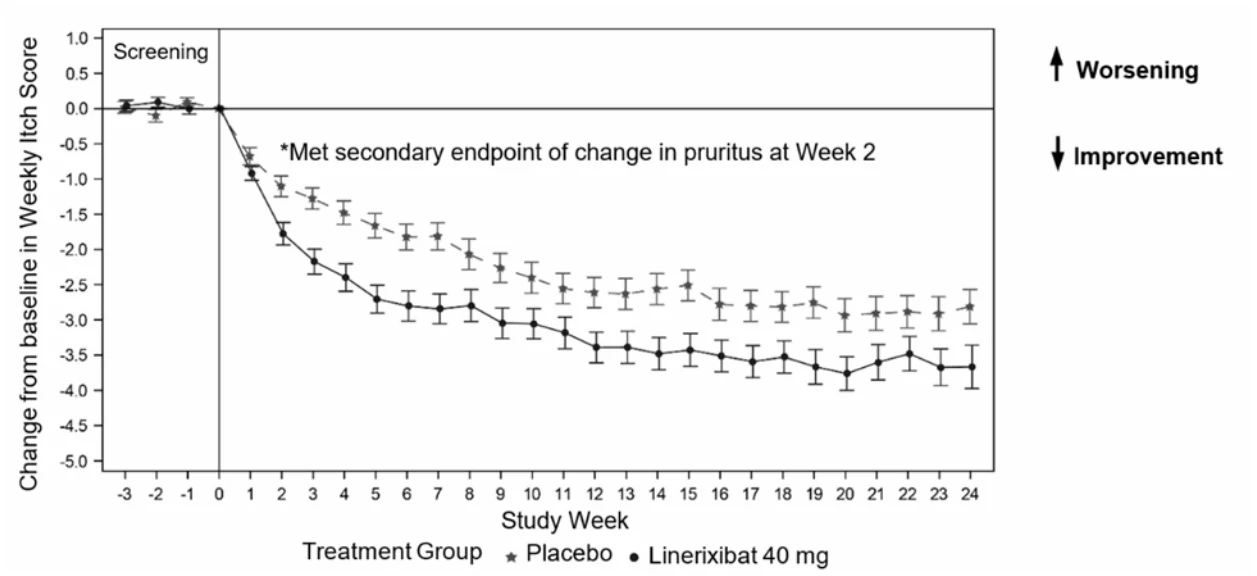
ITT = Intent to Treat; NRS = Numerical Rating Scale.
Itch Responders
A higher proportion of patients randomised to linerixibat compared with placebo achieved a clinically meaningful itch response at Week 24 when defined as an improvement of ≥2-, ≥3-, or ≥4-points from baseline in the Worst Itch NRS Score (Table 3).
Table 3. Analysis for Difference in Itch Responder Rates at Week 24 (GLISTEN; ITT Population)
| % | |||||||
| Treatment Group | n | Adjusted Difference vs Placebo (95% CI)a | |||||
| Responders | |||||||
| ≥ | |||||||
| Responder: reduction in Monthly Itch Score from Baseline 2 | |||||||
| Linerixibat 40 mg | 119 | 68% | 4% (-9%, 17%) ≥ | ||||
| Placebo | 119 | 64% | |||||
| Responder: reduction in Monthly Itch Score from Baseline 3 | |||||||
| Linerixibat 40 mg | 119 | 56% | 13% (0%b, 27%) ≥ | ||||
| Placebo | 119 | 43% | |||||
| Responder: reduction in Monthly Itch Score from Baseline 4 | |||||||
| Linerixibat 40 mg | 119 | 41% | 12% (0%c, 24%) | ||||
| Placebo | 119 | 29% | |||||
ITT = Intent to Treat
a Based on Cochran-Mantel-Haenszel (CMH) stratified analysis adjusting for the following Baseline stratification factors: Baseline Itch Severity (Moderate: ≥4 and <7, Severe: ≥7); Concomitant cholestatic pruritus treatment regimen (Regimen contains Bile Acid Binding Resin [BABR], Regimen that does not contain BABR, No defined anti-cholestatic pruritus treatment). Combined results from multiple imputation. b The lower limit of the 95% CI represents a rounded value of 0.4% c The lower limit of the 95% CI represents a rounded value of -0.4%
Pruritus-Related Sleep Interference
Patients randomised to linerixibat had significantly improved pruritus-related sleep interference compared with placebo over 24 weeks of treatment (Table 4).
Table 4. Change from Baseline in Sleep Interference NRS Score Over 24 Weeks (GLISTEN; ITT Population)
| Linerixibat (n = 119) | Placebo (n = 118) | |||
| Baseline Monthly Sleep Score, Mean (SD)a | 6.29 (2.69) | 6.33 (2.10) | ||
| Analysis of Change from Baseline in Monthly Sleep Score Over 24 Weeks | b | |||
| Change from Baseline LS Mean (95% CI) | -2.77 (-3.15, -2.38) | -2.24 (-2.62, -1.86) | ||
| LS Mean Difference vs. Placebo (95% CI) | -0.53 (-0.98, -0.07) p=0.024 | |||
ITT = Intent to Treat; SD = standard deviation; LS = least squares; CI = confidence interval
a Baseline determined from all placebo patients, n=119.
b Based on a least squares mean from a mixed-effect model for repeated measures (MMRM) for change from baseline in Monthly Sleep Score over the 24-week period with terms for treatment, visit, treatment by visit interaction, baseline itch, baseline itch by visit interaction, and use of baseline concomitant itch medication.
Additional Itch-related Assessments
At baseline, patients randomised to both linerixibat and placebo reported similar levels of itch severity (over past 7 days). Patients randomised to linerixibat reported improvement from baseline in itch severity based on the PGI-S when compared to placebo over 24 weeks (LS mean change from baseline -1.22 vs. -0.84; LS mean difference -0.37 [95% CI: -0.55, -0.20]). At Week 24, a larger proportion of linerixibat patients compared to placebo reported ‘absent’ or ‘mild’ itch, while a smaller proportion of linerixibat patients reported ‘moderate’, ‘severe’, or ‘very severe’ (Table 5).
Table 5. Patient Global Impression of Severity (PGI-S) Response at Baseline and Week 24 (GLISTEN; ITT Population)
| PGI-Sa | Linerixibat | Placebo | ||
| Baseline n=115 | Week 24 n=97 | Baseline n=113 | Week 24 n=101 | |
| Absent | 1 (<1%) | 20 (21%) | 1 (<1%) | 9 (9%) |
| Mild | 10 (9%) | 46 (47%) | 9 (8%) | 42 (42%) |
| Moderate | 49 (43%) | 22 (23%) | 41 (36%) | 31 (31%) |
| Severe | 42 (37%) | 6 (6%) | 49 (43%) | 14 (14%) |
| Very Severe | 13 (11%) | 3 (3%) | 13 (12%) | 5 (5%) |
a Overall, how would you rate the severity of your itch during the past 7 days?
Patients randomised to linerixibat reported itch improvement based on the PGI-C over 24 weeks compared to placebo (LS mean 1.97 vs. 2.46; LS mean difference -0.49 [95% CI: -0.76, -0.21]). For the PGI-C, a larger proportion of patients randomised to linerixibat compared to placebo reported their itch severity had ‘very much improved’ (since study start), including at Week 24 (Table 6). More patients randomised to placebo (24%) reported ‘no change’ in their itch compared to patients in the linerixibat group (3%).
Table 6. Patient Global Impression of Change (PGI-C) Response at Week 24 (GLISTEN; ITT Population)
| PGI-Ca | Linerixibat | Placebo |
| Week 24 | n=97 | n=102 |
| Very Much Improved | 53 (55%) | 38 (37%) |
| Moderately Improved | 25 (26%) | 24 (24%) |
| Minimally Improved | 12 (12%) | 15 (15%) |
| No Change | 3 (3%) | 24 (24%) |
| Minimally Worse | 1 (1%) | 0 |
| Moderately Worse | 2 (2%) | 1 (<1%) |
| Very Much Worse | 1 (1%) | 0 |
a Overall, how would you rate the change in severity of your itch since you first started this study?
Maintenance of Efficacy
Maintenance of efficacy with linerixibat was evaluated in a subset of patients (i.e., patients who were itch responders at Week 24) who completed 52 weeks of continuous treatment by participation in GLISTEN and the ongoing, open-label, uncontrolled, linerixibat long-term safety and tolerability study (LLSAT). Any Week 24 responders who withdrew prior to Week 52 were considered non-responders at Week 52. At Week 24 and Week 52, responders were defined as patients achieving a ≥ 2-, ≥ 3- or ≥ 4-point reduction (improvement) from baseline in their Worst Itch NRS Score (Monthly Itch Score). The majority of patients who achieved responder status at Week 24 maintained response at Week 52 (70.6% [≥ 2-point], 77.8% [≥ 3-point] and 78.3% [≥ 4-point]).
Paediatric population
The Medicines and Healthcare products Regulatory Agency (MHRA) has waived the obligation to submit the results of studies with Lynavoy in all subsets of the paediatric population in the treatment of cholestatic pruritus with PBC (see section 4.2 for information on paediatric use).
5.2 Pharmacokinetic properties
Linerixibat inhibits the ileal bile acid transporter in the lumen of the small intestine; therefore, plasma levels of linerixibat are not relevant to its clinical efficacy. Following single and repeated oral administration of linerixibat, plasma concentrations were often below the limit of quantification (10 pg/mL).
Absorption
Linerixibat is minimally absorbed following oral administration. The absolute oral bioavailability of linerixibat is 0.05 %. Following multiple doses of linerixibat 40 mg twice daily in PBC patients with cholestatic pruritus, the mean Cmax (95 % CI) was 922 pg/mL (347, 1500).
Effect of food
The effect of food on linerixibat plasma concentrations is not clinically relevant. Due to the minimal absorption of linerixibat, pharmacokinetic parameters in the food effect study were highly variable. Peak systemic concentrations of linerixibat (Cmax) were lower when 40 mg linerixibat was administered orally under fed compared to fasted conditions (geometric least squares mean ratio 0.663, 90 % CI 0.443 to 0.991). Despite the lack of clinically important pharmacokinetic effects with food, it is recommended to administer linerixibat approximately 30 minutes prior to food or beverage (other than water) to allow linerixibat to enter the gastrointestinal lumen prior to release of bile acids upon eating (see section 4.2).
Distribution
The in vitro plasma protein binding range of linerixibat was 71.0 to 76.4%
Biotransformation
Following administration of oral radiolabelled linerixibat, no linerixibat metabolites have been detected in plasma. Three minor oxidative metabolites were detected in faeces, and each accounted for negligible radioactivity (less than 1 %), demonstrating that linerixibat is minimally metabolised in humans.
Elimination
Following oral administration of radiolabelled linerixibat, approximately 97 % of the dose was excreted in faeces; approximately 0.04 % of the dose was excreted in urine. More than 99 % of faecal radioactivity was determined to be unchanged and unabsorbed linerixibat.
Special populations
No clinically meaningful differences in the pharmacokinetics of linerixibat were observed based on body weight, age, sex, or race, including Asian, and Caucasian patients. There are no data available in patients over 85 years of age.
Renal impairment
Linerixibat has not been studied in patients with severe renal impairment or end stage renal disease (ESRD) including those on haemodialysis. Renal impairment is not expected to impact linerixibat exposure, because linerixibat is minimally absorbed and has negligible recovery in urine (<0.04% of the oral dose).
Hepatic impairment
Hepatic metabolism is not a major component of the elimination of linerixibat. In a pharmacokinetic study in participants with moderate hepatic impairment (Child Pugh B), the mean AUC(0-∞) and Cmax values were approximately 13 times and 9.4 times higher than matched healthy subjects. However, given that linerixibat is minimally absorbed, the systemic exposures in participants with moderate hepatic impairment following a 40 mg dose were still exceedingly low (Cmax 1980 pg/mL) and were of a similar magnitude to exposures following a 40 mg dose in patients with PBC (Cmax 922 pg/mL). Linerixibat has not been studied in patients with severe hepatic impairment (Child Pugh C).
Drug interactions
Bile acid binding resins
Colestyramine and colesevelam bind linerixibat in vitro (78-95 % bound); therefore, these resins have the potential to inhibit the effect of linerixibat on its target, IBAT (see sections 4.2 and 4.5).
IBAT substrates
Obeticholic acid (OCA)
In a drug interaction study, healthy volunteers received linerixibat 40 mg twice daily and either 10 mg OCA (administered with the morning dose of linerixibat), or 5 mg OCA once daily (administered 4 hours after the morning dose of linerixibat). Decreases of 64 % in total-OCA AUC(0-24), 57% in Cmax, and 71% in mean Ctrough were observed in those receiving 10 mg OCA. Results were comparable in those receiving 5 mg OCA, demonstrating approximate decreases of 71% in total-OCA AUC(0-24), 65% in Cmax, and 73% in mean Ctrough. The decrease in total-OCA is primarily driven by the decrease in its tauro- and glyco-OCA conjugates (see section 4.5).
Ursodeoxycholic acid (UDCA)
In linerixibat clinical studies, concomitant administration of UDCA with linerixibat had no effect on UDCA plasma concentrations and no clinically relevant increases in ALP were observed (see section 4.5). The geometric mean ratio (90% CI) for dose-normalized UDCA AUC(0-24) was 0.99 (0.83, 1.19) when comparing co-administration of UDCA with linerixibat vs. with placebo.
Effects of linerixibat on cytochrome P450 enzymes (CYPs) and transporters
In in vitro studies, linerixibat did not inhibit CYPs 1A2, 2A6, 2B6, 2C8, 2C9, 2C19, 2D6, and 2E1, but was an inhibitor of CYP3A4. Due to the low fraction absorbed, an interaction based on CYP3A4 inhibition is not likely. Linerixibat did not induce CYPs 1A2, 2B6, and 3A4.
Linerixibat does not inhibit the transporters P-glycoprotein, breast cancer resistance protein (BCRP), organic anion transporters (OAT) 1 and 3, organic cation transporter (OCT) 2, and multi drug and toxin extrusion protein (MATE) 1 and 2-K. In vitro studies suggest that there is a potential for linerixibat to inhibit OATP1B1 and OATP1B3. However, due to the low fraction absorbed, an interaction is not likely.
5.3 Preclinical safety data
Non-clinical data reveal no special hazard for humans based on studies of safety pharmacology, repeat-dose toxicity, genotoxicity, carcinogenic potential, or toxicity to reproduction.
Carcinogenic potential
Linerixibat was not carcinogenic in transgenic rasH2 mice when administered orally at doses of 15, 50 or 160 mg/kg/day for six months or in rats when administered orally at doses of 250, 500 or 1000 mg/kg/day in a two-year carcinogenicity study (systemic exposures up to 5-times (for mice) and 38-times (for rats) the AUC at the maximal recommended human dose (MRHD)).
Linerixibat did not cause gene mutation or chromosomal damage in two in vitro assays (bacterial mutagen and chromosomal aberration) or an in vivo rat bone marrow micronucleus assay.
Reproductive and developmental toxicity
Linerixibat did not cause developmental toxicity in definitive rat or rabbit embryo-foetal development studies at doses up to 11-times (for rats) and 4.5-times (for rabbits) the AUC at the MRHD.
Linerixibat had no effect on male or female fertility or early embryonic development in rats or on offspring during gestation and lactation when administered to dams at exposures approximately 12-times the AUC at the MRHD. Linerixibat was present in the plasma of offspring (up to 15.3 ng/mL) via lactational exposure.
6 PHARMACEUTICAL PARTICULARS
6.1 List of excipients
Tablet core
Microcrystalline cellulose (E 460)
Croscarmellose sodium (E 468)
Magnesium stearate (E 470b)
Tablet coating
Hypromellose (E 464)
Titanium dioxide (E 171)
Macrogol (E 1521)
Iron oxide black (E 172)
Iron oxide red (E 172)
6.2 Incompatibilities
Not applicable.
6.3 Shelf life
4 years.
6.4 Special precautions for storage
This medicinal product does not require any special temperature storage conditions.
Store in the original package to protect from moisture. Keep the bottle tightly closed.
Do not remove or swallow the desiccant canister in the bottle.
6.5 Nature and contents of container
Opaque, white high-density polyethylene (HDPE) bottles with polypropylene child-resistant closures and polyethylene induction heat seal liner, containing a HDPE canister with silica gel desiccant.
Pack sizes available:
- single bottles containing 60 film-coated tablets.
- multipacks containing 180 (3 bottles of 60) film-coated tablets.
Not all pack sizes may be marketed.
6.6 Special precautions for disposal
No special requirements for disposal.
Any unused medicinal product or waste material should be disposed of in accordance with local requirements.
7 MARKETING AUTHORISATION HOLDER
GlaxoSmithKline UK Limited
79 New Oxford Street
London
WC1A 1DG
United Kingdom
8 MARKETING AUTHORISATION NUMBER(S)
PL 19494/0330
9 DATE OF FIRST AUTHORISATION/RENEWAL OF THE
AUTHORISATION
01/05/2026
10 DATE OF REVISION OF THE TEXT
01/05/2026