

Patient leaflet - Lusama 20 micrograms/80 microlitres solution for injection in Pre-filled pen
1. What Lusama is and what it is used for
Lusama contains the active substance
teriparatide that is used to make the
bones stronger and to reduce the risk of
fractures by stimulating bone formation.
Lusama is used to treat osteoporosis in
adults. Osteoporosis is a disease that
causes your bones to become thin and
fragile. This disease is especially common
in women after the menopause, but
it can also occur in men. Osteoporosis
is also common in patients receiving
corticosteroids.
2. What you need to know before you use Lusama
Do not use Lusama
if you are allergic to teriparatide or
any of the other ingredients of this
medicine (listed in section 6).
if you suffer from high calcium levels
(pre-existing hypercalcaemia).
if you suffer from serious kidney
problems.
if you have ever been diagnosed with
bone cancer or other cancers that have
spread (metastasised) to your bones.
if you have certain bone diseases. If
you have a bone disease, tell your
doctor.
- if you have unexplained high levels of alkaline phosphatase in your blood, which means you might have Paget’s disease of bone (disease with abnormal bone changes). If you are not sure, ask your doctor.
- if you have had radiation therapy involving your bones.
- if you are pregnant or breast-feeding.
Warning and precautions
Lusama may cause an increase in the amount of calcium in your blood or urine.
Talk to your doctor or pharmacist before or while using Lusama:
- if you have continuing nausea, vomiting, constipation, low energy, or muscle weakness. These may be signs there is too much calcium in your blood.
- if you suffer from kidney stones or have a history of kidney stones.
- if you suffer from kidney problems (moderate renal impairment).
Some patients get dizzy or get a fast heartbeat after the first few doses. For the first doses, inject Lusama where you can sit or lie down right away if you get dizzy.
The recommended treatment time of 24 months should not be exceeded.
Lusama should not be used in growing adults.
Children and adolescents
Lusama should not be used in children and adolescents (less than 18 years).
Other medicines and Lusama
Please tell your doctor or pharmacist if you are taking, have recently taken or might take any other medicines because occasionally they may interact (e.g. digoxin/digitalis, a medicine used to treat heart disease).
Package leaflet: Information for the user
Lusama 20 micrograms/80 microlitres solution for injection in pre-filled pen Teriparatide
Read all of this leaflet carefully before you start using this medicine because it contains important information for you.
- Keep this leaflet. You may need to read it again.
- If you have any further questions, ask your doctor or pharmacist.
- This medicine has been prescribed for you only. Do not pass it on to others. It may harm them, even if their signs of illness are the same as yours.
If you get any side effects, talk to your doctor or pharmacist. This includes any possible side effects not listed in this leaflet. See section 4.
Pregnancy and breast-feeding
Do not use Lusama if you are pregnant or breast-feeding.
If you are a woman of child-bearing potential, you should use effective methods of contraception during use of Lusama.
If you become pregnant, Lusama should be discontinued.
Ask your doctor or pharmacist for advice before taking any medicine.
Driving and using machines
Some patients may feel dizzy after injecting Lusama. If you feel dizzy you should not drive or use machines until you feel better.
Important information about some of the ingredients of Lusama
This medicine contains less than 1 mmol sodium (23 mg) per dose. This means that it is essentially “sodium-free”.
3. How to use Lusama
Before using Lusama, you will be trained by your doctor or nurse on the injection technique.
Please also read the user manual carefully before you use your new pen as this describes the correct way to use and store the pen.
Always use this medicine exactly as your doctor has told you to. Check with your doctor or pharmacist if you are not sure.
The recommended dose is 20 micrograms (corresponding to 80 microlitres) given once daily by injection under the skin (subcutaneous injection) in the thigh or abdomen. To help you remember to take your medicine, inject it at about the same time each day.
Before you use a new pen for the first time, it has to be prepared. Please refer also to the user manual.
Inject Lusama each day for as long as your doctor prescribes it for you. The total duration of treatment with Lusama should not exceed 24 months. You should not receive more than one treatment course of 24 months over your lifetime. Lusama can be injected at meal times.
Injection needles are not included with the pen. For example, Becton, Dickinson and Company pen needles 29 to 31 gauge (diameter 0.25-0.33 mm) and 12.7, 8 or 5 mm length can be used.
You should take your Lusama injection shortly after you take the pen out of the refrigerator as described in the user manual. Put the pen back into the refrigerator immediately after you have used it. Use a new injection needle for each injection and dispose of it after each use. Never store your pen with the needle attached. Never share your Lusama pen with others.
Your doctor may advise you to take Lusama with calcium and vitamin D. Your doctor will tell you how much you should take each day.
Lusama can be given with or without food.
If you use more of Lusama than you should
If, by mistake, you have used more Lusama than you should, contact your doctor or pharmacist.
The effects of overdose that might be expected include nausea, vomiting, dizziness, and headache.
If you forget or cannot take Lusama at your usual time, take it as soon as possible on that day. Do not take a double dose to make up for a forgotten dose. Do not take more than one injection in the same day. Do not try to make up for a missed dose.
If you stop taking Lusama
If you are considering stopping Lusama treatment, please discuss this with your doctor. Your doctor will advise you and decide how long you should be treated with Lusama.
If you have any further questions on the use of this medicine, ask your doctor or pharmacist.
4. Possible side effects
Like all medicines, this medicine can cause side effects, although not everybody gets them.
Some patients may have experienced allergic reactions soon after injection, consisting of breathlessness, swelling of the face, rash and chest pain (frequency is rare). In rare cases, serious and potentially life-threatening allergic reactions including anaphylaxis can occur. If you experience any of these symptoms, stop taking Lusama and contact your doctor immediately.
The most common side effects are pain in the limbs (frequency is very common: may affect more than 1 in 10 people) and feeling sick, headache and dizziness (frequency is common). If you become dizzy (light-headed) after your injection, you should sit or lie down until you feel better. If you do not feel better, you should call a doctor before you continue treatment. Cases of fainting have been reported in association with teriparatide use.
If you experience discomfort such as redness of the skin, pain, swelling, itching, bruising or minor bleeding around the area of the injection (frequency is common), this should clear up in a few days or weeks. Otherwise tell your doctor as soon as possible.
Other side effects include:
Common: may affect up to 1 in 10 people
- increase in blood cholesterol levels
- depression
- neuralgic pain in the leg
- feeling faint
- spinning sensations
- irregular heart beats
- breathlessness
- increased sweating
- muscle cramps
- loss of energy
- tiredness
- chest pain
- low blood pressure
- heartburn (painful or burning sensation just below the breast bone)
- being sick (vomiting)
- a hernia of the tube that carries food to your stomach
low haemoglobin or red blood cell count (anaemia)
Uncommon: may affect up to 1 in 100 people
- increased heart rate
- abnormal heart sound
- shortness of breath
- haemorrhoids (piles)
- accidental loss or leakage of urine
- increased need to pass water
- weight increase
- kidney stones
- pain in the muscles and pain in the joints. Some patients have experienced severe back cramps or pain, which led to hospitalisation.
- increase in blood calcium level
- increase in blood uric acid level
- increase in an enzyme called alkaline phosphatase.
Rare: may affect up to 1 in 1,000 people
- reduced kidney function, including renal failure
- swelling, mainly in the hands, feet and legs.
Reporting of side effects
If you get any side effects, talk to your doctor or pharmacist. This includes any possible side effects not listed in this leaflet. You can also report side effects directly via the Yellow card Scheme at www.mhra.gov.uk/yellowcard or search for MHRA Yellow Card in the Google Play or Apple App Store. By reporting side effects, you can help provide more information on the safety of this medicine.
5. How to store Lusama
Keep this medicine out of the sight and reach of children.
Do not use this medicine after the expiry date which is stated on the carton and pen after EXP. The expiry date refers to the last day of that month.
Lusama should be stored in a refrigerator (2°C to 8°C) at all times. You can use the pen for up to 28 days after the first injection, as long as the pen is stored in a refrigerator (2°C to 8°C).
Do not freeze Lusama. Avoid placing the pens close to the ice compartment of the refrigerator to prevent freezing. Do not use the pen if it is, or has been, frozen.
Each pen should be properly disposed of after 28 days, even if it is not completely empty.
Lusama contains a clear and colorless solution. Do not use Lusama if solid particles appear or if the solution is cloudy or coloured.
Do not throw away any medicines via wastewater or household waste. Ask your pharmacist how to throw away medicines you no longer use. These measures will help to protect the environment.
6. Contents of the pack and other information
What Lusama contains
- The active substance is teriparatide. Each ml of the solution for injection contains 250 micrograms of teriparatide.
- The other ingredients are glacial acetic acid, sodium acetate, mannitol, metacresol, and water for injections. In addition, hydrochloric acid and/or sodium hydroxide solution may have been added for pH adjustment.
What Lusama looks like and contents of the pack
Lusama is a colorless and clear solution. It is supplied in a cartridge contained in a pre-filled disposable pen. Each pen contains 2.4 ml of solution enough for 28 doses. The pens are available in cartons containing 1 or 3 pens. Not all pack sizes may be available.
Marketing Authorisation Holder
Aristo Pharma GmbH
Wallenroder Straße 8–10
13435 Berlin
Germany
Manufacturer
GP-PHARM, S.A.
Polígono Industrial Els Vinyets-Els Fogars, Sector 2, Carretera Comarcal C-244, Km 22 08777 Sant Quintí de Mediona Spain
This leaflet was last revised in 02/2022.
XXXXXXXXXXXXXX/XXXX XXXXXXXX/X
| Customer | Aristo Pharma GmbH |
| Product Name | Teriparatide_20micrograms-80mi-crolitres_solution-pen |
| Market | United Kingdom (UK) |
| Language/s | English |
| XXX | |
| Word Ref: | XXXXXXXXXXXXXX/XXXX |
| Aristo Article No: | XXXXXXXX/X |
| Manufacturer Code | n/a |
| Our Ref | Teriparatide_20micrograms-80microlitres_solution-pen_PIL_ ver04 — (** to follow final proof) |
| Issue | 04 |
| Date | 29 April 2021 |
| SPECIFICATION DETAILS | |
| Origination | 03 August 2021 — (as Issue 01) |
| 280 x 270 mm | |
| Border | 10 mm |
| n/a | |
| Font details | Main title: Frutiger LT Std - 75 Black
Sub-titles: Frutiger LT Std - 75 Black — 11 pt Body copy: Frutiger LT Std - 55 Roman — 9 pt |
| Black - K | |
Lusama Parts* 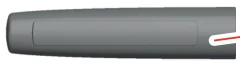
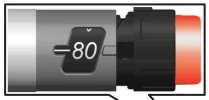

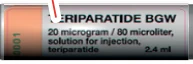
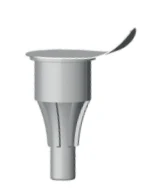

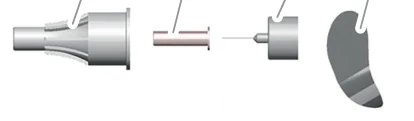 1. pen cap
 2. cartridge with medicine
- 3. label
- 4. dose window
- 5. dose knob
- 6. dose activator
- 7. large outer cap
- 8. small inner cap
- 9. needle
- 10. seal foil
 * Needles are not included.
Becton, Dickinson and Company pen needles can be used. Ask your doctor or pharmacist which needle gauge and length are best for you.
For your safety
Prevention of infectious diseases
Do not share your pen as this may risk the
transmission of infectious diseases.
- Use a new sterile needle for each injection.
Put used needles in a sharps container or a hard
plastic container with a secure lid. Do not throw needles directly into your household waste.
Use of the pen
Check the pen label when taking the pen out of
 the refrigerator. Ensure that you use the right
medicine.
Check the expiry date. Do not use the pen if it
has expired.
Check the medicine. It must be clear, colourless
and free of particles.
Do not transfer the medicine to a syringe. It
must be administered using this pen only.
- Do not use the pen for more than 28 injections.
Note the first day of injection in the Injection Diary on the back of these Instructions for Use. Calculate the date for the 28th injection by using a calendar and make a note of this date in 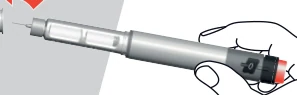
 the Injection Diary.
The pen is not recommended for use by the blind or visually impaired without help from a
person who is trained in the proper use of the device.
Storage
Keep the pen in the refrigerator, preferably in
the door compartment.
- Keep the pen and needles out of the sight and
 reach of children.
Troubleshooting
If you have a problem with the injection, do not
give a second injection on the same day.
Read the section “What to do if...” in these
Instructions for Use.
- Do not use the pen if it is damaged.
Only use the pen if the medicine is clear,
colourless and free of particles.
If you cannot solve the problem by yourself
or if you are uncertain, contact your doctor, pharmacist, nurse or carer.
Preparing the pen before the first injection
Follow these instructions every time you prepare a new pen before the first injection.
You only have to perform this step once. You do NOT need to repeat this step for the second, third or any further injections.
Attaching the needle
- 1. Remove the pen cap.
- 2.
Take a new needle and remove the seal foil from
the large outer cap.
- 3.
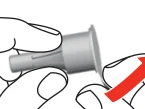 Attach the needle with the large outer cap to
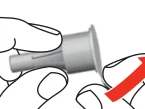 the pen. Screw the large outer cap clockwise as
far as it will go.
- 4.
 Remove the large outer cap from the needle and
save it.
Dialling the Dose
- 5.
Turn the dose knob clockwise to the hard stop
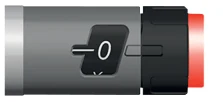
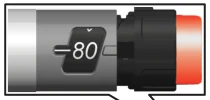
(until it cannot be rotated any further). Make sure the figure “80” is fully visible and centred in the dose window. The white mark and the window notch should be aligned.
- 6. Remove the small inner cap from the needle and throw away.
- 7. Hold the pen with the needle up. Push the dose activator as far as it will go (to the hard stop) and hold for 5 seconds. Collect the expelled liquid with a tissue.
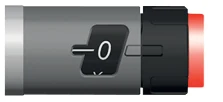
- 8. Check that the display reads “0” and that this figure is fully visible and centred in the dose window, the white mark and the window notch are aligned, and the dose knob and pen body marks are aligned.
- 5.
Removing the Needle
Remove the needle after preparation of the pen, to minimise the risk of infection.
- 9. Carefully push the needle into the large outer cap. Do not touch the needle.
- 10. Unscrew the needle by turning the large outer cap anti-clockwise and pull the needle from the pen.
- 11. Dispose of the needle (in the needle cap) in a sharps container or a hard plastic container with a secure lid as directed by your doctor or pharmacist (see “For your safety” above).
Keeping the Injection Diary
- 12. Note the current date and the date of the 28th injection in the Injection Diary on the back of these instructions for use.
Now your pen is prepared for the first and all further injections as described below.
Injecting the Pen
Prepare yourself for injection
- Wash your hands before every injection.
- Prepare the injection site (on the thigh or abdomen) as directed by your doctor, pharmacist or carer.
Use a new needle for every injection. A used needle poses a risk of infection.
Attaching the needle
- 1. Remove the pen cap.
- 2. Take a new needle and remove the seal foil from the needle cap.
- 3. Attach the needle with the large outer cap to the pen. Screw the large outer cap clockwise as far as it will go.
- 4.

 Remove the large outer cap from the needle and
save it.
7 8 9 10
1
654
2 3
Pen User Manual
Lusama 20 micrograms/80 microlitres solution for injection in pre-filled pen Instructions for use
Before you use your new pen, please read these instructions carefully. Follow the directions carefully when using the pen. Also read the package leaflet provided. Your pen contains 28 days of medicine.
5 s Dialling the Dose
- 5.
Turn the dose knob clockwise to the hard stop
(until it cannot be rotated any further). Make sure the figure “80” is fully visible and centred in the dose window. The white mark and the window notch should be aligned.
- 6.
 Remove the small inner cap from the needle and
throw away.
- 7.
 Select an appropriate injection site and prepare
your skin as recommended by your doctor. Gently hold a fold of skin from your thigh or abdomen between your thumb and index finger.
- 8. Insert the needle, preferably at a 90 degree
angle at the prepared injection site. Push the dose activator as far as it will go (to the hard stop) and hold for 5 seconds. Count slowly to 5.
- 9. Pull out the needle from the skin.
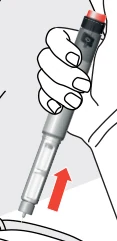
- 10. Check that the display reads “0”and that this figure is fully visible and centred in the dose window, the white mark and the window notch are aligned, and the dose knob and pen body marks are aligned.
 Removing the needle
Always remove the needle immediately after the pen has been used.
- 11. Carefully push the needle into the large outer
cap. Do not touch the needle.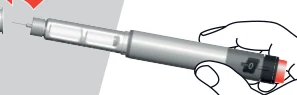
 12. Unscrew the needle by turning the large outer cap
anti-clockwise and pull the needle from the pen.
- 13.
 Dispose of the needle (in its large outer cap) in
a sharps container or a hard plastic container with a secure lid, as directed by your doctor or pharmacist.
- 14. Re-attach the pen cap to the pen.
Storing the pen
Do not store the pen with a needle attached.
Doing this may cause air bubbles to form in the medicine cartridge. Always close the pen with the pen cap.
- Store the pen in the refrigerator, preferably in the door compartment. Do not store it next to the back wall of the refrigerator or in the freezer. The medicine becomes unusable if frozen.
- If your pen has been left out of the refrigerator, do not thrown the pen away. Put it back in the refrigerator and contact your doctor or pharmacist.
Disposing of the pen
- Before throwing away the pen, be sure to remove the needle and attach the pen cap.
- Throw away your pen and used needles in a sharps container or a hard plastic container with a secure lid, as directed by your doctor or pharmacist.
- Dispose of the pen 28 days after first use.
What to do if….
You can see an air bubble in the cartridge: You can continue to use your pen as usual.
While preparing the pen for first use, no medicine is expelled: Perform the steps as described in “Dialling the dose” again (page 5).
The dose activator is blocked or you think you may not have injected the full dose: Do not give a second injection the same day. Proceed with your regular injection the next day. Make sure you turn the dose knob to the hard stop and the figure “80” is fully visible and centred in the dose window with the white mark aligned in the window notch.
| Injection Diary | |
| Date of first injection day 1 | |
| Manufacturer | |
| Date of last injection day 28 |
This user manual was last revised in 02/2022
5 s
| Customer | Aristo Pharma GmbH |
| Product Name | Teriparatide_20micrograms-80mi-crolitres_solution-pen |
| Market | United Kingdom (UK) |
| Language/s | English |
| XXX | |
| Word Ref: | XXXXXXXXXXXXXX/XXXX |
| Aristo Article No: | XXXXXXXX/X |
| Manufacturer Code | n/a |
| Our Ref | Teriparatide_20micrograms-80microlitres_solution-pen_User-Manual_ver03 — (** to follow final proof) |
| Issue | 03 |
| Date | 29 April 2021 |
| SPECIFICATION DETAILS | |
| Origination | 03 August 2021 — (as Issue 01) |
| 180 x 560 mm | |
| Border | 10 mm |
| n/a | |
| Font details | Main title: Frutiger LT Std - 75 Black
Sub-titles: Frutiger LT Std - 75 Black — 10 pt Body copy: Frutiger LT Std - 55 Roman — 9 pt |