

Summary of Product Characteristics (SmPC) - Lanreotide Zentiva 90 mg solution for injection in a Pre-filled syringe
1 NAME OF THE MEDICINAL PRODUCT
Lanreotide Zentiva 90 mg solution for injection in a pre-filled syringe
2 QUALITATIVE AND QUANTITATIVE COMPOSITION
Each pre-filled syringe contains a supersaturated solution of lanreotide acetate corresponding to 0.246 mg of lanreotide base/mg of solution, which ensures an actual injection dose of 90 mg of lanreotide respectively.
For a full list of excipients, see section 6.1.
3 PHARMACEUTICAL FORM
Solution for injection in a pre-filled syringe.
White to pale yellow semi solid formulation with a pH of 5.5 – 6.5.
4 CLINICAL PARTICULARS
4.1 Therapeutic indications
Lanreotide is indicated for:
- The long term treatment of individuals with acromegaly when the circulating levels of Growth Hormone (GH) and/or Insulin-like Growth Factor-I (IGF-I) remain abnormal after surgery and/or radiotherapy or in patients who otherwise require medical treatment. The goal of treatment in acromegaly is to reduce GH and IGF-1 levels and where possible to normalise these values.
- The relief of symptoms associated with acromegaly.
The treatment of grade 1 and a subset of grade 2 (Ki67 index up to 10%)
gastroenteropancreatic neuroendocrine tumours (GEP-NETs) of midgut, pancreatic or unknown origin where hindgut sites of origin have been excluded, in adult patients with unresectable locally advanced or metastatic disease (see section 5.1).
- The treatment of symptoms associated with neuroendocrine (carcinoid) tumours.
4.2 Posology and method of administration
Posology
Acromegaly
The recommended starting dose is 60 to 120 mg administered every 28 days.
Thereafter the dose should be individualised according to the response of the patient (as judged by a reduction in symptoms and/or a reduction in GH and/or IGF-1 levels).
If the desired response is not obtained, the dose may be increased.
The dose may be increased if GH levels are over 2.5 ng/ml.
For GH levels between 2.5 ng/ml and 1 ng/ml, the dose can be maintained if age-adjusted IGF-1 level is normal.
If complete control is obtained (based on GH levels under 1 ng/ml, normalised IGF-I levels and/or disappearance of symptoms), the dose may be decreased.
Patients well controlled on a somatostatin analogue can be treated with Lanreotide 120 mg every 42 or 56 days. For example, patients, who are well controlled on Lanreotide 60 mg injected every 28 days, can be treated with Lanreotide 120 mg every 56 days and patients, who are well controlled on Lanreotide 90 mg injected every 28 days, can be treated with Lanreotide 120 mg every 42 days.
Long term monitoring of symptoms, GH and IGF-I levels should be undertaken as clinically indicated.
Treatment of symptoms associated with neuroendocrine tumours
The recommended starting dose is 60 to 120 mg administered every 28 days.
Thereafter the dose should be individualised according to the degree of symptomatic relief obtained. The maximum recommended dose is 120 mg Lanreotide every 28 days.
Patients well controlled on a somatostatin analogue can be treated with lanreotide 120 mg every 42 or 56 days. For example, patients, who are well controlled on lanreotide 60 mg injected every 28 days, can be treated with lanreotide 120 mg every 56 days and patients, who are well controlled on lanreotide 90 mg injected every 28 days, can be treated with lanreotide 120 mg every 42 days. There should be close monitoring of symptoms when treatment is switched to the extended dosing interval.
Grade 1 and a subset of grade 2 (Ki67 index up to 10%) gastroenteropancreatic neuroendocrine tumours of midgut, pancreatic or unknown origin where hindgut sites of origin have been excluded, in adult patients with unresectable locally advanced or metastatic disease.
The recommended dose is one injection of Lanreotide 120 mg administered every 28 days. The treatment with Lanreotide is to be continued for as long as needed for tumour control.
Renal and/or hepatic impairment:
In patients with impaired renal or hepatic function, no dosage adjustment is necessary due to the wide therapeutic window of lanreotide (see section 5.2).
Elderly patients:
In elderly patients, no dosage adjustment is necessary due to the wide therapeutic window of lanreotide (see section 5.2).
Paediatric population:
The safety and efficacy of lanreotide in children and adolescents has not been established.
Method of administration:
Lanreotide is administered by deep subcutaneous injection in the superior external quadrant of the buttock or in the upper outer thigh.
For patients who receive a stable dose of Lanreotide, and after appropriate training, the product may be administered either by the patient or by a trained person. In case of self- injection, the injection should be given in the upper outer thigh.
The decision regarding administration by the patient or a trained person should be taken by a healthcare professional.
Regardless of the injection site, the skin should not be folded and the needle should be inserted rapidly and to its full length, perpendicularly to the skin.
The injection site should alternate between the right and left side.
4.3 Contraindications
Hypersensitivity to the active substance, somatostatin or related peptides or to any of the excipients listed in section 6.1.
4.4 Special warnings and precautions for use
Cholelithiasis and Complications of Cholelithiasis
Lanreotide may reduce gallbladder motility and lead to gallstone formation. Therefore, patients may need to be monitored periodically. It is advised, during prolonged treatment, to perform before treatment and every 6 months, an echography of the gallbladder (see section 4.8).
Gallstones that led to complications, including cholecystitis, cholangitis and pancreatitis requiring cholecystectomy in patients on lanreotide were reported after introduction to the market. If complications of cholelithiasis are suspected, discontinue lanreotide and treat cholelithiasis accordingly.
Hyperglycaemia and Hypoglycaemia
Pharmacological studies in animals and humans show that lanreotide, like somatostatin and other somatostatin analogues, inhibits secretion of insulin and glucagon. Hence, patients treated with lanreotide may experience hypoglycaemia or hyperglycaemia. Blood glucose levels should be monitored when lanreotide treatment is initiated, or when the dose is altered and any anti-diabetic treatment should be adjusted accordingly.
Hypothyroidism
Slight decreases in thyroid function have been seen during treatment with lanreotide in acromegalic patients, though clinical hypothyroidism is rare. Thyroid function tests are recommended where clinically indicated.
Bradycardia
In patients without underlying cardiac problems lanreotide may lead to a decrease of heart rate without necessarily reaching the threshold of bradycardia. In patients suffering from cardiac disorders prior to lanreotide treatment, sinus bradycardia may occur. Care should be taken when initiating treatment with lanreotide in patients with bradycardia (see section 4.5).
Pancreatic function
Pancreatic exocrine insufficiency (PEI) has been observed in some patients receiving lanreotide therapy for gastroenteropancreatic neuroendocrine tumours. Symptoms of PEI can include steatorrhea, loose stools, abdominal bloating and weight loss. Screening and appropriate treatment for PEI according to clinical guidelines should be considered in symptomatic patients.
Pituitary tumour monitoring
In patients with acromegaly, use of lanreotide is not exempt from the monitoring of the volume of the pituitary tumour.
4.5 Interaction with other medicinal products and other forms of interaction
The pharmacological gastrointestinal effects of lanreotide may result in a reduction of the intestinal absorption of co-administered drugs including cyclosporin.
Concomitant administration of cyclosporin with lanreotide may decrease the relative bioavailability of cyclosporin and therefore may necessitate the adjustment of cyclosporine dose to maintain therapeutic levels.
Interactions with highly plasma bound drugs are unlikely in view of the moderate binding of lanreotide to serum proteins.
Limited published data indicate that concomitant administration of somatostatin analogues and bromocriptine may increase the availability of bromocriptine.
Dose adjustments of insulin and antidiabetics may be necessary when lanreotide is administered simultaneously:
Risk of hypoglycaemia or hyperglycaemia: decrease in the needs of anti-diabetic treatment following decrease or increase in endogen glucagon secretions.
The glycaemic self-monitoring must be reinforced and the posology of anti-diabetic treatment during treatment by lanreotide should be adapted as required.
Concomitant administration of bradycardia inducing drugs (e.g. beta blockers) may have an additive effect on the slight reduction of heart rate associated with lanreotide. Dose adjustments of such concomitant medications may be necessary.
The limited published data available indicate that somatostatin analogues may decrease the metabolic clearance of compounds known to be metabolized by cytochrome P450 enzymes, which may be due to the suppression of growth hormone. Since it cannot be excluded that lanreotide may have this effect, other drugs mainly metabolized by CYP3A4 and which have a low therapeutic index (e.g. quinidine, terfenadine) should therefore be used with caution.
4.6 Fertility, pregnancy and lactation
Pregnancy
There is a limited amount of data (less than 300 pregnancy outcomes) from the use of lanreotide in pregnant women.
Studies in animals have shown reproductive toxicity but no evidence of teratogenic effects (see section 5.3). The potential risk for humans is unknown.
As a precautionary measure, it is preferable to avoid the use of lanreotide during pregnancy.
Breast-feeding
It is not known whether Lanreotide is excreted in human milk.
A risk to the newborns/infants cannot be excluded. Lanreotide should not be used during breast-feeding
Fertility
Reduced fertility was observed in female rats due to the inhibition of GH secretion at doses in excess of those achieved in humans at therapeutic doses.
4.7 Effects on ability to drive and use machines
Lanreotide has minor or moderate influence on the ability to drive and use machines. No studies on the effects on the ability to drive and use machines have been performed.
However, dizziness has been reported with Lanreotide (see section 4.8). If a patient is affected, he/she should not drive or operate machinery.
4.8 Undesirable effects
Undesirable effects reported by patients suffering from acromegaly and GEP-NETs treated with lanreotide in clinical trials are listed under the corresponding body organ systems according to the following classification:
Very common (≥1/10); common (≥1/100 to <1/10); uncommon (≥1/1,000 to<1/100), not known (cannot be estimated from the available data).
The most commonly expected adverse drug reactions following treatment with lanreotide are gastrointestinal disorders (most commonly reported are diarrhoea and abdominal pain, usually mild or moderate and transient), cholelithiasis (often asymptomatic) and injection site reactions (pain, nodules and indurations).
The profile of undesirable effects is similar for all indications.
| System organ class | Very common (≥1/10) | Common (≥1/100 to <1/10) | Uncommon (≥1/1,000 to <1/100) | Post-marketing safety experience (frequency not known) |
Immune system disorders | Allergic reactions (including angioedema, anaphylaxis, hypersensitivity) | |||
| Metabolism and nutrition disorders | Hypoglycaemia , decreased appetite**, hyperglycaemia , diabetes mellitus | |||
| Psychiatric disorders | Insomnia* | |||
| Nervous system disorders | Dizziness, headache, lethargy** | |||
| Cardiac disorders | Sinus bradycardia* | |||
| Vascular disorders | Hot flushes* | |||
| Gastrointestinal disorders | Diarrhoea, loose stools*, abdominal pain | Nausea, vomiting, constipation, flatulence, abdominal distension, abdominal discomfort*, dyspepsia, steatorrhoea** | Faeces discoloured* | Pancreatic exocrine insufficiency, pancreatitis |
| Hepatobiliary disorders | Cholelithiasis | Biliary dilatation* | Cholecystitis, cholangitis | |
Musculoskeleta l and connective tissue disorders | Musculoskeletal pain**, myalgia** |
Skin and subcutaneous tissue disorders | Alopecia, hypotrichosis* | |||
General disorders and administration site conditions | Asthenia, fatigue, injection site reactions (pain, mass, induration, nodule, pruritus) | Injection site abscess | ||
| Investigations | ALAT increased*, ASAT abnormal*, ALAT abnormal*, blood bilirubin increased*, blood glucose | ASAT increased*, blood alkaline phosphatase increased*, blood bilirubin | ||
increased*, glycosylated haemoglobin increased*, weight decreased, pancreatic enzymes decreased** | abnormal*, blood sodium decreased* |
* based on a pool of studies conducted in acromegalic patients
** based on a pool of studies conducted in patients with GEP-NETs
Reporting of suspected adverse reactions
Reporting suspected adverse reactions after authorisation of the medicinal product is important.
It allows continued monitoring of the benefit/risk balance of the medicinal product. Healthcare professionals are asked to report any suspected adverse reactions via the Yellow Card Scheme at: www.mhra.gov.uk/yellowcard or search for MHRA Yellow Card in the Google Play or Apple App Store.
4.9 Overdose
If overdose occurs, symptomatic management is indicated.
5 PHARMACOLOGICAL PROPERTIES
5.1 Pharmacodynamic properties
Pharmacotherapeutic group: Pituitary and hypothalamic hormones and analogues; Somatostatin and
analogues
ATC code: H01C B03.
Mechanism of action
Lanreotide is an octapeptide analogue of natural somatostatin. Like somatostatin, lanreotide is an inhibitor of various endocrine, neuroendocrine, exocrine and paracrine functions. Lanreotide has a high binding affinity for human somatostatin receptors (SSTR) 2 and 5 and a reduced binding affinity for human SSTR1, 3and 4. Activity at human SSTR 2 and 5 is the primary mechanism to be responsible for GH inhibition. Lanreotide is more active than natural somatostatin and shows a longer duration of action.
Lanreotide, like somatostatin, exhibits a general exocrine anti-secretory action. It inhibits the basal secretion of motilin, gastric inhibitory peptide and pancreatic polypeptide, but has no significant effect on fasting secretin or gastrin secretion. Additionally, it decreases the levels of plasma chromogranin A and urinary 5-HIAA (5 Hydroxyindolacetic acid) in patients with GEP-NETs and elevated levels of these tumour markers. Lanreotide markedly inhibits meal-induced increases in superior mesenteric artery blood flow and portal venous blood flow. Lanreotide significantly reduces prostaglandin E1- stimulated jejunal secretion of water, sodium, potassium and chloride. Lanreotide reduces prolactin levels in acromegalic patients treated long term.
In acromegalic patients lanreotide can cause a reduction in volume of the tumour tissue.
In an uncontrolled open-label study, lanreotide 120 mg was administered every 28 days for 48 weeks in 90 previously untreated acromegalic patients diagnosed with pituitary macroadenoma who were not intended for surgery or radiotherapy.
Whilst the responder rate did not reach statistical significance, a tumour volume reduction ≥ 20% was observed in 56/89 patients (63%, 95% CI: 52% - 73%) at week
48.
At week 48, the average percentage reduction of tumour volume was 26.8%.
At week 48, GH levels were below 2.5 µg/L in 77.8% of the patients and IGF-1 levels normalised in 50%. Normalised IGF-1 levels combined with GH levels below 2.5 µg/L were observed in 43.5% of the patients.
Most patients reported a clear relief of acromegaly symptoms such as headache (38.7%), fatigue (56.5%), excess perspiration (66.1%), arthralgia (59.7%) and soft tissue swelling (66.1%).
Both early and sustained reduction of tumour volume as well as of GH and IGF-1 levels were observed from week 12 onwards and maintained during 48 weeks.
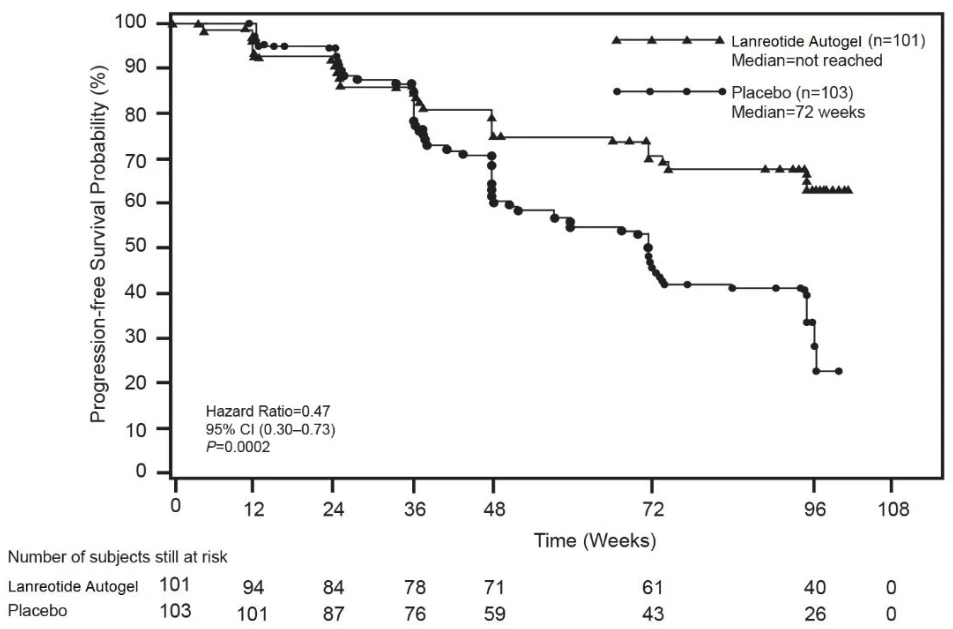
A phase III, 96-week, fixed duration, randomized, double-blind, multi-center, placebo-controlled trial of lanreotide was conducted in patients with gastroenteropancreatic neuroendocrine tumours to assess the antiproliferative effect of lanreotide.
Patients were randomized 1:1 to receive either lanreotide 120 mg every 28 days (n=101) or placebo (n=103). Randomization was stratified by previous therapy at entry and the presence/absence of progression at baseline as assessed by RECIST 1.0 (Response Evaluation Criteria in Solid Tumours) during a 3 to 6 month screening phase.
Patients had metastatic and/or locally advanced inoperable disease with histologically confirmed well or moderately well differentiated tumours primarily localized in the pancreas (44.6% patients), midgut (35.8%), hindgut (6.9%) or of other/unknown primary location (12.7%).
69% of patients with GEP-NETs had tumour grade 1 (G1), defined by either a proliferation index Ki67
≤ 2% (50.5% of the overall patient population) or a mitotic index < 2 mitosis/10 HPF (18.5% of the overall patient population) and 30% of patients with GEP-NETs had tumours in the lower range of grade 2 (G2) (defined by a Ki67 index > 2% - ≤ 10%). Grade was not available in 1% of the patients. The study excluded patients with G2 GEP-NETs with a higher cellular proliferation index (Ki 67
> 10% - ≤ 20%) and G3 GEP neuroendocrine carcinomas (Ki 67 index > 20%).
Overall, 52.5% of the patients had a hepatic tumour load ≤ 10%, 14.5% had a hepatic tumour load > 10 and ≤ 25% and 33% had a hepatic tumour load > 25%.
The primary endpoint was progression-free survival (PFS) measured as time to either disease progression by RECIST 1.0 or death within 96 weeks after first treatment administration. Analysis of PFS utilized independent centrally-reviewed radiological assessment of progression.
Table 1: Efficacy results of the phase III study
Median Progression free survival (weeks) | Hazard Ratio (95% CI) | Reduction in risk of progression or death | p-value | |
| Lanreotide (n=101) | Placebo (n=103) | |||
| > 96 weeks | 72.00 weeks (95% CI: 48.57, 96.00) | 0.470 (0.304, 0.729) | 53% | 0.0002 |
Figure 1: Kaplan-Meier Progression Free Survival Curves
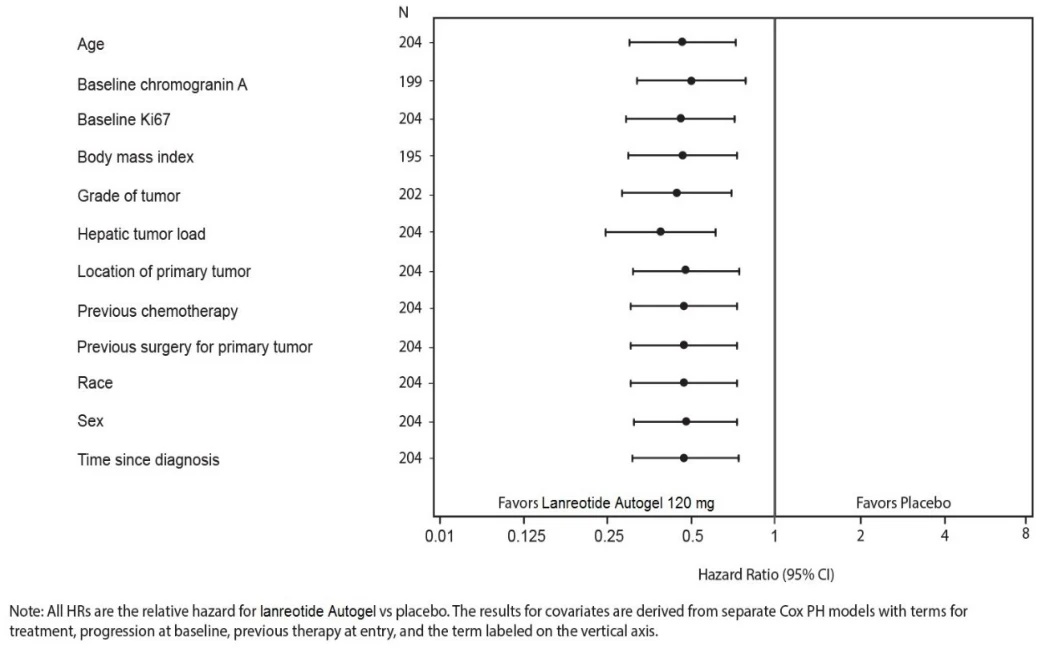
The beneficial effect of lanreotide in reducing the risk of progression or death was consistent regardless of the location of primary tumour, hepatic tumour load, previous chemotherapy, baseline Ki67, tumour grade or other pre-specified characteristics as shown in Figure 2.
A clinically relevant benefit of treatment with lanreotide was seen in patients with tumours of pancreatic, midgut and other/unknown origin as in the overall study population. The limited number of patients with hindgut tumours (14/204) contributed to difficulty in interpreting the results in this subgroup. The available data suggested no benefit of lanreotide in these patients.
Figure 2 – Results of the Cox Proportional Hazards Covariates Analysis of PFS
Crossover from placebo to open-label lanreotide, in the extension study, occurred in 45.6% (47/103) of the patients.
Paediatric population
The European Medicines Agency has waived the obligation to submit the results of studies with lanreotide in all subsets of the paediatric population in acromegaly and pituitary gigantism (see section 4.2 for information on paediatric use). The European Medicines Agency has listed gastroenteropancreatic neuroendocrine tumours (excluding neuroblastoma, neuroganglioblastoma, phaechromocytoma) on the list of class waivers.
5.2 Pharmacokinetic properties
Intrinsic pharmacokinetic parameters of lanreotide after intravenous administration in healthy volunteers indicated limited extravascular distribution, with a steady-state volume of distribution of 16.1 l. Total clearance was 23.7 l/h, terminal half-life was 1.14 hours and mean residence time was 0.68 hours.
In studies evaluating excretion, less than 5% of lanreotide were excreted in urine and less than 0.5% were recovered unchanged in faeces, indicating some biliary excretion.
After deep subcutaneous administration of lanreotide 60, 90 and 120 mg, to healthy volunteers lanreotide concentrations increase to achieve average maximum serum concentrations of 4.25, 8.39 and 6.79 ng/ml. These values of Cmax are achieved during the first day after the administration at 8, 12 and 7 hours (median values). From the peak serum levels of lanreotide concentrations decrease slowly following a first order kinetics with a terminal elimination half-life of 23.3, 27.4 and 30.1 days respectively and 4 weeks after the administration mean lanreotide serum levels were 0.9, 1.11 and 1.69 ng/ml respectively. Absolute bioavailability was 73.4, 69.0 and 78.4%.
After deep subcutaneous administration of lanreotide 60, 90 and 120 mg to acromegalic patients, lanreotide concentrations increase to achieve average maximum serum concentrations of 1.6, 3.5 and 3.1 ng/ml. These values of Cmax are achieved during the first day after the administration at 6, 6 and 24 hours. From the peak serum levels of lanreotide concentrations decrease slowly following first order kinetics and 4 weeks after the administration mean lanreotide serum levels were 0.7, 1.0 and 1.4 ng/ml, respectively.
Steady state serum levels of lanreotide were reached, on average, after 4 injections every 4 weeks. After repeated dose administration every 4 weeks the average values of Cmax at steady state were 3.8,
5.7 and 7.7 ng/ml for 60, 90 and 120 mg respectively, the average Cmin values obtained being 1.8, 2.5 and 3.8 ng/ml. The peak trough fluctuation index was moderate ranging from 81 to 108%.
Linear pharmacokinetic release profiles were observed after deep subcutaneous administration of lanreotide 60, 90 and 120 mg in acromegalic patients.
In a population PK analysis in 290 GEP-NET patients receiving lanreotide 120 mg, rapid initial release was seen with mean Cmax values of 7.49 ± 7.58 ng/mL reached within the first day after a single injection. Steady-state concentrations were reached after 5 injections of lanreotide 120 mg every 28 days and were sustained up to the last assessment (up to 96 weeks after the first injection). At steady-state the mean Cmax values were 13.9 ± 7.44 ng/mL and the mean trough serum levels were 6.56 ± 1.99 ng/mL. The mean apparent terminal half-life was 49.8 ± 28.0 days.
Renal / Hepatic impairment:
Subjects with severe renal impairment show an approximately 2-fold decrease in total serum clearance of lanreotide, with a consequent increase in half-life and AUC. In subjects with moderate to severe hepatic impairment, a reduction in clearance was observed (30%). Volume of distribution and mean residence time increased in subjects with all degrees of hepatic insufficiency.
No effect on clearance of lanreotide was observed in a population PK analysis of GEP-NET patients including 165 with mild and moderate renal impairment (106 and 59 respectively) treated with lanreotide. GEP-NET patients with severely impaired renal function were not studied.
No GEP-NET patients with hepatic impairment (as per Child-Pugh score) were studied.
It is not necessary to alter the starting dose in patients with renal or hepatic impairment, as lanreotide serum concentrations in these populations are expected to be well within the range of serum concentrations safely tolerated in healthy subjects.
Elderly patients:
Elderly subjects show an increase in half-life and mean residence time compared with healthy young subjects. It is not necessary to alter the starting dose in elderly patients, as lanreotide serum concentrations in this population are expected to be well within the range of serum concentrations safely tolerated in healthy subjects.
In a population PK analysis of GEP-NET patients including 122 aged 65 to 85 years, no effect of age on clearance and volume of distribution of lanreotide was observed.
5.3 Preclinical safety data
Effects in non-clinical studies were observed only at exposures considered sufficiently in excess of the maximum human exposure indicating little relevance to clinical use.
In carcinogenic bioassay studies conducted in rats and mice, no systemic neoplastic changes were observed at doses in excess of those achieved in humans at therapeutic doses. Increased incidence of subcutaneous tumours were observed at the injection sites likely due to the increased dose frequency in animals (daily) compared to monthly dosing in humans and therefore may not be clinically relevant.
In in vitro and in vivo standard battery tests, lanreotide did not show any genotoxic potential.
Lanreotide was not teratogenic in rats and rabbits. Embryo/fetal toxicity was observed in rats (increased pre-implantation loss) and in rabbits (increased post-implantation loss). Reproductive studies in pregnant rats given 30 mg/kg by subcutaneous injection every 2 weeks (five times the human dose, based on body surface area comparisons) resulted in decreased embryo/fetal survival. Studies in pregnant rabbits given subcutaneous injections of 0.45 mg/kg/day (two times the human therapeutic exposures at the maximum recommended dose of 120 mg, based on comparisons of relative body surface area) shows decreased fetal survival and increased fetal skeletal/soft tissue abnormalities.
6 PHARMACEUTICAL PARTICULARS
6.1 List of excipients
Water for injection
Glacial acetic acid (for pH adjustment).
6.2 Incompatibilities
Not applicable.
6.3 Shelf life
2 years.
After opening the protective laminated pouch, the product should be administered immediately.
6.4 Special precautions for storage
Store in a refrigerator (2°C - 8°C). Store in the original package in order to protect from light.
Once removed from the refrigerator, product left in its sealed pouch may be returned to the refrigerator (the number of temperature excursions must not exceed three times) for continued storage and later use, provided it has been stored for no longer than a total of 72 hours at below 30°C.
6.5 Nature and contents of container
Lanreotide is supplied in 0.5 mL polypropylene polymer barrel with fixed needle and LDPE tip cap, capped with grey chlorobutyl rubber plunger stopper. One labeled prefilled syringe is assembled with one plunger rod and needle safety device.
Each ready to use pre-filled syringe is placed into a plastic tray and packed in a laminated pouch and a cardboard box.
Pack sizes:
- Box of one 0.5 ml pre-filled syringe and one needle (1.2 mm x 20 mm).
- Box of three pouches, each one containing one 0.5 ml pre-filled syringe and one needle (1.2 mm x 20 mm).
1 x 90 mg, 3 x 90 mg
Not all pack sizes may be marketed.
6.6 Special precautions for disposal
The solution for injection in a pre-filled syringe is ready for use.
For immediate and single use following first opening.
It is important that the injection of the product is performed exactly according to the instructions in the package leaflet.
Do not use if the laminated pouch is damaged or opened.
Any unused product or waste material should be disposed of in accordance with local requirements.
7 MARKETING AUTHORISATION HOLDER
Zentiva Pharma UK Limited
12 New Fetter Lane
London
EC4A 1JP
United Kingdom
8 MARKETING AUTHORISATION NUMBER(S)
PL 17780/1318
9 DATE OF FIRST AUTHORISATION/RENEWAL OF THE
AUTHORISATION
24/01/2025
10 DATE OF REVISION OF THE TEXT
24/01/2025