


Patient leaflet - Klisyri 10 mg/g ointment
1. What Klisyri is and what it is used for
Klisyri contains the active substance tirbanibulin. It is used for the treatment of mild actinic keratosis in adults. Actinic keratosis is a rough area of skin that has developed in people who have been exposed to too much sunshine over a long time. Klisyri should only be used for flat actinic keratosis on the face and scalp.
2. What you need to know before you use Klisyri
Do not use Klisyri
- If you are allergic to tirbanibulin or any of the other ingredients of this medicine (listed in section 6).
Warnings and precautions
Talk to your doctor or pharmacist before using Klisyri
- Do not use Klisyri until the area to be treated has healed from any previous medicine, procedure or surgical treatment. Do not apply Klisyri on open wounds or broken skin.
- Wash your hands if you happen to touch the area where you applied the ointment.
- Do not get Klisyri in your eyes. If it accidentally gets in your eye, rinse the eye thoroughly with plenty of water, seek medical assistance as soon as possible and take this leaflet with you.
- Do not apply the ointment internally, to the inside of the nostrils, the inside of the ear or on the lips. If the ointment accidentally touches any of these areas, wash it off by rinsing with water.
- Do not swallow this medicine. Drink plenty of water if you accidentally swallow this medicine, seek medical assistance and take this leaflet with you.
- Tell your doctor if you have problems with your immune system.
- Watch for any new scaly red patches, open sores, and raised or warty growths around the treatment area. If you see any, talk to your doctor immediately.
- After using Klisyri, avoid activities that might cause excessive sweating, and avoid exposure to sunlight as much as possible (including sunlamps and tanning beds). When outdoors, wear protective clothing and a hat.
- Do not cover the treated area with bandages after using Klisyri.
- Do not apply more ointment than your doctor has advised.
- Do not apply the ointment more than once a day.
- Do not allow other people or pets to touch the treated area for around 8 hours after applying the ointment. If the treated area is touched, the area of contact on the other person or pet should be washed.
Contact your doctor if you get skin reactions to this medicine in the treated area that get severe (see section 4).
Children and adolescents
Do not give this medicine to children and adolescents under 18 years of age because they do not get actinic keratosis.
Other medicines and Klisyri
Tell your doctor or pharmacist if you are using, have recently used or might use any other medicines.
If you have previously used Klisyri or similar medicines, tell your doctor before starting the treatment.
Pregnancy, breast-feeding, and fertility
If you are pregnant or breast-feeding, think you may be pregnant or are planning to have a baby, ask your doctor for advice before taking this medicine.
Klisyri should not be used during pregnancy.
Driving and using machines
This medicine is not expected to have any effect on your ability to drive or to use machines.
Klisyri contains propylene glycol
This medicine contains 222.5 mg propylene glycol in each sachet which is equivalent to 890 mg/g.
3. How to use Klisyri
Always use this medicine exactly as your doctor has told you. Check with your doctor or pharmacist if you are not sure.
This medicine is intended to treat an area of up to 25 cm2 for only one treatment course of five days. If the treated area does not show complete clearance at about 8 weeks after the treatment cycle started, or new lesions develop within the treatment area, the treatment should be reconsidered by your doctor and other treatment options should be considered.
Apply a thin layer of Klisyri to the affected area on the face or scalp once daily for 5 days in a row. One sachet contains enough ointment to cover the treatment area. Do not save the opened sachet for use on another day, even if there is still ointment left.
Application instructions:
- 1. Wash your hands with soap and water before applying the ointment.
- 2. Wash the affected area with mild soap and water and dry it gently.
- 3. Open a new sachet each time you apply this medicine.
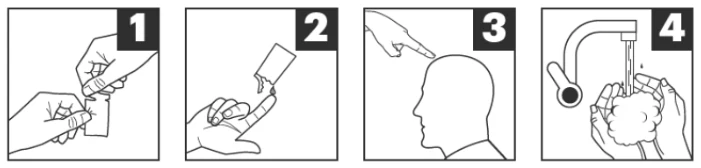
- 4. Open the sachet along the perforations (Figure 1).
- 5. Squeeze some ointment onto your fingertip (Figure 2).
- 6. Apply a thin layer of ointment evenly over the entire affected area (Figure 3).
- 7. Wash your hands with soap and water immediately after applying the ointment (Figure 4).
- 8. Do not wash or touch the treated area for about 8 hours. After this time, you may wash the treated area with mild soap and water.
- 9. Do not cover the treated area with bandages after you have applied Klisyri.
- 10. Repeat the above steps for each day of treatment at around the same time of the day.
If you use more Klisyri than you should
Wash the treated area with mild soap and water. Please contact your doctor or pharmacist if you get severe skin reactions.
If you forget to use Klisyri
If you miss a dose, apply the ointment as soon as you remember and then continue with your regular schedule. Do not apply the ointment more than once a day.
If you have any further questions on the use of this medicine, ask your doctor or pharmacist.
4. Possible side effects
Like all medicines, this medicine can cause side effects, although not everybody gets them.
After using this medicine, you may get side effects on the skin where you apply the ointment. These side effects may get worse for up to 8 days after you start the treatment, and they typically go away within 2 to 3 weeks after completing the treatment. Contact your doctor if these side effects get severe.
The most frequently occurring side effects in the treated area:
Very common (may affect more than 1 in 10 people)
- redness (erythema)
- skin scaling (flaking)
- scabs (crusting)
- swelling
- loss of the top layer of skin (erosion, ulcer)
Other possible side effects in the treated area:
Common (may affect up to 1 in 10 people)
- pain (tender, stinging, or burning feeling)
- itching (pruritus)
- blisters (vesicles, pustules)
Reporting of side effects
If you get any side effects, talk to your doctor or pharmacist. This includes any possible side effects not listed in this leaflet. You can also report side effects directly via the Yellow Card Scheme Website: www.mhra.gov.uk/yellowcard or search for MHRA Yellow Card in the Google Play or Apple App Store.
By reporting side effects, you can help provide more information on the safety of this medicine.
5. How to store Klisyri
- Keep out of the sight and reach of children.
- Do not use this medicine after the expiry date which is stated on the carton and label after EXP. The expiry date refers to the last day of that month.
- Do not refrigerate or freeze.
- For single use only. Do not re-use the sachets once opened.
- If your medicine becomes discoloured or shows any sign of deterioration, return it to your pharmacist.
- Medicines should not be disposed of via wastewater or household waste. Ask your pharmacist how to dispose of medicines no longer required. These measures will help to protect the environment.
6. Contents of the pack and other information
What Klisyri contains
The active substance is tirbanibulin. Each sachet contains 2.5 mg of tirbanibulin in 250 mg ointment. Each gram of ointment contains 10 mg of tirbanibulin.
The other ingredients are propylene glycol and glycerol monostearate 40-55.
What Klisyri looks like and contents of the pack
Each Klisyri sachet contains 250 mg of white to off-white ointment.
Klisyri is available in packs containing 5 polyethylene/aluminium foil sachets.
Manufactured by Almirall Hermal GmbH, Scholtzstrasse 3, 21465 Reinbek, Germany.
Procured from within the EU. Repackaged by the Product Licence Holder: MPT Pharma Ltd., Westgate Business Park, Unit 5-7 Tintagel Way, Aldridge, Walsall, WS9 8ER.
For any information about this medicine, please contact:
MPT Pharma Ltd.
Tel: 01922 745645
Email: qa@cstpharma.co.uk
PL: 33532/1645
Leaflet dated 26th May 2026
Leaflet coded XXXXXXX
Klisyri® is a registered trademark of ALMIRALL S.A.
To request a copy of this leaflet in Braille, large print or audio please call 01922 745645 and ask for the Regulatory Department.
POM