

Summary of Product Characteristics (SmPC) - Ipratropium Bromide 21 micrograms per Metered dose nasal spray, solution
1 NAME OF THE MEDICINAL PRODUCT
Ipratropium Bromide 21 micrograms per metered dose nasal spray, solution
2 QUALITATIVE AND QUANTITATIVE COMPOSITION
Ipratropium nasal spray is an aqueous formulation available as a 20 ml (240 metered doses) pump spray.
Each valve actuation delivers 70 µl of solution containing 21 micrograms of ipratropium bromide.
Excipient with known effect:
Benzalkonium chloride: Each spray of solution contains 17.5 micrograms of benzalkonium chloride (see section 4.4).
For the full list of excipients, see section 6.1.
3 PHARMACEUTICAL FORM
Nasal spray, solution
Clear colourless solution
4 CLINICAL PARTICULARS
4.1 Therapeutic indications
Ipratropium nasal spray is indicated for the symptomatic relief of rhinorrhoea in allergic and non-allergic rhinitis.
4.2 Posology and method of administration
Posology
Adults
Two sprays (42 micrograms) in each nostril administered 2–3 times a day.
Paediatric population
The use of Ipratropium nasal spray has not been evaluated in children, and therefore is not recommended for use in patients below the age of 12 years. Method of administration
To obtain the best results from your nasal spray follow the simple instructions given below. If you are unclear about how to use the nasal spray ask your doctor or pharmacist to explain.
- 1. Remove the dust cap.
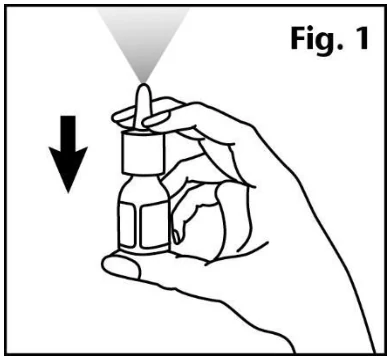
- 2. The nasal spray pump must be primed before Ipratropium nasal spray is used for the first time. To prime the pump, hold the bottle with your thumb at the base and your index and middle fingers on the white shoulder area (Fig. 1). Make sure the bottle points upright and away from your eyes. Press your thumb firmly and quickly against the bottle seven times. The pump is now primed and can be used. Your pump will hold its prime for up to 24 hours. If you have not used your pump for more than 24 hours, you will need to prime it again before use. Reprime the pump as before, but this time only two sprays are required. If you have not used your pump for more than 7 days reprime using 7 sprays.
- 3. Blow your nose to clear your nostrils if necessary.
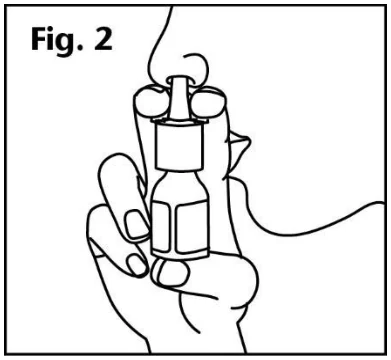
- 4. Close one nostril by gently placing your fingers against the side of your nose. Tilt your head slightly forward and, keeping the bottle upright, insert the nasal tip into the other nostril (Fig. 2). Point the tip toward the back and outer side of the nose.
- 5. Press firmly and quickly upwards with the thumb at the base while holding the white shoulder portion of the pump between your index and middle fingers. Following each spray, sniff deeply and breathe out through the mouth.
- 6. After spraying the nostril and removing the unit, tilt your head backwards for a few seconds to let the spray spread over the back of the nose.
- 7. Repeat step 4 to 6 for the other nostril.
- 8. Replace the cap.
Avoid spraying Ipratropium nasal spray in or around your eye. Should this occur, immediately flush your eye with cold tap water for several minutes. If you accidently spray Ipratropium nasal spray in your eyes, you may experience a temporary blurring of vision and increased sensitivity to light, which may last a few hours. Follow your doctor’s instructions about when and how to take your medicine and always read the label.
If the nasal tip becomes clogged, remove the plastic dust cap. Hold the nasal tip under warm running water for about a minute. Dry the nasal tip, reprime the nasal spray pump and replace the plastic dust cap.
Patients should be advised to stop using Ipratropium nasal spray and to seek medical advice for alternative treatment, if they do not feel any improvement or if symptoms worsen.
4.3 Contraindications
Hypersensitivity to atropine or its derivatives or to any of the excipients listed in section 6.1.
4.4 Special warnings and precautions for use
Immediate hypersensitivity reactions following the use of Ipratropium nasal spray, have been demonstrated by rare cases of urticaria, angioedema, rash, bronchospasm, oropharyngeal oedema, and anaphylaxis.
Caution is advocated in the use of anticholinergic agents in patients predisposed to or with narrow-angle glaucoma, or with pre-existing urinary outflow tract obstruction (e.g. prostatic hyperplasia or bladder-outflow obstruction).
As patients with cystic fibrosis may be prone to gastrointestinal motility disturbances, Ipratropium nasal spray, as with other anticholinergics, should be used with caution in these patients.
There have been isolated reports of ocular complications (i.e. mydriasis, increased intraocular pressure, narrow-angle glaucoma, eye pain) when aerosolised ipratropium bromide, either alone or in combination with an adrenergic beta2-agonist, has come into contact with the eyes. Thus, patients must be instructed in the correct administration of Ipratropium nasal spray.
Eye pain or discomfort, blurred vision, visual halos, or coloured images in association with red eyes from conjunctival congestion and corneal oedema may be signs of acute narrow-angle glaucoma. Should any combination of these symptoms develop, treatment with miotic drops should be initiated and specialist advice sought immediately.
Ipratropium nasal spray contains the (antimicrobial) preservative benzalkonium chloride which may cause irritation of the nasal mucosa.
4.5 Interaction with other medicinal products and other forms of interaction
The concomitant use of Ipratropium nasal spray with other drugs commonly prescribed for perennial rhinitis, i.e. antihistamines, decongestants or nasal steroids does not increase the incidence of nasal or non-nasal side-effects.
Ipratropium bromide is minimally absorbed into the systemic circulation; nonetheless, there is some potential for additive interaction with other concomitantly administered anticholinergic medications, including ipratropium bromide-containing aerosols for oral inhalation.
4.6 Fertility, pregnancy and lactation
Pregnancy
The safety of Ipratropium nasal spray during human pregnancy has not been established. The benefits of using Ipratropium nasal spray during a confirmed or suspected pregnancy must be weighed against the possible hazards to the unborn child. Preclinical studies have shown no embryotoxic or teratogenic effects following inhalation or intranasal application at doses considerably higher than those recommended in man.
Breast-feeding
It is not known whether ipratropium bromide is excreted into breast milk. It is unlikely that ipratropium bromide would reach the infant to an important extent, however caution should be exercised when Ipratropium nasal spray is administered to nursing mothers.
Fertility
Preclinical studies performed with ipratropium bromide showed no adverse effect on fertility (see section 5.3). Clinical data on fertility are not available for ipratropium bromide.
4.7 Effects on ability to drive and use machines
No studies on the effects on the ability to drive and use machines have been performed. However, patients should be advised that they may experience undesirable effects such as dizziness, accommodation disorder, mydriasis and blurred vision during treatment with Ipratropium nasal spray. If patients experience the above mentioned side effects they should avoid potentially hazardous tasks such as driving or operating machinery.
4.8 Undesirable effects
Many of the listed undesirable effects can be assigned to the anticholinergic properties of Ipratropium nasal spray. As with all topical therapy, Ipratropium nasal spray may show symptoms of local irritation. Adverse drug reactions were identified from data obtained in clinical trials and pharmacovigilance during post approval use of the drug.
The most frequent side effects reported in clinical trials were epistaxis, nasal dryness, headache, throat irritation and nasal discomfort.
Frequencies
Very common ≥ 1/10
Common ≥ 1/100 to <1/10
Uncommon ≥ 1/1000 to <1/100
Rare ≥ 1/10,000 to <1/1000
Very rare <1/10,000
Immune system disorders
Hypersensitivity Uncommon
Anaphylactic reaction Uncommon
Angioedema of tongue, lips and face Uncommon
Nervous system disorders
Headache Common
Dizziness Uncommon
Eye disorders
Blurred vision Uncommon
Mydriasis (1) Uncommon
Intraocular pressure increased (1) Uncommon
Glaucoma (1) Uncommon
Eye pain (1) Uncommon
Halo vision Uncommon
Conjunctival hyperaemia Uncommon
Corneal oedema Uncommon Accommodation disorder Uncommon
Cardiac disorders
Supraventricular tachycardia Uncommon
Atrial fibrillation Uncommon
Heart rate increased Uncommon
Palpitations Rare
Respiratory, thoracic and mediastinal disorders
Epistaxis Common
Nasal dryness Common
Throat irritation Common
Nasal discomfort Common
Bronchospasm Uncommon
Laryngospasm Uncommon
Pharyngeal Oedema Uncommon
Dry Throat Uncommon
Gastrointestinal disorders
Dry mouth Uncommon
Nausea Uncommon
Gastrointestinal motility disorder Uncommon
Stomatitis Uncommon
Burning Sensation Uncommon
Skin and subcutaneous tissue disorders
Rash Uncommon
Urticaria Rare
Pruritus Rare
Renal and urinary disorders
Urinary retention (2) Uncommon
(1) ocular complications have been reported when aerolised ipratropium bromide, either alone or in combination with an adrenergic beta2-agonist, has come into contact with the eyes– see section 4.4.
(2) the risk of urinary retention may be increased in patients with pre-existing urinary outflow tract obstruction
Reporting of suspected adverse reactions
Reporting suspected adverse reactions after authorisation of the medicinal product is important. It allows continued monitoring of the benefit/risk balance of the medicinal product. Healthcare professionals are asked to report any suspected adverse reactions via the Yellow Card Scheme at: www.mhra.gov.uk/yellowcard or search for MHRA Yellow Card in the Google Play or Apple App Store.
4.9 Overdose
No symptoms specific to overdose have been encountered. In view of the wide therapeutic window and topical administration of Ipratropium nasal spray, no serious anticholinergic symptoms are to be expected. As with other anticholinergics, dry mouth, visual accommodation disturbances and tachycardia would be the expected symptoms and signs of overdose.
5 PHARMACOLOGICAL PROPERTIES
5.1 Pharmacodynamic properties
Pharmacotherapeutic group: Decongestants and other nasal preparations for topical use.
ATC code: R01AX03
Ipratropium bromide, a quaternary ammonium derivative of atropine, is an anticholinergic drug. Ipratropium bromide administered intranasally has a localised parasympathetic blocking action which reduces watery hypersecretion from mucosal glands in the nose.
5.2 Pharmacokinetic properties
Absorption
Ipratropium is a quaternary amine that is rapidly absorbed from the nasal mucosa, however to a low extent. In healthy volunteers approximately 10% of a nasally given dose was excreted unchanged in the urine over 24 hours.
Distribution
The drug is minimally (less than 20%) bound to plasma proteins. The quaternary amine of the ipratropium ion does not cross the blood-brain barrier.
Biotransformation
Ipratropium has a total clearance of 2.3 l/min and a renal clearance of 0.9 l/min. After intravenous administration approximately 60% of a dose is metabolised, mainly by conjugation (40%), whereas after inhalation about 77% of the systemically available dose is metabolised by ester hydrolysis (41%) and conjugation (36%).
Elimination
In an excretion balance study cumulative renal excretion (6 days) of drug-related radioactivity (including parent compound and all metabolites) accounted for 72.1% after intravenous administration, 9.3% after oral administration and 3.2% after inhalation. Total radioactivity excreted via the faeces was 6.3% following intravenous application, 88.5% following oral dosing and 69.4% after inhalation. Therefore, the dominant excretion of drug-related radioactivity occurred via the kidneys. The main urinary metabolites bind poorly to the muscarinic receptor and have to be regarded as ineffective.
5.3 Preclinical safety data
The toxicity of ipratropium bromide has been investigated extensively in the following types of studies: acute, subchronic and chronic toxicity, carcinogenicity, reproductive toxicity and mutagenicity via oral, intravenous, subcutaneous, intranasal and/or inhalation routes. Based on these toxicity studies, the probability of systemic anticholinergic side effects decreases in the following order: intravenous > subcutaneous > oral > inhalation > intranasal.
Pre-clinically, ipratropium bromide was found to be well-tolerated. Two-year carcinogenicity studies in rats and mice have revealed no carcinogenic activity at doses up to approximately 1,200 times the maximum recommended human daily dose for Ipratropium nasal spray. Results of various mutagenicity tests were negative.
Studies to investigate the possible influence of ipratropium bromide on fertility, embryo-fetotoxicity, and peri-/postnatal development have been performed on mice, rats and rabbits. High oral dose levels, i.e. 1000 mg/kg/day in the rat and 125 mg/kg/day in the rabbit were maternotoxic for both species and embryo-/fetotoxic in the rat, where the foetal weight was reduced. Treatment-related malformations were not observed. The highest, technically feasible doses for inhalation of the metered dose aerosol, 1.5 mg/kg/day in rats (human equivalent dose (HED) of 0.24 mg/kg) and 1.8 mg/kg/day in rabbits (HED of 0.576 mg/kg), showed no adverse effects on reproduction.
The maximum recommended human daily dose (MRHDD) of Ipratropium nasal spray is 2 sprays in each nostril (= 42 micrograms/nostril) up to 3-times a day, or 0.136 mg. This equals to a dose of 0.00272 mg/kg, based on a body weight of 50 kg. This MRHDD based on mg/kg is 88- and 211-fold less than the highest, technically feasible doses tested in rats and rabbits, respectively which showed no adverse effects on reproduction.
6 PHARMACEUTICAL PARTICULARS
6.1 List of excipients
Sodium chloride
Benzalkonium chloride
Disodium edetate
Hydrochloric acid (for pH adjustment)
Sodium hydroxide (for pH adjustment)
Purified water
6.2 Incompatibilities
Not applicable
6.3 Shelf life
Unopened: 3 years
After first use: 3 months.
6.4 Special precautions for storage
Do not freeze. Do not drop the bottle.
6.5 Nature and contents of container
Brown glass bottle of 20 ml with a metered nasal spray pump. One bottle contains 240 doses.
6.6 Special precautions for disposal
Any unused medicinal product or waste material should be disposed of in accordance with local requirements.
7 MARKETING AUTHORISATION HOLDER
INFECTOPHARM Arzneimittel und Consilium GmbH
Von-Humboldt-Straße 1
64646 Heppenheim
Germany
Distributed by:
Consilient Health (UK) Ltd.,
No. 1 Church Road,
Richmond upon Thames,
Surrey, TW9 2QE, UK
8 MARKETING AUTHORISATION NUMBER(S)
PL 15011/0039
9 DATE OF FIRST AUTHORISATION/RENEWAL OF THE
AUTHORISATION
12 October 2023
10 DATE OF REVISION OF THE TEXT
20/01/2025