


Patient leaflet - Iopidine 5 mg / ml eye drops
1. WHAT IOPIDINE IS AND WHAT IT IS USED FOR
Iopidine contain apraclonidine (as hydrochloride) as the active substance.
Iopidine belongs to a group of medicines known as alpha agonists.
It is used in the treatment of chronic glaucoma in people who are already receiving other medicines to treat this disease.
In these people, Iopidine helps to reduce the fluid pressure in the eye and can delay the need for pressure relieving eye surgery.
2. WHAT YOU NEED TO KNOW BEFORE YOU USE IOPIDINE
Do not use Iopidine:
- If you have a history of severe or unstable heart disease or circulatory problems.
- If you are allergic to apraclonidine, clonidine or any of the other ingredients of this medicine listed in section 6.
- If you are currently taking monoamine oxidase inhibitors antidepressants or tricyclic antidepressants.
- If you are currently taking medicines of the class of sympathomimetics that are taken either orally or via injection.
- In CHILDREN.
Ask your doctor for advice.
Warnings and precautions
Take special care:
- Only use Iopidine for dropping in your eye(s).
- Iopidine may not continue to control your eye pressure after you have used them for a period of time. Your doctor will examine you often while you are using Iopidine to see whether the eye drops are still working for you.
- As Iopidine decreases the pressure in your eye(s), you should have your eye pressure checked regularly to ensure that the pressure in your eye(s) remains under control.
If you have a history of, or are taking medicine to treat, any of the following:
- Any heart disease (including angina, heart attacks or heart failure)
- High blood pressure or other circulatory problems (including stroke, Raynaud’s disease and fainting spells)
- Kidney or liver problems
- Depression
- Parkinson's disease
- Diabetes or low blood sugar. Iopidine may hide the signs and symptoms of a sudden reduction in blood sugar such as a fast heart beat or trembling.
- If you are due to have an operation.
If any of these apply, you may still be able to use Iopidine, but discuss it with your doctor first.
Using Iopidine with food, drink and alcohol
No alcohol should be consumed during treatment with Iopidine as it can increase its effects.
Other medicines and Iopidine
Tell your doctor or pharmacist if you are taking or have recently taken any other medicines, including medicines obtained without a prescription. Iopidine must not be used if you are taking monoamine oxidase inhibitor antidepressants or tricyclic antidepressants. Iopidine must also not be used if you are taking medicines of the class of sympathomimetics that are taken either orally or via injection. Iopidine may increase the effects of some medicines used to treat - depression - asthma – high blood pressure – heart medicines containing digoxin or digitoxin – some forms of mental illness and Parkinson’s disease; and may interact with - some pain killers - sedatives – anaesthetic – tricyclic antidepressants - phenothiazines - cough and cold remedies – glaucoma medications such as timolol, brimonidine or dipivefrine - eye drops used to whiten the eye.
Pregnancy and breast-feeding
If you are pregnant or breast-feeding, think you may be pregnant, or are planning to have a baby, ask your doctor or pharmacist before taking this medicine.
Iopidine should not be used during pregnancy or breast-feeding.
Driving and using machines
This type of medicine may cause you to feel sleepy and dizzy. If you do, you should not drive or operate machinery.
Important information if you wear Contact Lenses
Iopidine contains benzalkonium chloride
This medicine contains 0.1 mg of benzalkonium chloride in each ml of the product which is equivalent to 0.01%.
IOPIDINE contains a preservative (benzalkonium chloride) which may be absorbed by soft contact lenses and may change the colour of the contact lenses. You should remove contact lenses before using this medicine and put them back 15 minutes afterwards. Benzalkonium chloride may also cause eye irritation, especially if you have dry eyes or disorders of the cornea (the clear layer at the front of the eye). If you feel abnormal eye sensation, stinging or pain in the eye after using this medicine, talk to your doctor.
3. HOW TO USE IOPIDINE
The recommended dose
The recommended dose is 1 drop into your eye(s), 3 times each day.
Remove the loose collar from the cap when the bottle is first opened.
Always use Iopidine exactly as your doctor has told you. You should check with your doctor or pharmacist if you are not sure.
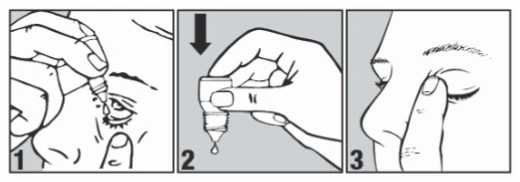
How to use
- Wash your hands before you start.
- Twist off the bottle cap.
- Hold the bottle pointing down, between your thumb and fingers.
- Tilt your head back.
- Pull down your lower eyelid with a finger until there is a 'pocket' between the eyelid and your eye. The drop will go in here (picture 1).
- Bring the bottle tip close to the eye. Do this in front of a mirror if it helps.
- Do not touch your eye or eyelid, surrounding areas or other surfaces with the dropper. It could infect the drops.
- Gently press on the base of the bottle to release one drop at a time (picture 2).
- Do not squeeze the bottle, only a gentle press on the bottom is needed.
- After using Iopidine, press a finger into the corner of your eye, by the nose (picture 3). This helps to stop Iopidine getting into the rest of the body.
- If you use drops in both eyes, repeat the steps for your other eye. Put the bottle cap firmly back on immediately after use.
- If a drop misses your eye, try again.
- If Iopidine is swallowed, see your doctor immediately.
- If you forget to use Iopidine
- Continue with the next dose as planned. However, if it is almost time for your next dose, skip the missed dose and go back to your regular dosing schedule.
- Do not take a double dose to make up for a forgotten dose.
- If you use more Iopidine than you should rinse it all out with warm water. Do not put in any more drops until it is time for your next regular dose. In case of accidental ingestion, symptoms of overdose may include decreased blood pressure, drowsiness, decreased heart rate, hypoventilation (reduced rate and depth of breathing), and convulsion.
If you are using other eye drop or eye ointment medicines
Leave at least 5 minutes between each medicine. Eye ointments should be administered last.
If you have any further questions on the use of Iopidine, ask your doctor or pharmacist.
4. POSSIBLE SIDE EFFECTS
Like all medicines, this medicine can cause side effects, although not everybody gets them.
Iopidine can cause allergic reactions. If you experience one or more of the following eye symptoms - redness - itching - discomfort – watery eyes - abnormal sensation – eye and eyelid swelling - poor vision - see your doctor immediately.
If your vision gets worse straight after using Iopidine, stop use and see your doctor immediately.
- You may experience some or all of the following effects in your eye(s):
Very Common (may affect more than 1 in 10 people):
increased redness - itching - inflammation.
Common (may affect upto 1 in 10 people):
discomfort - watery eyes – swelling of the eyelids - gritty feeling in the eye – dry eye – eyelid crusting.
Uncommon (may affect upto 1 in 100 people):
bumps under the eyelids – swelling of the eye – abnormal vision – pain – inflammation and irritation of the eye or eyelids – corneal (the front part of your eye) surface damage – sensitivity to light – redness of the eyelid – raising or pulling up of the eyelids – increase in pupil size – reduced vision – blurred vision – drooping of eyelid – discharge or whitening of the eye.
- You may also experience effects in other areas of your body including:
Common (may affect upto 1 in 10 people): dry mouth – inflammation inside the nose – dermatitis - dry nose - weakness - headache - unusual taste.
Uncommon (may affect upto 1 in 100 people): chest pain – swelling of your hands, feet or extremities - irregular heart beat - constipation - nausea - feeling tired - sore throat - runny nose - muscle aches - poor coordination - sleepiness - dizziness - tingling feeling - nervousness - depression - difficulty sleeping - shortness of breath or difficulty breathing - unusual sense of smell – facial swelling – irritability – widening of blood vessels.
Reporting of side effects
If you get any side effects, talk to your doctor or pharmacist. This includes any possible side effects not listed in this leaflet. You can also report side effects directly via the Yellow Card Scheme at: www.mhra.gov.uk/yellowcard or search for MHRA Yellow Card in the Google Play or Apple App Store. By reporting side effects, you can help provide more information on the safety of this medicine.
5. HOW TO STORE IOPIDINE
- Keep out of the sight and reach of children.
- Do not use after the expiry date printed on the bottle or carton label. The expiry date refers to the last day of the month.
- Do not store above 25°C. Do not refrigerate or freeze. Protect from light. Keep the container in the outer carton. Discard contents 28 days after first opening.
- Medicines should not be disposed of via waste water or household waste. Ask your pharmacist how to dispose of medicines no longer required. These measures will help to protect the environment.
- If the solution becomes discoloured or show any other signs of deterioration, you should ask your doctor or pharmacist who will advise you what to do.
- Do not pass this medicine on to others. It may harm them, even if their symptoms are the same as yours.
6. CONTENTS OF THE PACK AND OTHER INFORMATION
Each ml of eye drops, solution contains 5mg apraclonidine (as hydrochloride).
The drops are clear colourless to pale yellow solution in a plastic dropper bottle containing 5ml.
Iopidine also contain the following inactive ingredients:
benzalkonium chloride 0.1 mg/ml as a preservative, sodium acetate, sodium chloride, and purified water. Very small amounts of hydrochloric acid and/or sodium hydroxide may have been added to regulate the acidity/alkalinity of the product to ensure comfort in the eye.
POM PLGB: 15814/1409
Manufactured by Essential Pharma Limited, Vision Exchange Building, Triq it-Territorjals, Zone 1, Central Business District, Birkirkara, CBD 1070, Malta.
Procured from within the EU and repackaged by the Product Licence holder: O.P.D. Laboratories Ltd., Unit 6 Colonial Way, Watford, Herts WD24 4PR.
Leaflet revision and issue date (Ref.) 04.06.2024
Iopidine is a registered trademark of Essential Pharma Switzerland GmbH.
To request a copy of this leaflet in Braille, large print or audio please call 01923 332 796.