


Patient leaflet - IMIGRAN SUBJECT 6MG/0.5ML SOLUTION FOR INJECTION IN PRE-FILLED CARTRIDGES
1. What Imigran Subject is and what it is used for
Each Imigran Subject pre-filled cartridge syringe contains a single dose of sumatriptan, which belongs to a group of medicines called triptans (also known as 5-HT1 receptor agonists).
Imigran Subject is used to treat migraine headache and a rare condition called cluster headache.
Migraine and cluster headache symptoms may be caused by the temporary widening of blood vessels in the head. Imigran Subject is believed to reduce the widening of these blood vessels. This in turn helps to take away the headache and relieve other symptoms such as feeling or being sick (nausea or vomiting) and sensitivity to light and sound.
2. What you need to know before you use Imigran Subject
Don’t use Imigran Subject:
- If you’re allergic to sumatriptan, or any of the other ingredients of this medicine (listed in section 6)
- If you have a heart problem such as narrowing of the arteries (ischaemic heart disease) or chest pains (angina), or have already had a heart attack
- If you have circulation problems in your legs that cause cramp-like pains when you walk (peripheral vascular disease)
- If you have had a stroke or a mini-stroke (also called a transient ischaemic attack or TIA)
- If you have high blood pressure. You may be able to use Imigran if your high blood pressure is mild and is being treated
- If you have serious liver disease
- With other migraine medicines, including those which contain ergotamine, or similar medicines such as methysergide maleate; or any triptan or 5-HT1 agonist (such as naratriptan or zolmitriptan)
With any of the following anti-depressants:
- MAOIs (monoamine oxidase inhibitors) or if you have taken an MAOI in the last 2 weeks
- SSRIs (selective serotonin reuptake inhibitors) including citalopram, fluoxetine, fluvoxamine, paroxetine and sertraline
- SNRIs (serotonin noradrenaline reuptake inhibitors) including venlafaxine or duloxetine.
- For children under 18 years of age.
If any of these apply to you:
➜ Tell your doctor, and don’t use Imigran Subject.
Take special care with Imigran Subject
Talk to your doctor or pharmacist before using Imigran.
If you have any extra risk factors
- If you are a heavy smoker or are using nicotine replacement therapy, and especially
- If you are a man aged over 40, or
- If you are a woman who has been through the menopause
In very rare cases, people have developed serious heart conditions after using Imigran, even though they had no signs of heart disease before. If any of the points above applies to you it could mean you have a greater risk of developing heart disease - so:
➜ Tell your doctor so that your heart function can be checked before Imigran is prescribed for you.
If you have a history of fits (seizures)
Or if you have other conditions which might make it more likely that you’ll have a fit - for example, a head injury or alcoholism:
➜ Tell your doctor so that you can be supervised more closely.
If you have had high blood pressure Imigran may not be suitable for you
➜ Tell your doctor or pharmacist before using Imigran.
If you have liver or kidney disease
If either of these apply to you:
➜ Tell your doctor or pharmacist before using Imigran.
If you are allergic to antibiotics called sulphonamides
If so, you may also be allergic to Imigran. If you know you are allergic to an antibiotic but you are not sure whether it is a sulphonamide:
➜ Tell your doctor or pharmacist before using Imigran.
If you are taking anti-depressants called SSRIs (Selective Serotonin Reuptake Inhibitors) or SNRIs (Serotonin Noradrenaline Reuptake Inhibitors)
➜ Tell your doctor or pharmacist before using Imigran.
Also see Other medicines and Imigran, below.
Imigran syringe may contain latex
The syringe needle shield may contain latex.
➜ Tell your doctor if you are allergic to latex.
If you use Imigran frequently
Using Imigran too often may make your headaches worse.
➜ Tell your doctor if this applies to you. He or she may recommend you stop using Imigran.
If you feel pain or tightness in your chest after you use Imigran
These effects may be intense but they usually pass quickly. If they don’t pass quickly, or they become severe:
➜ Get medical help immediately. Section 4 (below) has more information about these possible side effects.
Other medicines and Imigran
Tell your doctor or pharmacist if you’re taking, have recently taken or might take any other medicines. This includes any herbal products or medicines you’ve bought without a prescription.
Some medicines must not be taken with Imigran and others may cause adverse effects if they’re taken with Imigran. You must tell your doctor if you are taking:
- ergotamine also used to treat migraine, or similar medicines such as methysergide (see section 2 Don’t use Imigran Subject). Don’t use Imigran at the same time as these medicines. Stop taking these medicines at least 24 hours before using Imigran. Don’t take any medicines which contain ergotamine or compounds similar to ergotamine again for at least 6 hours after using Imigran.
- other triptans/5-HT1 receptor agonists (such as naratriptan, rizatriptan, zolmitriptan), also used to treat migraine, (see section 2 Don’t use Imigran Subject). Don’t use Imigran at the same time as these medicines. Stop taking these medicines at least 24 hours before using Imigran. Don’t take another triptan/5-HT1 receptor agonist for at least 24 hours after using Imigran.
- MAOIs used to treat depression. Don’t use Imigran if you have taken these in the last 2 weeks.
- SSRIs and SNRIs used to treat depression. Using Imigran with these medicines can cause serotonin syndrome (a collection of symptoms which can include restlessness, confusion, sweating, hallucinations, increased reflexes, muscle spasms, shivering, increased heartbeat and shaking). Tell your doctor immediately if you are affected in this way.
- St John’s Wort (Hypericum perforatum). Taking herbal remedies containing St John’s Wort while using Imigran may make side effects more likely.
Pregnancy and breast-feeding
- If you are pregnant, think you may be pregnant or are planning to have a baby, ask your doctor for advice before taking this medicine. There is only limited information about the safety of Imigran for pregnant women, though up till now there is no evidence of any increased risk of birth defects. Your doctor will discuss with you whether or not you should use Imigran while you are pregnant
Don’t breast-feed your baby for 12 hours after using Imigran. If you express any breast milk during this time, discard the milk and don’t give it to your baby.
Some breastfeeding women report breast and/or nipple pain after use of sumatriptan. The pain is usually temporary and disappears in 3 to 12 hours.
Driving and using machines
Either the symptoms of migraine or your medicine may make you drowsy. If you are affected, don’t drive or operate machinery.
Imigran Subject contains
- Sodium: This medicine contains less than 1 mmol sodium (23 mg) per syringe, that is to say essentially ‘sodium-free’.
3. How to use Imigran Subject
Always use this medicine exactly as your doctor has told you. Check with your doctor or pharmacist if you are not sure.
Imigran Subject is usually injected into the thigh.
There’s a step-by-step guide to using the syringe at the end of this leaflet (see section 7 overleaf).
When to use Imigran
- It’s best to use Imigran as soon as you feel a migraine or a cluster headache coming on, although you can use it at any time during an attack
- Don’t use Imigran to try to prevent an attack - only use it after your migraine symptoms start.
How much to use
Adults aged 18 to 65
- The usual dose for adults aged 18 to 65 with migraine or a cluster headache is one 6 mg injection.
Children under 18
- Imigran is not recommended for children under 18 years old.
Older people (aged over 65)
- Imigran is not recommended for people aged over 65.
If your symptoms start to come back
- You can use a second Imigran injection if at least 1 hour has passed since the first injection.
If the first injection has no effect
- Don’t use a new injection or any other Imigran preparation for the same attack.
If Imigran doesn’t give you any relief:
➜ Ask your doctor or pharmacist for advice.
If you use more Imigran than you should
Using too much Imigran could make you ill. If you have used more than two injections in 24 hours:
➜ Contact your doctor for advice.
If you have further questions about the use of this medicine, ask your doctor or pharmacist.
4. Possible side effects
Like all medicines, this medicine can cause side effects, but not everybody gets them. Some symptoms may be caused by the migraine itself.
Allergic reaction: get doctor’s help straight away
The following side effects have occurred but their exact frequency is not known.
- The signs of allergy include rash, hives (itchy rash); wheezing; swollen eyelids, face or lips; complete collapse.
If you get any of these symptoms soon after using Imigran:
➜ Don’t use any more. Contact a doctor straight away.
Very common side effects
(affect more than 1 in 10 people)
- Temporary pain at the site of injection
- Stinging or burning, redness, swelling, bruising and bleeding at the site of injection.
Common side effects
(affect up to 1 in 10 people)
- Pain, heaviness, pressure or tightness in the chest, throat or other parts of the body, or unusual sensations, including numbness, tingling and warmth or cold. These effects may be intense but generally pass quickly.
If these effects continue or become severe (especially the chest pain):
➜ Get medical help urgently. In a very small number of people these symptoms can be caused by a heart attack.
Other common side effects include:
- Feeling sick (nausea) or being sick (vomiting), although this may be due to the migraine itself
- Tiredness or drowsiness
- Dizziness, feeling weak, or getting hot flushes
- Temporary increase in blood pressure
- Shortness of breath
- Aching muscles.
Rare side effects
(affect up to 1 in 1,000 people)
- Breast pain.
Very rare side effects
(affect up to 1 in 10,000 people)
Liver function changes. If you have a blood test to check your liver function, tell your doctor or nurse that you are using Imigran.
Some patients may have the following side effects but it is not known how often they occur
- Seizures/fits, tremors, short-lived/temporary muscle spasm (which may affect jaw movement), neck stiffness
- Visual disturbances such as flickering, reduced vision, double vision, loss of vision, and in some cases even permanent defects (although these may be due to the migraine attack itself)
- Heart problems, where your heartbeat may go faster, slower or change rhythm, chest pains (angina) or heart attack
- Pale, blue-tinged skin and/or pain in your fingers, toes, ears, nose or jaw in response to cold or stress (Raynaud’s phenomenon)
- Feeling faint (blood pressure may go down)
- Pain in the lower left side of the stomach and bloody diarrhoea (ischaemic colitis)
- Diarrhoea
- If you had a recent injury or if you have inflammation (like rheumatism or inflammation of the colon) you may experience pain or pain worsening at the site of injury or inflammation
- Pain in the joints
- Feeling anxious
- Difficulty swallowing
- Excessive sweating.
Reporting of side effects
If you get any side effects, talk to your doctor, pharmacist or nurse. This includes any possible side effects not listed in this leaflet. You can also report side effects directly via the Yellow Card Scheme at Website: www.mhra.gov.uk/yellowcard or search for MHRA Yellow Card in the Google Play or Apple App Store. By reporting side effects you can help provide more information on the safety of this medicine.
5. How to store Imigran Subject
Keep this medicine out of the sight and reach of children.
You may wish to carry Imigran Subject with you in case of a migraine attack.
Do not store above 30ºC.
Store in the original case provided to protect from light.
Don’t use this medicine after the expiry date shown on the carton. The expiry date refers to the last day of that month.
Do not use this medicine if it becomes discoloured or shows any other visible signs of deterioration. Consult your pharmacist for advice.
Do not throw away medicines via wastewater or household waste. Ask your doctor, practice nurse or pharmacist how to dispose of your empty Cartridge Packs safely. You may be able to do this at your doctor’s surgery.
6. Contents of the pack and other information
What Imigran Subject contains
- The active substance is sumatriptan. Each pre-filled 0.5ml cartridge syringe contains 6mg sumatriptan (as the succinate) in saline.
- The other ingredients are sodium chloride and water for injection.
What Imigran Subject looks like and contents of the pack
Each Imigran Subject injection treatment pack comes in a grey carrycase containing an injection device (Pen) and a blue cartridge pack which contains 2 pre-filled syringes.
Imigran Subject injection is also available as refill packs, which contain one blue cartridge pack of 2 pre-filled syringes.
Manufacturers:
- Glaxo Operations UK Ltd., United Kingdom.
- GlaxoSmithKline Manufacturing S.P.A., Strada Provinciale Asolana No. 90, San Polo di Torrile 43056, Parma, Italy.
Procured from within the EU and repackaged by the Product Licence holder: Pharmaram Limited, Unit F4 Tom Bill Way, Ivanhoe Business Park, Ashby de la Zouch, Leicestershire LE65 2UY, UK.
PL 33652/0276
Imigran® SubjectTM
Leaflet revision date: 15/12/2025
Trademarks are owned by or licensed to the GSK group of companies.
© 2025 GSK group of companies or its licensor.
Is this leaflet hard to see and read? Please call 01530 410920 to obtain the leaflet in a format suitable for you.
POM
|
|---|
This leaflet shows you how to load the Subject pen and how to use it to give a dose of Imigran medicine.
Please read this leaflet before using the injection system.
The GlaxoSmithKline Subject injection system is designed for use with a
medicine called Imigran.
Each Subject injection system comes complete with an Imigran cartridge pack.
The cartridge pack contains two pre-filled cartridge syringes.
Subject refill packs containing one Imigran Subject cartridge are also available.
Important: In the unlikely event that you have a problem with the Imigran Subject injection mechanism, please:
- Return it to your pharmacist who will replace it; or
- Contact GlaxoSmithKline customer contact centre on freephone 0800 221441 and they will tell you how to return it.
Keep out of the sight and reach of children
Description of parts
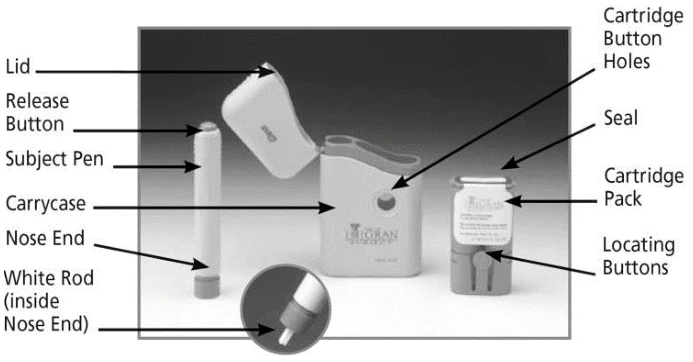
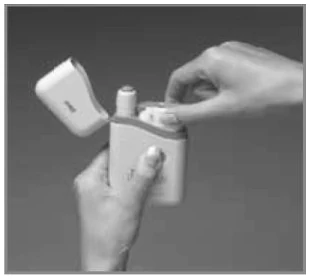

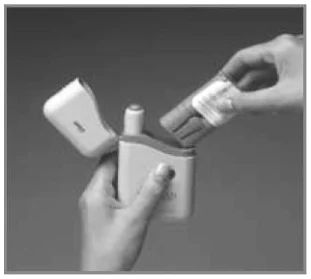
How to give an injection using the Subject pen
- Read the leaflet fully and carefully before using the Subject pen
- Each Imigran Subject injection system comes complete with a cartridge pack which contains two cartridge syringes pre-filled with Imigran
- Use the photo above to help you identify the different parts of the injection system.
- Do not load the pen until you are ready to give the injection.
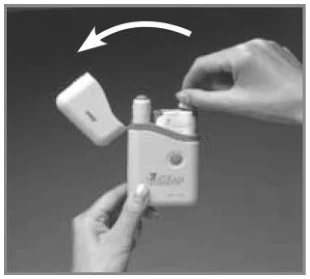
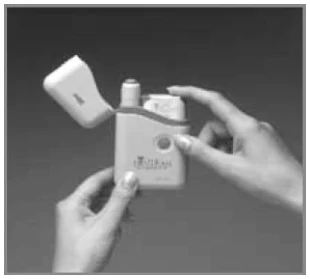
- 1.
Swing open the lid of the
carrycase.
- 2. Tear off the red seal from one
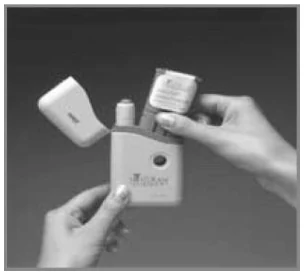
of the cartridges. Open the
blue hinged lid underneath the
seal.
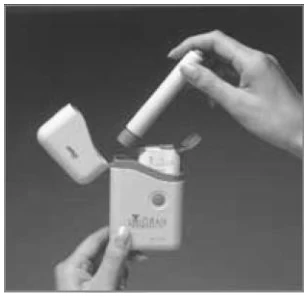
- 3. Take out the Subject pen from
the carrycase. Check that the
white rod is not sticking out
beyond the end of the pen
(see picture 11). If it is sticking
out, place the pen back inside
the carrycase, push firmly and
the rod should click into place.
The pen is now ready for use.
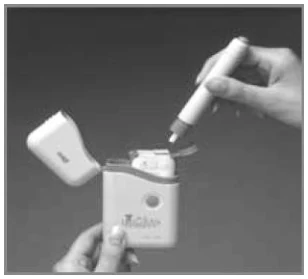
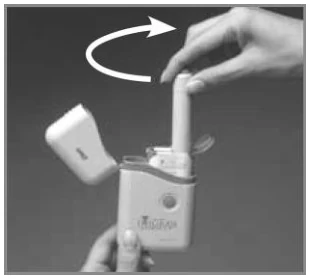
- 4.
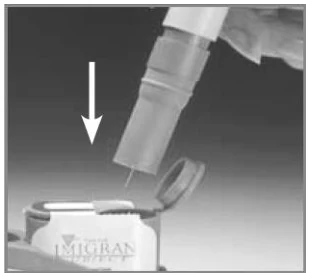
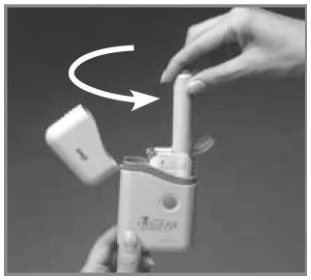
Push the Subject pen firmly into
the opened cartridge pack and
gently screw it clockwise (about
half a turn) until it will twist no
further.
- 5.
Keeping your finger away from
the blue release button pull the
Subject pen out of the cartridge
pack. You may have to pull quite
hard to do this. A safety catch
stops accidental injection until
you are ready.
- 6.
The loaded pen is now ready for immediate use.
Do not try to put the loaded pen back into the carrycase until after you have used the injection, or the needle may be damaged and the pen will not inject correctly.
- 7.
Press the pen with the long blue
nose end firmly against a clean
area of skin - usually the outside
of the thigh (as in picture) – so
the grey part slides down to
cover part of the blue nose.
This releases the safety catch.
- 8.
Hold the pen firmly and press
the blue release button at the
top of the Subject pen. Count
slowly to 10 keeping the Subject
pen very still and the release
button depressed. Do not take
the pen away from the skin too
soon or some of the injection
may be wasted.
Then lift the pen away taking care
not to touch the needle point.
- 9.
Return the used cartridge
syringe to the empty space in
the cartridge pack straight away.
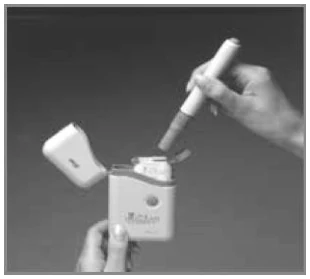
- 10.
Pushing the pen down into the
cartridge pack as far as it will
go, unscrew the pen by twisting
it anti-clockwise (about half a
turn) until it comes away.
- 11.
Withdraw the Subject pen from
the cartridge pack. Close the blue hinged lid over the used syringe.
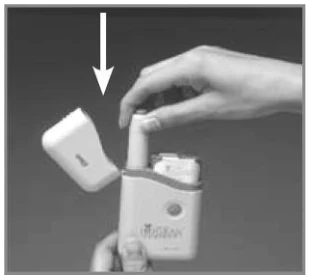
- 12.
Put the Subject pen back into
the carrycase and push it down until it stays down. It will click into place. The Subject pen is then ready for use next time.
- 13.
Close the lid of the carrycase
until you need to use the next cartridge syringe. When you have used both cartridges,
remove and replace the cartridge pack. (See below.)
- 11.
How to remove the used cartridge pack
- 1.
When both syringes have been
used, you can remove the
cartridge pack.
- 2.
Hold the carrycase and press
the two blue locating buttons with one hand.
- 3.
Gently pull out the cartridge pack
with the other hand.
- 4.
Be careful to dispose of your
empty cartridge packs safely. The cartridge pack will hold the used
Subject cartridge syringes and needles until you can safely
dispose of them. You should be able to do this at your doctor’s surgery, so ask your doctor or practice nurse.
How to put a new cartridge pack into the carrycase
Each Subject pen comes complete with an Imigran cartridge pack which contains two pre-filled cartridge syringes.
- 1.
Swing open the lid of the
carrycase, the Subject pen is already in its place.
- 2.
Push the cartridge pack into the
carrycase, pressing the blue buttons on either side so it slides in smoothly.
- 3.
It does not matter which side of
the cartridge pack is closest to the
Subject pen.
- 4.
The cartridge pack is in the right
position when the blue locating buttons show through the holes on either side of the carrycase.
- 5.
Close the carrycase by swinging
back the lid and snapping it shut.
- 6.
You can keep your cartridge pack
safely in the carrycase until you need to give yourself an injection.
- 7.
Keep your carrycase and any refill cartridge packs at a temperature below 30°C/86°F.
If they are kept warmer than this for more than 24 hours it could spoil them.