

Patient leaflet - Gynoxin 2% vaginal cream
1. What Gynoxin 2% vaginal cream is and what it is used for
Gynoxin 2% vaginal cream contains fenticonazole nitrate as the active ingredient, which is an anti-fungal agent.
Gynoxin prevents the growth of certain types of fungi. It is particularly effective against Candida albicans, which causes thrush.
2. What you need to know before you use Gynoxin 2% vaginal cream
Do not use Gynoxin:
- if you are allergic to fenticonazole or any of the other ingredients (listed in section 6).
Warnings and precautions
Talk to your doctor or pharmacist if:
- You are pregnant or breastfeeding (see section “Pregnancy, breast-feeding and fertility”).
- You are using a “barrier” method of contraception made of latex (see section “Other medicines and Gynoxin”). Consequently, you should use alternative precautions while using this product.
- You are using spermicides, intravaginal douches or other vaginal products (see section “Other medicines and Gynoxin vaginal cream).
- You experience any irritation or sensitivity to the product.
- Your symptoms are not reduced within one week or in case of severe or recurrent symptoms.
- Your partner is also affected.
- You had more than two previous infections in the last 6 months.
- You or your partner have ever had a sexually transmitted disease.
- You have ever had hypersensitivity to imidazoles or other vaginal antifungal products.
- You are aged over 60
You have any of the following symptoms:
- Abnormal or irregular vaginal bleeding
- Blood staining of a vaginal discharge
- Vulval or vaginal sores, ulcers or blisters
- Lower abdominal pain or dysuria
- Adverse effects such as redness, itching or rash associated with the treatment
It is necessary to avoid contact with the eyes.
Children and adolescents
Gynoxin vaginal cream is not recommended for children under 16 years.
Other medicines and Gynoxin vaginal cream
The fatty excipients and oils contained in the vaginal cream may damage contraceptives made of latex, such as condoms and diaphragms (see “Warnings and precautions” section).
It is not recommended to use spermicides (substance inserted vaginally, that destroys sperm and are used as contraceptive alone or in combination with e.g. diaphragms). It can inactivate the vaginal treatment.
Pregnancy, breast-feeding and fertility
If you are pregnant or breast-feeding or think you may be pregnant, ask your doctor for advice before using this medicine. Gynoxin should be used in pregnancy and breastfeeding periods under the supervision of a physician. During pregnancy the applicator should not be used.
Driving and using machines
Gynoxin has no influence on the ability to drive and use machines.
Gynoxin vaginal cream contains:
cetyl alcohol and wool fat hydrogenated which may cause local skin reactions (e.g. contact dermatitis)
- This medicine contains 50 mg of propylene glycol in 1 g of cream.
3. How to use Gynoxin 2% vaginal cream
Always use this medicine exactly as your doctor has told you. Check with your doctor or pharmacist if you are not sure.
The recommended dose is one applicator full in the morning and one applicator full in the evening for 3 days. Your symptoms may disappear quickly but it is important that you continue using the cream for 3 days.
If there is no improvement, or the condition worsens, consult your doctor.
Use in children and adolescents
The dose recommendation for children aged 16 years or above is the same as for adults.
How to apply Gynoxin
Follow the instructions in the diagrams below:
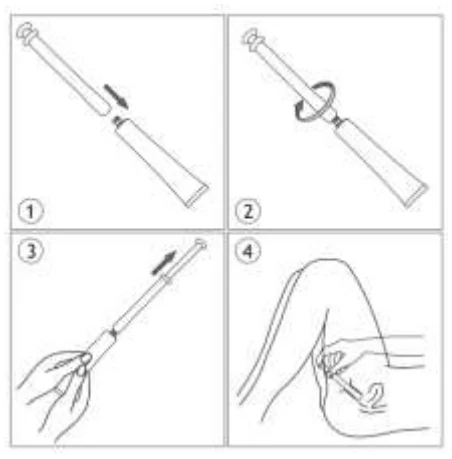
1
Screw the applicator onto the tube in place of
the cap.
2
Squeeze the tube gently at its lower end, so as to
fill the applicator. If there is a certain resistance
in the piston, pull it delicately. Unless otherwise
prescribed by the physician, the applicator must
be completely filled.
3
Remove the applicator from the tube which
should be closed immediately with the cap.
4
In a lying down position, with knees raised and
spread apart, delicately insert the applicator into
the vagina as deeply as possible. Push the piston
in completely, then pull out the applicator without
touching the piston.
Take care to ensure that the applicator is always perfectly clean.
After each use, wash it carefully with warm water and soap. If your doctor advises sterilisation of the applicator, for a particular reason, follow his instructions. Do not use water which is hotter than 50°C, or solvents. Then dry the applicator and store in its container.
Always wash your hands with mild soap and warm water afterwards. Gynoxin is not greasy, does not soil and can easily be removed with water.
If you use more Gynoxin than you should
In case the cream is eaten or swallowed, contact a doctor immediately or go to the nearest hospital.
If you forget to use Gynoxin
Do not use a double dose to make up for a missed dose.
If you stop using Gynoxin
If you have any further questions on the use of this medicine, ask your doctor or pharmacist.
4. Possible side effects
Like all medicines, this medicine can cause side effects, although not everybody gets them.
A slight burning sensation may be experienced when the medicine is inserted into the vagina. This will quickly disappear. When used as recommended, Gynoxin is absorbed only slightly and no side effects involving the entire body (systemic effects) are reported.
The use of medicines for topical use, especially if prolonged, may cause sensitisation (see “Warnings and precautions” section).
The following side effects have been reported with Gynoxin:
Very rare (may affect up to 1 in 10,000 people):
- vulvovaginal burning sensation
- skin erythema, pruritus and rash
Frequency Not known:
- application site hypersensitivity
Reporting of side effects
If you get any side effects, talk to your doctor or pharmacist. This includes any possible side effects not listed in this leaflet. You can also report side effects directly via the Yellow Card Scheme. Website: www.mhra.gov.uk/yellowcard or search for MHRA Yellow Card in the Google Play or Apple App Store.
By reporting side effects you can help provide more information on the safety of this medicine.
5. How to store Gynoxin 2% vaginal cream
Do not store above 30°C. Store in the original container.
Keep this medicine out of the sight and reach of children.
Do not use this medicine after the expiry date which is stated on the carton after EXP. The expiry date refers to the last day of that month.
Do not throw away any medicines via wastewater or household waste. Ask your pharmacist how to throw away medicines you no longer use. These measures will help protect the environment.
6. Contents of the pack and other information
What Gynoxin 2% vaginal cream contains
The active substance is fenticonazole nitrate. Each applicator full contains approximately
100mg fenticonazole nitrate.
- Other ingredients: propylene glycol (E1520), wool fat, almond oil, polyglycolic ester of fatty acids, cetyl alcohol, glyceryl monostearate, disodium edetate and purified water (see end of Section 2: Gynoxin vaginal cream contains for further information).
What Gynoxin 2% vaginal cream looks like and contents of the pack
Gynoxin is a white cream. It is packaged in an aluminium tube with a plastic cap. Each tube contains 30g. An applicator is provided; each applicator contains approximately 5g.
Marketing Authorisation Holder and Manufacturer
Recordati Industria Chimica e Farmaceutica SpA
via Matteo Civitali
1-20148 Milan
Italy
This leaflet was last revised in September 2020.