

Patient leaflet - Glycopyrronium Bromide 2 mg/5 ml oral solution
1. What Glycopyrronium Bromide oral solution is and what it is used for
This medicine is called Glycopyrronium Bromide and belongs to a group of medicines called anticholinergic or antimuscarinic drugs. It contains the active substance glycopyrronium bromide. Each 5 ml dose of oral solution contains 2 mg of glycopyrronium bromide. • Glycopyrronium bromide is used to treat excessive production of saliva (sialorrhoea) in patients suffering from long term neurological disorders which have occurred in childhood, in patients aged 3 years and older. Sialorrhoea (drooling or excessive salivation) is a common symptom of many diseases of the muscles or nerves. It is mainly caused by poor control of muscles in the face. Acute sialorrhoea may be associated with inflammation, dental or mouth infections. Glycopyrronium Bromide oral solution acts on the salivary glands to reduce production of saliva.
2. What you need to know before you take Glycopyrronium Bromide oral solution:
Do not take Glycopyrronium Bromide oral solution if you:
- are allergic (hypersensitive) to glycopyrronium bromide or any of the other ingredients of this medicine (listed in section 6)
- have glaucoma (increased pressure in the eye) • have a condition called myasthenia gravis which leads to muscle weakness and fatigue • have an obstruction of the stomach (pyloric stenosis) or bowel causing vomiting, abdominal pain and swelling (paralytic ileus)
- have an enlarged prostate gland (prostatic hypertrophy)
- are unable to completely empty the bladder (urinary retention)
- suffer from chronic end stage kidney disease and require dialysis
- are taking potassium chloride solid dose products • are taking anticholinergic medicines Warnings and precautions
Talk to a doctor or pharmacist before taking Glycopyrronium Bromide if you (or the patient):
- have gastric reflux (a condition in which the liquid stomach contents backs up into the gullet) • have ulcerative colitis (a chronic inflammation of the large intestine (colon) which can cause abdominal pain, diarrhoea and bleeding from the back passage)
- have pre-existing constipation
- have just had a heart attack or are suffering from heart disease, irregular heartbeats or high blood pressure, because this medicine can cause a change to your normal heart rate • have a condition characterised by a faster heartbeat than normal (this can be caused by conditions such as an overactive thyroid gland, heart failure or heart surgery)
- are due to have surgery (including at the dentist) during which you will be ‘put to sleep’ using inhalation anaesthesia. This is because this medicine may cause a change in your normal heart rhythm
- have diarrhoea, especially if you have had an ileostomy or colostomy
- have a high temperature (fever) or the environmental temperature is high (e.g. hot weather outside and high room temperature inside), as this medicine will reduce the amount you sweat, making it harder for your body to cool down. The doctor may need to temporarily reduce the dose to be taken
- have kidney disease, because this medicine’s dose may need to be decreased
- have compromised blood brain barrier (e.g. brain shunt/tumour and swollen brain can compromise blood brain barrier)
- have been told by your doctor that you have an intolerance to some sugars, because this medicine contains sorbitol
In addition, stop treatment and talk to your doctor if you are suffering with the following:
seem unwell with a very fast or very
slow heart rate
- constipation
- pneumonia
- changes in behaviour
The doctor will decide if treatment should continue and if there should be a dose reduction, after evaluating any of these events.
If you are not sure any of the above applies to you, talk to a doctor or pharmacist before taking Glycopyrronium Bromide oral solution.
Glycopyrronium Bromide oral solution reduces salivation which can increase the risk of dental disease, therefore teeth should be brushed daily and have regular dental checks.
Children under 3 years
This medicine is not recommended for children younger than 3 years. Talk to a doctor or pharmacist before taking this medicine or if this medicine has been prescribed for a child less than 3 years. Other medicines and Glycopyrronium Bromide oral solution
Tell the doctor or pharmacist if you or your patient are taking, have recently taken, or might take any other medicines. This includes medicines you have bought without a prescription.
- If your doctor tells you to take both this medicine and one or more similar medicines such as oxybutynin, then you may need to take less than the usual dose of this medicine. This is because of an increased risk of other side effects such as dry mouth, retention of urine and constipation when glycopyrronium bromide and similar medicines are taken together.
Please tell the doctor if you are taking or have recently taken:
- Antidepressants such as amitriptyline, clomipramine, lofepramine or imipramine (known as tricyclic antidepressants) or monoamine oxidase inhibitors (MAOIs) such as phenelzine, moclobemide, rasagiline, selegiline or tranylcypromine
- Phenothiazines such as chlorpromazine, fluphenazine, prochlorperazine or trifluoperazine, used to treat mental problems or nausea, vomiting or vertigo
- Antihistamines such as promethazine, used to treat allergies
- Parasympathomimetics such as carbachol, neostigmine or physostigmine which affect the transmission of nerve impulses to muscles • Skeletal muscle relaxants (botulinum toxin) • Opioids used to treat severe pain
- Corticosteroids such as prednisolone, used to treat various conditions including asthma and inflammation
- Inhaled anaesthetics, given before surgery (including at the dentist)
- Clozapine or haloperidol, used to treat schizophrenia
- Nefopam, used to treat acute and chronic pain • Domperidone or metoclopramide, used to treat nausea and vomiting
- Amantadine or levodopa, used to treat Parkinson’s disease
- Memantine, used to treat Alzheimer’s disease • Slow-dissolving digoxin tablets, disopyramide or atenolol, used to treat heart problems • Metformin, used to treat type 2 diabetes • Glyceryl trinitrate tablets, used to treat angina. These may not dissolve under the tongue as well as usual because this medicine can cause a dry mouth • Topiramate or zonisamide, used to treat epilepsy and to prevent migraines
- Potassium chloride containing solid dose products (see section 2 “Do not take Glycopyrronium Bromide oral solution if”) • Anticholinergic medicines. (see section 2, “Do not take Glycopyrronium Bromide oral solution if”) Long term use efficacy and safety of Glycopyrronium Bromide oral solution has not been studied beyond the recommended 24 weeks of use. Continued use should be discussed with the patient’s doctor every 3 months to check that Glycopyrronium Bromide oral solution is still right for the patient.
Glycopyrronium Bromide oral solution with food and drink
The effect of Glycopyrronium Bromide oral solution may be reduced when taken with high fat foods. For this reason, this medicine should be taken at least one hour before or two hours after meals. Speak to your (or the child’s) doctor if administration with a meal is required. Pregnancy and breast-feeding
Glycopyrronium is not recommended in pregnancy or breastfeeding. If the patient is pregnant or breastfeeding, think they may be pregnant or are planning to have a baby, ask the doctor for advice before taking this medicine.
Driving and using machines
Glycopyrronium Bromide may make the patient feel drowsy or cause their eyesight to become blurred and this could interfere with their ability to drive or operate machinery safely. Do not drive or operate machinery until these effects have fully cleared. If there is any doubt, ask your doctor for advice.
Glycopyrronium Bromide oral solution contains E420 (sorbitol), E217 and E219.
- This medicine contains 350 mg sorbitol (E420) in each 1 ml. Sorbitol is a source of fructose. If your doctor has told you that you (or your child) have an intolerance to some sugars or if you have been diagnosed with hereditary fructose intolerance (HFI), a rare genetic disorder in which a person cannot break down fructose, talk to your doctor before you (or your child) receive this medicine. Sorbitol may cause gastrointestinal discomfort and mild laxative effect.
- This medicine contains sodium propyl parahydroxybenzoate (E217) and sodium methyl parahydroxybenzoate (E219). May cause allergic reactions (possibly delayed). • This medicine contains less than 1 mmol sodium (23 mg) per maximum dose, that is to say essentially ‘sodium-free’.
Package leaflet: Information for the Patient
Glycopyrronium Bromide 2 mg/5 ml Oral Solution
 Country
UK
Body text
9pt
Dimensions in mm (H x W x D)
420 x 180
N/A
122962136_404528921
Operator
CG
Version No. Date
01 APR 2026
| PROCESS BLACK |
3. How to use Glycopyrronium Bromide oral solution
Always take this medicine exactly as the doctor has told you. There are other glycopyrronium bromide oral solutions available. This medicine is not interchangeable with other glycopyrronium medicines. Do not change between medicines unless advised by your doctor. Read carefully how to use this medicinal product and check with your doctor or pharmacist if you are not sure. Use only the oral syringe included in the container of this product.
This medicine is for oral use only.
This medicine should be taken at least one hour before or two hours after a meal. Do not take with high fat foods.
Use in children and adolescents aged 3 years and older and adults who have suffered from neurological disorders from childhood
The initial dose will be calculated based on the weight of the patient. The dose will be decided by the doctor, using the table below as a guide, and will depend on both the effect of Glycopyrronium Bromide oral solution and any side effects the patient is experiencing. Section 4 includes possible side effects related to the use of Glycopyrronium Bromide oral solution. These should be discussed with your doctor, including those for dose increases and decreases, and at any other time should you be concerned. The patient should be monitored at regular intervals to check that Glycopyrronium Bromide oral solution is still the right treatment for them.
| Weight | Dose Level 1 | Dose Level 2 D Le | ose vel 3 | Dose Level 4 | Dose Level 5 |
| (Kg) | (ml) | (ml) (m | l) | (ml) | (ml) |
| 13-17 | 0.75 | 1.5 2. | 25 | 3 | 3.75 |
| 18-22 | 1 | 2 3 | 4 | 5 | |
| 23-27 | 1.25 | 2.5 3. | 75 | 5 | 6.25 |
| 28-32 | 1.5 | 3 4. | 5 | 6 | 7.5 |
| 33-37 | 1.75 | 3.5 5. | 25 | 7 | 7.5 |
| 38-42 | 2 | 4 6 | 7.5 | 7.5 | |
| 43-47 | 2.25 | 4.5 6. | 75 | 7.5 | 7.5 |
| ≥48 | 2.5 | 5 7. | 5 | 7.5 | 7.5 |
Directions for use
Take (or give the child) the dose prescribed by the doctor three times each day.
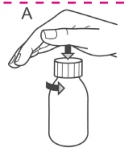
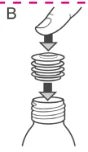
- 1. Open the bottle and at first use insert the PIBA (see pictures A-B). Note: this may have been done already by the pharmacist.
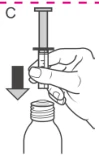
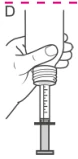
- 2. Insert the oral syringe into the PIBA and draw out the required volume from the inverted bottle (see pictures C-D). Note: check you have the correct level. Maximum dose of the highest dose level is 7.5 ml.
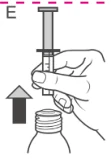
- 3. Remove the filled oral syringe from the bottle in the upright position (see picture E).
- 4. Discharge the oral syringe contents into the mouth.
- 5. Replace the cap on the bottle, the PIBA remains in place.
- 6. Rinse the oral syringe with warm water and allow to dry after each use.
If the patient is taking the medicine through a feeding tube, flush the tube with 20 ml of water after administering the medicine.
This medicine is not recommended for children less than 3 years of age. Talk to your doctor or pharmacist before giving this medicine to a child if this medicine has been prescribed for a child less than 3 years. This medicine is not recommended for patients over the age of 65 years.
If you take more Glycopyrronium Bromide oral solution than you should
If you take more of this medicine than you have been prescribed, you are more likely to experience side effects. Consult the doctor or get medical advice immediately. If possible, give any leftover solution, the bottle and this leaflet to the medical staff so they know what you have taken.
If you forget to take Glycopyrronium Bromide oral solution
- If you forget to take a dose, take it as soon as possible. Then take the next dose at the correct time, in accordance with the instructions given to you by the doctor. However, if the next dose is due, do not take the dose you have missed; just take the next dose as normal.
- Do not take a double dose to make up for the forgotten one.
- If you have any further questions on the use of this medicine, ask the doctor or pharmacist.
4. Possible side effects
Like all medicines, this medicine can cause side effects, although not everybody gets them. If any of the following serious side effects occur, stop using the medicine and seek medical advice immediately:
- Severe allergic reaction (swelling of the tongue, lips, face or throat) - unknown
- Constipation (difficulty in passing stools) – very common
- Urinary retention (unable to completely empty the bladder) – common
- Pneumonia (severe chest infection) – common
- Allergic reaction (hives, difficulty breathing or swallowing, itching) – uncommon
- Fever (pyrexia) – common
- Changes in behaviour such as mood changes, irritability – very common
Other side effects:
Very common side effects (may affect more than 1 in 10 people)
- Dry mouth
- Diarrhoea
Being sick (vomiting)
- Flushing
- Nasal congestion
- Reduced secretions in the chest
- Reduced secretions in the airways
Common side effects (may affect up to 1 in 10 people)
- Upper respiratory tract infection (chest infection)
- Urinary tract infection
- Drowsiness (sleepiness)
- Agitation
- Rash
Uncommon side effects (may affect up to 1 in 100 people)
- Allergy
- Headache
- Involuntary eye movement (nystagmus)
- Bad breath (halitosis)
- Rash (Hives)
- Nose bleeds (epistaxis)
- Fungal infection (thrush) of the throat (oesophageal candidiasis)
- Widening of the pupil of the eye (mydriasis)
- Dehydration
- Thirst
- Urgent need to urinate
- Insomnia (difficulty in sleeping)
- Abnormal contractions of digestive tract when food is ingested (gastrointestinal motility disorder)
- A disorder of the muscles and nerves in the intestine which causes an obstruction or blockage (pseudo-obstruction)
- Dizziness
Unknown side effects (frequency cannot be estimated from the available data)
- Nausea
- Angle-closure glaucoma (increased pressure in the eye)
- Photophobia
- Dry eyes
- Angioedema
- Decrease in heart rate (transient bradycardia)
- Sinus infection (sinusitis)
- Skin dryness
- Sweat inhibition
Reporting of side effects
If you get any side effects, talk to your doctor, pharmacist or nurse. This includes any possible side effects not listed in this leaflet.
You can also report side effects directly via the Yellow Card Scheme. Website: www.mhra.gov.uk/yellowcard or search for MHRA Yellow Card in the Google Play or Apple App Store. By reporting side effects you can help provide more information on the safety of this medicine.
5. How to store Glycopyrronium Bromide oral solution
- Keep this medicine out of the sight and reach of children.
- Do not use this medicine after the expiry date, which is stated on the label after EXP. The expiry date refers to the last day of that month.
- This medicine should be stored below 25 °C.
- Once the bottle has been opened, this medicine should be used within 3 months.
- Do not throw away any medicines via wastewater. Ask your pharmacist how to throw away medicines you no longer use. These measures will help protect the environment.
6. Contents of the pack and other information
What Glycopyrronium Bromide oral solution contains
- The active substance is glycopyrronium bromide. Each 5 ml of oral solution contains 2 mg of glycopyrronium bromide.
The other ingredients are:
o Glycerol
o Sorbitol liquid (non crystallising) (E420) (see section 2)
o Sodium methyl parahydroxybenzoate (E219) (see section 2)
o Sodium propyl parahydroxybenzoate (E217) (see section 2)
o Citric acid
o Sodium citrate
o Strawberry flavour
o Purified water
What Glycopyrronium Bromide oral solution looks like and contents of the pack
Glycopyrronium Bromide oral solution is a clear, colourless solution with characteristic strawberry odour. It is supplied in amber, type III glass bottles, safely closed with a child-resistant, screw cap with tamper evident closure. Each bottle contains 60 ml or 250 ml of this medicine. Not all pack sizes may be marketed.
A CE marked 5 ml oral syringe of 0.25 ml graduations along with a press-in bottle adaptor are also provided. Marketing Authorisation Holder and Manufacturer Marketing Authorisation Holder
Colonis Pharma Limited
25 Bedford Square
Bloomsbury
London
WC1B 3HH
United Kingdom
Manufacturers
Labialfarma
Laboratório de Produtos Farmacêuticos e Nutracêuticos, S.A.
Felgueira
Sobral Mortágua
3450-336
Portugal