

Patient leaflet - Gentamicin eye/ear drops 0.3%w/v
1. What Gentamicin is and what it is used for
Gentamicin is a sterile, preserved, aqueous solution used as eye/ear drops. The active ingredient Gentamicin is an antibiotic. Gentamicin is used in adults and children to kill bacteria which cause infection. It is used for the management of infection in injured eye and ear.
2. What you need to know before you use Gentamicin
Do not use Gentamicin if
you are allergic to Gentamicin or any of the other ingredients of this
medicine (listed in section 6).
you have or suspect you have a burst ear drum, if you are being treated
for a problem with your ear.
- you suffer from myasthenia gravis, a disease causing muscle weakness. Warnings and precautions
Talk to your doctor or pharmacist before using Gentamicin if you
- have any problems with your kidneys or liver;
- have open wounds or damaged skin;
- are using this medicine for a long period of time.
know (or think you have) a mitochondrial disease (mutations in the
parts of your cells which help make energy); certain mitochondrial diseases may increase your risk of hearing loss with this product. The drops must not be used in the ear if the ear drum is damaged in any way. Your doctor will check the condition of the ear drum before prescribing the drops.
In severe infections treatment with a systemic antibiotic may be necessary in addition to Gentamicin.
If any of these apply to you, or if you are not sure, tell your doctor. Other medicines and Gentamicin
Tell your doctor if you are taking, or have recently taken, or might take any other medicines including those obtained without a prescription. In particular:
cephalosporins(antibiotics), amphotericin(used to treat fungal
infection), cisplatin (used in anti-cancer therapy) or ciclosporin (used to stop the body rejecting bone marrow or organ transplants) which may increase the risk of kidney damage
diuretic medicines such as ethacrynic acid (used in the treatment of
high blood pressure and swelling) and furosemide(used in the treatment of congestive heart failure and swelling) which may increase the risk of ear damage
- curare-type muscle relaxants
caution is advised when the drops are used with other aminoglycoside
antibiotics given by injection.
Pregnancy and breast-feeding
If you are pregnant or breast-feeding, think you may be pregnant or are planning to have a baby, ask your doctor or pharmacist for advice before taking this medicine.
Gentamicin is not recommended for use in pregnancy or breastfeeding unless considered appropriate by your doctor.
Driving and using machines
Gentamicin may cause temporary blurred vision when used in the eyes. If you are affected, do not drive or use machinery until the blurring has cleared.
Gentamicin contains Benzalkonium Chloride
This medicine contains 0.10 mg/ml benzalkonium chloride as a preservative. Benzalkonium chloride may be absorbed by soft contact lenses and may change the colour of the contact lenses. You should remove contact lenses before using this medicine and put them back 15 minutes afterwards.
Benzalkonium chloride may also cause eye irritation, especially if you have dry eyes or disorders of the cornea (the clear layer at the front of the eye). If you feel abnormal eye sensation, stinging or pain in the eye after using this medicine, talk to your doctor.
3. How to use Gentamicin
Always use Gentamicin exactly as your doctor or pharmacist has told you. Check with your doctor or pharmacist if you are not sure. Eyes: Instill 1-2 drops into the affected eye up to 6 times a day. For more severe infections your doctor may tell you to use the drops more often than this. Contact lenses should be removed when treating an eye infection with these drops.

Ear: The area should be cleaned and 2-3 drops instilled 3-4 times a day 
 and at night. Your doctor may tell you to use the drops more often than this. The drops should not be used continuously for a long time as it may irritate your skin and the drops may stop working.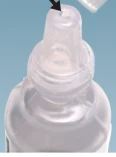
If your infection is severe, your doctor may also give you antibiotics by injection.
Use in children and adolescents: No dosage adjustment required in children.
Instructions for use (Please also refer to pictograms at the end of the leaflet)
- First wash your hands
- Avoid touching the eye (or any other surface) with the tip of the bottle
If you wear soft contact lenses, they should be removed before using
the eye drops and wait at least 15 minutes before reinserting
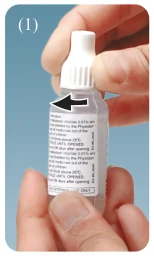
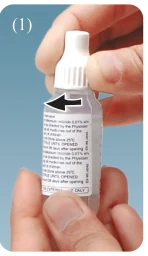
These drops are supplied as a sealed bottle with a spiked cap. When
using the bottle for the first time, screw the cap down tightly in order to pierce the tip of the bottle
MODE OF USE
The spike in
the cap will
pierce the tip
of the bottle. (2)
Pierced
Bottle
Tilt head backwards.
Dispense drops with gentle pressure. Do not touch dropper tip to the surface of the eye.
(3)
Tighten the cap
on the nozzle.
(1)
- Tilt your head back and look at the ceiling
- Pull the lower eyelid gently downwards
- Hold the bottle upside down above the eye and gently squeeze the bottle to release a drop into your eye
- Keep the affected eye closed and press your fingertip against the inside corner of the closed eye, and hold for 1 minute
- Repeat for the other eye if necessary
- Replace and tighten the cap immediately after use.
As ear drops: The area should be cleaned, tilt head sideways and dispense drops with gentle pressure
Ocular solutions if handled wrongly, can become contaminated by common bacteria and cause eye infections. If you do develop any other eye condition whilst using this product, see your doctor immediately. If you use more Gentamicin than you should
In adults an overdose due to the use of the eye / ear drops is unlikely, however, if you use too many drops or if the eye / ear drops are accidentally swallowed, you should contact your doctor.
If you swallow Gentamicin
If you, or someone else, accidentally swallows some of this medicine, contact your doctor, pharmacist or nearest hospital emergency department immediately.
If you forget to use Gentamicin
If you forget to use Gentamicin, use your next dose as soon as you remember and continue as before.
4. Possible side effects
Like all medicines Gentamicin can cause side effects, although not everybody gets them.
If you notice:
- Itching or skin rashes
- Swelling of the face, lips or throat
- Difficulty in breathing or wheeziness
Stop using these drops and tell your doctor immediately. These may be signs of allergic reaction.
Side effects which you may experience include
- ear damage such as difficulty in keeping your balance or hearing loss
- kidney problems such as passing less water than usual or signs of blood in urine
- local sensitivity in the eye, transient eye irritation, blurred vision, burning or stinging sensation, itching
- local sensitivity in the ear, burning or stinging sensation, itching, skin inflammation
- super infection (infection occurring after an earlier infection). Reporting of side effects
If you get any side effects, talk to your doctor or pharmacist. This includes any possible side effects not listed in this leaflet. You can also report side e f f e c t s d i r e c t l y v i a t h e Ye l l o w C a r d S c h e m e a t www.mhra.gov.uk/yellowcard or search for MHRA Yellow Card in the Google Play or Apple App Store. By reporting side effects you can help provide more information on the safety of this medicine.
5. How to store Gentamicin
Keep this medicine out of the sight and reach of children. Do not store above 25ºC. Protect from light
Discard after 28 days of opening.
Do not use this medicine after the expiry date which is stated on the bottle and on the carton the bottle is packed in. The expiry date refers to the last day of that month.
6. Contents of the pack and other information
What Gentamicin contains
The active substance(s) is Gentamicin sulphate 0.3% w/v. The other ingredient(s) are 0.02% v/v benzalkonium chloride solution (as preservative), sodium chloride, disodium edetate, sodium metabisulphite, borax, sodium hydroxide solution, hydrochloric acid and Water for Injection.
What Gentamicin looks like and contents of the pack
Each bottle contains 10 ml of the clear, colourless to pale straw coloured eye/ear drop solution.
Marketing Authorisation Holder and Manufacturer
FDC International Ltd,
Unit 6, Fulcrum 1,
Solent Way, Whiteley,
Fareham,
Hampshire, PO15 7FE
United Kingdom
PL number: 15872/0004
Hard to see or read the leaflet? Call + 44(0) 1489 565222 for help. This leaflet was last revised in: 10/2020.
Package Leaflet: Information for the patient
Eye/Ear Drops 0.3% w/v
Gentamicin Sulphate