


Patient leaflet - GADOBUTROL 1.0 MMOL/ML SOLUTION FOR INJECTION IN PREFILLED SYRINGE
1. WHAT GADOBUTROL IS AND WHAT IT IS USED FOR
Gadobutrol is a contrast medium for magnetic resonance imaging
(MRI) used for diagnostics of the brain, spine and vessels.
Gadobutrol can also help the doctor find out the kind (benign or
malignant) of known or suspected abnormalities in the liver and
kidneys.
Gadobutrol can also be used for MRI of abnormalities of other body
regions.
It facilitates visualisation of abnormal structures or lesions and
helps in the differentiation between healthy and diseased tissue.
It is for use in adults and children of all ages (including term
newborn infants).
How Gadobutrol works
MRI is a form of medical diagnostic imaging that uses the behaviour
of water molecules in normal and abnormal tissues. This is done by
a complex system of magnets and radio waves. Computers record
the activity and translate that into images.
Gadobutrol is given as an injection into your vein. This medicine is
for diagnostic use only and will only be administered by healthcare
professionals experienced in the field of clinical MRI practice.
2. WHAT YOU NEED TO KNOW BEFORE YOU ARE GIVEN GADOBUTROL
Do not use Gadobutrol:
if you are allergic to gadobutrol or any of the other ingredients of
this medicine (listed in section 6).
Warnings and precautions
Talk to your doctor before you are given Gadobutrol if you:
suffer or have suffered from an allergy (e.g. hay fever, hives) or
asthma
- had a previous reaction to any contrast media
- have very poor kidney function
suffer from brain conditions with seizures (fits) or from other
diseases of the nervous system
have a heart pacemaker or if there are any implants or clips
containing iron in your body.
Your doctor will decide whether the intended examination is
possible or not.
Allergy-like or other types of reactions leading to heart
problems, breathing difficulties or skin reactions may occur
after use of Gadobutrol. Severe reactions are possible. Most
of these reactions occur within half an hour after you are
given Gadobutrol. Therefore, you will be observed after the
examination. Delayed reactions have been observed (after hours
or days) (see section 4).
Kidneys/Liver
Tell your doctor if:
- your kidneys do not work properly
- you have recently had, or soon expect to have, a liver transplant.
Your doctor may decide to take a blood test to check how well your
kidneys are working before making the decision to use Gadobutrol,
especially if you are 65 years of age or older.
Neonates and infants
As kidney function is immature in babies up to 4 weeks of age and
infants up to 1 year of age, Gadobutrol will only be used in these
patients after careful consideration by the doctor.
Other medicines and Gadobutrol
Tell your doctor if you are taking, have recently taken or might take
any other medicines.
Pregnancy and breast-feeding
Ask your doctor for advice before taking any medicine.
Pregnancy
Gadobutrol can cross the placenta. It is not known whether it affects the baby. You must tell your doctor if you think you are, or might become, pregnant as Gadobutrol should not be used during pregnancy unless strictly necessary.
Breast-feeding
Tell your doctor if you are breast-feeding or about to start breast-feeding. Your doctor will discuss whether you should continue or interrupt breast-feeding for a period of 24 hours after you receive Gadobutrol.
Sodium content
This medicinal product contains less than 23 mg sodium per dose (based on the average amount given to a 70 kg person), i.e. essentially ‘sodium-free’.
3. HOW GADOBUTROL WILL BE GIVEN
Gadobutrol is injected into your vein using a small needle by a healthcare professional. Your MRI examination can start immediately. After the injection you will be observed for at least 30 minutes.
The usual dose
The actual dose that is right for you will depend on your body weight and on the region being examined by MRI:
In adults a single injection of 0.1 millilitres Gadobutrol per kg body weight is recommended (this means for a person weighing 70 kg the dose would be 7 millilitres), however a further injection of up to 0.2 millilitres per kg body weight within 30 minutes of the first injection may be given. A total amount of 0.3 millilitres Gadobutrol per kg body weight may be given at maximum (this means for a person weighing 70 kg the dose would be 21 millilitres) for imaging of the central nervous system (CNS) and CE-MRA. A dose of 0.075 millilitres Gadobutrol per kg body weight may be given at minimum (this means for a person weighing 70 kg the dose would be 5.25 millilitres) for the CNS.
Further information regarding the administration and handling of Gadobutrol is given at the end of the leaflet.
Dosage in special patient groups
The use of Gadobutrol is not recommended in patients with severe kidney problems and patients who have recently had, or soon expect to have, a liver transplant. However if use is required you should only receive one dose of Gadobutrol during a scan and you should not receive a second injection for at least 7 days.
Neonates, infants, children and adolescents
In children of all ages (including term newborn infants) a single dose of 0.1 millilitres Gadobutrol per kg body weight is recommended for all examinations (see section 1).
As kidney function is immature in babies up to 4 weeks of age and infants up to 1 year of age, Gadobutrol will only be used in these patients after careful consideration by the doctor. Neonates and infants should only receive one dose of Gadobutrol during a scan and should not receive a second injection for at least 7 days.
Elderly
It is not necessary to adjust your dose if you are 65 years of age or older but you may have a blood test to check how well your kidneys are working.
If you receive more Gadobutrol than you should
Overdosing is unlikely. If it does happen, the doctor will treat any symptoms and may use kidney dialysis to remove Gadobutrol from your body.
There is no evidence to suggest that this will prevent the development of Nephrogenic Systemic Fibrosis (NSF; see section 4) and it should not be used as treatment for the condition. In some cases your heart will be checked.
If you have any further questions on the use of this medicine, ask your doctor or radiologist.
Package leaflet: Information for the patient Gadobutrol 1.0 mmol/mL solution for injection in prefilled syringe
Gadobutrol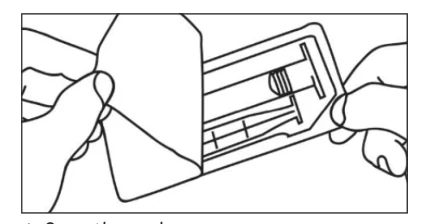
continued overleaf continued overleaf
The following information is intended for healthcare professionals only:
Renal impairment
Prior to administration of Gadobutrol, it is recommended that all patients are screened for renal dysfunction by obtaining laboratory tests.
There have been reports of nephrogenic systemic fibrosis (NSF) associated with use of some gadolinium-containing contrast agents in patients with acute or chronic severe renal impairment (GFR < 30 ml/min/1.73 m2). Patients undergoing liver transplantation are at particular risk since the incidence of acute renal failure is high in this group. As there is a possibility that NSF may occur with Gadobutrol, it should therefore only be used in patients with severe renal impairment and in patients in the perioperative liver transplantation period after careful risk/benefit assessment and if the diagnostic information is essential and not available with non-contrast enhanced MRI. If it is necessary to use Gadobutrol, the dose should not exceed 0.1 mmol/kg body weight. More than one dose should not be used during a scan.
Because of the lack of information on repeated administration, Gadobutrol injections should not be repeated unless the interval between injections is at least 7 days.
As the renal clearance of Gadobutrol may be impaired in the elderly, it is particularly important to screen patients aged 65 years and older for renal dysfunction.
Haemodialysis shortly after Gadobutrol administration may be useful at removing Gadobutrol from the body. There is no evidence to support the initiation of haemodialysis for prevention or treatment of NSF in patients not already undergoing haemodialysis.
Pregnancy and breast-feeding
Gadobutrol should not be used during pregnancy unless the clinical condition of the woman requires use of Gadobutrol.
Continuing or discontinuing of breast-feeding for a period of 24 hours after administration of Gadobutrol, should be at the discretion of the doctor and lactating mother.
Hypersensitivity reactions
As with other intravenous contrast agents, Gadobutrol can be associated with anaphylactoid/hypersensitivity or other idiosyncratic reactions, characterized by cardiovascular, respiratory or cutaneous manifestations, and ranging to severe reactions including shock. In general, patients with cardiovascular disease are more susceptible to serious or even fatal outcomes of severe hypersensitivity reactions.
The risk of hypersensitivity reactions may be higher in case of:
- previous reaction to contrast media
- history of bronchial asthma
- history of allergic disorders
In patients with an allergic disposition the decision to use Gadobutrol must be made after particularly careful evaluation of the risk-benefit ratio.
Most of these reactions occur within half an hour of administration. Therefore, post-procedure observation of the patient is recommended.
Medication for the treatment of hypersensitivity reactions as well as preparedness for institution of emergency measures are necessary. Delayed reactions (after hours up to several days) have been rarely observed.
Seizure disorders
Like with other gadolinium containing contrast agents special precaution is necessary in patients with a low threshold for seizures.
Overdose
In case of inadvertent overdosage, cardiovascular monitoring (including ECG) and control of renal function are recommended as a measure of precaution.
In case of overdose in patients with renal insufficiency, Gadobutrol can be removed by haemodialysis. After 3 haemodialysis sessions approx. 98 % of the agent are removed from the body. However, there is no evidence that haemodialysis is suitable for prevention of nephrogenic systemic fibrosis (NSF).
Before injection
This product is intended for single use only.
This medicinal product is a clear, colourless or slightly yellowish solution. It should be visually inspected before use.
Gadobutrol should not be used in case of severe discolouration, the occurrence of particulate matter or a defective container.
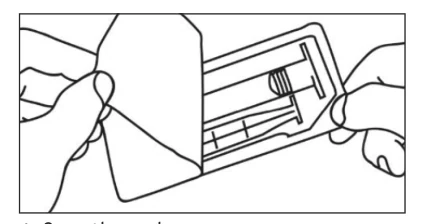
Instructions for use
The prefilled syringe must be taken from the pack and prepared for the injection immediately before the administration.
The tip cap should be removed from the prefilled syringe immediately before use.
HAND INJECTION
- 1.
Open the package
INJECTION WITH A POWER INJECTOR
- 1. Open the package
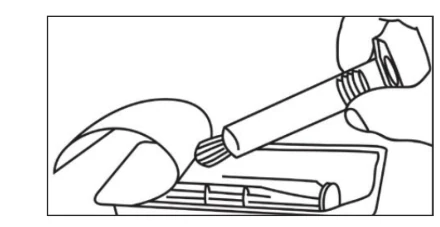
- 2. Take syringe and plunger rod out of the package 2. Take syringe out of the package
 *
*
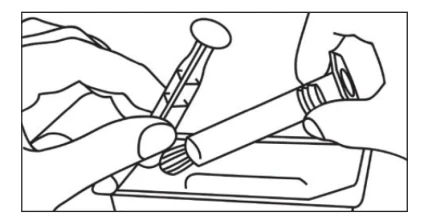
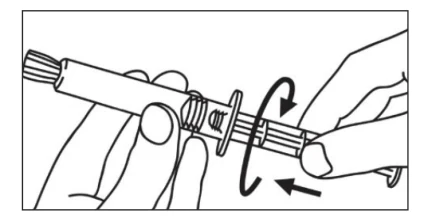
- 3. Turn clock-wise the plunger rod into the syringe
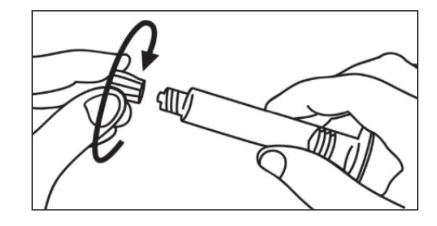
- 4. Open the cap with a twist
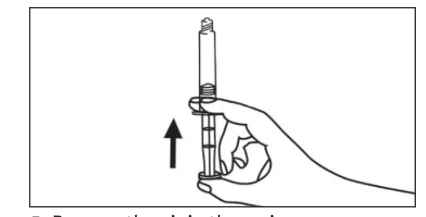
- 5.
Remove the air in the syringe
*
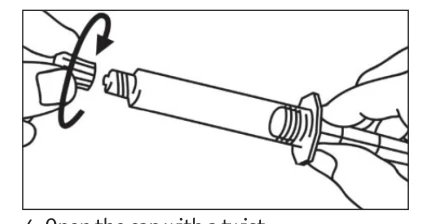
- 3. Open the cap with a twist
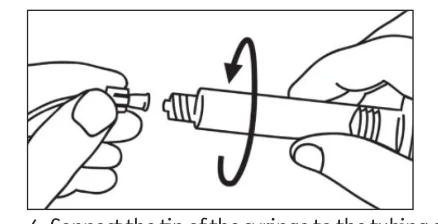
- 4. Connect the tip of the syringe to the tubing system clock-wise and go on according to the instructions of the device manufacturer
4. POSSIBLE SIDE EFFECTS
Like all medicines, this medicine can cause side effects, although
not everybody gets them.
Most of these reactions occur within half an hour after you are
given Gadobutrol. Delayed allergy-like or other types of adverse
reactions, occurring hours to several days after you have received
Gadobutrol, have been observed in rare cases. If this should happen
to you, tell your doctor or radiologist immediately.
The most serious side effects (which have been fatal or life-
threatening in some cases) are:
heart stops beating (cardiac arrest), a severe lung disease (acute
respiratory distress syndrome) / fluid in the lungs (pulmonary
oedema) and severe allergy-like (anaphylactoid) reactions
(including stop of breathing and shock).
In addition for the following side effects life-threatening or fatal
outcomes have been observed in some cases:
shortness of breath (dyspnoea), loss of consciousness, severe
allergy-like reaction, severe decrease of blood pressure may lead
to collapse, stopping of breathing, fluid in the lungs, swelling of
mouth and throat and low blood pressure.
In rare cases:
allergy-like reactions (hypersensitivity and anaphylaxis)
may occur, including severe reactions (shock) that may need
immediate medical intervention.
If you notice:
- swelling of the face, lips, tongue or throat
- coughing and sneezing
- difficulty breathing
- itching
- runny nose
- hives (nettle-type rash)
tell the MRI department staff immediately. These may be the first
signs that a severe reaction is happening. Your investigation may
need to be stopped and you may need further treatment.
The most frequently observed side effects (may affect 5 or more in
1,000 people) are:
- headache, feeling sick (nausea) and dizziness.
Most of the side effects are mild to moderate.
Possible side effects which have been observed in clinical trials
before the approval of Gadobutrol are listed below by how likely
they are.
Common (may affect up to 1 in 10 people):
- headache
- feeling sick (nausea)
Uncommon (may affect up to 1 in 100 people):
allergy-like reaction, e.g.:
- low blood pressure
- hives
- swelling of the face
- swelling (oedema) of the eyelid
- flushing
The frequency of the following allergy-like reactions is not known:
- severe allergy-like reaction (anaphylactoid shock)
severe decrease of blood pressure may lead to collapse
(shock)
- breathing stops
- breathing difficulties (bronchospasm)
- blueness of the lips
- swelling of the mouth and throat
- swelling of the throat
- increased blood pressure
- chest pain
swelling of the face, throat, mouth, lips and/or tongue
(angioedema)
- conjunctivitis
- increased sweating
- cough
- sneezing
- burning sensation
- pale skin (pallor)
- dizziness, disturbed sense of taste, numbness and tingling
- shortness of breath (dyspnoea)
- vomiting
- redness of the skin (erythema)
- itching (pruritus including generalised pruritus)
rash (including generalised rash, small flat red spots [macular
rash], small, raised, circumscribed lesions [papular rash] and
itchy rash [pruritic rash])
various kinds of injection site reactions (e.g. leakage into the
surrounding tissue, burning, coldness, warmth, reddening, rash,
pain or bruising)
- feeling hot
Rare (may affect up to 1 in 1,000 people):
- fainting
convulsion
- disturbed sense of smell
- rapid heart beat
- palpitations
- dry mouth
- generally feeling unwell (malaise)
- feeling cold
Additional side effects which have been reported after the approval of Gadobutrol with an unknown frequency (frequency cannot be estimated from the available data) are:
- heart stops beating (cardiac arrest)
- a severe lung disease (acute respiratory distress syndrome)
- fluid in the lungs (pulmonary oedema)
- there have been reports of nephrogenic systemic fibrosis - NSF (which causes hardening of the skin and may affect also soft tissue and internal organs).
Variations in blood tests of the kidney function (e.g. increase of serum creatinine) have been observed after administration of Gadobutrol.
Reporting of side effects
If you get any side effects, talk to your doctor or radiologist. This includes any possible side effects
not listed in this leaflet. You can also report side effects directly via the Yellow Card Scheme Website: www.mhra.gov.uk/yellowcard or search for MHRA Yellow Card on the Google Play or Apple App Store. By reporting side effects you can help provide more information on the safety of this medicine.
5. HOW TO STORE GADOBUTROL
Keep this medicine out of the sight and reach of children.
Do not use this medicine after the expiry date which is stated on the packaging after EXP. The expiry date refers to the last day of that month.
This medicinal product does not require any special storage conditions.
Chemical, physical and microbiological in-use stability has been demonstrated for 24 hours at 20-25°C. From a microbiological point of view, the product should be used immediately after opening.
This medicinal product is a clear, colourless or slightly yellowish solution. Do not use this medicine if you notice severe discolouration or the presence of particulate matter or if the container appears defective.
Medicines should not be disposed of via wastewater or household waste. The healthcare professional will dispose of this medicine when no longer required. These measures will help protect the environment.
6. CONTENTS OF THE PACK AND OTHER INFORMATION
What Gadobutrol contains
The active substance is gadobutrol.
1 ml of solution for injection contains 604.72 mg gadobutrol (equivalent to 1.0 mmol gadobutrol containing 157.25 mg gadolinium).
1 prefilled syringe with 5 ml contains 3,023.6 mg gadobutrol. 1 prefilled syringe with 7.5 ml contains 4,535.4 mg gadobutrol. 1 prefilled syringe with 10 ml contains 6,047.2 mg gadobutrol. 1 prefilled syringe with 15 ml contains 9,070.8 mg gadobutrol.
The other ingredients are calcobutrol sodium, trometamol, dilute hydrochloric acid and water for injection.
What Gadobutrol looks like and contents of the pack
Gadobutrol is a clear, colourless or slightly yellowish solution for injection packaged in a pre-filled syringe.
Gadobutrol is available in:
5 ml, 7.5 ml and 10 ml in pre-filled 10 ml syringes with a glass barrel, rubber plunger and syringe rod.
15 ml in pre-filled 20 ml syringes with a glass barrel, rubber plunger and syringe rod.
1 pre-filled syringe in a blister. 1 or 5 blisters per carton.
Not all pack sizes may be marketed.
Marketing Authorisation Holder and Manufacturer
Farmak Pharmaceuticals UK Ltd
First Floor, 47 Queen Street,
Hull, HU1 1UU,
United Kingdom
This leaflet was last revised in 08/2025.
Shelf life after first opening of the container
Any solution for injection not used in one examination must be discarded. Chemical, physical and microbiological in-use stability has been demonstrated for 24 hours at 20-25°C. From a microbiological point of view, the product should be used immediately. If not used immediately, in-use storage times and conditions prior to use are the responsibility of the user.
The peel-off tracking label on the syringes should be stuck onto the patient record to enable accurate recording of the gadolinium contrast agent used. The dose used should also be recorded. If electronic patient records are used, the name of the product, the batch number and the dose should be entered into the patient record.
Posology
The lowest dose that provides sufficient enhancement for diagnostic purposes should be used. The dose should be calculated based on the patient’s body weight, and should not exceed the recommended dose per kilogram of body weight detailed in this section.
- Adults
CNS indications
The recommended dose for adults is 0.1 mmol per kilogram body weight (mmol/kg BW). This is equivalent to 0.1 ml/kg BW of the 1.0 M solution.
If a strong clinical suspicion of a lesion persists despite an unremarkable MRI or when more accurate information might influence therapy of the patient, a further injection of up to 0.2 ml/kg BW within 30 minutes of the first injection may be performed. A dose of 0.075 mmol gadobutrol per kg body weight (equivalent to 0.075 ml of Gadobutrol 1.0 mmol/ml solution for injection per kg body weight) may be given at minimum for imaging of the CNS.
Whole Body MRI (except MRA)
In general, the administration of 0.1 ml of Gadobutrol 1.0 mmol/ml solution for injection per kg body weight is sufficient to answer the clinical question.
CE-MRA
Imaging of 1 field of view (FOV): 7.5 ml for body weight below 75 kg; 10 ml for body weight of 75 kg and higher (corresponding to 0.1-0.15 mmol/kg BW).
Imaging of > 1 field of view (FOV): 15 ml for body weight below 75 kg; 20 ml for body weight of 75 kg and higher (corresponding to 0.2-0.3 mmol/kg BW).
- Paediatric population
For children of all ages (including term neonates) the recommended dose is 0.1 mmol gadobutrol per kg body weight (equivalent to 0.1 ml of Gadobutrol 1.0 mmol/ml solution for injection per kg body weight) for all indications (see section 1).
Due to immature renal function in neonates up to 4 weeks of age and infants up to 1 year of age, Gadobutrol should only be used in these patients after careful consideration at a dose not exceeding 0.1 mmol/kg body weight. More than one dose should not be used during a scan. Because of the lack of information on repeated administration, Gadobutrol injections should not be repeated unless the interval between injections is at least 7 days.
Imaging
The dose required is administered intravenously as a bolus injection. Contrast-enhanced MRI can commence immediately afterwards (shortly after the injection depending on the pulse sequences used and the protocol for the examination).
Optimal signal enhancement is observed during arterial first pass for CE-MRA and within a period of about 15 minutes after injection of Gadobutrol for CNS indications (time depending on type of lesion/tissue).
T1 -weighted scanning sequences are particularly suitable for contrast-enhanced examinations.
Further information regarding the use of Gadobutrol is given in section 3 of the leaflet.
* *
| WIP URN | ✓ | 300425-XXXXX-PIL-01 |
| APPROVED URN | ||
| JOB | Gadobutrol Syringe PIL | |
| 180 x 700mm | ||
| DATE | 30 April 2025 | |
| BOH APPROVAL DATE | ||
| SAVED AS | XXXXX-01 Gadobutrol Syringe PIL Farmak | |
| PRINTS | 1 colour - black |