

Patient leaflet - Fulvestrant 250 mg solution for injection in Pre-filled syringe
1. What Fulvestrant is and what it is used for
Fulvestrant contains the active substance fulvestrant, which belongs to the group of estrogen blockers. Estrogens, a type of female sex hormones, can in some cases be involved in the growth of breast cancer.
Fulvestrant is used either:
alone, to treat postmenopausal women with a type of breast
cancer called estrogen receptor positive breast cancer that is locally advanced or has spread to other parts of the body (metastatic), or
in combination with palbociclib to treat women with a type
of breast cancer called hormone receptor-positive, human epidermal growth factor receptor 2-negative breast cancer, that is locally advanced or has spread to other parts of the body (metastatic). Women who have not reached menopause will also be treated with a medicine called a luteinizing hormone releasing hormone (LHRH) agonist.
When Fulvestrant is given in combination with palbociclib, it is important that you also read the package leaflet for palbociclib. If you have any questions about palbociclib, please ask your doctor.
2. What you need to know before you use Fulvestrant
Do not use Fulvestrant
if you are allergic to fulvestrant or to any of the other ingredients
of this medicine
- (listed in section 6)
- if you are pregnant or breast-feeding
- if you have severe liver problems
Warnings and precautions
Talk to your doctor or pharmacist or nurse before using Fulvestrant if any of these apply to you:
- kidney or liver problems
low numbers of platelets (which help blood clotting) or bleeding
disorders
- previous problems with blood clots
- osteoporosis (loss of bone density)
alcoholism
Children and adolescents
Fulvestrant is not indicated in children and adolescents under 18 years.
Other medicines and Fulvestrant
Tell your doctor or pharmacist if you are taking, have recently taken or might take any other medicines.
In particular, you should tell your doctor if you are using anticoagulants (medicines to prevent blood clots).
Pregnancy and breast-feeding
You must not use Fulvestrant if you are pregnant. If you can become pregnant, you should use effective contraception while you are being treated with Fulvestrant and for 2 years after your last dose.
You must not breast-feed while on treatment with Fulvestrant.
Driving and using machines
Fulvestrant is not expected to affect your ability to drive or use machines. However, if you feel tired after treatment do not drive or use machines.
Fulvestrant contains 10% w/v ethanol (alcohol), i.e. up to 500 mg per injection, equivalent to 10 ml beer or 4 ml wine.
Harmful for those suffering from alcoholism.
To be taken into account in high-risk groups such as patients with liver disease, or epilepsy.
This medicine contains 500 mg benzyl alcohol per injection, equivalent to 100 mg/ml.
Benzyl alcohol may cause allergic reactions. Ask your doctor or pharmacist for advice if you are pregnant or breast-feeding or have liver or kidney disease. This is because large amounts of benzyl alcohol can build-up in your body and may cause side effects (called “metabolic acidosis”).
This medicine contains 750 mg benzyl benzoate per injection, equivalent to 150 mg/ml
3. How to take Fulvestrant
Always use this medicine exactly as your doctor or pharmacist has told you. Check with your doctor or pharmacist if you are not sure. The recommended dose is 500 mg fulvestrant (two 250 mg/5 ml injections) given once a month, with an additional 500 mg dose given 2 weeks after the initial dose.
Your doctor or nurse will give you fulvestrant as a slow intramuscular injection, one into each of your buttocks.
If you have any further questions on the use of this medicine, ask your doctor, pharmacist or nurse.
4. Possible side effects
Like all medicines, this medicine can cause side effects, although not everybody gets them.
You may need immediate medical treatment if you experience any of the following side effects:
- Allergic (hypersensitivity) reactions, including swelling of the face, lips, tongue and/or
- throat that may be signs of anaphylactic reactions
- Thromboembolism (increased risk of blood clots) *
- Inflammation of the liver (hepatitis)
- Liver failure
Tell your doctor, pharmacist, or nurse if you notice any of the following side effects:
Very common side effects (may affect more than 1 in 10 people)
- Injection site reactions, such as pain and/or inflammation
- Abnormal levels of liver enzymes (in blood tests) *
- Nausea (feeling sick)
- Weakness, tiredness*
- Joint and musculoskeletal pain
- Hot flushes
- Skin rash
- Allergic (hypersensitivity) reactions, including swelling of the face, lips, tongue and/or throat
All other side effects:
Common side effects (may affect up to 1 in 10 people)
- Headache
- Vomiting, diarrhoea, or loss of appetite*
- Urinary tract infections
- Back pain*
- Increase of bilirubin (bile pigment produced by the liver)
- Thromboembolism (increased risk of blood clots)*
- Decreased levels of platelets (thrombocytopenia)
- Vaginal bleeding
- Lower back pain irradiating to leg on one side (sciatica)
- Sudden weakness, numbness, tingling, or loss of movement in your leg, especially on
- only one side of your body, sudden problems with walking or balance (peripheral
- neuropathy)
Uncommon side effects (may affect up to 1 in 100 people)
- Thick, whitish vaginal discharge and candidiasis (infection)
- Bruising and bleeding at the site of injection
- Increase of gamma-GT, a liver enzyme seen in a blood test
- Inflammation of the liver (hepatitis)
- Liver failure
- Numbness, tingling and pain
- Anaphylactic reactions
* Includes side effects for which the exact role of Fulvestrant cannot be assessed due to the underlying disease.
Reporting of side effects
If you get any side effects, talk to your doctor, pharmacist or nurse. This includes any possible side effects not listed in this leaflet. You can also report side effects directly via the Yellow Card Scheme Website at www.mhra.gov.uk/yellowcard or search for MHRA Yellow Card in the Google Play or Apple App Store. By reporting side effects you can help provide more information on the safety of this medicine.
5. How to store Fulvestrant
Keep this medicine out of the sight and reach of children.
Do not use this medicine after the expiry date which is stated on the carton after EXP. The expiry date refers to the last day of that month.
Store in a refrigerator (2°C – 8°C).
Package leaflet: Information for the user
Fulvestrant 250 mg solution for injection in
pre-filled syringe
fulvestrant
Black A/s: 210 x 420 mm
 Your healthcare professional will be responsible for the correct storage, use and disposal of this medicine. This medicine may pose a risk to the aquatic environment. Do not throw away any medicines via wastewater or household waste. Ask your pharmacist how to throw away medicines you no longer use. These measures will help to protect the environment.
6. Contents of the pack and other information
What Fulvestrant contains
The active substance is Fulvestrant. Each prefilled syringe (5 ml)
contains 250 mg of Fulvestrant.
The other ingredients are ethanol (96%), benzyl alcohol, benzyl
benzoate and castor oil, refined.
What Fulvestrant looks like and contents of the pack
Solution for injection in pre-filled syringe.
Fulvestrant is a clear, colourless to yellow viscous solution essentially free from visible particles in a prefilled syringe with OVS tip cap and stoppered with grey plunger stopper containing 5 ml solution for injection. Two syringes must be administered to receive the 500 mg recommended monthly dose.
Fulvestrant has 1 pack presentation, a pack contains 2 (5ml) prefilled syringes. Safety needles (BD Safety Glide) for connection to each barrel are also provided.
Not all pack sizes may be marketed.
Marketing Authorisation Holder
Milpharm Limited
Ares Block
Odyssey Business Park
West End Road
Ruislip HA4 6QD
United Kingdom
Manufacturer
Milpharm Limited
Ares Block, Odyssey Business Park, West End Road, Ruislip, HA4 6QD, United Kingdom
Or
APL Swift Services (Malta) Ltd,
HF26, Hal Far Industrial Estate,
Hal Far, Birzebbugia, BBG 3000,
Malta.
This leaflet was last revised in 08/2026.
The following information is intended for healthcare professionals only:
Fulvestrant 500 mg (2 x 250 mg/5 ml solution for injection) should be administered using two pre-filled syringe, see section 3.
Instructions for administration
Warning - Do not autoclave safety needle (BD SafetyGlide Shielding Hypodermic Needle) before use.
Hands must remain behind the needle at all times during use and disposal.
For each of the two syringes:
Remove glass syringe barrel from tray and check that it is not
damaged.
- Peel open the safety needle (Safety Glide) outer packaging.
Parenteral solutions must be inspected visually for particulate
matter and discolouration prior to administration.
- Hold the syringe upright on the ribbed part (C). With the other
hand, take hold of the cap (A) and carefully tilt back and forth until the cap disconnects and can be pulled off, do not twist (see Figure 1). 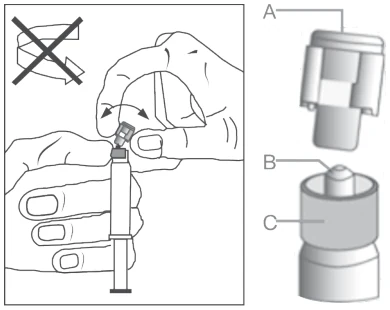 Figure 1
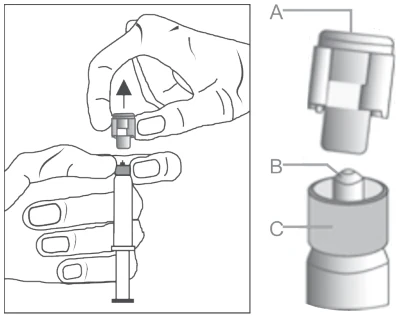
Remove the cap (A) in a straight upward direction. To maintain
sterility do not touch the syringe tip (B) (see Figure 2).
Figure 2
- Attach the safety needle to the Luer-Lok and twist until firmly seated (see Figure 3).
- Check that the needle is locked to the Luer connector before moving out of the vertical plane.
- Pull shield straight off needle to avoid damaging needle point.
- Transport filled syringe to point of administration.
- Remove needle sheath.
Expel excess gas from the syringe.
Figure 3
Administer intramuscularly slowly (1-2 minutes/injection) into the buttock (gluteal area). For user convenience, the needle bevel-up position is oriented to the lever arm (see Figure 4).
Figure 4
- After injection, immediately apply a single-finger stroke to the activation assisted lever arm to activate the shielding mechanism (see Figure 5).
NOTE: Activate away from self and others. Listen for click and visually confirm needle tip is fully covered.
Figure 5 Disposal
Pre-filled syringes are for single use only.
This medicine may pose a risk to the aquatic environment. Any unused medicinal product or waste material should be disposed of in accordance with local requirements (see section 5.3).