


Patient leaflet - Flixotide 250 micrograms Evohaler
1. What Flixotide is and what it is used for
Fluticasone propionate belongs to a group of medicines called corticosteroids (often just called steroids). A very small dose of steroid is needed when it is inhaled. This is because it is inhaled straight to your lungs.
Flixotide works by reducing swelling and irritation in the lungs. It has what is called an ‘anti-inflammatory action’.
Flixotide helps to prevent asthma attacks in people who need regular treatment. This is why it is sometimes called a ‘preventer’. It needs to be used regularly, every day.
Flixotide will not help treat sudden asthma attacks where you feel breathless.
- A different medicine is used for treating sudden attacks (called a ‘reliever’).
- If you have more than one medicine, be careful not to confuse them.
2. What you need to know before you use Flixotide
Do not use:
- if you are allergic to fluticasone propionate or any of the other ingredients of this medicine (listed in section 6).
Warnings and precautions
Talk to your doctor, nurse or pharmacist before taking if:
- you have ever been treated for tuberculosis (TB).
- you are using Flixotide at the same time as taking steroid tablets. Also if you have just finished taking steroid tablets. In both cases, you should carry a steroid warning card until your doctor tells you not to carry one.
If you are not sure if any of the above applies to you, talk to your doctor, nurse or pharmacist before using Flixotide.
If you find your reliever medicine is not working as well as before, or you need to take more than usual, go and see your doctor.
If your breathing suddenly gets worse, this can be life-threatening so seek medical advice urgently.
Contact your doctor if you experience blurred vision or other visual disturbances.
Other medicines and Flixotide
Tell your doctor, nurse or pharmacist if you are taking, have recently taken or might take any other medicines, including medicines obtained without a prescription. This includes herbal medicines. Remember to take this medicine with you if you have to go into hospital.
In particular tell your doctor or pharmacist if you are taking any of the following:
- a type of antiviral medicine known as a ‘protease inhibitor’ (such as ritonavir) or cobicistat containing products which may increase the effects of fluticasone propionate. Your doctor may wish to monitor you carefully if you are taking these medicines.
- medicines used to treat fungal infections (such as ketoconazole).
If you are not sure if any of the above applies to you, talk to your doctor or pharmacist before using Flixotide
Using Flixotide with food and drink
You can use Flixotide at any time of day, with or without food.
Pregnancy and breast-feeding
If you are pregnant or breast-feeding, think you may be pregnant or are planning to have a baby, ask your doctor for advice before taking this medicine.
Driving and using machines
Flixotide is not likely to affect you being able to drive or use any tools or machines.
3. How to use Flixotide
Flixotide comes in three different strengths. Your doctor will have decided which strength you need. Always use Flixotide exactly as your doctor has told you. Check with your doctor, nurse or pharmacist if you are not sure.
Using this medicine
The medicine in Flixotide should be inhaled using a special kind of inhaler called an Evohaler.
Make sure that you have one and can use it properly.
- Instructions on how to use the inhaler are given as a step-by-step guide.
- If you are over 16 years of age and are on higher doses (above 1,000 micrograms daily) you should take your medicine via the Volumatic® large-volume spacer device to help reduce side-effects in the mouth and throat. Your doctor, nurse or pharmacist will be able to advise you about this.
Some people find it difficult to release a puff of medicine just after they start to breathe in. The Volumatic spacer device helps to overcome this problem.
Your doctor, nurse or pharmacist will be able to advise you about this.
- It takes a few days for this medicine to work and it is very important that you use it regularly.
Adults and Children over 16 years of age
Mild asthma
- The usual starting dose is 100 micrograms twice a day.
Moderate to severe asthma
- The usual starting dose is 250 to 500 micrograms twice a day.
The most taken should be 1000 micrograms twice a day.
Flixotide Evohaler 125 and 250 micrograms are not recommended for children below 16 years of age.
It is recommended that children being treated with steroids, including Flixotide Evohaler have their height checked regularly by their doctor.
Your doctor may give you a Flixotide 250 microgram Evohaler if your dose is increased.
If you are using high doses of an inhaled steroid for a long time you may sometimes need extra steroids for example during stressful circumstances such as a road traffic accident or before an operation.
Your doctor may decide to give you extra steroid medicines during this time.
Patients who have been on high doses of steroids, including Flixotide Evohaler for a long time, must not stop taking their medicine suddenly without talking to their doctor. Suddenly stopping treatment can make you feel unwell and may cause symptoms such as vomiting, drowsiness, nausea, headache, tiredness, loss of appetite, low blood sugar level and fitting.
Instructions for use
Your doctor, nurse or pharmacist should show you how to use your inhaler.
They should check how you use it from time to time. Not using the Flixotide Evohaler properly or as prescribed, may mean that the medicine will not help your asthma as it should.
The medicine is contained in a pressurised canister in a plastic casing with a mouthpiece.
Testing your inhaler
1 When using the inhaler for the first time, test that it is working.
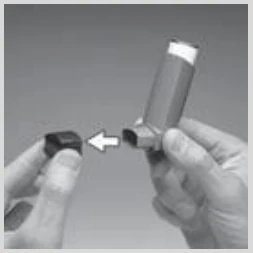
Remove the mouthpiece cover by gently squeezing the sides with
your thumb and forefinger and pull apart.
2 To make sure that it works, shake it well, point the mouthpiece
away from you and press the canister to release a puff into the
air. If you have not used the inhaler for a week or more, release two
puffs of medicine into the air.
Using your inhaler
It is important to start to breathe as slowly as possible just before using your inhaler.
1 Stand or sit upright when using your inhaler.
2 Remove the mouthpiece cover
(as shown in the first picture). Check
inside and outside to make sure that the
mouthpiece is clean and free of objects.
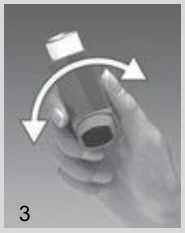
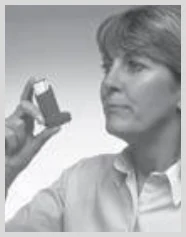
3 Shake the inhaler 4 or 5 times to ensure
that any loose objects are removed and 3
that the contents of the inhaler are evenly
mixed.
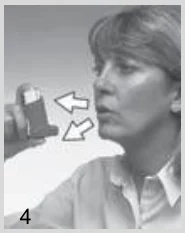
4 Hold the inhaler upright with your
thumb on the base, below the
mouthpiece. Breathe out as far as is
comfortable. Do not breathe in again yet.
5 Place the mouthpiece in your mouth
between your teeth. Close your lips 4
around it. Do not bite.
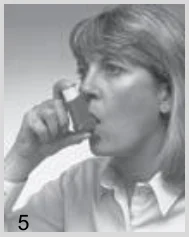
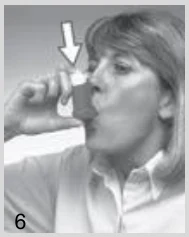
6 Breathe in through your mouth. Just after starting to
breathe in, press down on the top of the canister to release
a puff of medicine. Do this while still breathing in steadily and
deeply.
7 Hold your breath; take the inhaler from
your mouth and your finger from the
top of the inhaler. Continue holding your 5
breath for a few seconds, or as long as is
comfortable.
8 If your doctor has told you to take two puffs,
wait about half a minute before you take another puff
by repeating steps 3 to 7.
9 Afterwards, rinse your mouth with water
and spit it out.
6
10 After use always replace the mouthpiece cover straight
away to keep out dust. Replace the cover by firmly pushing and
clicking into position.
Practise in front of a mirror for the first few times. If you see a “mist” coming from the top of your inhaler or the sides of your mouth you should start again.
Older children or people with weak hands may find it easier to hold the inhaler with both hands.
Put the two forefingers on top of the inhaler and both thumbs on the bottom below the mouth- piece. Your doctor, nurse or pharmacist will be able to advise you.
Cleaning your Evohaler
To stop your inhaler blocking, it is important to clean it at least once a week.
To clean your inhaler:
- Remove the mouthpiece cover.
- Do not remove the metal canister from the plastic casing at any time.
- Wipe the inside and outside of the mouthpiece and the plastic casing with a dry cloth or tissue.
- Replace the mouthpiece cover.
Do not put the metal canister in water.
If you use more Flixotide than you should
If you use more than you should, talk to your doctor as soon as possible.
It is important that you take your dose as stated on the pharmacist’s label or as advised by your doctor. You should not increase or decrease your dose without seeking medical advice.
If you forget to use Flixotide
- Take the next dose when it is due.
- Do not take a double dose to make up for the forgotten dose.
If you stop using Flixotide
- Do not stop treatment even if you feel better unless told to do so by your doctor.
If you have any further questions on the use of this medicine, ask your doctor, nurse or pharmacist.
4. Possible side effects
Like all medicines, this medicine can cause side effects, although not everybody gets them.
If you notice any of the following serious side effects, stop using this medicine and talk to your doctor straight away. You may need urgent medical treatment.
- allergic reactions (may affect up to 1 in 100 people) – the signs include skin rashes, redness, itching or weals like nettle rash or hives
- severe allergic reactions (may affect up to 1 in 10,000 people) - the signs include swelling of your face, lips, mouth, tongue or throat which may cause difficulty in swallowing or breathing, itchy rash, feeling faint and light headed and collapse
- your breathing or wheezing gets worse straight after using your inhaler
Other side effects include:
Very common (may affect more than 1 in 10 people)
- thrush in the mouth and throat
Common (may affect up to 1 in 10 people)
- sore tongue or throat
- hoarseness of voice
Problems with your mouth and throat can be reduced by doing certain things straight after inhaling your dose. These are brushing your teeth, rinsing your mouth or gargling with water and spitting it out. Tell your doctor if you have these problems with your mouth or throat, but do not stop treatment unless you are told to.
The following side effects have also been reported in patients with Chronic Obstructive Pulmonary Disease (COPD):
- Pneumonia and bronchitis (lung infection). Tell your doctor if you notice any of the following symptoms: increased sputum production, change in sputum colour, fever, chills, increased cough, increased breathing problems
- Bruising
Rare (may affect up to 1 in 1,000 people)
- thrush (candidiasis) in the oesophagus
Very rare (may affect up to 1 in 10,000 people)
- sleeping problems or feeling worried, over-excited and irritable. These effects are more likely to occur in young people
- joint pains
- indigestion
- level of sugar (glucose) in your blood may be increased
the way steroids are produced by your body may be affected when using Flixotide. This is more likely to happen if you use high doses for a long period of time (e.g. 400 micrograms daily in children). This can cause:
- young people to grow more slowly
- something called ‘Cushing’s syndrome’. This happens when you have too much steroid in your body
and it can cause thinning of your bones and eye problems (such as cataracts and glaucoma which is
high pressure in the eye)
Your doctor will help stop this happening by making sure you use the lowest dose of steroid which controls your symptoms.
Not known: frequency cannot be estimated from the available data
- depression, feeling restless or nervous. These effects are more likely to occur in children
- nosebleeds.
- blurred vision
Talk to your doctor as soon as possible if:
- after 7 days of using Flixotide your shortness of breath or wheezing does not get better, or gets worse
- you or your child is on high doses of inhaled steroid and become unwell with vague symptoms such as tummy ache, sickness, diarrhoea, headache or drowsiness. This can happen during an infection such as a viral infection or stomach upset. It is important that your steroid is not stopped suddenly as this could make your asthma worse and could also cause problems with the body’s hormones
Reporting of side effects
If you get any side effects, talk to your doctor, pharmacist or nurse. This includes any possible side effects not listed in this leaflet. You can also report side effects directly via the Yellow Card Scheme at: www.mhra.gov.uk/yellowcard or search for MHRA Yellow Card in the Google Play or Apple App Store.
By reporting side effects you can help provide more information on the safety of this medicine.
5. How to store Flixotide
- Keep this medicine out of the sight and reach of children.
- Clean your inhaler on a weekly basis and if it becomes blocked as described under ‘Cleaning’.
- Do not use this medicine after the expiry date, which is stated on the label and carton after EXP. The expiry date refers to the last day of that month.
- Do not store above 30°C. Protect from frost and direct sunlight.
- If the inhaler gets very cold, take the metal canister out of the plastic case and warm it in your hands for a few minutes before use. Never use anything else to warm it up.
- Pressurised container. Do not expose to temperatures higher than 50°C. The canister should not be punctured, broken or burnt even when apparently empty.
- Replace the mouthpiece cover firmly and snap it into position.
- If you are told to stop taking this medicine, return the inhaler to your pharmacist to be destroyed.
Do not throw away any medicines via wastewater or household waste. Ask your pharmacist how to throw away medicines you no longer use. These measures will help protect the environment.
If your medicine shows signs of deterioration or discolouration seek the advice of your pharmacist who will tell you what to do.
6. Contents of the pack and other information
What Flixotide contains
- Each metered dose contains 250 micrograms fluticasone propionate.
- Also contains HFA 134a.
This medicine contains fluorinated greenhouse gases.
Each inhaler contains 12 g of HFC 134a (also referred as HFA 134a) corresponding
to 0.0172 tonne CO2 equivalent (global warming potential GWP = 1,430).
What Flixotide looks like and contents of the pack
Pressurised metered dose inhaler with a plastic orange body and a light orange removable dust cap.
Each pack contains 1 Evohaler containing 120 metered actuations.
Who manufactured your medicine
Manufactured by Glaxo Wellcome S.A. Spain.
or
GlaxoWellcome Production, France.
Procured from with the EU and repackaged by Product Licence Holder Uni Health Distribution Ltd, Unit G4 Riverside Industrial Estate, Riverside Way, Dartford, Kent, DA1 5BS, UK.
PL 45396/0166 POM
Leaflet date: 22 April 2026 Ref: FlixE/UT2
Evohaler is a registered trademark of the GSK group of companies.
Blind or partially sighted?
Is this leaflet hard to see or read?
Call 01322 629220 to obtain the leaflet in a format suitable for you.