

Patient leaflet - Eurneffy 2 mg nasal spray, solution in single-dose Container
1. What EURneffy is and what it is used for
EURneffy contains the active substance adrenaline (epinephrine) which is an adrenergic medicine (medicine that has an effect on the sympathetic nervous system, the part of the nervous system that increases heart rate, blood pressure, breathing rate, and pupil size).
EURneffy is used in adults and children with a body weight of 30 kg or more for the emergency treatment of severe allergic reactions, including anaphylaxis (sudden, severe and sometimes life-threatening allergic reactions), to insect stings or bites, foods, medicines and other allergens (substances that cause an allergy) as well as idiopathic anaphylaxis (the cause of anaphylaxis is not known) or anaphylaxis caused by exercise. EURneffy is intended for immediate self-administration by a person (or given to a person by a caregiver or medical professional) with a history or recognised risk of a severe allergic reaction that can lead to anaphylactic shock. Use EURneffy without delay if anaphylaxis is suspected, even if in doubt about the severity of the reaction. Then dial 999 straight away as you might need further treatment for your anaphylaxis.
The active substance in EURneffy, adrenaline, is a naturally occurring hormone released by the body in response to stress. It works directly on the cardiovascular (heart and blood circulation) and respiratory (lung) systems to stop the possible fatal effects of a severe allergic reaction that can lead to anaphylactic shock. In acute allergic reactions it improves blood pressure, heart function and breathing, and reduces tissue swelling. 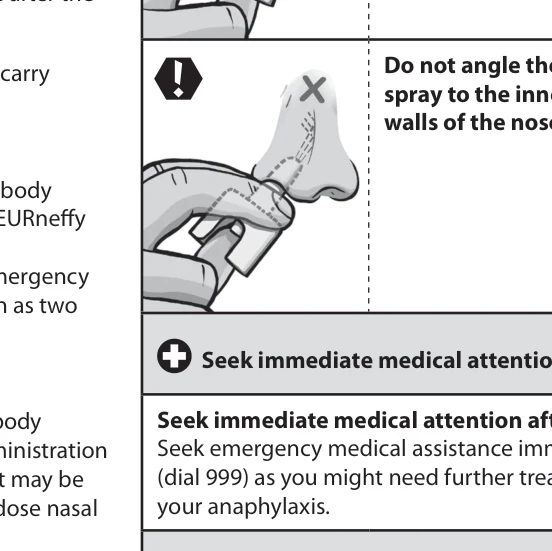
 EURneffy is an emergency rescue therapy but you must seek emergency medical assistance immediately (dial 999) as you might need further treatment for your anaphylaxis. Always tell your friends and family that you carry EURneffy with you (see section 2 Warnings and precautions).
2. What you need to know before you use EURneffy
Do not use EURneffy
There is no known reason why anyone should not use EURneffy during an allergic emergency.
Warnings and precautions
You, or anyone who may need to give EURneffy to you (such as a parent, caregiver, or teacher), should be carefully instructed by your doctor or nurse on how and when to correctly use EURneffy (see the instructions for use in section 3 How to use EURneffy). 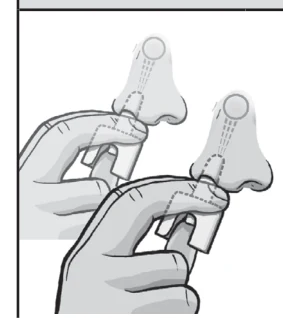 Symptoms that signal the onset of an anaphylactic shock occur within minutes of exposure to the allergen and include: itching of the skin, raised rash (like a nettle rash), flushing, swelling of the lips, throat, tongue, hands and feet, wheezing, hoarseness, shortness of breath, nausea, vomiting, stomach cramps and, in some cases, loss of consciousness, apprehension, a fast heartbeat, fitting, diarrhoea (loose stools), loss of bladder control. Use EURneffy at the first signs or symptoms of a severe allergic reaction.
Symptoms of anaphylaxis can reoccur within 72 hours of the initial episode, even without new exposure to the allergen that triggered the allergic reaction.
You must make sure you understand the reason EURneffy has been prescribed for you. You should be confident that you know exactly how and when to use EURneffy. Explain how to use EURneffy to your family, carers, co-workers, or teachers. They will need to know how to use it before you suffer an anaphylactic reaction.
If you are at risk of a severe allergic reaction, you should always keep EURneffy with you.
Patients with a history or a recognised risk of a severe allergic reaction that can lead to anaphylactic shock should have quick access to EURneffy.
If you have asthma, you may be at increased risk of a severe allergic reaction.
Anyone who has an episode of anaphylaxis should see their doctor about testing for substances they may be allergic to, so these can be strictly avoided in future. It is important to be aware that an allergy to one substance can lead to allergies to a number of related substances.
Populations with an increased risk of side effects from the use of adrenaline
You may have a greater risk of developing side effects with EURneffy if you:
have cardiovascular disease (disease affecting the
heart and blood circulation).
- have increased pressure in your eyes.
- have reduced renal (kidney) function.
have prostatic adenoma (a benign (not cancer)
condition in which an overgrowth of prostate tissue pushes against the urethra and the bladder, blocking the flow of urine).
- have hypercalcaemia (high blood calcium levels).
- have hypokalaemia (low blood potassium levels).
- have Parkinson’s disease.
- have hyperthyroidism (an overactive thyroid gland).
- have hypertension (high blood pressure).
- have diabetes.
- are elderly.
are pregnant (see section 2 Pregnancy,
breastfeeding and fertility).
Talk to your doctor if any of the above conditions apply to you, or if you are not sure.
Children and adolescents
Do not give this medicine to children weighing less than 30 kg. The safety and efficacy of this medicinal product are unknown in children below 30 kg body weight.
Other medicines and EURneffy
Tell your doctor or pharmacist if you are taking, have recently taken or might take any other medicines.
This is especially important if you take any of the following as they may reduce the effect of adrenaline:
Alpha and beta-blocking medicines, e.g.
propranolol.
Medicines that counteract the pressor effects
of adrenaline (vasodilators or alpha-adrenergic-blocker, e.g. phentolamine).
You must also tell your doctor or pharmacist if you take any of the following as they may increase the risk of side effects of adrenaline:
Medicines that may make the heart sensitive to
arrhythmias (abnormal or irregular heartbeat), such as digoxin, mercurial diuretics (medicines that increase urine production which act mainly on the transport of sodium) (e.g. chlormerodrin, merbaphen, mersalyl acid, meralluride, mercaptomerin, mercurophylline, merethoxylline procaine) or quinidine.
Antidepressants such as tricyclic antidepressants,
e.g. imipramine, or monoamine oxidase inhibitors (MAO inhibitors) (e.g. isocarboxazid, phenelzine, selegiline, tranylcypromine).
Medicines for the treatment of Parkinson’s disease
such as catechol-O-methyl transferase inhibitors (COMT inhibitors) (e.g. entacapone, tolcapone, carbidopa-levodopa-entacapone, opicapone) and levodopa.
- Medicines for thyroid disease such as levothyroxine.
Medicines that make you breathe more easily;
used for asthma (theophylline).
- Medicines used in labour (oxytocin).
Medicines used to treat allergies such as
diphenhydramine or chlorpheniramine (antihistamines).
Medicines that act on the nervous system
(parasympatholytics) (e.g. atropine, cyclopentolate, homatropine, hyoscine, tropicamide).
Patients with diabetes should carefully monitor their glucose levels after they use EURneffy, as adrenaline can reduce the amount of insulin made by the body, thus increasing the blood glucose level.
Pregnancy, breastfeeding and fertility
If you are pregnant or breastfeeding, think you may be pregnant or are planning to have a baby, ask your doctor or pharmacist for advice before taking this medicine.
There is limited experience of the use of adrenaline during pregnancy. If you are pregnant, do not hesitate to use EURneffy in an emergency, since you and your baby’s lives may be in danger. Discuss this with your doctor if you are pregnant.
It is expected that the amount of EURneffy that is passed through breastfeeding is very low. For the emergency treatment of anaphylaxis, EURneffy should be used in breastfeeding women in the same manner as for non-breastfeeding patients.
EURneffy with alcohol
Alcohol can increase the effect of adrenaline.
Driving and using machines
The ability to drive and use machines is unlikely to be affected by this medicine. Do not drive if you are having an anaphylactic reaction.
EURneffy contains sodium metabisulphite and benzalkonium chloride
EURneffy contains sodium metabisulphite, which may cause severe allergic reactions (hypersensitivity) or breathing difficulty (bronchospasm).
This medicine contains 0.04 mg benzalkonium chloride in each dose. Benzalkonium chloride may cause irritation or swelling inside the nose, especially if used repeatedly.
3. How to use EURneffy
Always use EURneffy exactly as your doctor or pharmacist has told you. Check with your doctor or pharmacist if you are not sure.
What to do in an emergency:
Use EURneffy immediately if you have any signs
of anaphylaxis. If in doubt use. Don’t delay.
Dial 999 – say anaphylaxis (“ana-fill-axis”) as
you might need further treatment for your anaphylaxis.
- Lie down and raise your legs.
Use a new EURneffy to give a second dose – in
the same nostril – if you haven’t improved after 5 minutes.
Sit up if you are struggling to breathe but don’t
change position suddenly.
- Lie down again as soon as you can.
- Stay lying down even if you are feeling better.
You must not stand up even if someone
encourages you to.
Be prepared:
Carry two EURneffy nasal sprays with you at all
times.
You must use your EURneffy as soon as you
notice any signs of anaphylaxis.
Make sure you know beforehand what the signs
are so you can act swiftly.
Make sure you know how to use your EURneffy
before you need to.
Familiarise yourself with the trainer device.
Practise regularly and often with the trainer device.
When to carry EURneffy
You should always carry EURneffy with you or have it close at all times in the event of an allergic emergency. Always carry at least two EURneffy nasal sprays in the event a second dose is needed due to a mistake in taking the medicine or insufficient response after the first dose.
Always tell your friends and family that you carry EURneffy with you.
Dose
The recommended dose for patients with a body weight of 30 kg or more, is a single dose of EURneffy nasal spray delivering 2 mg of adrenaline. The maximum dose of adrenaline for the emergency treatment of allergic reactions is 4 mg, taken as two separate single-dose nasal sprays.
Use in children
The recommended dose for patients with a body weight of 30 kg or more is a single nasal administration of 2 mg adrenaline. The maximum dose that may be given is 4 mg taken as two separate single-dose nasal sprays.
Method of administration
EURneffy must be given nasally (in the nose) only. EURneffy is a ready-to-use single-dose nasal spray that delivers its entire content (2 mg) upon activation. EURneffy can be used even if you have a cold or a congested nose.
Do not press the plunger before inserting the EURneffy nasal spray into a nostril, otherwise the single dose will be lost prior to use.
EURneffy should only be given as a nasal spray into a nostril; do not spray EURneffy into the eyes or mouth.
The instructions for use must be carefully followed in order to use EURneffy correctly.
If you notice the signs of a severe allergic reaction (see section 2 Warnings and precautions), use EURneffy immediately. Seek emergency medical assistance immediately (dial 999) as you might need further treatment for your anaphylaxis. Ideal dosing is to use the dominant hand to hold the sprayer and administer to the same side nostril (e.g. right hand to right nostril; or left hand to left nostril).
Sometimes a single dose of EURneffy may not be sufficient to completely reverse the effects of a severe allergic reaction. If your symptoms have not improved or have deteriorated within 5 minutes after using the first nasal spray of EURneffy, either you or the person with you should use a new EURneffy nasal spray to give a second dose in the same nostril as the first dose.
The instructions for use given below must be followed.
Instructions for use Before you need to use it, fully familiarise yourself with EURneffy, including when and how it should be used. | ||
Nozzle/Tip Plunger EURneffy 2 mg nasal spray | ||
| Follow these instructions only when ready to use | ||
Remove EURneffy 2 mg nasal spray from the packaging. Pull open the packaging to remove the EURneffy 2 mg nasal spray. | ||
Hold the nasal spray as shown. Hold the nasal spray with your thumb on the bottom of the plunger and one finger on either side of the nozzle.
| ||
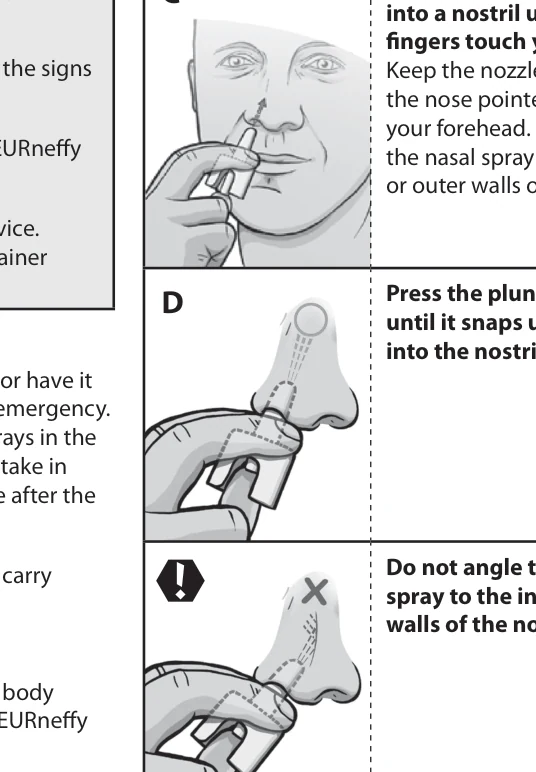
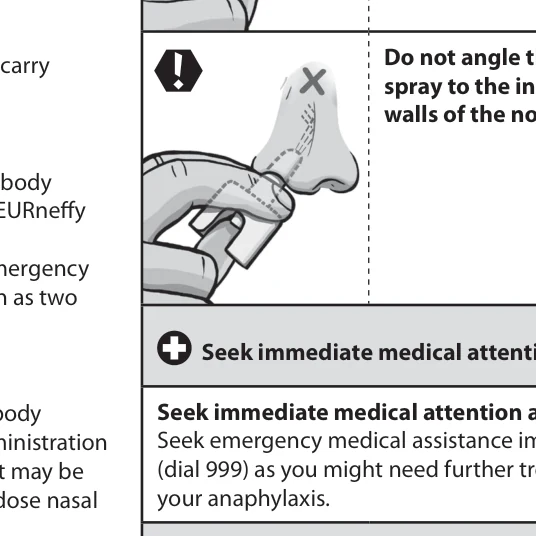
Insert the tip of nasal spray into a nostril until your fingers touch your nose. Keep the nozzle straight into the nose pointed toward your forehead. Do not angle the nasal spray to the inner or outer walls of the nose. | ||
| Press the plunger up firmly until it snaps up and sprays into the nostril. | ||
| Do not angle the nasal spray to the inner or outer walls of the nose. | ||
| Seek immediate medical attention after use | ||
Seek immediate medical attention after use Seek emergency medical assistance immediately (dial 999) as you might need further treatment for your anaphylaxis. | ||
| Monitor patient symptoms | ||
If symptoms continue to worsen or reoccur after 5 minutes, or in case of any error in administration, use a new EURneffy nasal spray, to give a second dose in the SAME nostril as the first dose and seek emergency medical
assistance.
You should lie down with feet raised. If this makes you breathless, you can gently sit up. You should not change position suddenly and should lie down again as soon as possible. You should not stand up even if someone encourages you to. You should stay lying down even if you feel better. Pregnant women should lie on their left side. Unconscious patients should be placed on their side in the recovery position to prevent choking. If symptoms do not resolve, you should, if possible, remain with another person until medical assistance arrives.
If you use more EURneffy than you should
In case of an overdose of adrenaline, you should always seek immediate medical help.
| A | ||
| B | ||
| C | ||
| D | ||
Overdose may cause a sudden increase in blood pressure (with symptoms including headache or dizziness), bleeding in brain tissue, palpitations (forceful heartbeats that may be rapid or irregular), reduced blood flow and accumulation of fluid in the lungs (causing symptoms including difficulty breathing). You will need to be monitored.
If you have any further questions on the use of this medicine, ask your doctor or pharmacist.
4. Possible side effects
Like all medicines, this medicine can cause side effects, although not everybody gets them. Tell your doctor or pharmacist if any of the following side effects occur or worsen.
The following side effects are associated with the use of EURneffy nasal spray:
Very common (may affect more than 1 in 10 people)
- Nasal discomfort
- Headache
- Feeling jittery
- Throat irritation
Common (may affect up to 1 in 10 people)
- Increased blood pressure
- Palpitations (forceful heartbeats that may be rapid or irregular)
- Rhinorrhea (runny nose)
- Anxiety
- Nasal oedema (itching and burning pain of the nose; nose feels swollen, hot and red)
- Rhinalgia (nose pain)
- Heart rate increased
- Nasal congestion
- Tremor (shaking)
Uncommon (may affect up to 1 in 100 people)
- Dizziness
- Lacrimation increased (watery eyes)
- Oropharyngeal pain (pain in the tongue, soft palate, the side and back walls of the throat and tonsils)
- Nausea (feeling sick)
- Nasal pruritus (irritation or inflammation of the nose)
- Intranasal paraesthesia (sensations like numbness, tingling, pins and needles in the nose)
- Sneezing
- Paranasal sinus discomfort (nasal obstruction and congestion, nasal discharge that is thick, opaque, and coloured, and facial pain or pressure)
- Paraesthesia oral (sensations like numbness, tingling, pins and needles in the mouth or back of the throat)
- Paraesthesia (sensations like numbness, tingling, pins and needles)
- Salivary hypersecretion (drooling)
- Toothache
- Head discomfort
- Nasal dryness
- Nasal mucosal disorder (inflammation of the tissue that lines the nasal cavity)
- Gingival discomfort (gum and mouth irritation)
- Energy increased
- Fatigue (feeling tired)
- Feeling hot
- Body temperature increased
- Presyncope (feeling faint)
- Euphoric mood
- Nervousness
- Pruritus (itching skin)
- Epistaxis (nosebleed)
- Chest discomfort
Reporting of side effects
If you get any side effects, talk to your doctor, pharmacist or nurse. This includes any possible side effects not listed in this leaflet. You can also report side effects directly via the Yellow Card Scheme at www.mhra.gov.uk/yellowcard or search for MHRA Yellow Card in the Google Play or Apple App Store. By reporting side effects, you can help provide more information on the safety of this medicine.
5. How to store EURneffy
Keep this medicine out of sight and reach of children who are not the intended user.
Do not use this medicine after the expiry date which is stated on the nasal spray label after EXP. The expiry date refers to the last day of that month.
This medicine does not require any special storage conditions.
If accidentally frozen, the nasal spray will not function. Allow the nasal spray to thaw for at least one hour; do not use if the contents are still frozen or not completely thawed. Freezing does not affect the shelf life of the product.
Do not throw away any medicines via wastewater. Ask your pharmacist how to throw away medicines you no longer use. These measures will help protect the environment.
6. Contents of the pack and other information
What EURneffy contains
The active substance is adrenaline (epinephrine).
Each dose of nasal spray solution delivers 2 mg adrenaline in 100 µL.
- The other ingredients are sodium chloride, dodecylmaltoside, disodium edetate, benzalkonium chloride, sodium metabisulphite (E 223), hydrochloric acid, concentrated (for pH-adjustment), sodium hydroxide (for pH-adjustment), water for injections (see section 2 EURneffy contains sodium metabisulphite and benzalkonium chloride).
What EURneffy looks like and contents of the pack
The EURneffy 2 mg nasal spray, solution in a single-dose container is a non-pressurised dispenser delivering a single-dose spray containing the active substance in a clear and colourless to pink brownish solution.
EURneffy is available in packs containing 1 or 2 nasal single-dose sprays.
Not all pack sizes may be marketed.
Marketing authorisation holder
ALK-Abelló A/S
Bøge Allé 6-8
2970 Hørsholm
Denmark
Manufacturer
ALK-Abelló S.A.
Miguel Fleta 19
28037 Madrid
Spain
This leaflet was last revised in April 2026
Other sources of information
Detailed and updated information on this product is available by scanning the QR code included in the PL, outer carton and blister with a smartphone/device. The same information is also available on the following URL: https://www.eurneffy.eu and the MHRA website.
1069990
Format: 684 x 466,4 mm Colour: Black