


Patient leaflet - Ethosuximide Glenmark 250 mg/5 ml oral solution
1. What Ethosuximide Glenmark is and what it is used for
Ethosuximide Glenmark contains the active substance ethosuximide.
Ethosuximide Glenmark is a medicine for the treatment of epileptic fits (anti-epileptic).
Ethosuximide Glenmark is used to treat:
Pyknoleptic absences and complex and atypical
absences.
Myoclonic-astatic petit mal and myoclonic fits of
adolescents (impulsive petit mal), if other medicines are not effective and/or are not tolerated.
2. What you need to know before you take Ethosuximide Glenmark
Do not take Ethosuximide Glenmark:
if you are allergic to ethosuximide, other succinimides
(group of medicines to which ethosuximide belongs) or any of the other ingredients of this medicine listed in section 6.
Warnings and precautions
Talk to your doctor before taking Ethosuximide Glenmark: If you experience movement disorders (see section 4) do not continue taking Ethosuximide Glenmark. Please, contact the nearest doctor who, in the event of significant disturbances, can administer diphenhydramine as an antidote by the intravenous route.
Pay special attention to symptoms of bone marrow depression such as fever, inflammation of throat or pharynx tonsils as well as haemorrhagic tendency, and consult your doctor, if you experience any of these symptoms.
The blood count should be checked regularly (initially monthly, after one year every six months) to identify potential injury of the medulla. At a leucocyte count (number of white blood cells) of less than 3500/mm3 or a granulocyte ratio of less than 25% the dose should be reduced or Ethosuximide
Glenmark discontinued completely. The liver enzymes should also be checked regularly.
Psychic side effects (anxiety, illusion) can occur in particular in patients with a history of psychiatric disorders. Special caution is required when Ethosuximide Glenmark is administered to this group of patients. A small number of patients treated with anti-epileptics such as ethosuximide have developed thoughts about self-harm or suicidal thoughts. If at any time during the treatment you have such thoughts, tell your doctor immediately.
Note:
To prevent grand mals which are often associated with complex and atypical absences, ethosuximide can be combined with effective anti-epileptics (e.g. primidone or phenobarbital). Additional grand mal prophylaxis can be dispensed with only in the case of pyknoleptic absence epilepsies in children of school age. Serious skin reactions including Stevens-Johnson syndrome and drug reaction with eosinophilia and systemic symptoms (DRESS) have been reported in association with ethosuximide treatment. Stop using Ethosuximide Glenmark and seek medical attention immediately if you notice any of the symptoms described in section 4.
Other medicines and Ethosuximide Glenmark
Tell your doctor or pharmacist if you are taking/using, have recently taken/used or might take/use any other medicines:
What other medicines affect the efficacy of Ethosuximide Glenmark?
In patients also taking carbamazepine (medicine for the treatment of epileptic fits), the plasma clearance (excretion rate) of ethosuximide, the active substance of Ethosuximide Glenmark may be elevated. In patients taking valproic acid (medicine for the treatment of epileptic fits), the concentration of ethosuximide in blood may rise.
It cannot be excluded that CNS depressants and Ethosuximide Glenmark mutually potentiate their sedative (calming and sleep inducing) effects.
The efficacy of what other medicines is affected by Ethosuximide Glenmark?
Ethosuximide, the active substance of Ethosuximide Glenmark, normally does not change the concentration of other medicines for the treatment of epileptic fits (e.g. primidone, phenobarbital, phenytoine) in blood. In individual cases the phenytoine level in blood may rise, however.
Ethosuximide Glenmark with alcohol
Alcohol can change and potentiate the effects of
Ethosuximide Glenmark in an unforeseeable manner. Do not drink alcohol or consume alcohol-containing food while you take Ethosuximide Glenmark!
Pregnancy and breast-feeding
If you are pregnant or breast-feeding, think you may be pregnant or are planning to have a baby, ask your doctor or pharmacist for advice before taking this medicine. Pregnancy
If you are of childbearing age, you should be advised by your doctor regarding the necessity of planning and monitoring any pregnancy before starting the treatment with Ethosuximide Glenmark. Do not discontinue Ethosuximide Glenmark without first consulting your doctor as epileptic seizures might recur, which could harm you and/or your unborn child.
No specific malformations of babies are known, which were caused by the treatment with ethosuximide. However, patients treated with medicines against the epileptic seizures generally have a higher risk for malformations than other women. The most commonly reported malformations are cleft lip, cardiovascular malformation and neural tube defects (spina bifida). This risk is even higher in patients treated with more than one anti-epileptic, and therefore combination treatment should be avoided during pregnancy.
Prenatal diagnostics measures like high level ultrasound and the determination of a α-fetoprotein are recommended for the early detection of foetal damage.
The lowest effective ethosuximide dose ensuring seizures control must not be exceeded, particularly during the 20th and 40th day of pregnancy. Your ethosuximide serum concentration must be checked regularly. You should take extra folic acid, if you are planning to have a baby or if you are pregnant.
To prevent vitamin K1 deficiency in your baby and bleeding caused by this deficiency, you should also be given vitamin K1 during the last month of your pregnancy. Breast-feeding
Ethosuximide passes into the breast milk and may lead to sedation, poor suckling and irritability in breast-fed infants.
Therefore, you should stop breast-feeding during treatment with Ethosuximide Glemark.
Driving and using machines
Ethosuximide Glenmark can impair reactivity. Therefore, the following should be considered throughout the treatment period, in particular, however, during the adjustment phase: You are not able to respond quickly and purposefully to unexpected and sudden events. Do not drive cars or other vehicles! Do not operate dangerous electrical tools or machines! Do not work without a secure hold!
The decision about whether you are able to drive and use machines will be taken in each case by your doctor considering your individual response to the medicine. Be advised that alcohol further impairs your driving capacity. Ethosuximide Glenmark contains sucrose
1 ml oral solution contains 600 mg sucrose. This should be taken into account in patients with diabetes mellitus. If you have been told by your doctor that you have an intolerance to some sugars, contact your doctor before taking this medicine.
This medicine may be harmful to the teeth.
Ethosuximide Glenmark contains sodium
This medicine contains less than 1 mmol sodium (23 mg) per dose, that is to say essentially ‘sodium-free’.
3. How to take Ethosuximide Glenmark
Always take this medicine exactly as your doctor told you. Check with your doctor or pharmacist if you are not sure. Dosage
Unless otherwise prescribed by your doctor, the recommended dose is:
Adults, elderly patients and children over 6 years of age: The treatment is started at a daily dose of 500 mg (10 ml).
Depending on the patient’s tolerance, the dose is increased every five to seven days in increments of max. 250 mg (5 ml) until the fits are controlled by a daily dose of 1000-1500 mg (20-30 ml). In an
individual case, a daily dose of 2000 mg (40 ml), taken in several single doses, may be required.
The therapeutic plasma level of ethosuximide is normally between 40 and 100 μg/ml. However, the dose depends on the patient’s clinical response. The half-life of ethosuximide in plasma is more than 24 hours so that the daily dose can be taken as a single dose provided the medicine is well tolerated.
Higher daily doses should be taken in 2 or 3 single doses, however.
The decision about changes to the dosage regimen can be taken by your doctor only.
The risk of side effects which depend on the dose taken can be reduced by taking small initial doses of Ethosuximide Glenmark and increasing them gradually to optimum amounts (increasing the amounts slowly from day to day) and by taking them during or after meals. Haemodialysis patients
Ethosuximide is dialysable. Haemodialysis patients therefore require a supplementary dose or a modified dosage regimen. During a dialysis period of four hours, 39% to 52% of the dose taken is removed.
Children and adolescents
Children under 2 years: The treatment is started at a daily dose of 125 mg (2.5 ml).
The dose is increased gradually in small increments every few days until the fits are controlled.
Package leaflet: Information for the patient Ethosuximide Glenmark 250 mg/5 ml oral solution
ethosuximide
Children between 2 and 6 years of age: The treatment is started at a daily dose of 250 mg (5 ml). The dose is increased gradually in small increments every few days until the fits are controlled.
The optimum daily dose for most children is 20 mg/kg. The maximum dose is 1000 mg (20 ml).
Method of administration
Ethosuximide Glenmark is for oral use.
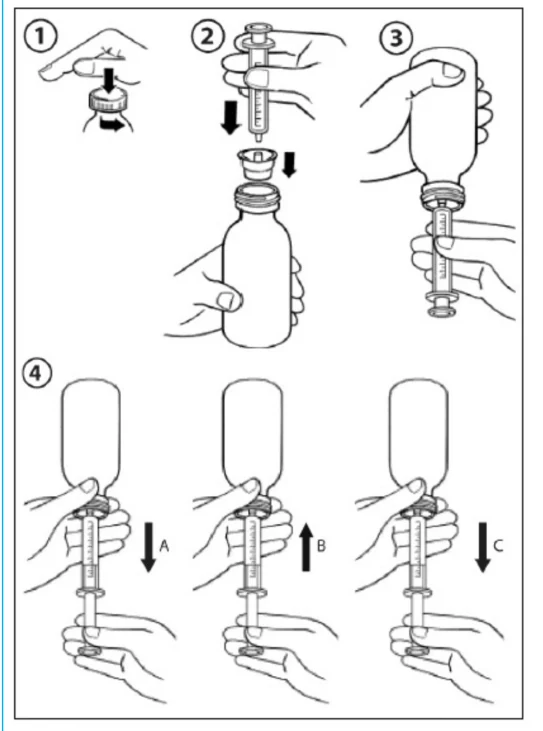
The solution can be taken during or after meals. Measuring your dose using the oral syringe provided:
The oral syringe provided in the pack should be used for measuring the dose.
The numbers up the side of the oral syringe show how many millilitres (ml) of the solution you have inside the syringe.
- 1.
Open the bottle: press the cap and turn it
anticlockwise (figure 1).
- 2.
Insert the syringe adaptor into the bottle neck
(figure 2).
- 3.
Take the syringe and put it in the adaptor opening
(figure 2).
- 4. Turn the bottle upside down (figure 3).
- 5.
Fill the syringe with a small amount of the solution by
pulling the piston down (figure 4A).
- 6.
Push the piston upward in order to remove any
possible bubbles (figure 4B).
- 7.
Pull the piston down to the graduation mark
corresponding to the quantity in millilitres (ml) prescribed by your doctor (figure 4C).
- 8. Turn the bottle the right way up.
- 9. Remove the syringe from the adaptor.
- 10.
Put the end of the syringe into your mouth and push
the piston slowly back in to take the medicine.
- 11.
Wash the syringe with water and let it dry before you
use it again.
- 12. Close the bottle with the plastic screw cap.
 Duration of treatment The treatment of epileptic seizures is principally a long-term treatment. The dose, the distribution of the daily dose, the duration of the treatment and discontinuation of Ethosuximide Glenmark are determined by a specialist with experience in the treatment of epilepsy. If you take more Ethosuximide Glenmark than you should
If by mistake you have taken a double dose Ethosuximide Glenmark, do not change your dosage regimen, but continue taking Ethosuximide Glenmark as prescribed. Significantly higher doses potentiate effects such as tiredness, lethargy (lack of drive, apathy), depressive states and states of agitation, in some cases also irritability as well as any other side effects depending on the quantity taken (overdose effects may occur at concentrations over 150 μg ethosuximide per ml blood). Overdose symptoms are potentiated by alcohol and other CNS depressants. If any of these symptoms occur, contact the nearest doctor and, if possible, present the medicine taken and the package leaflet.
If a significant overdose was taken, the doctor will perform gastric lavage and administer medicinal charcoal. Monitoring of the cardiovascular and respiratory systems in an intensive care unit is required.
If you forget to take Ethosuximide Glenmark
Do not take a double dose to make up for the forgotten dose. Normally no symptoms will appear when you forgot to take a single dose. Continue taking the medicine as prescribed, i.e. do not take the forgotten dose at a later time. Be advised, however, that Ethosuximide Glenmark will control your state safely and appropriately only when taken regularly!
If you stop taking Ethosuximide Glenmark
If you wish to discontinue the treatment, talk to your doctor first. Do not stop taking this medicine without checking with your doctor, as this may jeopardise the success of the treatment.
Strictly follow the treatment recommendations of your doctor, as otherwise you may have again epileptic fits! If you think that you do not tolerate Ethosuximide Glenmark, please contact your doctor!
If you have any further questions on the use of this medicine, ask your doctor or pharmacist.
4. Possible side effects
Like all medicines, this medicine can cause side effects, although not everybody gets them.
Serious side effects:
Stop taking Ethosuximide Glenmark and seek medical attention immediately if you notice any of the following symptoms:
- reddish patches on the trunk; the patches are target-like macules or circular, often with central blisters, skin peeling, ulcers of mouth, throat, nose, genitals and eyes. These serious skin rashes may be preceded by fever and flu-like symptoms (Stevens-Johnson syndrome).
- widespread rash, high body temperature and enlarged lymph nodes (drug reaction with eosinophilia and systemic symptoms (DRESS)).
Seek medical attention if you notice any of the following symptoms:
- changes in your blood (bruising or bleeding more easily, fever, sore throat, mouth ulcers, fatigue, repeated infections or infections that will not go away). Your doctor may take regular blood samples to test for these effects.
Other side effects:
Common (may affect up to 1 in 10 people) to very common (may affect more than 1 in 10 patients):
- nausea, vomiting, hiccup and abdominal pain Uncommon (may affect up to 1 in 100 people):
- severe headache, sleep disturbances, lethargy (lack of drive, apathy), ataxia (movement disorders)
- withdrawal, anxiety
- loss of appetite, loss of weight
- diarrhoea, constipation
Rare (may affect up to 1 in 1000 patients):
- paranoid and hallucinatory phenomena developing over days and weeks (illusion, persecution complex)
- lupus erythematodeos* of varying extent (skin disease that may involve internal organs)
leucopenia* (shortage of white blood cells),
eosinophilia* (increase of certain type of white blood cells), thrombocytopenia* (shortage of blood platelets) or agranulocytosis* (absence of certain defensive cells) Not known (frequency cannot be estimated from the available data):
- in individual cases dyskinesias (movement disorders, see section 2) may occur during the first 12 hours of the treatment
- allergic skin reactions* such as rash, Stevens-Johnson syndrome (very severe allergic skin reaction) or DRESS (drug reaction with eosinophilia and systemic symptoms)
- in individual case aplastic anaemia* (shortage of red blood cells due to failure of body to produce new cells) and pancytopenia* (shortage of all blood cells) may occur (see section 2)
If side effects occur which are independent of the dose taken, the medicine is usually discontinued and side effects disappear. They may reappear when Ethosuximide Glenmark is taken again.
Note:
Long-term treatment may affect the patient’s performance, e.g. the performance in school of children and adolescents. Reporting of side effects
If you get any side effects, talk to your doctor or pharmacist. This includes any possible side effects not listed in this leaflet. You can also report side effects directly via the Yellow Card Scheme at: www.mhra.gov. uk/yellowcard or search for MHRA Yellow Card in the Google Play or Apple App Store.
By reporting side effects you can help provide more information on the safety of this medicine.
5. How to store Ethosuximide Glenmark
Keep this medicine out of the sight and reach of children. Do not use this medicine after the expiry date which is stated on the carton and the bottle after EXP. The expiry date refers to the last day of that month.
This medicine does not require any special storage conditions.
After first opening discard any unused solution after 90 days.
Do not throw away any medicines via wastewater or household waste. Ask your pharmacist how to throw away medicines you no longer use. These measures will help protect the environment.
6. Contents of the pack and other information
What Ethosuximide Glenmark contains
The active substance is ethosuximide.
Each ml of oral solution contains 50 mg ethosuximide 5 ml of oral solution contain 250 mg ethosuximide The other ingredients are:
glycerol anhydrous (E 422), sucrose, citric acid monohydrate (E 330), sodium citrate dihydrate (E 331), saccharin sodium (E 954), raspberry flavouring (contains propylene glycol (E 1520), nature identical flavourings, natural flavouring substances) and purified water What Ethosuximide Glenmark looks like and contents of the pack
This medicine is clear, colourless to slightly yellowish oral solution.
It comes in an amber coloured bottle with child resistant closure holding 250 ml of solution and 5 ml graduated oral syringe (graduation 0.1 ml, 0.2 ml, 0.3 ml, 0.4 ml, 0.5 ml up to 5.0 ml) with adaptor.
Marketing Authorisation Holder
Glenmark Pharmaceuticals Europe Limited Laxmi House, 2-B Draycott Avenue
Kenton, Middlesex, HA3 0BU
United Kingdom
Manufacturer
Glenmark Pharmaceuticals Europe Limited
Building 2, Croxley Green Business Park
Croxley Green, Hertfordshire, WD18 8YA
United Kingdom
Glenmark Pharmaceuticals s.r.o
Fibichova 143
566 17 Vysoké Mýto
Czech Republic
This leaflet was last revised in February 2026 PRODUCT: Amends: Approval:
Indesign CS 5
GM2763
Ethosuximide Glenmark
250 mg/5 ml oral solution UK
National submission
1.12.25
170x440 mm
2
19.2.26
Leaflet (PIL)
Y
Times New Roman ALL 9 pts body copy (min)
Internal proof approval
External proof approval Signed (digitally)
Signed (digitally)
off (digitally):