

Patient leaflet - EpiPen Adrenaline Auto-injector 0.3 mg solution for injection
1. WHAT EPIPEN® IS AND WHAT IT IS USED FOR
EpiPen® contains a sterile solution of adrenaline for emergency injection into the outer part of the thigh muscle (intramuscular injection). EpiPen® is to be used for the emergency treatment of sudden life-threatening allergic reactions (anaphylactic shock) to insect stings or bites, foods or drugs or exercise. The reaction is the result of the body trying to protect itself from the allergen (the foreign substance that causes the allergy) by releasing chemicals into the blood stream. Sometimes the cause of the allergic reaction is not known.
Symptoms that signal the onset of an anaphylactic shock occur within minutes of exposure to the allergen
and include: itching of the skin; raised rash (like a nettle rash); flushing; swelling of the lips, throat, tongue, hands and feet; wheezing; hoarseness; shortness of breath; nausea; vomiting; stomach cramps and in some
cases, loss of consciousness.
The medicine in EpiPen® is adrenaline which is an adrenergic drug. It works directly on the cardiovascular (heart and circulation) system and respiratory (lung) system, to stop the possible fatal effects of anaphylactic shock by very quickly making the blood vessels smaller, relaxing muscles in the lungs to improve breathing, reducing swelling and increase heart rate.
The EpiPen® is intended for immediate self-administration by a person with a history or recognised risk of going into anaphylactic shock. If you are at risk, you should always keep your EpiPen® with you. It is designed as an emergency rescue therapy but you must get medical attention as soon as possible after its use.
2. WHAT YOU NEED TO KNOW BEFORE YOU USE EPIPEN®
Do not use EpiPen®
There is no known reason why anyone should not use EpiPen® during an allergic emergency.
Take special care with EpiPen®
Adrenaline is essential for the treatment of anaphylaxis.
However, take special care with EpiPen®:
- particularly if you have heart disease as it may affect the medicines that you are taking and may bring on an attack of chest pain (angina)
- if you have an overactive thyroid (hyperthyroidism)
- if you have high blood pressure
- if you have diabetes
if you are elderly, pregnant or the child weighs less than 25 kg (3 stone 13 lbs) as there is a greater risk of getting side effects.
- If you have increased pressure in your eye(s) (glaucoma)
- if you have severe kidney problems
- if you have a tumour in your prostate
- if you have high calcium levels or a low potassium level in your blood
- if you have Parkinson’s disease
Make sure you have discussed this with your doctor if any of these apply to you.
Anyone in the position to administer EpiPen®, including patients with these conditions, should be clear on how and when to use EpiPen®.
The instructions for use must be carefully followed
in order to avoid accidental injection.
EpiPen® should only be injected into the outer thigh. It should not be injected into the buttock due to the risk of accidental injection into a vein.
Warnings and precautions
If you have asthma you may be at increased risk of severe allergic reaction. Anyone who has an episode of anaphylaxis should see their doctor about testing for substances they may be allergic to, so these can be strictly avoided in future. It is important to be aware that an allergy to one substance can lead to allergies to a number of related substances. If you have food allergies it is important to check the ingredients in everything you ingest (including medicines) as even small amounts can cause severe reactions.
Accidental injection into the hands or fingers may result in reduced blood supply to these areas.
If there is an accidental injection into these areas, you should go immediately to the nearest hospital emergency department for treatment.
If you have a thick-subcutaneous fat layer, there is a risk of the adrenaline not reaching the muscle tissue resulting in a suboptimal effect. In such individuals
there may be a higher likelihood of needing a second injection with an additional EpiPen®. Therefore you should ensure you carry two EpiPen® with you at all times.
In case of injection performed by a caregiver, immobilisation of the patient's leg should be ensured during injection to minimise the risk of injection site laceration.
EpiPen® is for single use only and cannot be reused.
Other medicines and EpiPen®
When being prescribed EpiPen®, please tell your doctor or pharmacist if you are taking, have recently taken or might take, any other medicines, including medicines obtained without a prescription as they may affect how
the adrenaline works.
This is especially important if you take any of the following:
- Antidepressants such as tricyclic antidepressants or monoamine oxidase inhibitors (MAO inhibitors), since the effects of adrenaline may be increased.
- Medicines that may make the heart sensitive to uneven beats (arrhythmias), such as digitalis, mercurial diuretics or quinidine.
- Medicines for the treatment of Parkinson’s disease such as catechol-O-methyl transferase inhibitors (COMT inhibitors) and levodopa since the effect of adrenaline may be increased
- Alpha and Beta-blocking medicines for heart disease (phentolamine, propranolol) or medicines to treat disorders of the nervous system as they can reduce the effect of adrenaline
Medicines for thyroid disease.
- Medicines that make you breathe more easily; used for asthma (theophylline)
- Medicines used in labour (oxytocin)
- Medicines used to treat allergies such as diphenhydramine or chlorpheniramine (antihistamines)
- Medicines that act on the nervous system (parasympatholytics).
Diabetic patients should carefully monitor their glucose levels after use of EpiPen® as adrenaline can reduce the amount of insulin made by the body, thus increasing the blood glucose level.
Pregnancy, breast-feeding and fertility
Pregnancy
Ask your doctor or pharmacist for advice before taking any medicine.
There is limited experience of the use of adrenaline during pregnancy. If you are pregnant, do not hesitate to use EpiPen® in an emergency, since you and your baby’s lives may be in danger.
Discuss this with your doctor if you are pregnant.
Breast-feeding
EpiPen® would not be expected to have any effect on the nursing infant.
Fertility
Adrenaline is a substance that naturally occurs in the body, it is unlikely that EpiPen® would have any detrimental effects on fertility.
Driving and using machines
The ability to drive and use machines is unlikely to be affected by the administration of an adrenaline injection but may be affected by an anaphylactic reaction. If affected do not drive.
EpiPen® contains sodium metabisulphite and sodium chloride
EpiPen® contains sodium metabisulphite (E223), which may in rare cases, cause severe allergic reactions (hypersensitivity) or breathing difficulty (bronchospasm). However, you should still use the EpiPen® in line with the advice from your healthcare professional.
This medicine contains less than 23 mg sodium per dose, i.e. essentially ‘sodium-free’.
3. HOW TO USE EPIPEN®
When your doctor prescribes EpiPen®, you must make sure you understand the reason it has been prescribed for you. You should be confident that you know exactly how and when to use it.
Always use EpiPen® exactly as your doctor or pharmacist has told you. If you are at all unsure about how to use it, ask to have the instructions repeated by your doctor, nurse or pharmacist.
It is recommended that your family members, carers or teachers are also instructed in the correct use of EpiPen®.
Dosage
The usual adult dose for allergic emergencies is 0.3 mg adrenaline for injection into muscle (intramuscular use).
EpiPen® is intended to be used by people with a body weight above 25 kg (3 stone 13 lbs). For persons weighing less than 25 kg (3 stone 13lbs) EpiPen® Jr. may be more appropriate for use.
If you notice the signs of an acute allergic reaction, use EpiPen® immediately, through your clothing if necessary.
Each EpiPen® delivers one single dose of 0.3 ml liquid which is equal to 0.3 mg (300 micrograms)
adrenaline. After use a volume of 1.7 ml will remain in the Auto- injector but this cannot be reused.
Sometimes a single dose of adrenaline may not be sufficient to completely reverse the effects of a serious allergic reaction. For this reason, your doctor is likely to prescribe two EpiPen® for you. If your symptoms have not improved or have deteriorated within 5 minutes after the first injection, either you or the person with you should give a second injection. For this reason you should carry two EpiPen® with you at all times.
Method of administration
The EpiPen® is designed to be used easily by people without medical training. EpiPen® should be jabbed firmly against the outer portion of the thigh from a distance of approximately 10 cm (4 inches). There is no need for precise placement in the outer portion
of the thigh.
When you jab the EpiPen® firmly into your thigh, a spring activated plunger will be released, which pushes the hidden needle into the thigh muscle and administers a dose of adrenaline.
If you are wearing clothes the EpiPen® can be injected through the clothes.
The instructions for use of the EpiPen® given below must be carefully followed.
EpiPen® should only be injected into the outer thigh.
It should not be injected into the buttocks (your bottom).
Directions for use
Before you ever need to use it, fully familiarise yourself
with the EpiPen®, when and how it should be used (refer to diagram 1).
Follow these directions only when ready to use.
Hold the EpiPen® by the middle, never by the ends. For proper administration, look at the diagrams and follow these steps:
- Never put thumb, fingers or hand over the orange tip.
- Do not remove blue safety cap until ready to use.
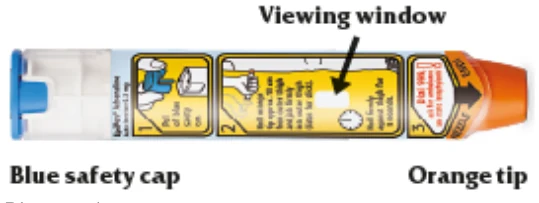
Diagram 1
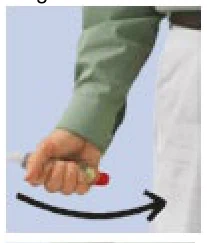
- 1. Grasp EpiPen® in dominant hand (the hand you use to write), with thumb nearest blue cap and form fist around unit (orange tip down)
- 2. With other hand pull off blue safety cap.
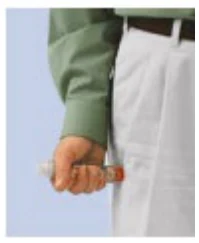
- 3. Hold the EpiPen® at a distance of approximately 10 cm away from the outer thigh. The orange tip should point towards the outer thigh.
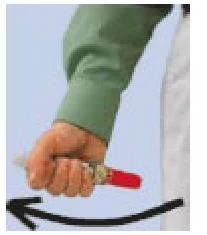
- 4. Jab the EpiPen® firmly into outer thigh at a right angle (90 degree angle) (listen for click).
- 5. Hold firmly against thigh for 3 seconds. The injection is now complete and the window on the autoinjector is obscured.
- 6. EpiPen® should be removed (the orange needle cover will extend to cover needle) and safely discarded.
- 7.
Dial 999, ask for ambulance, and state anaphylaxis.
What to do in an emergency:
Use your adrenaline auto-injector immediately if you have any signs of anaphylaxis.
If in doubt use. Don’t delay.
- Dial 999 – say anaphylaxis (“ana-fill-axis”) – straight after using your auto-injector.
- Lie down and raise your legs.
- Sit up if you are struggling to breathe but don’t change position suddenly.
- Lie down again as soon as you can.
- Stay lying down even if you are feeling better.
- You must not stand up even if someone encourages you to.
- Use your second auto-injector if you haven’t improved after 5 minutes.
Be prepared:
- Carry two adrenaline auto-injectors with you at all times.
- You must use your auto-injector as soon as you notice any signs of anaphylaxis.
- Make sure you know beforehand what the signs are so you can act swiftly.
- Make sure you know how to use your auto-injector before you need to. Get familiar with it. Get a trainer auto-injector from the manufacturer. Practise. If you change brand, get familiar with the new one. Each one is used differently.
A small air bubble may be present in the EpiPen®.
It does not affect the way the product works.
Even though most of the liquid (about 90 %) remains in the EpiPen® after use, it cannot be reused. EpiPen® is for single use only. The correct dose has been administered if the orange needle tip is extended and the window is obscured.
Always seek medical help immediately after using EpiPen®. Dial 999- say anaphylaxis (“ana-fill-axis”) and ask for an ambulance, even if symptoms are improving.
You will need to go to the hospital for observation and further treatment as required. This is because the reaction may happen again at some time later.
While waiting for the ambulance, ask someone to stay with you until the ambulance arrives in case you feel unwell again. Unconscious patients should be placed on their side in the recovery position.
Make sure that you inform the healthcare professional that you have received an intramuscular injection of adrenaline and hand over the EpiPen® to them for safe disposal.
If you use more EpiPen® than you should
In case of overdose or accidental injection of the adrenaline, you should always seek immediate medical help. Your blood pressure may rise sharply and it will need to be monitored.
If you have any further questions on the use of this medicine; ask your doctor, pharmacist or nurse.
4. POSSIBLE SIDE EFFECTS
Like all medicines this medicine can cause side effects, although not everybody gets them.
Seek urgent medical advice immediately in case of accidental injection. Accidental injection of EpiPen® in hands or fingers have been reported and may result in lack of blood supply to these areas.
Adverse reactions experienced as a result of accidental injections may include increased heart rate, local reactions including injection site paleness, coldness and numbness or injury at the injection site resulting in bruising, bleeding, discoloration, redness or skeletal injury.
Tell your doctor or pharmacist if any of the following
side effects occur or worsen.
Rare (may affect up to 1 in 1,000 people)
Cardiomyopathy has been seen in patients treated with adrenaline.
Not known (frequency cannot be estimated from the available data):
Usual side effects include: irregular heartbeat, palpitations, severe rapid heartbeats, severe chest pains, high blood pressure, reduced blood flow to limbs, sweating, nausea, vomiting, difficulty breathing, paleness, headache, dizziness, weakness, tremor and apprehension, nervousness or anxiety, injection site infection, injection site bruising, bleeding, discoloration, redness of the skin and skeletal injury.
Reporting of side effects
If you get any side effects, talk to your doctor, pharmacist or nurse. This includes any possible side effects not listed in this leaflet. You can also report side effects directly via the Yellow Card Scheme at www.mhra.gov.uk/yellowcard or search for MHRA Yellow Card in the Google Play or Apple App Store. By reporting side effects you can help provide more information on the safety of this medicine.
5. HOW TO STORE EPIPEN
Keep this medicine out of the sight and reach of children.
Do not use this medicine after the expiry date which is stated on the carton and label. The expiry date refers to the last day of that month.
Do not store above 25 °C. Do not refrigerate or freeze.
Keep container in the outer carton in order to protect from light. When exposed to air or light, adrenaline deteriorates rapidly and will become pink or brown.
Please remember to check the contents of the glass cartridge in the EpiPen® Auto-injector from time to time to make sure the liquid is still clear and colourless. Do not use this medicine if you notice that the liquid is unclear, coloured or contains solid particles. Replace the EpiPen® Auto-injector by the expiry date or earlier if the solution is discoloured or contains a precipitate (solid particles).
Do not throw away any medicines via wastewater or household waste. Ask your pharmacist how to throw away medicines you no longer use. These measures will help protect the environment.
6. CONTENTS OF THE PACK AND OTHER INFORMATION
What EpiPen® contains
The active substance is adrenaline 0.3 mg (300 microgram).
The other ingredients are Sodium Chloride, Sodium Metabisulphite (E223), Hydrochloric Acid and Water for Injections.
What EpiPen® looks like and contents of the pack
Clear and colourless solution in a pre-filled pen (Auto-injector).
The Auto-injector (single-dose) contains 2 ml solution for injection. Each auto-injector delivers one single dose (0.3 ml) of adrenaline.
Manufactured by Ferring GmbH, Wittland 11, Kiel, D-24109, Germany. Procured from within the EU and repackaged in the UK by the Parallel Import Product Licence holder: CD Pharma Ltd, 4 Cairn Court, East Kilbride, G74 4NB.
EpiPen® Adrenaline Auto-Injector 0.3mg solution for injection
PL: 20492/0742
POM
EpiPen is a registered trademark.
Date of preparation: 24th February 2026
Blind or partially sighted? Is this leaflet hard to see or read? Call 01355 204 448 to obtain a leaflet in a format suitable for you.