

Patient leaflet - Eligard 45 mg powder and solvent for solution for injection
1. WHAT ELIGARD IS AND WHAT IT IS USED FOR
The active substance of ELIGARD is leuprorelin acetate. It belongs to the group of so-called gonadotropin releasing hormones. These medicines are used to decrease the production of certain sex hormones (testosterone).
ELIGARD is used to treat hormone dependent metastatic prostate cancer in adult men and for the treatment of high-risk non-metastatic hormone dependent prostate cancer in combination with radiotherapy.
2. WHAT YOU NEED TO KNOW BEFORE YOU USE ELIGARD
Do not use ELIGARD
- If you are a woman or a child
If you are hypersensitive (allergic) to the active substance leuprorelin acetate, products with an activity
comparable to the naturally occurring hormone gonadotropin, or to any of the other ingredients of ELIGARD (listed in section 6).
Following surgical removal of your testes, as in that case ELIGARD does not lead to a further decrease in
serum testosterone levels.
As the only treatment if you suffer from symptoms related to pressure on the spinal cord or tumour in the spinal
column. In this case, ELIGARD may only be used in combination with other medicinal products for prostate cancer.
Warnings and precautions
Talk to your doctor, pharmacist or nurse before using ELIGARD
If you have any of the following: any heart or blood vessel conditions, including heart rhythm problems
(arrhythmia), or are being treated with medicines for these conditions. The risk of heart rhythm problems may be increased when using ELIGARD.
- If you have difficulties urinating. You should be monitored closely during the first weeks of treatment.
If pressure on the spinal cord or difficulties with urinating develops. In connection with other drugs having
a similar mechanism of action like ELIGARD, it has been reported that severe cases of pressure effects on the spinal cord and narrowing of the tubes between the kidneys and the urinary bladder may contribute to paralysis like symptoms. If these complications develop, standard therapy should be started.
If you experience sudden headache, vomiting, altered mental status and sometimes heart collapse, within
two weeks of taking ELIGARD, then alert the doctor or medical staff. These are rare cases termed as pituitary apoplexy, which have been reported IN OTHER DRUGS which have a mechanism similar to ELIGARD.
If you suffer from diabetes mellitus (elevated blood sugar levels). You should be regularly monitored during
treatment.
- Treatment with ELIGARD can increase the risk for fractures due to osteoporosis (decrease in bone density).
There have been reports of depression in patients taking ELIGARD. If you are taking ELIGARD and develop
depressed mood, inform your doctor.
There have been reports of cardiovascular events in patients taking products similar to ELIGARD of which it
is unknown if it is related to these products. If you are taking ELIGARD and develop cardiovascular signs or symptoms, inform your doctor.
There have been reports of seizures in patients after administration of ELIGARD. If you are taking ELIGARD and
develop seizures, inform your doctor.
If you suffer from a bad or recurrent headache, problems with your eyesight and ringing or buzzing in the ears
contact your doctor immediately.
- If you have fatty liver (a condition where excess fat builds up in the liver).
Severe skin rashes including Stevens-Johnson syndrome, Toxic Epidermal Necrolysis (SJS/TEN) have been reported in association with leuprorelin. Stop using leuprorelin and seek medical attention immediately if you notice any of the symptoms related to these serious skin reactions described in section 4.
Initial treatment complications
During the first week of treatment, there is generally a brief increase in the male sex hormone testosterone in the blood. This can lead to a temporary worsening in the disease-related symptoms and also to the occurrence of new symptoms that have not been experienced up to this point. These especially include bone pain, urination disturbances, pressure on the spinal cord, or the secretion of blood in the urine. These symptoms usually subside on continuation of treatment. If the symptoms do not subside, you should contact your doctor.
If ELIGARD does not help
A proportion of the patients will have tumours, which are not sensitive to decreased serum testosterone levels. Please talk to you doctor if you have the impression that the effect of ELIGARD is too weak.
Other medicines and ELIGARD
ELIGARD might interfere with some medicines used to treat heart rhythm problems (e.g. quinidine, procainamide, amiodarone and sotalol) or might increase the risk of heart rhythm problems when used with some other drugs (e.g. methadone (used for pain relief and part of drug addiction detoxification), moxifloxacin (an antibiotic), antipsychotics used for serious mental illnesses).
Tell your doctor, pharmacist or nurse if you are taking or have recently taken any other medicines, including medicines obtained without a prescription.
Pregnancy and breast-feeding
ELIGARD is not intended for women.
Driving and using machines
Fatigue, dizziness and visual disturbances are possible side effects of the treatment with ELIGARD or might be a result from the disease. If you suffer from these side effects, take care when driving or operating machines.
3. HOW TO USE ELIGARD
Dose
Always use this medicine exactly as your doctor, pharmacist or nurse has told you. Check with your doctor, pharmacist or nurse if you are not sure.
If not otherwise prescribed by your doctor, ELIGARD is administered once every six months.
The injected solution forms an active substance depot from which a continuous release of the active substance leuprorelin acetate takes place over a period of six months.
Additional tests
Method of administration
ELIGARD should only be administered by your doctor or a nurse who will also take care of the preparation of the product.
After preparation, ELIGARD is administered as a subcutaneous injection (injection into the tissue below the skin). Intra-arterial (into an artery) or intravenous (into a vein) injection has to be strictly avoided. As with other active substances that are injected subcutaneously, the site of injection should be varied periodically.
If you receive more ELIGARD than you should
Since the injection is generally administered by your doctor or appropriately trained staff, over dosage is not to be expected.
If a larger amount than intended is nevertheless administered, your doctor will monitor you specifically and give you additional treatment as required.
If the administration of ELIGARD is forgotten
Please talk to you doctor if you believe that your six monthly administration of ELIGARD was forgotten.
Effects when the treatment with ELIGARD is stopped
As a general rule, the therapy of prostate cancer with ELIGARD requires long-term treatment. Therefore, therapy should not be terminated, even if there is an improvement in the symptoms or if they disappear completely.
Marketing Authorisation Holder and Manufacturer
Recordati Industria Chimica e Farmaceutica S.p.A. Via Matteo Civitali, 1
20148 – Milan
Italy
This leaflet was last revised in 05/2025
0000 X Rev. 0 00/00 00000000
0000 X
ELIGARD
LEAFLET
45
United Kingdom
539,75x596,9mm
LFT_001 FD
2025-00750.1 05.06.25/11:02
The following information is intended for healthcare professionals only:
Allow Eligard to come to room temperature by removing from the refrigerator not less than 30 minutes prior to use. Eligard can remain out of the fridge for up to 4 weeks at temperatures below 25 degrees. Please prepare the patient for injection first, followed by the preparation of the product, using the instructions below. If the product is not prepared using the proper technique, it should not be administered as lack of clinical efficacy may occur due to incorrect reconstitution of the product.
Step 1
On a clean field, open the tray by tearing off the foil from the corners to remove the contents. Discard the desiccant pouch. Remove the pre-connected syringe system (Figure 1.1) from the tray. Open the safety needle package, available under the tray (Figure 1.2) by peeling back the paper tab. The enclosed safety needle must be used only. Note: Syringe A and Syringe B should not be lined-up yet.
Figure 1.1
Tray Contents: pre-connected syringe system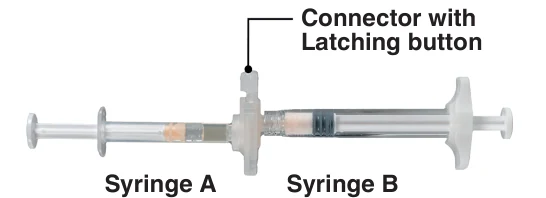
Connector with Latching button
Syringe A Syringe B
Figure 1.2
Under the Tray: safety needle and cap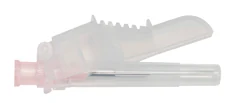
Safety needle and cap
Step 2
Press the latching button on the connector with your finger and thumb (Figure 2) until you hear a snapping sound (“Click”). The two syringes will now be lined up. No particular orientation of the syringe system is required to activate the connector. Do not bend the syringe system (please note that this may cause leakage as you may partially unscrew the syringes).
Figure 2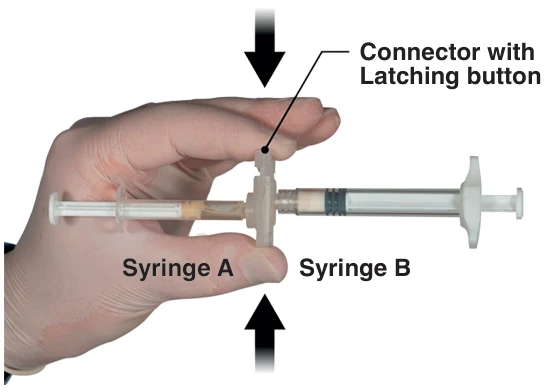
Connector with Latching button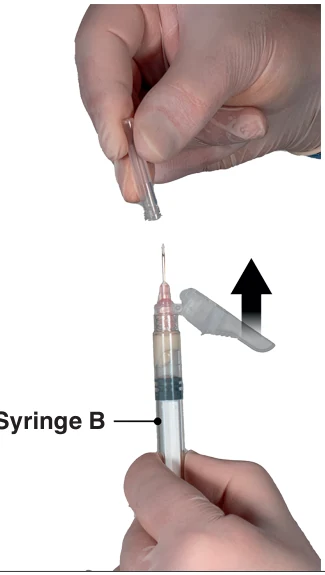
Syringe A Syringe B
Step 3
Hold the syringes horizontally, gently push the liquid contents of Syringe A into the leuprorelin acetate powder contained in Syringe B. Thoroughly mix the contents by gently pushing the plungers back and forth between the syringes for 60 cycles until a homogenous, viscous solution is obtained (a cycle is one push of the plunger for Syringe A and one push of the plunger for Syringe B) (Figure 3). Do not push both plungers at the same time as it may cause leakage. Do not bend the syringe system (please note that this may cause leakage as you may partially unscrew the syringes).
Figure 3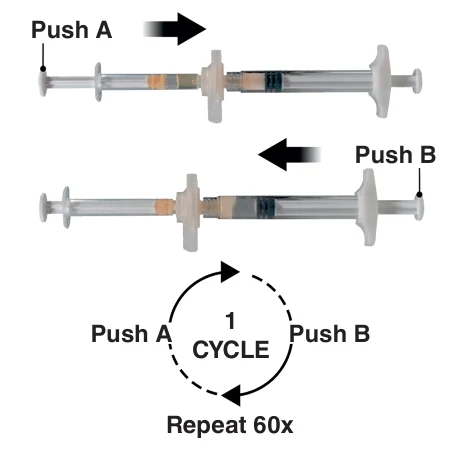
Push A
Push B
Push B
Push A 1
CYCLE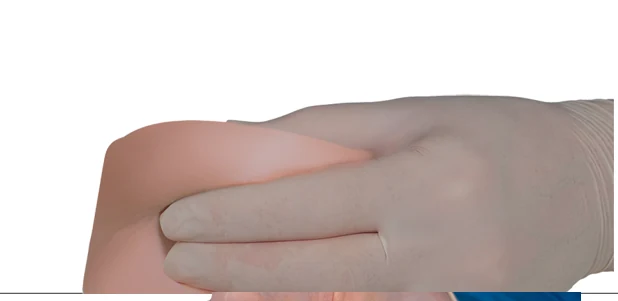
Repeat 60x
When thoroughly mixed, the viscous solution will appear with a colour in the range of colourless to shades of white or pale yellow.
Important: After mixing proceed with the next step immediately as the product gets more viscous over time. Do not refrigerate the mixed product.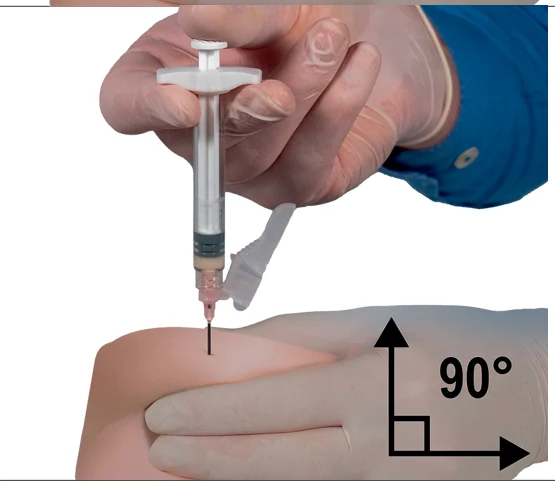
Please note: Product must be mixed as described; shaking WILL NOT provide adequate mixing of the product.
Step 4
After mixing, hold the syringes vertically with Syringe B on the bottom. The syringes should remain securely coupled. Draw the entire mixed product into Syringe B (wide syringe) by pushing down the Syringe A plunger and slightly withdrawing the Syringe B plunger (Figure 4).
Figure 4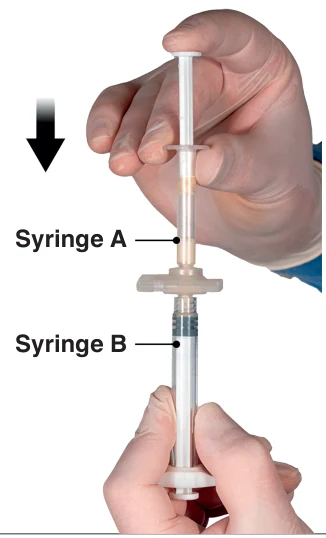
Syringe A
Syringe B
Step 5
While ensuring Syringe A plunger is fully pushed down, hold the connector and unscrew it from Syringe B. Syringe A will remain attached to the connector (Figure 5). Ensure that no product leaks out as the needle will then not secure properly when attached.
Please note: one large or a few small air bubbles may remain in the formulation - this is acceptable. Please do not purge the air bubbles from Syringe B as product may be lost!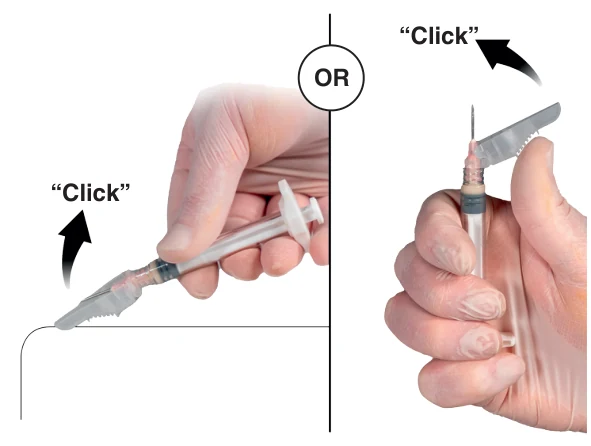
Figure 5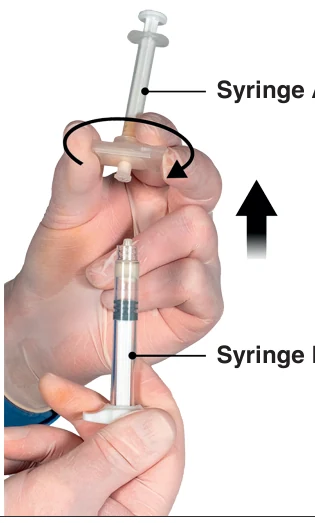
Syringe A
Syringe B
Step 6
- Hold Syringe B upright and hold back the white plunger to prevent loss of the product.
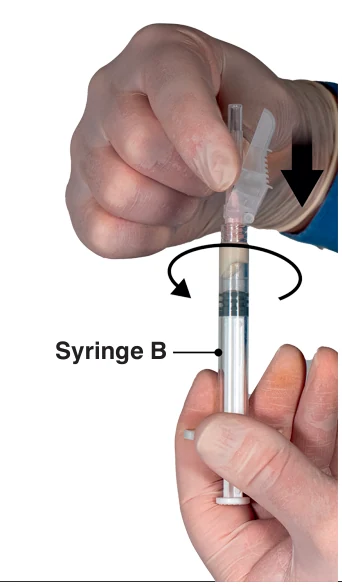
- Secure the safety needle to Syringe B by holding the syringe and gently turning the needle clockwise with approximately a three-quarter turn until the needle is secure (Figure 6).
Do not over tighten as this may cause cracking of the needle hub resulting in leakage of the product during injection. The safety shield may also be damaged if the needle is screwed with too much force.
Should the needle hub crack, appear to be damaged, or have any leakage, the product should not be used. The damaged needle should not be substituted/replaced and the product should not be injected. The entire product should be disposed of securely.
In the event of damage to the needle hub, use another ELIGARD kit.
Figure 6
Syringe B
Step 7
Move the safety shield away from the needle and pull off the protective needle cover immediately prior to administration (Figure 7).
Important: Do not operate the safety needle mechanism before administration. Should the needle hub appear to be damaged, or leak, the product should NOT be used. The damaged needle should NOT be replaced and the product should NOT be injected. In the event of damage to the needle hub, use another ELIGARD kit.
Figure 7
Syringe B
Step 8
It is not necessary to purge the air bubbles as it poses no risks for the subcutaneous injection. Purging air bubbles might cause product loss. Inject the product subcutaneously whilst keeping the safety shield away from the needle.
Administration Procedure:
- Select an injection site on the abdomen, upper buttocks, or another location with adequate amounts of subcutaneous tissue that does not have excessive pigment, nodules, lesions, or hair and has not recently been used.
Cleanse the injection-site area with an alcohol swab (not enclosed).
Pinch the skin around the injection site with your thumb and forefinger.
Figure 8
- Quickly insert the needle at a 90° angle into the skin. Release the skin.
- Inject the entire contents of Syringe B using a slow, steady push. Ensure that the full amount of the product in Syringe B is injected before removing the needle.
- Withdraw the needle quickly at the same 90° angle used for insertion while maintaining pressure on the plunger.
Step 9
After injection, lock the safety shield using any of the activation methods listed below.
a. Closure on a flat surface
Press the safety shield, lever side down, onto a flat surface (Figure 9a) to cover the needle and lock the shield. Verify locked position through audible and tactile “click”. Locked position will completely cover needle tip.
b. Closure with your thumb
Placing your thumb on the safety shield (Figure 9b), cover the needle tip and lock the shield. Verify locked position through audible and tactile “click”. Locked position will completely cover needle tip.
Figure 9a
Closure on a flat surface
Figure 9b
Closure with your thumb
“Click”
“Click”
OR
Once safety shield is locked, immediately dispose of the needle and syringe in an approved sharps container.
Latest approved information of the educational materials on this medicine is available by scanning the QR code included in the Package Leaflet and outer carton with a smartphone/device. The same information is also available on the following URL: www.Eligard.eu
0000 X
If the treatment with ELIGARD is stopped prematurely, a deterioration of disease-related symptoms can occur. 
You should not stop the therapy prematurely without previously consulting your doctor.
If you have any further question on the use of this medicine, ask your doctor, pharmacist or nurse.
4. POSSIBLE SIDE EFFECTS
Like all medicines, ELIGARD can cause side effects, although not everybody gets them.
Side effects that have been observed during treatment with ELIGARD are mainly attributable to the specific effect of the active substance leuprorelin acetate, namely the increase and decrease of certain hormones. The most commonly described side effects are hot flashes (approximately 58 % of patients), nausea, malaise and fatigue, as well as temporary local irritations at the site of injection.
Initial side effects
During the first weeks of treatment with ELIGARD, disease-specific symptoms may worsen, because in the first instance there is generally a brief increase in the male sex hormone testosterone in the blood. Therefore, your doctor may administer an appropriate anti-androgen (substance that inhibits the effect of testosterone) at the initial phase of the treatment in order to reduce possible after-effects (See also Section 2 Before you use ELIGARD, Initial treatment complications).
Local side effects
Local side effects that have been described after the injection of ELIGARD are typically those, which are often associated with similar subcutaneously injected preparations (preparations which are injected into the tissue below the skin). Mild burning immediately after the injection is very common. Stinging and pain after the injection are common, as well as a bruise at the injection site. Redness of the skin at the injection site has been reported commonly. Tissue hardening and ulceration are uncommon.
These local side effects following subcutaneous injection are mild and described as being of brief duration. They do not occur again in between the individual injections.
Very common side effects (may affect more than 1 in 10 people)
- Hot flashes
- Spontaneous bleeding in skin or mucous membrane, redness of the skin
- Fatigue, injection-related side effects (see also local side effects above)
Common side effects (may affect up to 1 in 10 people)
- Nasopharyngitis (symptoms of common cold)
- Alteration in the skin sensation
Nausea, malaise, diarrhoea, inflammation of the stomach and intestines (gastroenteritis/ colitis), dyspepsia
(disturbed digestion, with symptoms as full stomach, pain in the stomach, belching, nausea, vomiting, burning feeling in the stomach)
- Itching, nightly sweating
- Pain in the joints, muscle pain
- Irregular trips to the toilet to pass water (also at night), difficulty in starting to pass water, painful urination, reduced urine output
- Breast tenderness, swelling of the breast, shrinking of testicles, testicular pain, infertility, erectile dysfunction, reduced penis size
- Rigors (episodes of exaggerated shaking with high fevers), weakness
- Prolonged bleeding time, changes in blood values, decreased red blood cells/low red blood cell count
Uncommon side effects (may affect up to 1 in 100 people)
- Urinary tract infection, local skin infection
- Worsening of diabetes mellitus
- Abnormal dreams, depression, decreased libido
- Dizziness, headache, insomnia, taste disturbance, smell disturbance
- Hypertension (increased blood pressure), hypotension (decreased blood pressure)
- Rhinorrhea, shortness of breath
- Constipation, dry mouth, vomiting
- Clamminess, increased sweating
- Back pain, muscle cramps
- Haematuria (blood in the urine)
- Bladder spasm, more trips to the toilet to pass water than usual, unable to pass water
- Enlargement of male breast tissue, impotence
- Lethargy (sleepiness), pain, fever
- Increased weight
- Loss of balance, light-headedness
- Muscle wasting/loss of muscle tissue after prolonged use
Rare side effects (may affect up to 1 in 1,000 people)
- Abnormal involuntary movements
- Sudden loss of consciousness, fainting
- Flatulence, belching
- Hair loss, skin eruption (pimples on the skin)
- Breast pain
- Injection site ulceration
Very rare side effects (may affect up to 1 in 10,000 people)
- Injection site necrosis
Not known (frequency cannot be estimated from the available data)
- Changes in ECG (QT prolongation)
- Inflammation of lungs, lung disease
- Idiopathic intracranial hypertension (increased intracranial pressure around the brain characterised by headache, double vision and other visual symptoms and ringing or buzzing in one or both ears)
- Reddish non-elevated, target-like or circular patches on the trunk, often with central blisters, skin peeling, ulcers of mouth, throat, nose, genitals and eyes. These serious skin rashes can be preceded by fever and flu- like symptoms (Stevens-Johnson syndrome/Toxic Epidermal Necrolysis).
- Skin redness and itchy rash (Toxic skin eruption): a skin reaction that causes red spots or patches on the skin, that may look like a target or “bulls-eye” with a dark red centre surrounded by paler red rings (Erythema Multiforme).
Other side effects
Other side effects that have been described in the literature in relation with treatment with leuprorelin, the active substance of ELIGARD, are oedema (accumulation of fluid in tissue, appearing as swelling of the hands and feet), pulmonary embolism (resulting in symptoms like breathlessness, difficulty in breathing and chest pain), palpitations (awareness of your heartbeat), muscle weakness, chills, rash, impaired memory and impaired vision. Increasing signs of a decrease in bone tissue (osteoporosis) may be expected after long-term treatment with ELIGARD. Due to osteoporosis, the risk for fractures increases.
Serious allergic reactions, which cause difficulty in breathing or dizziness, have been reported rarely after administration of products in the same class as ELIGARD.
Seizures have been reported after administration of products in the same class as ELIGARD.
Reporting of side effects
If you get any side effects, talk to your doctor, pharmacist or nurse. This includes any possible side effects not listed in this leaflet. You can also report side effects directly via the Yellow Card Scheme at: www.mhra.gov.uk/yellowcard or search for MHRA Yellow Card in the Google Play or Apple App Store. By reporting side effects you can help provide more information on the safety of this medicine.
5. HOW TO STORE ELIGARD
Keep this medicine out of the sight and reach of children.
Do not use this medicine after the expiry date which is stated on the carton after EXP. The expiry date refers to the last day of that month.
Storage instructions
Store in a refrigerator (2°C - 8°C).
Store in the original package in order to protect from moisture.
Eligard must be at room temperature prior to injection. Remove from the refrigerator not less than 30 minutes before use to ensure the product has sufficient time to reach room temperature. This is important for easier reconstitution. Once outside the refrigerator Eligard may be stored in its original packaging at room temperature (below 25°C) for up to four weeks.
Once the tray has been opened, the product must be prepared straight away and the product must be used immediately. For single use only.
Instructions on disposal of unused or expired ELIGARD packs
Do not throw away any medicines via wastewater or household waste. Ask your pharmacist how to throw away medicines you no longer use. These measures will help to protect the environment.
6. CONTENTS OF THE PACK AND OTHER INFORMATION
What ELIGARD contains
The active substance is leuprorelin acetate.
One pre-filled syringe (Syringe B) contains 45 mg leuprorelin acetate.
The other ingredients are Poly (DL-lactic-co-glycolic-acid) (85:15) and N-methyl-2-pyrrolidone in the pre-filled syringe with solution for injection (Syringe A).
What ELIGARD looks like and contents of the pack
ELIGARD is a powder and solvent for solution for injection.
ELIGARD 45 mg is available in the following packs:
A thermoformed tray pack and a 18-gauge sterile needle in a cardboard carton.
The tray contains a desiccant pouch and a pre-connected syringe system consisting of:
- syringe A pre-filled with the solvent
- syringe B pre-filled with the powder
- connector with latching button for syringe A and B.
- A bundle pack containing kits of 2 pre-connected syringe system.
Not all pack sizes may be available.