


Patient leaflet - Dzuveo 30 micrograms sublingual tablet
1. What Dzuveo is and what it is used for
The active substance of Dzuveo is sufentanil, which belongs to a group of strong painkillers called opioids. Sufentanil is used to treat sudden moderate-to-severe pain in adults in medically monitored settings such as a hospital.
2. What you need to know before you use Dzuveo
Do not use Dzuveo:
- if you are allergic to sufentanil or any of the other ingredients of this medicine (listed in section 6).
- if you have a serious lung or breathing problem. Warnings and precautions
Talk to your doctor or nurse before using Dzuveo. Tell your doctor or nurse before treatment if you:
- Are suffering from any condition that affects your breathing (such as asthma, wheezing, or shortness of breath). As Dzuveo may affect your breathing, your doctor or nurse will check your breathing during treatment;
- Have a head injury or brain tumour;
- Have problems with your heart and circulation, especially slow heart rate, irregular heartbeat, low blood volume or low blood pressure;
- Have moderate to severe liver problems or severe kidney problems, as these organs have an effect on the way in which your body breaks down and eliminates the medicine; have abnormally slow bowel movements; - Have a disease of the gall bladder or pancreas;
- Or anyone in your family have ever abused or been dependent on alcohol, prescription medicines or illegal drugs (“addiction”);
- Are a smoker;
- Have ever had problems with your mood (depression, anxiety or a personality disorder) or have been treated by a psychiatrist for other mental illnesses.
This medicine contains sufentanil which is an opioid medicine. Repeated use of opioid painkillers may result in the drug being less effective (you become accustomed to it). It may also lead to dependence and abuse which may result in life-threatening overdose. If you have concern that you may become dependent on Dzuveo, it is important that you consult your doctor.
Consult your doctor WHILE using Dzuveo if:
- You experience pain or increased sensitivity to pain (hyperalgesia) which does not respond to a higher dosage of your medicine as prescribed by your doctor. What do you need to know before you take Dzuveo: Sleep-related breathing disorders
- Dzuveo can cause sleep-related breathing disorders such as sleep apnoea (breathing pauses during sleep) and sleep related hypoxemia (low oxygen level in the blood). The symptoms can include breathing pauses during sleep, night awakening due to shortness of breath, difficulties to maintain sleep or excessive drowsiness during the day. If you or another person observe these symptoms, contact your doctor. A dose reduction may be considered by your doctor.
Children and adolescents
Dzuveo should not be used in children and adolescents below 18 years.
Other medicines and Dzuveo
Tell your doctor if you are taking, have recently taken or might take any other medicines. In particular, tell your doctor if you are taking any of the following:
- Ketoconazole, which is used for the treatment of fungal infections this medicine may have an effect on the way in which your body breaks down sufentanil.
- Any medicines which might make you sleepy (have a sedative effect), such as sleeping pills, medicines to treat anxiety (e.g. benzodiazepines), tranquillisers or other opioid medicines, as they can increase the risk of severe breathing problems, coma and may be life-threatening.
- Medicines for the treatment of depression known as Monoamine Oxidase Inhibitors (MAOIs). These medicines must not be taken in the 2 weeks before or at the same time as Dzuveo is given.
- Medicines for the treatment of depression known as Selective Serotonin Reuptake Inhibitors (SSRIs) and Serotonin Norepinephrine Reuptake Inhibitors (SNRIs). It is not recommended to use these medicines at the same time as Dzuveo.
Medicines to treat epilepsy, nerve pain or anxiety (gabapentin and pregabalin), as they can increase the risk of opioid overdose, respiratory depression and may be life-threatening.
- Other medicines which are also taken sublingually (placed under the tongue where they dissolve) or medicines which take effect in your mouth (e.g. nystatin, a liquid or pastilles you hold in your mouth to treat fungus infections), as the effect on Dzuveo has not been studied.
- Regularly prescribed opioid medicine (e.g. morphine, codeine, fentanyl, hydromorphone, oxycodone).
- Medicines used to treat high blood pressure or angina (chest pain) known as calcium channel or beta blockers e.g. diltiazem and nifedipine.
Dzuveo with alcohol
Do not drink alcohol while using Dzuveo. It can increase the risk of experiencing severe breathing problems. Pregnancy and breast-feeding
If you are pregnant or breast-feeding, think you may be pregnant or are planning to have a baby, ask your doctor for advice before taking this medicine.
Dzuveo should not be used during pregnancy or in women of childbearing potential not using effective contraception.
Dzuveo passes into breast milk and can cause side effects in the breast-fed child. Breastfeeding is not recommended while you are taking Dzuveo.
Driving and using machines
Dzuveo affects your ability to drive or use machines as it may cause sleepiness, dizziness or visual disturbances. You should not drive or operate machinery if you experience any of these symptoms whilst or after being treated with sufentanil. You should only drive and use machines if sufficient time has elapsed after your last dose of Dzuveo.
Driving in the UK:
The medicine can affect your ability to drive as it may make you sleepy or dizzy.
- Do not drive while taking this medicine until you know how it affects you.
- It is an offence to drive if this medicine affects your ability to drive.
However, you would not be committing an offence if:
- The medicine has been prescribed to treat a medical or dental problem and
- You have taken it according to the instructions given by the prescriber or in the information provided with the medicine and
- It was not affecting your ability to drive safely Talk to your doctor or pharmacist if you are not sure whether it is safe for you to drive while taking this medicine.
Dzuveo contains sodium
This medicinal product contains less than 1 mmol sodium (23 mg) per tablet, that is to say essentially ‘sodium-free’.
3. How to use Dzuveo
This medicine must be given to you by a doctor or a nurse using the single-dose administration device. You will not give yourself this medicine.
Dzuveo is only used in a medically monitored setting, such as a hospital. It is only prescribed by a doctor who is experienced in the use of strong painkillers like sufentanil and knows the effects it may have on you, in particular on your breathing (see ‘Warnings and precautions’ above). The recommended dose is a maximum of one 30 microgram sublingual tablet per hour. The sublingual tablet will be given to you by a healthcare professional using the disposable single-dose applicator.
The applicator will help your healthcare provider place one tablet under your tongue. The tablets dissolve under your tongue and should not be chewed, or swallowed because the tablet is not effective for pain relief unless it is allowed to dissolve under your tongue. You should not eat or drink and should talk as little as possible for 10 minutes after each dose.
After receiving a dose you will not be given another dose for at least one hour. The maximum daily dose is 720 micrograms (24 tablets per day).
Dzuveo should not be used beyond 48 hours. After your treatment the medical staff will dispose of the applicator accordingly.
If you use more Dzuveo than you should
The symptoms of overdose include severe breathing problems like slow and shallow breathing, loss of consciousness, extremely low blood pressure, collapse and muscle rigidity. If these start to develop, tell a doctor or nurse immediately.
If you have any further questions on the use of this medicine, ask your doctor or nurse.
4. Possible side effects
Like all medicines, this medicine can cause side effects, although not everybody gets them.
Serious side effects
The most serious side effects are severe breathing problems, like slow and shallow breathing, which may even lead to you stopping breathing.
If you experience any of the above mentioned side effects, tell your doctor or nurse immediately.
Very common side effects (may affect more than 1 in 10 people):
Nausea or feeling sick, vomiting or being sick and generally feeling hot.
Common side effects (may affect up to 1 in 10 people):
- Inability or difficulty sleeping, feeling anxious or confused, dizziness.
- Headache, drowsiness, feeling sleepy.
- Increased heart rate, high blood pressure, low blood pressure.
- Low levels of oxygen in your blood, feeling pain in the lower throat, slow shallow breathing.
- Dry mouth, flatulence (passing wind), constipation, indigestion or reflux.
- Allergic reactions, itching of the skin.
- Muscle twitching and spasms.
- Inability to pass urine.
This medicine may also cause changes in levels of red blood cells, white blood cells, calcium, albumin, potassium and sodium in your blood which can only be identified through a blood test. If you are having a blood test ensure your doctor knows you are taking this medicine. Uncommon side effects (may affect up to 1 in 100 people):
- Inflammation of the lungs, eye redness and inflammation, inflammation of the throat.
- Fatty lumps underneath skin.
- Inability to manage blood sugar (diabetes), increased cholesterol.
- Feeling agitated, lack of interest or emotion, lack of energy, disorientation, feeling elated, hallucinating or seeing things that are not there, nervousness.
- Problems coordinating muscle movements, muscle contractions, tremors or excessive shaking, exaggeration of reflex responses, burning sensation, feeling faint, abnormal sensation of the skin (tingling, skin crawling), numbness in general, tiredness, forgetfulness, migraine, tension headaches.
- Vision disturbances, eye pain.
- Decreased heart rate, irregular heartbeat, angina or other chest discomfort.
- High blood pressure or low blood pressure when standing up, skin flushing.
- Slow or difficult breathing (including when sleeping), Nose bleeds, hiccups.
- Chest pain and breathing difficulties caused by a blood clot in lung, fluid in the lungs, wheezing.
- Diarrhoea, burping or belching, inflammation of stomach lining or gastritis, bloating, acid reflux, retching, stomach pain or an uncomfortable stomach.
- Developing blisters, excessive sweating, rash, dry skin numbness of mouth or face.
- Pain in the back, chest or other body parts, pain in the extremities.
- Difficulty urinating, strong smelling urine, pain urinating, kidney failure.
- Swelling, uncomfortable sensations in your chest, chills, and weakness (lack of energy).
This medicine may also cause changes in levels of platelets (which help your blood to clot), magnesium, protein, sugar, fats, phosphates and plasma in your blood which can only be identified through a blood test. If you are having a blood test ensure your doctor knows you are taking this medicine.
Frequency not known (frequency cannot be estimated from the available data):
- Severe allergic reactions (anaphylactic shock), convulsions (fits), coma, small pupil size, redness of the skin.
- Withdrawal syndrome which may include symptoms such as agitation, anxiety, muscle aches, insomnia, sweating and yawning.
Reporting of side effects
If you get any side effects, talk to your doctor or nurse. This includes any possible side effects not listed in this leaflet. You can also report side effects directly via the national reporting system:
Yellow Card Scheme
Website: www.mhra.gov.uk/yellowcard or search for MHRA Yellow Card in the Google Play or Apple App Store
By reporting side effects, you can help provide more information on the safety of this medicine.
5. How to store Dzuveo
Keep this medicine out of the sight and reach of children. Your doctor or nurse will ensure that:
- this medicine is not used after the expiry date which is stated on the label and carton after EXP.
The expiry date refers to the last day of that month.
- is stored in the original package in order to protect from light and oxygen.
- this medicine is not used if there are signs of deterioration.
Medicines should not be thrown away via wastewater or household waste. Your healthcare provider will dispose of any waste according to hospital policies. These measures will help protect the environment.
6. Contents of the pack and other information
What Dzuveo contains
- The active substance is sufentanil. Each sublingual tablet contains 30 micrograms of sufentanil (as citrate).
- The other ingredient(s) are mannitol (E421), dicalcium phosphate, hypromellose, croscarmellose sodium, Indigo Carmine (E132), stearic acid, and magnesium stearate. What Dzuveo looks like and contents of the pack
Dzuveo is a blue-coloured, flat-faced sublingual tablet with round edges. It measures 3 mm in diameter and is enclosed within a single-dose applicator (labelled [sublingual tablet]).
The applicator, with the tablet inside, is enclosed within a pouch.
Each pouch contains one applicator and one sufentanil 30 micrograms tablet. Each pack contains either 5 or 10 pouches.
Not all pack sizes may be marketed.
Marketing Authorisation Holder
Laboratoire Aguettant
1, rue Alexander Fleming
69007 Lyon
France
Manufacturer
Laboratoire Aguettant
Lieu Dit Chantecaille
07340 Champagne
France
Distributed by
AGUETTANT Ltd.
N°1, Farleigh House
Flax Bourton BRISTOL - BS48 1UR
United Kingdom
This leaflet was last revised in 01/2025.
- 2.
Remove the white Lock from the green Pusher by squeezing the sides together and detaching
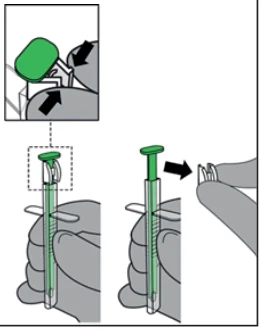
from Pusher. Discard the Lock.
- 5.
Place the SDA tip under the tongue and aim at the floor
of the patient’s mouth.
NOTE: Avoid direct mucosal contact with the SDA tip.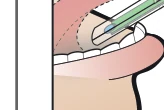
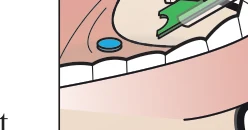
- 6. Depress the green Pusher to deliver the tablet
to the patient’s sublingual space and confirm tablet placement.
- 3.
Tell the patient to touch their tongue to the roof of their mouth if possible.
- 4. Rest the SDA lightly on the patient’s teeth or lips.
The single-dose applicator (SDA) must be discarded in accordance to the institutional policies and local requirements.