Patient leaflet - Dupixent 300 mg solution for injection in Pre-filled syringe
what it is used for
What Dupixent is
Dupixent contains the active
substance dupilumab.
Dupilumab is a monoclonal
antibody (a type of specialised
protein) that blocks the action of proteins called interleukins
(IL)-4 and IL-13. Both play a major role in causing the signs and symptoms of atopic dermatitis, asthma, chronic
rhinosinusitis with nasal polyposis (CRSwNP), prurigo nodularis (PN), eosinophilic esophagitis (EoE), chronic obstructive pulmonary
disease (COPD) and chronic spontaneous urticaria (CSU).
What Dupixent is used for
Dupixent is used to treat adults
and adolescents 12 years and older with moderate-to-severe atopic dermatitis, also known as atopic eczema. Dupixent is also used to treat children 6 months to 11 years old with severe atopic dermatitis. Dupixent may be used with eczema medicines that you apply to the skin or it may be used on its own.
Dupixent is also used with other asthma medicines for the
maintenance treatment of severe asthma in adults, adolescents, and children aged 6 years and older whose asthma is not controlled with
their current asthma medicines (e.g. corticosteroids).
Dupixent is also used with other medicines for the maintenance treatment of CRSwNP in adults whose disease is not controlled with their current CRSwNP medicines. Dupixent can also reduce the need for surgery and the need for systemic
corticosteroid use.
Dupixent is also used to treat adults with moderate-to-severe prurigo nodularis (PN), also known as chronic nodular prurigo (CNPG). Dupixent
may be used with PN medicines that you apply to the skin or it may be used on its own.
Dupixent is also used to treat adults, adolescents and children 1 year and older, weighing at least 15 kg, with
eosinophilic esophagitis (EoE).
Dupixent is also used with other medicines for the maintenance treatment of chronic obstructive pulmonary disease (COPD) in adults with uncontrolled COPD.
Dupixent is also used to treat chronic spontaneous urticaria (CSU) in adults and adolescents aged
12 years and older.
How Dupixent works
Using Dupixent for atopic dermatitis (atopic eczema) can improve the condition of your skin and reduce itching. Dupixent has also been shown to improve symptoms of pain, anxiety, and depression
associated with atopic dermatitis. In addition, Dupixent helps improve your sleep disturbance and overall quality of life.
Dupixent helps prevent severe
asthma attacks exacerbations)
and can improve your breathing.
Dupixent may also help reduce
the amount of another group of
medicines you need to control your asthma, called oral corticosteroids, while preventing severe asthma attacks and improving your breathing.
Dupixent helps prevent moderate or severe COPD attacks (exacerbations) and can improve your breathing. Dupixent may also help to improve overall symptoms of COPD.
2. What you need to know before you use Dupixent
Do not use Dupixent
if you are allergic to dupilumab or any of the
other ingredients of this medicine (listed in section 6).
If you think you may be allergic, or you are not sure, ask your doctor, pharmacist or nurse for
advice before using Dupixent.
Warnings and precautions
Talk to your doctor, pharmacist or nurse before using Dupixent:
Dupixent is not a rescue medicine and should not be used to treat a sudden asthma or COPD attack.
Every time you get a new pack of Dupixent, it is important that you note down the name of the medicine, the date of the administration and the batch number (which is on the packaging after “Lot”) and keep this information in a safe place.
Allergic reactions
- Rarely, Dupixent can cause serious side effects, including allergic (hypersensitivity) reactions and anaphylactic reaction and angioedema. These reactions can occur from minutes until seven days after Dupixent administration. You must look out for signs of these conditions (i.e. breathing problems, swelling of the face, lips, mouth, throat or tongue, fainting, dizziness, feeling lightheaded (low blood pressure), fever, general ill feeling, swollen lymph nodes, hives, itching, joint pain, skin rash) while you are taking Dupixent. Such signs are listed under “Serious side effects” in section 4.
- Stop using Dupixent and tell your doctor or get medical help immediately if you notice any signs of an allergic reaction.
Eosinophilic conditions
- Rarely patients taking an asthma medicine may develop inflammation of blood vessels or lungs due to an increase of certain white blood cells (eosinophilia).
It is not known whether this is caused by Dupixent. This usually, but not always,
happens in people who also take a steroid medicine which is being stopped or for which the dose is being lowered.
- Tell your doctor immediately if you develop a combination of symptoms such as a flu-like illness, pins and needles or numbness of arms or legs, worsening of pulmonary symptoms, and/or rash.
Parasitic (intestinal parasites) infection
- Dupixent may weaken your resistance to infections caused by parasites. If you already have a parasitic infection it should be treated before you start treatment with Dupixent.
- Check with your doctor if you have diarrhoea, gas, upset stomach, greasy stools, and dehydration which could be a sign of a parasitic infection.
- If you live in a region where these infections are common or if you are travelling to such a region check with your doctor.
Asthma
If you have asthma and are taking asthma medicines, do not change or stop your asthma medicine without talking to your doctor. Talk to your doctor before you stop Dupixent or if your asthma remains uncontrolled or worsens during treatment with this medicine.
Eye problems
Talk to your doctor promptly if you have any new or worsening eye problems. These may include watering, itching, redness and swelling, eye dryness, a feeling of gritty eyes or a sensation of a foreign body in the eye. If you experience sudden changes in vision or significant eye pain that does not settle, speak to your doctor straight away.
Children and adolescents
- The safety and benefits of Dupixent are not yet known in children with atopic dermatitis below the age of 6 months.
The safety and benefits of Dupixent are not yet known in children with asthma below the age of
6 years.
- The safety and benefits of Dupixent are not yet known in children with CRSwNP below the age of 18 years.
- The safety and benefits of Dupixent are not known in children with PN below the age of 18 years.
The safety and benefits of Dupixent are not yet known in children with EoE below the age of
1 year, or with a body weight < 15 kg.
- The safety and benefits of Dupixent are not known in children with COPD below the age of 18 years.
- The safety and benefits of Dupixent are not yet known in children with CSU below the age of 12 years
Other medicines and Dupixent
Tell your doctor or pharmacist
if you are using, have recently used or might
use any other medicines.
if you have recently had or are due to have a
vaccination.
Other medicines for asthma
Do not stop or reduce your asthma medicines, unless instructed by your doctor.
These medicines (especially ones called
corticosteroids) must be stopped gradually.
- This must be done under the direct supervision of your doctor and dependent on your response to Dupixent.
Pregnancy and breast-feeding
If you are pregnant, think you may be pregnant, or are planning to have a baby, ask your doctor for advice before using this
medicine. The effects of this medicine in pregnant women are not known; therefore, it is preferable to avoid the use of Dupixent in pregnancy unless your doctor advises to use it.
If you are breast-feeding or are planning to breast-feed, talk to your doctor before using this medicine. You and your doctor should decide if you will breast-feed or use Dupixent.
You should not do both.
Driving and using machines
Dupixent is unlikely to influence your ability to drive and use machines.
Dupixent contains sodium
This medicine contains less than 1 mmol sodium (23 mg) per 300 mg dose, that is to say essentially ’sodium-free’.
Dupixent contains polysorbate
This medicine contains 4 mg of polysorbate 80 in each 300 mg dose (2 mL). Polysorbates may cause allergic reactions. Tell your doctor if you have or your child has any known allergies.
3. How to use Dupixent
Always use this medicine exactly as your doctor or pharmacist has told you. Check with your doctor or pharmacist if you are not sure.
How much Dupixent you will receive
Your doctor will decide which dose of Dupixent is right for you.
Recommended dose in adults with atopic dermatitis
For patients with atopic dermatitis, the recommended dose of Dupixent is:
- An initial dose of 600 mg (two 300 mg injections)
- Followed by 300 mg given every other week by subcutaneous injection.
Recommended dose in adolescents with atopic dermatitis
The recommended dose of Dupixent for adolescents
(12 to 17 years of age) with atopic dermatitis is based on body weight:
Body weight of patient | Initial dose | Subsequent doses (every other week) |
|---|---|---|
less than 60 kg | 400 mg (two 200 mg injections) | 200 mg |
60 kg or more | 600 mg (two 300 mg injections) | 300 mg |
Recommended dose in children 6 to 11 years of age with atopic dermatitis
The recommended dose of Dupixent for children (6 to
11 years of age) with atopic dermatitis is based on body weight:
Body weight of patient | Initial dose | Subsequent doses |
|---|---|---|
15 kg to less than 60 kg | 300 mg (one 300 mg injection) on Day 1, followed by 300 mg on Day 15 | 300 mg every 4 weeks*, starting 4 weeks after Day 15 dose |
| 60 kg or more | 600 mg (two 300 mg injections) | 300 mg every other week |
* The dose may be increased to 200 mg every other week based on the doctor’s opinion.
Recommended dose in children 6 months to 5 years of age with atopic dermatitis
The recommended dose of Dupixent for children 6 months to 5 years of age with atopic dermatitis is based on body weight:
Body weight of patient | Initial dose | Subsequent doses |
|---|---|---|
5 kg to less than 15 kg | 200 mg (one 200 mg injection) | 200 mg every 4 weeks |
15 kg to less than 30 kg | 300 mg (one 300 mg injection) | 300 mg every 4 weeks |
Recommended dose in adult and adolescent patients with asthma (12 years of age and older)
For patients with severe asthma and who are on oral corticosteroids or for patients with severe asthma and co-morbid moderate-to-severe atopic dermatitis or adults with co-morbid severe chronic rhinosinusitis with nasal polyposis, the recommended dose of Dupixent is:
- An initial dose of 600 mg (two 300 mg injections)
Followed by 300 mg given every other week
administered as subcutaneous injection.
For all other patients with severe asthma, the recommended dose of Dupixent is:
- An initial dose of 400 mg (two 200 mg injections)
Followed by 200 mg given every other week
administered as subcutaneous injection.
Recommended dose children with asthma
The recommended dose of Dupixent for children (6 to 11 years of age) with asthma is based on body weight:
Body weight of patient | Initial and subsequent doses |
|---|---|
15 to less than 30 kg | 300 mg every 4 weeks |
30 kg to less than 60 kg | 200 mg every other week or 300 mg every 4 weeks |
| 60 kg or more | 200 mg every other week |
For patients 6 to 11 years old with asthma and coexisting severe atopic dermatitis, your doctor will decide which dose of Dupixent is right for you.
Recommended dose in adults with chronic rhinosinusitis with nasal polyposis (CRSwNP)
In CRSwNP, the recommended first dose of Dupixent is 300 mg followed by 300 mg given every two weeks by subcutaneous injection.
Recommended dose in adults with prurigo nodularis (PN)
For patients with prurigo nodularis, the recommended dose of Dupixent is:
- An initial dose of 600 mg (two 300 mg injections)
- Followed by 300 mg given every other week by subcutaneous injection.
Recommended dose in adults, adolescents and children
(1 year of age and older) with eosinophilic esophagitis (EoE)
| Body Weight | Dose |
|---|---|
| ≥15 to <30 kg | 200 mg every other week |
| ≥30 to <40 kg | 300 mg every other week |
| ≥40 kg | 300 mg every week |
Recommended dose in adults with chronic obstructive pulmonary disease (COPD)
In COPD, the recommended dose of Dupixent is 300 mg given every other week by subcutaneous injection.
Recommended dose in adults with chronic spontaneous urticaria (CSU) The recommended dose of Dupixent for adult patients is an initial dose of 600 mg (two 300 mg injections), followed by 300 mg given every other week.
Recommended dose in adolescents with chronic spontaneous urticaria (CSU)
The recommended dose of Dupixent for adolescents (12 to 17 years of age) with chronic spontaneous urticaria is based on body weight:
Body Eeight | Initial Dose | Subsequent Doses |
|---|---|---|
30 to less than 60 kg | 400 mg (two 200 mg injections) | 200 mg every other week (Q2W) |
60 kg or more | 600 mg (two 300 mg injections) | 300 mg every other week (Q2W) |
Injecting Dupixent
Dupixent is given by injection under your skin (subcutaneous injection). You and your doctor or nurse should decide if you should inject Dupixent yourself.
Before injecting Dupixent yourself you must have been properly trained by your doctor or nurse. Your Dupixent injection may also be given by a caregiver after proper training by a doctor or nurse.
Each pre-filled syringe contains one dose of Dupixent (300 mg). Do not shake the pre-filled syringe. Read carefully the “Instructions for Use” included at the end of the package leaflet before using Dupixent.
If you use more Dupixent than you should
If you use more Dupixent than you should or the dose has been given too early, talk to your doctor, pharmacist or nurse.
If you forget to use Dupixent
If you have forgotten to inject a dose of Dupixent, talk to your doctor, pharmacist or nurse. In addition, If your dose schedule is every week and you miss a dose of Dupixent:
give the Dupixent injection as soon as possible and start a new every week dose schedule from the time you remember to
take your Dupixent injection.
If your dose schedule is every other week and you miss a dose of Dupixent:
- give the Dupixent injection within 7 days from the missed dose, then continue with your original schedule.
- if the missed dose is not given within 7 days, wait until the next scheduled dose to give your Dupixent injection.
If your dose schedule is every
4 weeks and you miss a dose of Dupixent:
- give the Dupixent injection within 7 days from the missed dose, then continue with your original schedule.
- if the missed dose is not given within 7 days, start a new every 4 week dose schedule from the time you remember to take your Dupixent injection.
If you stop using Dupixent
Do not stop using Dupixent without speaking to your doctor first.
If you have any further questions on the use of this medicine, ask your doctor, pharmacist or nurse.
4. Possible side effects
Like all medicines, this medicine can cause side
effects, although not everybody gets them.
Dupixent can cause serious side effects, including rare allergic (hypersensitivity) reactions, including anaphylactic reaction, serum sickness reaction, serum sickness-like reaction; the signs may include:
- breathing problems
- swelling of the face, lips, mouth, throat or tongue (angioedema)
- fainting, dizziness, feeling lightheaded (low blood pressure)
- fever
- general ill feeling
- swollen lymph nodes
- hives
- itching
- joint pain
- skin rash
If you develop an allergic reaction, stop using Dupixent and talk to your doctor right away.
Other side effects
Common (may affect up to
1 in 10 people):
- injection site reactions (e.g. localized redness, swelling, itching, pain, bruising)
- eye redness and itching
- eye infection
- cold sores (on lips and skin)
an increase in a certain kind of white blood cell (eosinophils)
- joint pain (arthralgia)
Uncommon (may affect up to 1 in 100 people):
- swelling of the face, lips, mouth, throat or tongue (angioedema)
- eyelid itching, redness and swelling*
- inflammation of the eye surface, sometimes with blurred vision (keratitis)
- facial rash or redness
- eye dryness*
*These eye side effects were common (up to 1 in 10 people) in patients with atopic dermatitis
Rare (may affect up to 1 in 1000 people):
- serious allergic (hypersensitivity) reactions
ulcers on the outer clear layer of the eye,
sometimes with blurred vision (ulcerative keratitis)*
*The side effect of ulcerative keratitis was uncommon (up to 1 in 100 people) in patients with atopic dermatitis
Additional side effects in children 6 to 11 years old with asthma
Common: pinworms (enterobiasis)
Reporting of side effects
If you get any side effects, talk to your doctor, pharmacist or nurse. This includes any possible side effects not listed in this leaflet. You can also report side effects directly via the Yellow Card Scheme at: www.mhra.gov.uk/yellowcard or search for MHRA in the Google Play or Apple App Store. By reporting side effects you can help provide more information on the safety of this medicine.
5. How to store Dupixent
Keep this medicine out of the sight and reach of children.
Do not use this medicine after the expiry date which is stated on the label and carton after EXP. The expiry date refers to the last day of that month.
Store in a refrigerator
(2 °C to 8 °C). Do not freeze. Store in the original carton to protect from light. If necessary, the pre-filled syringe can be removed from the refrigerator and kept in the pack for up to 14 days at room temperature up to 25 °C, while protected from light. The date of removal from the refrigerator shall be recorded in the space provided on the outer carton. The pack must be discarded if left out of the refrigerator for more than 14 days or if the expiry date has passed.
Do not use this medicine if you notice that the medicine is cloudy, discoloured, or has particles in it. Do not throw away any medicines via wastewater or household waste. Ask your doctor, pharmacist or nurse how to throw away medicines you no longer use. These measures will help protect the environment.
6. Contents of the pack and other information
What Dupixent contains
- The active substance is dupilumab.
- Each pre-filled syringe contains 300 mg of dupilumab in 2 mL solution for injection (injection).
The other ingredients are
L-Arginine monohydrochloride,
L-Histidine, L-Histidine monohydrochloride monohydrate, Polysorbate 80 (E 433), Sodium acetate trihydrate, Acetic acid glacial (E 260), Sucrose, Water for injections.
What Dupixent looks like and contents of the pack
Dupixent is a clear to slightly opalescent, colourless to pale yellow solution supplied in a glass pre-filled syringe with needle shield.
Dupixent is available as 300 mg prefilled syringes in a pack containing 2 pre-filled syringes.
Manufacturers
SANOFI WINTHROP, INDUSTRIE 1051 Boulevard Industriel, 76580 LE TRAIT, FRANCE or
Sanofi-Aventis Deutschland GmbH, Brüningstrasse 50 Industriepark Hoechst, 65926 FRANKFURT AM MAIN, GERMANY.
Product procured from within the EU and repackaged by PCO Manufacturing Ltd., Unit 10, Ashbourne Business Park, Rath, Ashbourne, Co. Meath, Ireland. Product Licence Holder: Ecosse harmaceuticals Limited, 3 Young Place, East Kilbride, G75 0TD
This leaflet does not contain all the information about your medicine. If you have any questions or are not sure about anything, ask your doctor or pharmacist.
Dupixent is a registered trademark of SANOFI BIOTECHNOLOGY.
PL 19065/0943
This leaflet was last revised in 21.10.2025
If you are blind or partially sighted and require this leaflet in a different format, call
01355 574450 and ask for the Regulatory Department
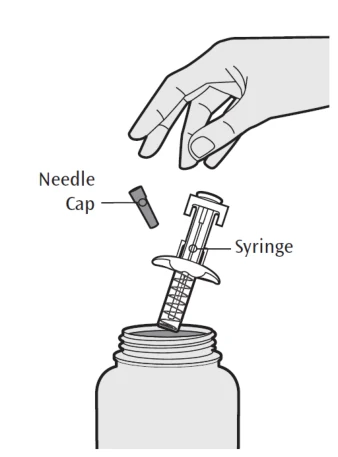
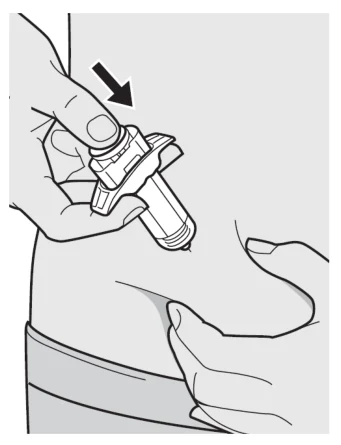
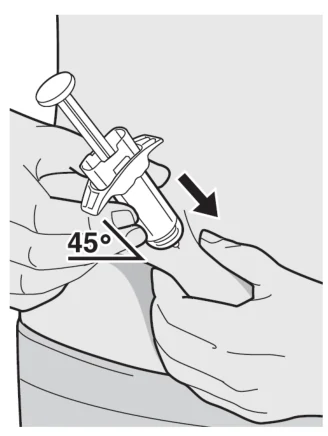
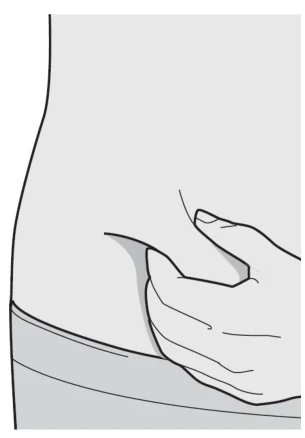
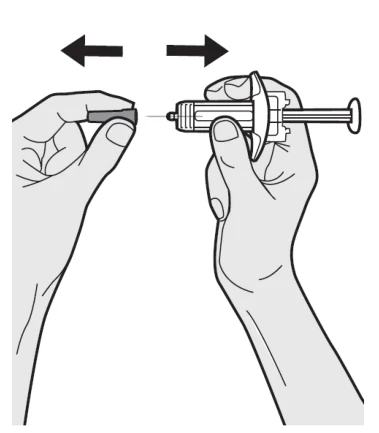
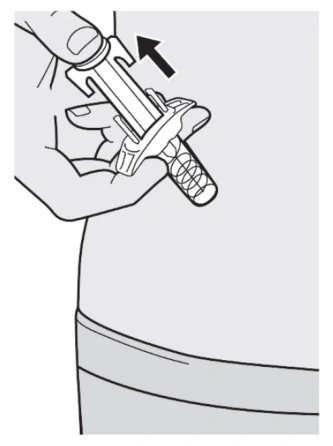
Step 7: Pull Hold the syringe in the middle of the syringe body with the needle pointing away from you and pull off the needle cap. Do not put the needle cap back on. Do not touch the needle. Inject your medicine immediately after removing the needle cap. | Step 8: Pinch Pinch a fold of skin at the injection site, as shown in the picture. | Step 9: Insert Insert the Needle completely into the fold of skin at roughly a 45º angle. | Step 10: Push Relax the pinch. Push the plunger rod down slowly and steadily as far as it will go until the syringe is empty. Note: You will feel some resistance. This is normal. | Step 11: Release and Remove Lift your thumb to release the plunger rod until the needle is covered by the needle shield and then remove the syringe from the injection site. Lightly press a cotton ball or gauze on the injection site if you see any blood. Do not put the needle cap back on. Do not rub your skin after the injection. | Step 12: Dispose Dispose of the syringe and the needle cap in a puncture-resistant container. Do not put the needle cap back on. Always keep the container out of the reach of children. |
|---|
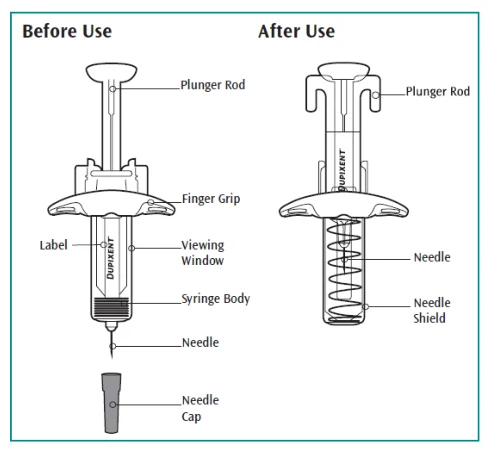
Instructions for use Dupixent® 300 mg solution for injection in a pre-filled syringe with needle shield dupilumab | The parts of the Dupixent pre-filled syringe with needle shield are shown in this picture. | Important information This device is a single-use prefilled syringe. It contains 300 mg of Dupixent for injection under the skin (subcutaneous injection). You must not try to give yourself or someone else the injection unless you have received training from your healthcare professional. In adolescents 12 years and older, it is recommended that Dupixent is administered by or under supervision of an adult. In children less than 12 years of age, Dupixent should be given by a caregiver.
|
| How to Store Dupixent
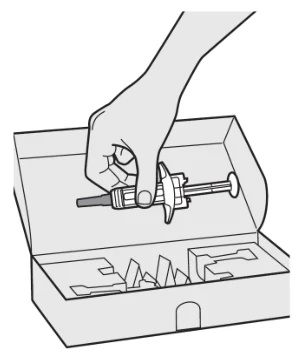
| Step 1: Remove Remove the syringe from the carton by holding the middle of the syringe body. Do not pull off the needle cap until you are ready to inject. Do not use the syringe if it has been dropped on a hard surface or damaged. | Step 2: Prepare Ensure you have the following:
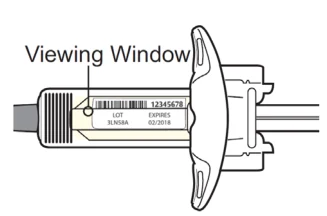
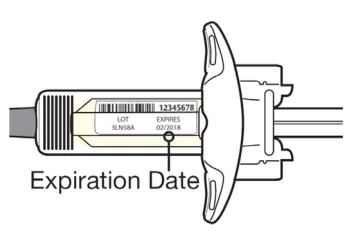
*Items not included in the carton Look at the label:
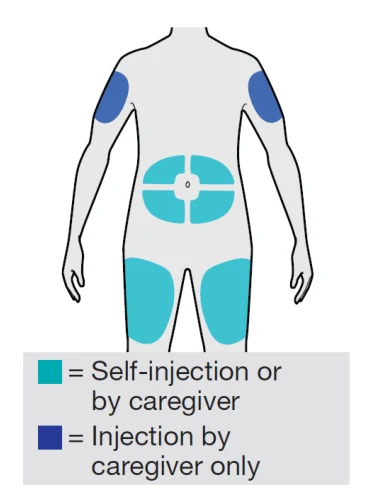
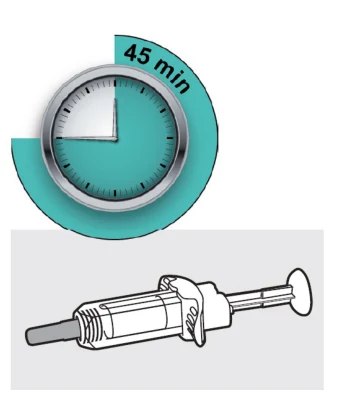
| Step 3: Inspect Look at the medicine through the viewing window on the syringe: Check if the liquid is clear and colourless to pale yellow. Note: You may see an air bubble; this is normal. Do not use the syringe if the liquid is discoloured or cloudy, or if it contains flakes or particles. | Step 4: Wait 45 minutes Lay the syringe on a flat surface for at least 45 minutes and let it get to room temperature naturally. Do not warm the syringe in a microwave, hot water, or direct sunlight. Do not place the syringe in direct sunlight. Do not keep Dupixent at room temperature for more than 14 days. | Step 5: Choose Select the injection site.
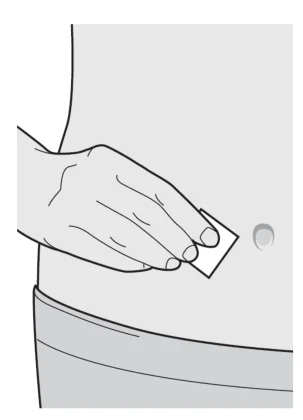
| Step 6: Clean Wash your hands. Clean the injection site with an alcohol wipe. Let your skin dry before injecting. Do not touch the injection site again or blow on it before the injection. |
|---|