

Patient leaflet - Duaklir Genuair 340 micrograms /12 micrograms inhalation powder
1. What Duaklir Genuair is and what it is used for
What Duaklir Genuair is
This medicine contains two active ingredients called aclidinium and formoterol fumarate dihydrate. Both belong to a group of medicines called bronchodilators. Bronchodilators relax the muscles in your airways, which allows the airways to open more widely and helps you to breathe more easily. The Genuair inhaler delivers the active ingredients directly into your lungs as you breathe in.
What Duaklir Genuair is used for
Duaklir Genuair is used for adult patients who have breathing difficulties due to a lung disease called chronic obstructive pulmonary disease (COPD), in which the airways and air sacs in the lungs become damaged or blocked. By opening the airways, the medicine helps relieve symptoms such as shortness of breath. Taking Duaklir Genuair regularly will reduce the effects of COPD on your everyday life.
2. What you need to know before you use Duaklir Genuair
Do not use Duaklir Genuair:
if you are allergic to aclidinium, formoterol fumarate dihydrate or to the
other ingredient of this medicine (listed in section 6).
Warnings and precautions
Talk to your doctor, pharmacist or nurse before using Duaklir Genuair, if you have any of the following conditions/symptoms:
If you have asthma. This medicine should not be used for
the treatment of asthma.
- If you have heart problems.
- If you have epilepsy.
- If you have thyroid gland problems (thyrotoxicosis).
If you have a tumour in one of your adrenal glands (phaeochromocytoma). • If you have difficulty passing urine or problems due to an enlarged prostate. • If you have an eye condition called narrow angle glaucoma, which results
in high pressure in the eye.
Stop taking Duaklir Genuair and seek medical help immediately if you experience any of the following:
If you get sudden tightness of the chest, coughing, wheezing or
breathlessness immediately after using the medicine. See section 4.
Duaklir Genuair is used as a maintenance (long-term) treatment for COPD. You should not use this medicine to treat a sudden attack of breathlessness or wheezing.
If your usual COPD symptoms (breathlessness, wheezing, cough) do not improve or get worse while you are using Duaklir Genuair you should continue to use it, but go to see your doctor as soon as possible because you may need another medicine.
If you see halos around lights or coloured images, have eye pain or discomfort or suffer temporary blurring of vision, go to see your doctor for advice as soon as possible.
Dry mouth has been observed with medicines like Duaklir Genuair. In the long-term, dry mouth can be associated with tooth decay, so it is important to pay attention to oral hygiene.
Children and adolescents
Duaklir Genuair is not for use in children or adolescents below 18 years of age.
Other medicines and Duaklir Genuair
Tell your doctor or pharmacist if you are taking, have recently taken or might take any other medicines. If you use Duaklir Genuair with some other medicines, the effect of Duaklir Genuair or the other medicines may be altered.
Tell your doctor or pharmacist if you are taking:
Any medicines that may be similar to Duaklir Genuair to treat
breathing difficulties.
Medicines that lower the amount of potassium in your blood.
These include:
corticosteroids that you take by mouth (such as prednisolone), - diuretics (such as furosemide or hydrochlorothiazide), - certain medicines used to treat breathing conditions (such as
theophylline).
Medicines called beta blockers that may be used to treat high blood
pressure or other heart problems (such as atenolol or propranolol) or to treat glaucoma (such as timolol).
Medicines which can cause a type of change in the electrical activity
of the heart known as QT interval prolongation (observed in an electrocardiogram). These include medicines for the treatment of: - depression (such as monoamine oxidase inhibitors or tricyclic
antidepressants),
- bacterial infections (such as erythromycin, clarithromycin, telithromycin), - allergic reactions (anti-histamines).
Pregnancy and breast-feeding
If you are pregnant or breast-feeding, think you may be pregnant or are planning to have a baby, ask your doctor, nurse or pharmacist for advice before using this medicine. You should not use Duaklir Genuair if you are pregnant or are breast-feeding unless your doctor tells you to do so.
Driving and using machines
Duaklir Genuair is unlikely to affect your ability to drive or use machines. In some patients, this medicine may cause blurred vision or dizziness. If you are affected by either of these side effects, do not drive or use machines until the dizziness has cleared or your vision has returned to normal.
Duaklir Genuair contains lactose
This medicine contains lactose. If you have been told by your doctor that you have an intolerance to some sugars, contact your doctor before taking this medicine.
3. How to use Duaklir Genuair
Always use this medicine exactly as your doctor or pharmacist has told you. Check with your doctor or pharmacist if you are not sure.
The recommended dose is one inhalation in the morning and one
inhalation in the evening.
You can use Duaklir Genuair anytime before or after food or drink. • The effects of Duaklir Genuair last for 12 hours; therefore, you should try
to use Duaklir Genuair at the same time each morning and evening as this will ensure that there is always enough medicine in your body to help you
breathe more easily throughout the day and night. Taking your medicine at regular times will also help you to remember to use it.
The recommended dose can be used for elderly patients and for patients
with kidney or liver problems. No dose adjustments are necessary in these patients.
- Duaklir Genuair is for inhalation use.
Instructions for use: Refer to the Instructions for Use at the end of this
leaflet for instructions on how to use the Genuair inhaler. If you are not sure of how to use Duaklir Genuair, contact your doctor or pharmacist.
COPD is a long-term disease; therefore, Duaklir Genuair is for long-term use. The medicine must be used every day, twice a day and not only when breathing problems or other symptoms of COPD are experienced.
If you use more Duaklir Genuair than you should
If you think you may have used more Duaklir Genuair than you should, you are more likely to experience some of its side effects, such as blurred vision, dry mouth, feeling sick, shaking/tremor, headache, palpitations or an increase in blood pressure, therefore you must immediately contact your doctor or go to the nearest emergency unit. Show the packaging of Duaklir Genuair. Medical attention may be needed.
If you forget to use Duaklir Genuair
If you forget a dose of Duaklir Genuair, just take it as soon as possible and take your next dose at the usual time. Do not take a double dose to make up for a forgotten dose.
If you stop using Duaklir Genuair
This medicine is for long-term use. If you want to stop treatment, first talk to your doctor, as your symptoms may worsen.
If you have any further questions on the use of this medicine, ask your doctor, pharmacist or nurse.
4. Possible side effects
Like all medicines, this medicine can cause side effects, although not everybody gets them.
Stop using the medicine and contact your doctor immediately if you: • develop swelling of the face, throat, lips or tongue (with or without difficulty
breathing or swallowing), severe itchy bumps on the skin (hives) as these may be symptoms of an allergic reaction. Frequency of this reaction cannot be estimated from the available data.
develop tightness of the chest, coughing, wheezing or breathlessness
immediately after using the medicine. These may be signs of a condition called “paradoxical bronchospasm”, which is an excessive and prolonged contraction of the airway muscles immediately following treatment with a bronchodilator. This reaction may rarely occur (may affect up to 1 in 1,000 people).
Some side effects may be serious: if you get any of these side effects, tell your doctor immediately.
Uncommon (may affect up to 1 in 100 people)
Muscle weakness, twitching and/or abnormal heart rhythm, as these may
be signs of a decrease in the amount of potassium in your blood • Tiredness, increased thirst and/or a need to pass urine more frequently
than usual, as these may be signs of an increase in the amount of sugar in your blood
Palpitations, as these may be a sign of an unusually fast heart beat or an
abnormal heart rhythm
Rare (may affect up to 1 in 1,000 people)
Sudden difficulty in breathing or swallowing, swelling of the tongue, throat,
lips or face, skin rash and/or itching - these may be signs of an allergic reaction
Other side effects which may occur while using Duaklir Genuair:
Common (may affect up to 1 in 10 people)
Combination of sore throat and runny nose – these may be signs of
nasopharyngitis
- Headache
Painful and/or frequent urination – these may be signs of a urinary tract
infection
- Cough
- Diarrhoea
A blocked, runny or stuffy nose and/or pain or a feeling of pressure in the
cheeks or forehead – these may be symptoms of sinusitis • Dizziness
- Muscle cramps
- Nausea (feeling sick)
- Difficulty sleeping
- Dry mouth
- Muscle pain
- Abscess (infection) in the tissues at the base of a tooth
Increased blood levels of a protein found in muscle called creatine
phosphokinase
- Shaking/tremor
- Anxiety
Uncommon
- Fast heart beat (tachycardia)
- Chest pain or tightness in the chest (angina pectoris)
- Blurred vision
- Changes in the sound of the voice (dysphonia)
Difficulty passing urine or a feeling that your bladder has not completely
emptied (urinary retention)
An abnormal heart trace (QT interval prolongation) potentially leading to an
abnormal heart rhythm
- Distorted sense of taste (dysgeusia)
- Throat irritation
- Inflammation of the mouth (stomatitis)
- Increased blood pressure
- Agitation
- Rash
- Itching of the skin
Reporting of side effects
If you get any side effects, talk to your doctor, pharmacist or nurse. This includes any possible side effects not listed in this leaflet. You can also report side effects directly via the Yellow Card Scheme at
www.mhra.gov.uk/yellowcard or search for MHRA Yellow Card in the Google Play or Apple App Store. By reporting side effects you can help provide more information on the safety of this medicine.
5. How to store Duaklir Genuair
Keep this medicine out of the sight and reach of children.
Do not use this medicine after the expiry date which is stated on the inhaler label, carton and inhaler bag after “EXP”. The expiry date refers to the last day of that month.
This medicine does not require any special temperature storage conditions.
Keep the Genuair inhaler protected inside the sealed bag until the administration period starts.
To be used within 60 days of opening the bag.
Do not use Duaklir Genuair if you notice that the pack is damaged or shows signs of tampering.
After you have taken the last dose, the inhaler has to be disposed of. Do not throw away any medicines via household waste. Ask your pharmacist how to throw away medicines you no longer use. These measures will help protect the environment.
If the medicine becomes discolored or shows any other signs of deterioration, you should seek the advice of your pharmacist who will tell you what to do.
6. Contents of the pack and other information
What Duaklir Genuair contains
The active substances are aclidinium and formoterol fumarate dihydrate.
Each delivered dose (the dose leaving the mouthpiece) contains 396 micrograms aclidinium bromide equivalent to 340 micrograms of aclidinium and 11.8 micrograms of formoterol fumarate dihydrate. • The other ingredient is lactose monohydrate (see end of section 2 under
‘Duaklir Genuair contains lactose’ for more information).
What Duaklir Genuair looks like and contents of the pack
Duaklir Genuair is a white or almost white inhalation powder. The Genuair inhaler is a white device fitted with an integral dose indicator and an orange dosage button. The mouthpiece is covered with a removable orange protective cap. It is supplied in a sealed protective aluminium bag containing a desiccant sachet. After removing the inhaler from the bag, the bag and desiccant sachet should be thrown away.
Pack sizes supplied:
Carton containing 1 inhaler with 60 doses.
Not all pack sizes may be marketed.
Manufacturer:
Industrias Farmacéuticas Almirall, S.A.
Ctra. de Martorell 41-61
08740 Sant Andreu de la Barca, Barcelona
Spain
Procured from within the EU and repackaged for the PL Holder: Abacus Medicine Ltd., Abbey House, 282 Farnborough Road, Farnborough, GU14 7NA, United Kingdom
PL 45763/1823
POM
Duaklir® Genuair® is a registered trademark of ALMIRALL, S.A.
For any information about this medicine, please contact the local representative of the Product Licence Holder:
Abacus Medicine Ltd.
tel: +44(0)2036301244 email: MedInfo@abacusmedicine.co.uk or
drugsafetyuk@abacusmedicine.co.uk
This leaflet was last revised on 17.02.2025.
Blind or partially sighted? Is this leaflet hard to see or read? Call 02036301310 or write to info@abacusmedicine.com to obtain the leaflet in a format suitable for you.
Instructions for Use
This section contains information on how to use your Genuair inhaler. It is important that you read this information as the Genuair may work differently from inhalers you have used previously. If you have any questions about how to use your inhaler, please ask your doctor, pharmacist or nurse for assistance.
The Instructions for Use is divided into the following sections: - Getting started
- Step 1: Prepare your dose
- Step 2: Inhale your medicine
- Additional information
Getting Started
Read these Instructions for Use before you start using the medicine.
Become familiar with the parts of your Genuair inhaler.
Figure A
Before use:
- a)
Before first use, tear open the
sealed bag and remove the
inhaler. Throw away the bag and
the desiccant.
- b)
Do not press the orange button
until you are ready to take a dose.
- c)
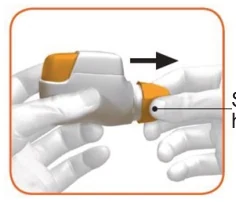
Pull off the cap by lightly
squeezing the arrows marked on
each side (Figure B).
Squeeze here and pull
Figure B
STEP 1: Prepare your dose
1.1 Look in the opening of the
mouthpiece and make sure
nothing is blocking it (Figure C).
1.2 Look at the control window
(should be red, Figure C).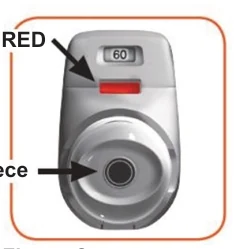
1.3 Hold the inhaler horizontally with
the mouthpiece facing you and
the orange button on top
(Figure D).
1.4 Press the orange button all the
way down to load your dose
(Figure E).
When you press the button all the way
down, the control window changes
from red to green.
Make sure the orange button is on
top. Do not tilt.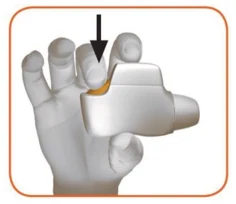
1.5 Release the orange button
(Figure F).
Make sure you release the button so
the inhaler can work correctly.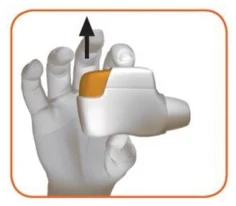
Stop and Check:
1.6 Make sure the control window is
now green (Figure G).
Your medicine is ready to be inhaled.
Go to ‘STEP 2: Inhale your medicine’.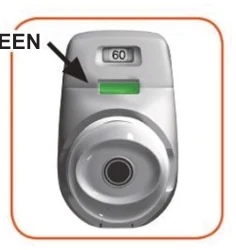
What to do if the control window is still red after pressing the button (Figure H).
The dose is not prepared. Go back to ‘STEP 1 Prepare your dose’ and repeat steps 1.1 to 1.6.
STEP 2: Inhale your medicine
Read steps 2.1 to 2.7 fully before use.
Do not tilt. Do not hold the orange
button down while inhaling.
2.1 Hold the inhaler away from
your mouth, and breathe out
completely. Never breathe out
into the inhaler (Figure I).
2.2 Hold your head upright, put the
mouthpiece between your lips,
and close your lips tightly
around it (Figure J).
2.3 Take a strong, deep breath
through your mouth. Keep
breathing in for as long as
possible.
A ‘click’ will let you know that you are inhaling correctly. Keep breathing in as long as possible after you hear the ‘click’. Some patients may not hear the ‘click’. Use the control window to ensure you have inhaled correctly.
2.4 Take the inhaler out of your mouth.
2.5 Hold your breath for as long as possible.
2.6 Slowly breathe out away from the inhaler.
Some patients may experience a grainy sensation in their mouth, or a slightly sweet or bitter taste. Do not take an extra dose even if you do not taste or feel anything after inhaling.
Stop and Check:
2.7 Make sure the control window is
now red (Figure K). This means
you have inhaled your medicine
correctly.
What to do if the control window is still green after inhalation (Figure L).
This means you have not inhaled your medicine
correctly. Go back to ‘STEP 2 Inhale your
medicine’ and repeat steps 2.1 to 2.7.
If the control window still does not change to red,
you may have forgotten to release the orange
button before inhaling, or you may not have
inhaled strongly enough. If this happens, try again.
Make sure you have released the orange button,
and you have breathed out completely. Then take
a strong, deep breath through the mouthpiece. Please contact your doctor if the control window is still green after repeated attempts.
Push the protective cap back onto the mouthpiece
after each use (Figure M), to prevent contamination
of the inhaler with dust or other materials.
You should discard your inhaler if you lose the cap.
Additional information
What should you do if you accidently prepare a dose?
Store your inhaler with the protective cap in place until it is time to inhale your medicine, then remove the cap and start at Step 1.6.
How does the dose indicator work?
The dose indicator shows the total number of
doses left in the inhaler (Figure N).
On first use, every inhaler contains at least
60 doses.
Each time you load a dose by pressing the orange
button, the dose indicator moves by a small
amount towards the next number (50, 40, 30, 20,
10, or 0).
Dose indicator moves slowly from 60 to 0: 60, 50, 40, 30, 20, 10, 0.
When should you get a new inhaler?
You should get a new inhaler:
If your inhaler appears to be damaged or if you
lose the cap, or
When a red band appears in the dose indicator,
this means you are nearing your last dose
(Figure N), or
- If your inhaler is empty (Figure O).
How do you know that your inhaler is empty?
When the orange button will not return to its full
upper position and is locked in a middle position,
you have reached the last dose (Figure O). Even though the orange button is locked, your last dose may still be inhaled. After that, the inhaler cannot be used again and you should start using a new inhaler.
How should you clean the inhaler?
NEVER use water to clean the inhaler, as this may damage your medicine.
If you wish to clean your inhaler, just wipe the outside of the mouthpiece with a dry tissue or paper towel.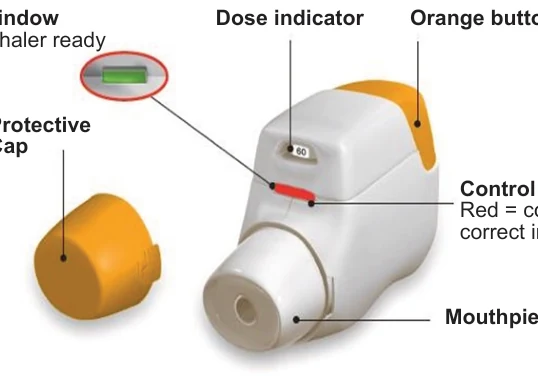
Check mouthpiece opening
Figure C
RED
Figure D
Figure E
Figure F
Figure G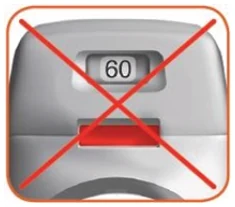
Figure H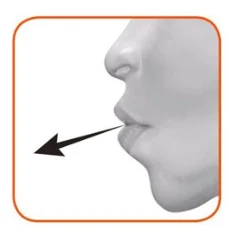
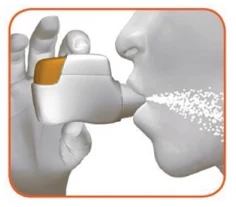
Figure I
Figure J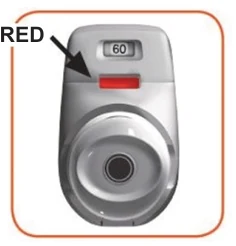
Figure K
RED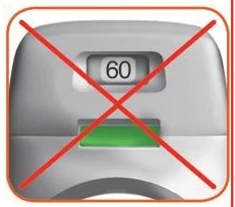
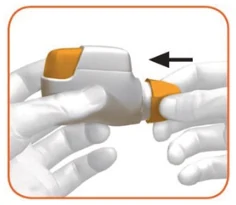
Figure M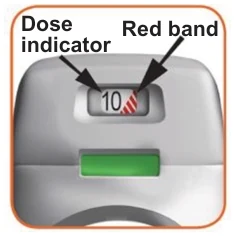
Figure N
Dose
indicator Red band Control window
Green = inhaler ready
to use
Dose indicator
Protective
Cap
Orange button
Control window
Red = confirms correct inhalation
Mouthpiece
GREEN
Figure L
Figure O
Locked