

Patient leaflet - Dexamethasone 2 mg / 5 ml oral solution
1. What Dexamethasone Oral Solution is and what it is used for
The name of this medicine is Dexamethasone Oral Solution. It contains dexamethasone sodium phosphate. Dexamethasone belongs to a group of medicines called steroids. Their full name is corticosteroids.These corticosteroids occur naturally in the body, and help to maintain health and well-being. Boosting your body with extra corticosteroid (such as dexamethasone) is an effective way to treat various illnesses involving inflammation in the body. Dexamethasone reduces this inflammation, which could otherwise go on making your condition worse.You must take this medicine regularly to get maximum benefit from it.
Dexamethasone is a synthetic glucocorticoid (adrenocortical hormone). Glucocorticoids are hormones produced by the cortex of adrenal glands.The medicine has anti-inflammatory, analgesic and anti-allergic effects, and suppresses the immune system. • Dexamethasone is recommended for the treatment of rheumatic and autoimmune diseases (e.g. systemic lupus erythematosus, rheumatoid arthritis, juvenile idiopathic arthritis, polyarthritis nodosa)
- diseases of respiratory tract (e.g. bronchial asthma, croup)
- skin (e.g. erythroderma, pemphigus vulgaris)
- tuberculous meningitis only in conjunction with anti-infective therapy • diseases of blood (e.g. idiopathic thrombocytopenic purpura in adults) • cerebral oedema
- treatment of symptomatic multiple myeloma
- acute lymphoblastic leukemia
- Hodgkin’s disease and non-Hodgkin’s lymphoma in combination with other medicinal products
- palliative treatment of neoplastic diseases
- prophylaxis and treatment of nausea and vomiting caused by chemotherapy and prevention and treatment of vomiting after operation, within antiemetic treatment Dexamethasone Oral Solution is used as a treatment of coronavirus disease 2019 (COVID-19) in adult and adolescent patients (aged 12 years and older with body weight at least 40kg) with difficulty breathing and need of oxygen therapy.
2. What you need to know before you take Dexamethasone Oral Solution
Do not take Dexamethasone Oral Solution and consult your doctor if:
- you are allergic to dexamethasone or any of the other ingredients of this medicine (listed in section 6).The signs of an allergic reaction include a rash, itching or shortness of breath
- you have an infection that affects the whole body (unless you are receiving treatment).
- you have an ulcer in your stomach (peptic ulcer) or digestive tract area (duodenal ulcer)
- you are going to have a vaccination by live vaccines.
Warnings and precautions
Check with your doctor first
- if you have ever had severe depression or manic depression (bipolar disorder). This includes having had depression before or while taking steroid medicines like dexamethasone.
- if any of your close family has had these illnesses.
If either of these applies to you, talk to a doctor before taking dexamethasone. Mental health problems while taking dexamethasone
Mental health problems can happen while taking steroids like Dexamethasone (see also section 4 Possible Side Effects).
- These illnesses can be serious.
- Usually they start within a few days or weeks of starting the medicine. • They may be more likely to happen at high doses.
- Most of these problems go away if the dose is lowered or the medicine is stopped. However, if problems do happen, they might need treatment.
Talk to a doctor if you (or someone taking this medicine), show any signs of mental health problems.This is particularly important if you are depressed, or might be thinking about suicide. In a few cases, mental health problems have happened when doses are being lowered or stopped.
Talk to your doctor before taking this medicine if:
- you have kidney or liver problems (liver cirrhosis or chronic liver failure), • you have a tumour of the adrenal gland (pheochromocytoma), • you have high blood pressure, heart disease or you have recently had a heart attack (myocardial rupture has been reported),
- you have diabetes or there is a family history of diabetes,
- you have osteoporosis (thinning of the bones), particularly if you are a female who has been through the menopause
- you have suffered from muscle weakness with this or other steroids in the past, • you have glaucoma (raised eye pressure) or there is a family history of glaucoma, cataract (clouding of the lens in the eye leading to a decrease in vision), • you have myasthenia gravis (a condition causing weak muscles), • you have a bowel disorder or a stomach (peptic) ulcer,
- you have psychiatric problems or you have had a psychiatric illness which was made worse by this type of medicine,
- you have epilepsy (condition where you have repeated fits or convulsions), • you have migraine,
- you have an underactive thyroid gland,
- you have a parasitic infection,
- you have tuberculosis, septicaemia or a fungal infection in the eye, • you have cerebral malaria,
- you have herpes (cold sores or genital herpes and ocular herpes simplex because of possible corneal perforation),
- you have asthma,
- you are treated for a blockage of blood vessels by blood clots (thromboembolism), • you have corneal ulcerations and corneal injuries.
Treatment with corticosteroid may reduce your body’s ability to fight infection.This can sometimes lead to infections caused by germs that rarely cause infection under
normal circumstances (called opportunistic infections). If you get an infection of any kind during treatment with this medicine, contact your doctor immediately.This is particularly important if you notice signs of pneumonia: cough, fever, shortness of breath and chest pain.You may also feel confused, particularly if you are elderly.You should also tell your doctor if you have had tuberculosis or if you have stayed in regions where roundworm infections are common.
While you are taking this kind of medicine, you should not come into contact with anyone who has chickenpox, shingles or measles.This is because you may need specialist treatment if you get these diseases.
If you think you may have had exposure to any of these diseases, you should talk to your doctor immediately.You should also tell your doctor if you have ever had infectious diseases such as measles or chickenpox and of any vaccinations.
You should tell your doctor if you have any symptoms of tumour lysis syndrome such as muscle cramping, muscle weakness, confusion, visual loss or disturbances and shortness of breath, in case you suffer from haematological malignancy. Treatment with this medicine may cause central serous chorioretinopathy, an eye disease that leads to blurred or distorted vision.This happens usually in one of the eyes. If you notice blurring or distorted vision that lasts for several days, please contact your doctor.
Treatment with this medicine may cause tendon inflammation. In extremely rare cases, a tendon may rupture.This risk is increased by treatment with certain antibiotics and by kidney problems. Contact your doctor if you notice painful, stiff or swollen joints or tendons.
Treatment with Dexamethasone Oral Solution can cause a condition called adrenocortical insufficiency.This can cause change in effectiveness of the medicine following stress and trauma, surgery, childbirth or illness and your body may not be able to respond in the usual way to severe stress such as accidents, surgery, childbirth or illness.
If you have an accident, are ill, have other specific physical stress conditions, or require any surgery (even at the dentists) or you require a vaccination (particularly with‘live virus’ vaccines) whilst taking or when you have finished taking Dexamethasone, you should inform the person treating you that you are taking or have taken steroids. If you have suppression tests (test for the amount of hormone in the body), skin test for allergy or test for bacterial infection you should inform the person performing the test that you are taking dexamethasone as it may interfere with the results. You may also find that your doctor will reduce the amount of salt in your diet and give you a potassium supplement whilst you are taking this medicine.
If you are elderly, some of the side effects of this medicine may be more serious, especially thinning of the bones (osteoporosis), high blood pressure, low potassium levels, diabetes, susceptibility to infection and thinning of the skin.Your doctor will monitor you more closely.
Children and adolescents
This medicine can cause children to grow more slowly. Because of this, they should take the lowest possible dose for the shortest possible time. Children who use this medicine for any length of time should be carefully monitored by the doctor. If a child is taking this medicine, it is important that the doctor monitors their growth and development regularly. Dexamethasone Oral Solution should not be routinely given to premature babies with respiratory problems.
Other medicines and Dexamethasone Oral Solution
- Tell your doctor or pharmacist if you are taking, have recently taken or might take any other medicines: Anticoagulant medicines which thin the blood (e.g. warfarin) • Acetylsalicylic acid or similar (Non-Steroidal AntiInflammatory drugs) e.g. indomethacin
- Medicines used to treat diabetes
- Medicines used to treat high blood pressure
- Medicines used to treat cardiac diseases
- Diuretics (water tablets)
- Amphotericin B injection
- Phenytoin, carbamazepine, primidone (epilepsy medication)
- Rifabutin, rifampicin, isoniazid (antibiotics used to treat tuberculosis) • Antacids – particularly those containing magnesium trisilicate • Barbiturates (medication used to aid sleep and relieve anxiety) • Aminoglutethimide (anti-cancer treatment) • Carbenoxolone (used in the treatment of stomach ulcers)
- Ephedrine (nasal decongestant) Acetazolamide (used for glaucoma and epilepsy) • Hydrocortisone, cortisone and other corticosteroids
- Ketoconazole, itraconazole (for fungal infections)
- Ritonavir (for HIV)
- Antibiotics including erythromycin, fluoroquinolones
- Medicines that help muscle movement in myasthenia gravis (e.g. neostigmine) • Colestyramine (for high cholesterol levels)
- Estrogen hormones including the contraceptive pill
- Tetracosactide used in the test for adrenocortical function
- Sultopride used to calm emotions
- Ciclosporin used to prevent rejection after transplants
- Thalidomide used for e.g. multiple myeloma
- Praziquantel given for certain worm infections
- Vaccination with live vaccines
- Chloroquine, hydroxychloroquine and mefloquine (for malaria) • Somatotropin
- Protirelin
Please tell your doctor if you are taking or have recently taken any other medicines, including medicines obtained without a prescription.You may be at an increased risk of serious side effects if you take dexamethasone together with these medicines:
- Some medicines may increase the effects of Dexamethasone and your doctor may wish to monitor you carefully if you are taking these medicines (including some medicines for HIV: ritonavir, cobicistat).
- Acetylsalicylic acid or similar (Non-Steroidal AntiInflammatory drugs) e.g. indometacin
- Medicines used to treat diabetes
- Medicines used to treat cardiac diseases
- Diuretics (water tablets) • Amphotericin B injection • Acetazolamide (used for glaucoma and epilepsy) •Tetracosactide used in the test for adrenocortical function • Carbenoxolone (used in the treatment of stomach ulcers)
- Chloroquine, hydroxychloroquine and mefloquine (for malaria) • Medicines used to treat high blood pressure
- Thalidomide used for e.g. multiple myeloma
- Vaccination with live vaccines
- Medicines that help muscle movement in myasthenia gravis (e.g. neostigmine) • Antibiotics including fluoroquinolones
You must read the package leaflets of all medicinal products to be taken in combination with Dexamethasone for information related to these medicines before starting treatment with Dexamethasone.When thalidomide, lenalidomide or pomalidomide is used, particular attention to pregnancy testing and prevention requirements is needed.
Dexamethasone with food, drink and alcohol
Dexamethasone should be taken with or after food to minimise irritation to the gastrointestinal tract. Drinks containing alcohol or caffeine should be avoided. Eating small, frequent meals is recommended, and possibly taking of antacids, if recommended by your doctor.
Pregnancy and breast-feeding
If you are pregnant or breast-feeding, think you may be pregnant or are planning to have a baby, ask your doctor or pharmacist for advice before taking this medicine. Dexamethasone should be prescribed during pregnancy and particularly in the first trimester only if the benefit outweighs the risks for the mother and child. If you become pregnant during the use of the product, do not stop using Dexamethasone, but tell your doctor immediately that you are pregnant. Corticosteroids may pass into breast milk. A risk to the newborns/infants cannot be excluded. A decision on whether to continue/discontinue breast feeding or to continue/discontinue therapy with dexamethasone should be made taking into account the benefit of breast feeding to the child and the benefit of dexamethasone therapy to the woman.
105225/3 23LF01825PW
| Customer W | ockhardt UK Limited | |||||||
| Description D | examethasone Oral 150ml Leaflet | |||||||
| 05225/3 | ||||||||
| Profile A | s per the uploaded pdf | |||||||
| Size ( |
| |||||||
| ther | Actual Min Point Siz | e 8.5 pt | Cirrus_Info_Box | |||||
| Market U | K | |||||||
| Language E | nglish | |||||||
| PO | ||||||||
| PA | ||||||||
| 4/12/2020 | ||||||||
| yriad Pro | ||||||||
| Body Text Ctd. | ||||||||
 PHAR
PHAR
| MA |
| P | ODE | ||
| HARMAC |
| CODE |
Driving and using machines
Do not drive, use any tools or machines or carry out any hazardous tasks if you experience side effects, such as confusion, hallucinations, dizziness, tiredness, sleepiness, fainting or blurred vision.
Dexamethasone Oral Solution contains maltitol, sorbitol, propylene glycol, ethanol (alcohol), benzoic acid and sodium
- Maltitol: If you have been told by your doctor that you have an intolerance to some sugars, contact your doctor before taking this medicinal product. • Sorbitol: Sorbitol is a source of fructose. If your doctor has told you that you (or your child) have an intolerance to some sugars or if you have been diagnosed with hereditary fructose intolerance (HFI), a rare genetic disorder in which a person cannot break down fructose, talk to your doctor before you (or your child) take or receive this medicine.
- This medicine contains 94mg propylene glycol in each ml, which is equivalent to 470mg/5ml. If your baby is less than 4 weeks old, talk to your doctor or pharmacist before giving them this medicine, in particular if the baby is given other medicines that contain propylene glycol or alcohol.
- This medicine contains small amounts of ethanol (alcohol), less than 100mg per dose.
- This medicine contains 1mg benzoic acid in each ml, which is equivalent to 5mg/5ml. Benzoic acid may increase jaundice (yellowing of the skin and eyes) in newborn babies (up to 4 weeks old).
- This medicine contains less than 1mmol sodium (23mg) per 5ml, that is to say essentially‘sodium-free’.
You should not stop taking any other steroid medications unless your doctor has instructed you to do.
Talk to your doctor, pharmacist or nurse before you take Dexamethasone Oral Solution General precautions regarding steroid use in specific diseases, masking infection, concomitant medicines etc. in line with current recommendations.
3. How to take Dexamethasone Oral Solution
Take Dexamethasone as only as prescribed by your doctor.Your doctor will decide how long you should take dexamethasone for. Check with your doctor or pharmacist if you are not sure.
Taking this medicine
- This medicine contains 2mg of dexamethasone in each 5ml.
- Take this medicine by mouth. Some people may be given a dexamethasone injection at the same time.
- You may also find that your doctor will tell you to lower the amount of salt in your diet.
- You may also need to take potassium supplements whilst taking this medicine.Your prescriber will advise you if this is necessary since patients should not routinely be taking potassium without medical supervision.
- If your daily dose is very small, ask your pharmacist for a device to help you measure these amounts, such as an oral syringe.
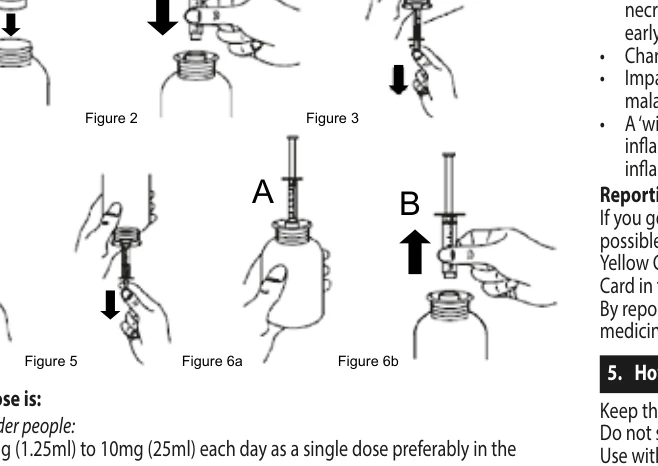
How to use the Oral Syringe
- 1. Shake the bottle well making sure the cap is firmly on the bottle. 2. Remove the cap. Note: keep the cap nearby to close the bottle after each use. 3. Push the plastic adapter into the neck of the bottle (Figure 1). Note: the adapter must always stay in the bottle.
- 4. Take the syringe and check the plunger is fully down.
- 5. Keep the bottle upright and insert the oral syringe firmly into the plastic adapter (Figure 2).
- 6. Turn the whole bottle with the syringe upside down.
- 7. Slowly pull the plunger down fully so that the syringe fills with medicine (Figure 3). Push the plunger back up completely to expel any large air bubbles that may be trapped inside the oral syringe (Figure 4).
- 8. Then pull the plunger slowly back to the volume you need for your dose (Figure 5). 9. Turn the whole bottle with the syringe the right way up and take the syringe out of the bottle (Figure 6a and 6b).
10.The dose of medicine can now be swallowed directly from the oral syringe. Please ensure that you are sitting upright and the plunger must be pushed slowly to allow you to swallow the dose.
11.Replace the child resistant cap after use, leaving the adapter in place. 12.To clean the oral syringe, take apart by removing the plunger completely. Pull straight out of the barrel. The barrel and plunger can be washed with soap and water, rinsed, and allowed to dry. Do not wash the oral syringe in the dishwasher.
The usual dose is:
Adultsandolderpeople:
- Take 0.5mg (1.25ml) to 10mg (25ml) each day as a single dose preferably in the morning.
- Your doctor will decide your exact dose based on the disease being treated. • As you get better your doctor may then reduce your dose.
Children:
If a child is taking this medicine, it is important that the doctor monitors their growth and development at frequent intervals. A single dose on alternate days (every other day).
Longtermtreatment
For the long-term treatment of several conditions, after initial therapy, glucocorticoid treatment should be switched from dexamethasone to prednisone/prednisolone to reduce suppression on the function of the adrenal cortex.
For the treatment of COVID-19
Adult patients are recommended to take 6mg (15ml) once a day for up to 10 days. Use in adolescents
Paediatric patients (adolescents of 12 years of age or older) are recommended to take 6mg (15ml) once a day for up to 10 days.
If you take more Dexamethasone Oral Solution than you should
Do not take more dexamethasone than stated on the label of your medicine. If you take too much medicine you should seek medical attention immediately, either by calling your doctor, or going to the nearest casualty department. Always take the labelled medicine container with you, even if there is no medicine left.
If you forget to take Dexamethasone Oral Solution
If you forget to take a dose, take it as soon as you remember unless it is almost time for the next one, then carry on as before. Do not take a double dose to make up for a forgotten dose.
If you stop taking Dexamethasone Oral Solution
If your treatment is to be stopped follow your doctor’s advice. He may tell you to reduce the amount of medicine you are taking gradually until you stop taking it altogether. The symptoms that have been reported when treatment has been stopped too quickly have included low blood pressure and in some cases, relapse of the disease for which the treatment was given.
A‘withdrawal syndrome’ may also occur which includes fever, muscle and joint pain, inflammation of the nose lining (rhinitis), weight loss, itchy skin and inflammation of the eye (conjunctivitis).
If you stop treatment too soon and some of the mentioned symptoms occur, you must talk to your doctor as soon as possible. If you have any further questions on the use of this medicine, ask your doctor or pharmacist.
4. Possible side effects
Like all medicines, this medicine can cause side effects, although not everybody gets them.
Serious side effects: tell a doctor straight away
Steroids including dexamethasone can cause serious mental health problems.These are common in both adults and children.They can affect about 5 in every 100 people taking medicines like dexamethasone.
These include:
- feeling depressed, including thinking about suicide
- feeling high (mania), very happy (euphoria) or moods that go up and down • feeling anxious or irritable, having problems sleeping, difficulty in thinking or being confused and losing your memory
- feeling, seeing or hearing things that do not exist or believing in things that are not real (delusions). Having strange and frightening thoughts, changing how you act or having feelings of being alone
- schizophrenia becoming worse.
If you notice any of these problems, talk to a doctor straight away. Tell a doctor straight away if you experience:
- severe abdominal pains, nausea, vomiting, diarrhoea, profound muscle weakness and fatigue, extremely low blood pressure, weight loss and fever as these may be signs of adrenocortical insufficiency;
- sudden abdominal pain, tenderness, nausea, vomiting, fever and blood in stool as these may be signs of tearing of the bowel particularly if you have or have had a bowel disease.
This medicine may worsen your existing heart problem. If you experience shortness of breath or ankle swelling, consult your doctor straight away.
Other side effects may be: (frequency not known)
- Greater chance of picking up infections, including viral and fungal infections e.g. thrush; recurrence of tuberculosis or some other infections, e.g. eye infections if you have already had it
- Reduction in the number of white blood cells or increased number of white blood cells, abnormal coagulation
- An allergic reaction to the medicine, including serious, potentially life-threatening allergic reaction (which may show as a rash and swelling of the throat or tongue and in severe cases difficulty in breathing or dizziness)
- Impairment of the body’s regulation of hormones, swelling and weight gain of the body, full-moon face (Cushingoid state), change in effectiveness of endocrines following stress and trauma, surgery, childbirth or illness, your body may not be able to respond in the usual way to severe stress such as accidents, surgery, childbirth or illness, stunted growth in children and teenagers, irregular and absence of menstrual cycles (periods) development of excess body hair (particularly in women) • Weight gain, loss of protein and calcium balance, increased appetite, salt imbalances, water retention in the body, potassium loss which can cause rhythm disorder, increased requirement for diabetic medication, unknown diabetes becomes evident, high levels of cholesterol and triglycerides in the blood (hypercholesterolemia and hypertriglyceridaemia)
- Extreme mood swings, schizophrenia (mental disorder) may become worse, depression, inability to sleep
- Severe unusual headache with visual disturbances linked with the withdrawal of treatment, fits and worsening of epilepsy, dizziness
- Increased pressure in the eye, papilloedema, thinning of the eye membranes, increased eye viral, fungal and bacterial infections, worsening of symptoms associated with corneal ulcers, worsening of existing eye infections, protrusion of the eyeballs, cataracts
- Congestive heart failure in susceptible people, cardiac muscle rupture after a recent heart attack, cardiac decompensation
- High blood pressure, blood clots: formation of blood clots that may clog blood vessels for example in legs or lungs (thromboembolic complications) • Hiccups
- Nausea, vomiting, stomach discomfort and swollen abdomen, inflammation and ulcers in the oesophagus, peptic ulcers that may split and bleed, inflamed pancreas (which may show as pain in the back and abdomen), flatulence, oesophageal candidiasis
- Thinned delicate skin, unusual marks on the skin, bruising, redness and inflammation of the skin, stretch marks, visible swollen, capillaries, acne, increased sweating, skin rash, swelling, thinning of the hair, unusual fat deposits, excessive hair growth, water retaining in the body, pigment disorders, weakened capillaries that rupture easily observed as bleeding under the skin (increased capillary fragility), skin irritation around the mouth (perioral dermatitis)
- Thinning of the bone with an increased risk of fractures (osteoporosis), bone necrosis, tendinitis, ruptured tendons, muscle wasting, myopathy, muscle weakness, early stoppage of bone growth (premature epiphyseal closure) • Changes to the number and movement of sperm, impotence
- Impaired reaction to vaccination and skin tests, slow wound healing, discomfort, malaise.
- A‘withdrawal syndrome’ may also occur which includes fever, muscle and joint pain, inflammation of the nose lining (rhinitis), weight loss, painful itchy skin nodules and inflammation of the eye (conjunctivitis).
Reporting of side effects
If you get any side effects, talk to your doctor, pharmacist or nurse.This includes any possible side effects not listed in this leaflet.You can also report side effects directly via Yellow Card SchemeWebsite: www.mhra.gov.uk/yellowcard or search for MHRAYellow Card in the Google Play or Apple App Store
By reporting side effects you can help provide more information on the safety of this medicine.
5. How to store Dexamethasone Oral Solution
Keep this medicine out of the sight and reach of children.
Do not store above 25°C.
Use within 3 months of opening.
Do not use this medicine after the expiry date which is stated on the carton and bottle label.The expiry date refers to the last day of that month.
Do not throw away medicines via wastewater or household waste. Ask your pharmacist how to throw away medicines you no longer use.These measures will help protect the environment.
6. Contents of the pack and other information
What Dexamethasone Oral Solution contains
- Each 5ml of Dexamethasone Oral Solution contains 2mg of the active substance dexamethasone as dexamethasone sodium phosphate.
- The other ingredients are: benzoic acid (E210), propylene glycol (E1520), citric acid monohydrate (E330), sodium citrate (E331), liquid maltitol (E965), liquid sorbitol (non-crystallising) (E420), garden mint flavour (containing ethanol (alcohol)), hydrochloric acid (for pH adjustment), sodium hydroxide (for pH adjustment) and purified water.
What Dexamethasone Oral Solution looks like and contents of the pack
Dexamethasone Oral Solution is a colourless solution with an odour of mint. It is available in 75ml and 150ml amber soda glass bottles, fitted with a 28mm white, polypropylene, push and turn, tamper evident cap. In addition, this medicine will be supplied with a 5ml dispensing oral syringe and bottle adapter. Not all pack sizes may be marketed.
Marketing Authorisation Holder
Wockhardt UK Ltd, Ash Road North,Wrexham, LL13 9UF, United Kingdom Manufacturer
CP Pharmaceuticals Ltd, Ash Road North,Wrexham, LL13 9UF, United Kingdom Other sources of information
To listen to or request a copy of this leaflet in Braille, large print or audio please call, free of charge:
0800 198 5000 (UK only).
Please be ready to give the following information:
Product Name Reference Number
Dexamethasone 2mg/5ml Oral Solution PL 29831/0604
This is a service provided by the Royal National Institute of Blind People.
This leaflet was last revised in 11/2020
Figure 1 Figure 2 Figure 3
Figure 4 Figure 6a Figure 6b
A B
Figure 5
105225/3 23LF01825PW
| Customer W | ockhardt UK Limited | |||||||
| Description D | examethasone Oral 150ml Leaflet | |||||||
| 05225/3 | ||||||||
| Profile A | s per the uploaded pdf | |||||||
| Size (w | ) 190 x (h) 420mm | |||||||
| ther | Actual Min Point Siz | e 8.5 pt | Cirrus_Info_Box | |||||
| Market U | K | |||||||
| Language E | nglish | |||||||
| PO | ||||||||
| PA | ||||||||
| 4/12/2020 | ||||||||
| yriad Pro | ||||||||
| Body Text Ctd. | ||||||||