

Patient leaflet - Colistimethate Sodium 2 million International units (IU) powder for nebuliser solution
1. What is Colistimethate sodium and what it is used for
Colistimethate sodium contains the active substance colistimethate sodium. Colistimethate sodium is an antibiotic. It belongs to a group of antibiotics that are called polymyxins.
Colistimethate sodium is given as an inhalation to treat chronic chest infections in patients with cystic fibrosis. Colistimethate sodium is used when these infections are caused by specific bacteria called Pseudomonas aeruginosa.
2. What you need to know before you use Colistimethate sodium
Do not use Colistimethate sodium
If you are allergic to colistimethate sodium, colistin or to other polymyxins.
Warnings and precautions
Talk to your doctor, pharmacist or nurse before using Colistimethate sodium
- If you have or have had kidney problems.
- If you suffer from porphyria
- If you suffer from myasthenia gravis
- If you suffer from asthma
If you experience muscle spasm, fatigue or increased urine output at any time, tell your doctor immediately as these events may be related to a condition known as pseudo-Bartter syndrome.
Some people may experience a feeling of tightness in the chest due to narrowing of the airways when inhaling Colistimethate sodium. Your doctor may prescribe other medicines for inhalation directly before or after using Colistimethate sodium; in order to prevent or treat this.
Children
In premature and new-born babies, special care should be taken when using Colistimethate sodium as the kidneys are not yet fully developed.
Other medicines and Colistimethate sodium
Tell your doctor or pharmacist if you are taking, have recently taken or might take any other medicines.
If you are taking any of the following medicines, you may or may not be able to take Colistimethate sodium. Sometimes the other medicines must be stopped (if only for a while) or you may need a lower dose of Colistimethate sodium or you may need to be monitored while you are taking Colistimethate sodium. In some cases, the level of Colistimethate sodium in your blood may have to be measured from time to time to make sure that you are having the right dose.
medicines like antibiotics called aminoglycosides (which
include gentamicin, tobramycin, amikacin and netilmicin) and cephalosporins which can affect how your kidneys function. Taking such medicines at the same time as Colistimethate sodium can increase the risk of damage to the kidneys (see section 4 of this leaflet).
Medicines like antibiotics called aminoglycosides (which
include gentamicin, tobramycin, amikacin and
netilmicin) which can affect your nervous system. Taking such medicines at the same time as Colistimethate sodium can increase the risk of side effects in the ears and other parts of your nervous system (see section 4 of this leaflet).
- medicines called muscle relaxants, often used during general anaesthesia. Colistimethate sodium can increase the effects of these medicines. If you have a general anaesthetic, let your anaesthetist know that you are having Colistimethate sodium.
If you suffer from myasthenia gravis and are also taking other antibiotics called macrolides (such as azithromycin, clarithromycin or erythromycin) or antibiotics called fluoroquinolones (such as ofloxacin, norfloxacin and ciprofloxacin), taking Colistimethate sodium further increases the risk of muscle weakness and breathing difficulties.
Having Colistimethate sodium as an infusion at the same time as receiving Colistimethate sodium as an inhalation can increase your risk of side effects.
Pregnancy and breast-feeding
If you are pregnant, think you may be pregnant or are planning to have a baby ask your doctor or pharmacist for advice before taking this medicine.
Colistimethate sodium is not known to harm the unborn child but, like all medicines, it will only be given to a pregnant woman if it is really needed.
Are you breast-feeding?
Small amounts of Colistimethate sodium enter the milk. If you cannot stop breast-feeding while you take Colistimethate sodium, you should watch your baby carefully for any signs of illness and tell your doctor if you notice anything wrong.
Driving and using machines
When Colistimethate sodium is given into a vein there may be side effects such as dizziness, confusion or problems with vision. If these occur, you should not drive or operate machinery.
Colistimethate sodium contains sodium
This medicine contains less than 1 mmol sodium (23 mg) per vial, that is to say essentially 'sodium-free'.
Size:- 550 x 240 mm
3. How to use Colistimethate sodium
Colistimethate sodium powder for solution for inhalation can be breathed into the lungs as a fine spray made using a machine called a nebuliser. The droplets of the spray produced by the nebuliser are small enough to enter the lungs so that Colistimethate sodium can reach the site of the bacterial infection.
Always use this medicine exactly as your doctor or pharmacist has told you. Check with your doctor or pharmacist if you are not sure.
Your doctor will monitor your kidney function regularly while you receive Colistimethate sodium.
For use with a nebuliser
The usual dose for adults, adolescents and children aged 2 years or older is 1-2 million units two to three times per day (maximum 6 million units per day).
The usual dose for children less than 2 years old is 0.5-1 million units twice daily (maximum 2 million units per day).
Your doctor may decide to adjust the dose depending on your circumstances. If you also take other inhaled medicines, your doctor will tell you which order to taken them in.
Method of administration
If you are treating yourself at home, your doctor, pharmacist or nurse will show you how to use Colistimethate sodium in your nebuliser when you first start the treatment. You should sit upright and breathe normally during inhalation. The following are general instructions.
Preparation for inhalation treatment
Before Colistimethate sodium can be used it must be dissolved in isotonic saline solution (salt water).
To start your treatment. you will need the following:
l One clear-glass vial of Colistimethate sodium 1 Million IU
l The solvent for dissolving the powder (3 ml of isotonic saline
solution)
l A nebuliser appropriate for inhalation use of Colistimethate
sodium 1 Million IU (e.g. PARI LC SPRINT)
To start your treatment. you will need the following:
l One clear-glass vial of Colistimethate sodium 2 Million IU
l The solvent for dissolving the powder (4 ml of isotonic saline
solution)
l A nebuliser appropriate for inhalation use of Colistimethate sodium 2 Million IU (e.g. PARI LC SPRINT)
It is important that your nebuliser system functions properly before starting your treatment with Colistimethate sodium. Read carefully the instructions for use of the nebuliser for further information on handling the nebuliser system.
Place the components of your nebuliser on a clean flat surface and follow the manufacturer's instructions for use.
Preparing your Colistimethate sodium for inhalation
Colistimethate sodium must be used immediately after dissolution. Do not dissolve Colistimethate sodium until ready to administer a dose (see also section 5).
Colistimethate sodium 1 million IU: Add the solvent (3 ml of isotonic saline solution) to the corresponding vial to dissolve the powder.
Colistimethate sodium 2 million IU: Add the solvent (4 ml of isotonic saline solution) to the corresponding vial to dissolve the powder.
In order to avoid foaming, shake the vial gently until all powder is dissolved. Pour the solution into the nebuliser. Do not use Colistimethate sodium if you notice visible particles in the solution after dissolution.
Once prepared Colistimethate sodium should be used immediately. Any unused solution should be disposed of.
How to prepare:
- 1.
Carefully lift the coulorful plastic disk to expose the tear off ring
(see diagram 1).
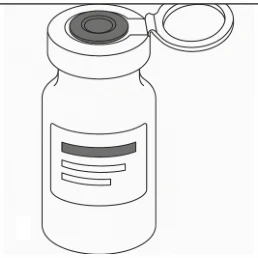
- 2. Lift the ring and carefully pull it back to slowly break the aluminium seal.
- 3. Carefully twist the ring to break the seal. If needed, use gloves to avoid injury due to sharp edges.
- 4. Once the seal is broken, hold the vial firmly and peel off the metal seal to reveal the whole of the rubber stopper (diagram 4).
- 5.
Remove the rubber stopper from the vial, while holding only the outside edge of the stopper. Place the rubber stopper on a clean surface such that the clean part of the stopper is not in contact with anything. Slowly add the volume of solvent (usually sterile isotonic saline solution) as advised by your doctor or nurse.
- 6. Place the rubber stopper back onto the vial and make sure it is sitting properly. Gently turn the vial upside down twice (diagram 6), while making sure that the rubber stopper does not fall off.
- 7. Roll the vial gently between both hands to dissolve all the Colistimethate powder visible on the base and side of the vial (diagram 7). Do not shake the vial too hard as this may make the solution foam.
5min
- 8. Once most of the powder is dissolved leave the vial to stand for 5-10 minutes to let any foam disappear and to allow any remaining powder to dissolve.
Pour the solution into the nebuliser and inhale immediately. If it is not possible to use the solution immediately replace the stopper in the vial and store for no longer than 24 hours in a refrigerator. Do not use any solutions that have been prepared for more than 24 hours. see section 5 How to store Colistimethate for instructions on how to store or dispose of any unused Colistimethate.
Using your Colistimethate sodium
Colistimethate sodium is for inhalation use with an appropriate nebuliser (e.g. PARI LC SPRINT).
For more detailed information on correct use of the selected nebuliser follow the instruction manual of the nebuliser. Inhalation should take place in a well-ventilated room.
After inhalation of Colistimethate sodium
Please refer to the manufacturer's instructions for use of the nebuliser for cleaning and disinfecting instructions.
IMPORTANT: Do not mix Colistimethate sodium with any other product for nebulisation at the same time.
Duration of treatment
For nebulised use your doctor will advise on the course of the treatment.
If you use more Colistimethate sodium than you should
If you think that you have given yourself too much Colistimethate sodium, you shouId contact your doctor or nurse immediately for advice or, if they are not available, contact or go to your nearest hospital accident and emergency department. If too much Colistimethate sodium is accidentally given, the side effects can be serious and can include kidney problems, muscle weakness and difficulty (or even stopping) breathing.
If you are being treated in hospital or at home by a doctor or nurse and think that you may have missed a dose or been given too much Colistimethate sodium, please ask your doctor, nurse or pharmacist about this.
If you forget to use Colistimethate sodium
If you are treating yourself and have missed any doses, you should give the missed dose as soon as you remember and then give the next dose 8 hours later if using Colistimethate sodium three times a day, or 12 hours later if using Colistimethate sodium twice a day. Carry on from there as instructed. Do not take a double dose to make up for a forgotten dose.
If you stop using Colistimethate sodium
Do not stop your treatment early unless your doctor says you can. Your doctor will decide how long your treatment should last. If you have any further questions on the use of this medicine, ask your doctor, pharmacist or nurse.
4. Possibly Side Effects
Like all medicines, this medicine can cause side effects, although not everybody gets them.
Allergic reactions
Whether Colistimethate sodium is given into a vein or by inhalation, an allergic reaction is possible.
Serious allergic reactions can happen even with the very first dose
and can include rapid development of rashes, swelling of the face, tongue and neck, inability to breathe due to narrowing of the airways and loss of consciousness.
If you experience signs of an allergic reaction you should seek urgent medical attention.
Less severe allergic reactions include skin rashes that appear later during treatment.
Side effects associated with inhaling Colistimethate sodium (nebulisation)
The risk of side effects is usually much less when it is given by inhalation because very little Colistimethate sodium usually reaches the bloodstream when it is given this way.
Possible side effects include coughing, a feeling of tightness in the chest due to narrowing of the airways, sore mouth or throat and thrush (Candida) infections of the mouth or throat.
Reporting of side effects
If you get any side effects, talk to your doctor, pharmacist or nurse.
This includes any possible side effects not listed in this leaflet. You can also report side effects directly via the Yellow Card Scheme
Website: www.mhra.gov.uk/yellowcard or search for MHRA Yellow Card in the Google Play or Apple App Store. By reporting side effects you can help provide more information on the safety of this medicine.
5. How to store Colistimethate sodium
Keep this medicine out of the sight and reach of children.
Do not use this medicine after the expiry date which is stated on the vial label and the carton after EXP. The expiry date refers to the last day of that month.
Keep the vials in the outer carton in order to protect from light.
Colistimethate sodium solutions for inhalation should be used immediately after preparation.
If this is not possible, talk first to your doctor or pharmacist as the solutions may be stored in a refrigerator for no longer than 24 hours. Any remaining solution should be discarded.
Do not throw away any medicines via wastewater or household waste. Ask your pharmacist how to throw away medicines you no longer use. These measures will help protect the environment.
- 1. Contents of the Package and other Information
What Colistimethate sodium contains
The active substance is colistimethate sodium.
Each vial contains 1 million IU colistimethate sodium.
Each vial contains 2 million IU colistimethate sodium.
There are no other ingredients.
6. Contents of the Package and other Information
Colistimethate sodium, a powder for solution for inhalation, is supplied as a sterile white powder in single dose vials of either.
l 1 million units of colistimethate sodium per vial: (1.0 MIU) l 2 million units of colistimethate sodium per vial: (2.0 MIU)
Each carton contains 1, 10 or 30 vials. Not all pack sizes may be marketed.
Marketing Authorisation Holder
SGS Pharma Magyarország Kft.
Honved Utca 8.1. em 2
1054 Budapest Hungary
Manufacturer
SGS Pharma Magyarország Kft.
Derkovits Gyula Utca 53, Budapest XIX
1193 Hungary
This leaflet was last revised in June 2025.