

Patient leaflet - Clobazam Wockhardt 2 mg / ml oral suspension
1. What Clobazam Oral Suspension is and what it is used for
Clobazam Oral Suspension contains a medicine called Clobazam. This belongs to a group of medicines called benzodiazepines. It works by having a calming effect on the brain.
This medicine has been prescribed to you and should not be given to anyone else.
Benzodiazepines can cause dependence, tolerance and addiction, and you may get withdrawal symptoms if you stop taking it or reduce the dose suddenly. Your prescriber should have explained how long you will be taking it for and, when it is appropriate to stop, how to do this safely. When your treatment is stopped, it is usually done gradually over a period which is specific to you and may occur over a period of weeks to months. If this medicine is being used for the treatment of epilepsy you must continue to take it as prescribed by your doctor.
Clobazam can be used for:
- Symptomatic treatment of severe anxiety in adults (short term use only)
- Epilepsy (fits) in adults and children over 2 (together with other treatments)
- Short-term symptomatic treatment of hyperarousal and agitation in patients with schizophrenic or other psychotic illnesses (only together with other treatments as benzodiazepines alone are not effective in these patients)
2. What you need to know before you take Clobazam Oral Suspension
Do not take Clobazam Oral Suspension if:
- You are allergic (hypersensitive) to Clobazam, other benzodiazepine medicines or any of the other ingredients of Clobazam Oral Suspension (see section 6: contents of the pack and other information). Signs of an allergic reaction include: a rash, swallowing or breathing problems, swelling of your lips, face, throat or tongue
- You are in the first three months of pregnancy or think you might be pregnant (see below under ‘Pregnancy and breast-feeding’ for more information)
- You are breast-feeding
- You have ever had problems with drugs or alcohol dependence in the past
- You are intoxicated with drugs or alcohol
- You suffer from an illness that causes muscle weakness (called ‘myasthenia gravis’)
- You have severe liver problems
- You have severe breathing problems
- You stop breathing for short periods during sleep (called ‘sleep apnoea syndrome’)
- The patient is under 2 years old, except if the doctor decides this is necessary
Do not take if any of the above apply to you. If you are not sure, talk to your doctor or pharmacist before taking Clobazam Oral Suspension.
Warnings and precautions
Note: Make sure that you receive the same clobazam medicine every time you collect your prescription unless your doctor has agreed to change to a different clobazam medicine. If the appearance of this medicine is not the same as usual or if the dosage instructions have changed, speak to your doctor or pharmacist as soon as possible to make sure you have the right medicine.
Talk to your doctor or pharmacist before taking Clobazam Oral Suspension if:
- You have suicidal thoughts - tell your doctor straight away if you start thinking about suicide or harming yourself. Some patients have had suicidal thoughts while taking medicines containing clobazam, especially if they were also depressed.
- You have problems with controlling your movements (called ‘spinal or cerebellar ataxia’)
- You have depression, irrational fears and obsessions
- You have delusions (believing things which are not true) or hallucinations (sensing things which are not there)
- You have liver or kidney problems. Your doctor will decide whether to reduce the dose of Clobazam Oral Suspension.
- You have ever become dependent upon another drug or alcohol. Alcohol should not be taken during treatment with Clobazam as there is an increased risk of experiencing side effects.
- You are over 65. This is due to the increased sensitivity to adverse reactions in the elderly such as drowsiness, dizziness and muscle weakness. There is also an increased risk of fall that may result in serious injury.
- You have difficulty digesting medicines. Some patients’ liver may not metabolise (break down) medicines adequately. In these patients the medicine may remain in the body for a longer period of time. This may result in side effects. If you are known to poorly metabolise certain medicines please speak to your doctor.
Talk to your prescriber before taking this medicine if you:
- are or have ever been addicted to opioids, alcohol, prescription medicines, or illegal drugs, or if you have ever had a history of struggling to control your alcohol or drug intake.
- have previously suffered from withdrawal symptoms such as agitation, anxiety, shaking or sweating, when you have stopped taking alcohol or drugs.
- feel you need to take more of Clobazam to get the same level of symptom control, this may mean you are developing tolerance to the effects of this medicine or are becoming addicted to it. Speak to your prescriber who will discuss your treatment and may change your dose or switch you to an alternative medication.
Taking this medicine regularly, particularly for a long time, can lead to physical dependence and addiction. Your prescriber should have explained how long you will be taking it for and, when it is appropriate to stop, how to do this safely. When your treatment is stopped, it is usually done gradually over a period which is specific to you and may occur over a period of weeks to months.
Physical dependence and addiction can cause withdrawal symptoms when you stop taking this medicine. Withdrawal symptoms can include:
- headaches, muscle pain, anxiety, tension, depression, restlessness, sweating, confusion or irritability. Do not stop taking your tablets suddenly. This could lead to more serious symptoms such as loss of the sense of reality, feeling unreal or detached from life, and unable to feel emotion. Some patients have also experienced numbness or tingling of the arms or legs, tinnitus (ringing sounds in the ears), oversensitivity to light, sound and touch, uncontrolled or overactive movements, twitching, shaking, feeling sick, being sick, stomach upsets or stomach pain, loss of appetite, agitation, abnormally fast heartbeats, panic attacks, dizziness or feeling that you are about to fall, memory loss, hallucinations, feeling stiff and unable to move easily, feeling very warm, convulsions (sudden uncontrolled shaking or jerking of the body).
Your prescriber will discuss with you how to gradually reduce your dose before stopping the medicine. It is important that you do not stop taking the medicine suddenly as you will be more likely to experience withdrawal symptoms. Your prescriber will ensure that your plan for stopping treatment is tailored to you and can be adapted according to your needs and experience of any withdrawal symptoms.
Benzodiazepines should only be used by those they are prescribed for. Do not give your medicine to anyone else. Taking higher doses or more frequent doses of benzodiazepines, may increase the risk of addiction. Overuse and misuse can lead to overdose and/or death.
If you are not sure if any of the above apply to you, talk to your doctor or pharmacist before taking Clobazam.
Suicidal thoughts
Tell your doctor straight away if you start thinking about suicide or harming yourself.
Some patients have had suicidal thoughts while taking medicines containing clobazam, especially if they were also depressed.
Psychotic or ‘Paradoxical’ reactions
It is known that with the use of clobazam restlessness, agitation, irritability, aggression, delusions, rage, nightmares, hallucinations, deceptive thoughts (psychosis), inappropriate behaviour and other adverse behavioural effects may occur. If this happens you should stop taking Clobazam Oral Suspension and contact your doctor. These reactions are more common in children and elderly patients.
Dependence, withdrawal and tolerance
You may become dependent on Clobazam Oral Suspension if you take it for a long period of time or with high dose, particularly if you have a history of heavy alcohol or drug use. This means that you may feel that you need to continue treatment with Clobazam Oral Suspension in order to feel well (known as psychological dependence). You should therefore take Clobazam Oral Suspension for as short time as possible.
If you suddenly stop taking Clobazam Oral Suspension you may experience worsening of the symptoms you were originally being treated for, as well as mood changes, anxiety, sleep disturbance, headache, increased dreaming, tension, confusion, excitability, hallucinations, muscle pain, numbness of the limb, tingling, sweating, tremor, nausea, sensitivity to light, increased sensitivity to sound, sensitivity to light or restlessness.
This is known as withdrawal symptoms and can be avoided by slowly reducing your dose. If you are worried about dependence or withdrawal please talk to your doctor.
If you take Clobazam Oral Suspension for a long period of time for treatment of epilepsy it is possible that you may become tolerant to it, meaning that it will not be as effective as it was when you first started taking it. If you feel that Clobazam Oral Suspension is no longer helping to control your symptoms please talk to your doctor, they may suggest you take a short break from this medicine.
Breathing difficulties
Clobazam Oral Suspension may cause respiratory depression, particularly when administered at high doses. Tell your doctor if you have respiratory failure, your doctor will decide whether to reduce the dose. In case of severe respiratory disturbance, clobazam may not be used.
Serious skin problems
Clobazam Oral Suspension may cause serious skin reactions. You should talk to your doctor if you develop any rash unless it is clearly not drug related.
Children under 2 years
Epilepsy (fits): Clobazam Oral Suspension should only be taken by children under 2 years if the doctor decides this is necessary
Other medicines and Clobazam Oral Suspension
Please tell your doctor or pharmacist if you are taking, have recently taken, or might take any other medicines.
This includes medicines you buy without a prescription, including herbal medicines.
This is because Clobazam can affect the way some other medicines work.
Also some medicines can affect the way Clobazam works.
In particular, tell your doctor if you are taking any of the following:
- Medicines for epilepsy (such as phenytoin, carbamazepine, stiripentol or valproic acid)
- Medicines for depression such as trazodone, selective serotonin reuptake inhibitors-‘SSRIs’ (such as fluoxetine or citalopram), tricyclic anti-depressants (such as amitriptyline or nortriptyline) or monoamine oxidase inhibitors-‘MAOIs’ (such as phenelzine or moclobemide)
- Medicines for severe mental illness called 'antipsychotics' (such as chlorpromazine, haloperidol, clozapine and pimozide)
- Painkillers. Taking Clobazam and opioids (strong pain killers, such as medicines containing codeine, dihydrocodeine or morphine, medicines for substitution therapy and some cough medicines) increases the risk of drowsiness, difficulties in breathing (respiratory depression), coma and may be life-threatening. Because of this, concomitant use should only be considered when other treatment options are not possible. If your doctor does prescribe Clobazam together with opioids, the dose and duration of concomitant treatment should be limited by your doctor. Tell your doctor about all opioid medicines you are taking, and follow your doctor’s dose recommendation closely. It could be helpful to inform friends or relatives to be aware of the signs and symptoms stated above. Contact your doctor when experiencing such symptoms.
- Sleeping tablets (such as zolpidem)
- Tranquilisers (such as diazepam, temazepam or lorazepam)
- Muscle relaxants (such as baclofen)
- Antihistamines that make you sleepy (such as chlorphenamine, promethazine or diphenhydramine)
- Lithium - used for a mental illness called ‘manic-depressive illness’ (mood changes between a state of high excitability or exaggerated emotions and depression)
- Cimetidine - used to treat ulcers and heartburn
- Omeprazole - used to treat the symptoms of acid reflux such as heartburn or acid regurgitation.
- Ticlopidine - an antiplatelet medication used in patients with an increased risk of stroke
- Fluconazole - used in the treatment of fungal conditions
- Dextromethorphan - used to relieve dry, irritating coughs
- Nebivolol - used to treat high blood pressure.
If you are not sure if any of the above apply to you talk to your doctor or pharmacist
Anaesthetics
If you are going to have an anaesthetic, tell your doctor or anaesthetist you are taking Clobazam. This is because your doctor may need to change the amount of anaesthetic or muscle relaxants to give you.
Clobazam Oral Suspension with food, drink and alcohol
- Do not drink alcohol while taking Clobazam. This is because there is increased risk of sleepiness and other side effects.
Pregnancy, breast-feeding and fertility
Do not take Clobazam if you are:
- A woman of childbearing potential and are not using contraception
- In the first three months of pregnancy
- Breast-feeding or planning to breast-feed. This is because it may pass into the mother’s milk
Talk to your doctor before taking this medicine if you are pregnant, plan to get pregnant, or think you may be pregnant. This is because Clobazam is not recommended for use in pregnant women.
- However, your doctor may give you this medicine during late pregnancy or during labour.If this happens, there is a risk of having a baby with a low body temperature, floppiness, breathing or feeding problems
- If this medicine is taken regularly in late pregnancy, your baby may get withdrawal symptoms. In this case the newborn should be closely monitored during the postnatal period.
Driving and using machines
Clobazam has major influence on the ability to drive and use machines.
You may feel sleepy or have concentration or memory problems after taking this medicine. You may also experience double vision or you may react more slowly to things. If this happens, do not drive or use any tools or machines.
The medicine can affect your ability to drive as it may make you sleepy or dizzy. Do not drive while taking this medicine until you know how it affects you.
- It is an offence to drive if this medicine affects your ability to drive.
However, you would not be committing an offence if:
- The medicine has been prescribed to treat a medical or dental problem and
- You have taken it according to the instructions given by the prescriber or in the information provided with the medicine and
- It was not affecting your ability to drive safely.
Talk to your doctor or pharmacist if you are not sure whether it is safe for you to drive while taking this medicine.
Clobazam Oral Suspension contains:
- Propylene glycol (E1520): This medicine contains 4.7 mg propylene glycol in each 5ml dose which is equivalent to 0.94 mg/ml.
- Sorbitol (E420): This medicine contains 1000 mg sorbitol in each 5ml dose which is equivalent to 200mg mg/ml. Sorbitol is a source of fructose. If your doctor has told you that you (or your child) have an intolerance to some sugars or if you have been diagnosed with hereditary fructose intolerance (HFI), a rare genetic disorder in which a person cannot break down fructose, talk to your doctor before you (or your child) take or receive this medicine.
- Sodium methyl parahydroxybenzoate (E219) and Sodium propyl parahydroxybenzoate (E217): These may cause allergic reactions in some people that could occur some time after taking this medicine. The signs may include a rash, swallowing or breathing problems and swelling of your lips, face, throat or tongue.
Sodium
Daily doses up to 15ml
In doses up to 15 ml this medicine contains less than 23mg sodium that is to say essentially ‘sodium-free’.
Daily doses between 20ml and 60ml
This medicine contains 23mg sodium (main component of cooking/table salt) in each 20 ml dose, (34.5mg/30ml or 69mg/60ml). This is equivalent to a maximum daily dose of 3.5% of the recommended maximum daily dietary intake of sodium for an adult.
3. How to take Clobazam Oral Suspension
Up to 10ml doses - use only the syringe and adaptor provided in pack.
Doses over 10ml - use only the measuring cup provided.
DO NOT insert the bottle adaptor if the measuring cup is to be used.
Always take this medicine exactly as your doctor has told you. Check with your doctor or pharmacist if you are not sure.
- If you feel the effect of your medicine is too weak or too strong, do not change the dose yourself, ask your doctor
- Keep taking Clobazam until your doctor tells you to stop
- Clobazam is usually given for 2 to 4 weeks. After that, your doctor will decide whether you should keep taking this medicine
Recommended Dose:
1mg/ml Doses:
Adults
- Treatment of Anxiety 20 ml (20mg) to 30 ml (30mg) each day.
- Treatment of Epilepsy starting dose is 5ml (5mg) to 15ml (15 mg) each day
- This can be taken as two separate doses or as a single dose at night. Your doctor may increase your dose to up to 60 ml (60mg) each day
- Your doctor may lower the dose to suit you
Children (2 years and above)
- The usual starting dose is 0.1mg/kg each day
- Your doctor will then adjust the dose according to your child’s need.
Elderly
- 10 m1 (10mg) to 20 ml (20mg) each day for anxiety
2mg/ml Doses:
Adults
- Treatment of Anxiety 10 ml (20mg) to 15 ml (30mg) each day.
Treatment of Epilepsy starting dose is 2.5ml (5mg) to 7.5ml (15 mg) each day
This can be taken as two separate doses or as a single dose at night
- Your doctor may increase your dose to up to 30 ml (60mg) each day
- Your doctor may lower the dose to suit you
Children (2 years and above)
- The usual starting dose is 0.1mg/kg each day
- Your doctor will then adjust the dose according to your child’s need.
Elderly
- 5 ml (10mg) to 10 ml (20mg) each day for anxiety
In patients with liver or kidney disease and in elderly patients lower initial doses are required, with a gradual increase under careful observation of your doctor (see section "Warnings and precautions").
Method of Administration
Shake the bottle for at least 10 seconds before use.
Carefully measure your dose using either the 5ml dosing syringe for doses up to 10ml or the 30ml cup to measure larger doses.
Dosing Syringe
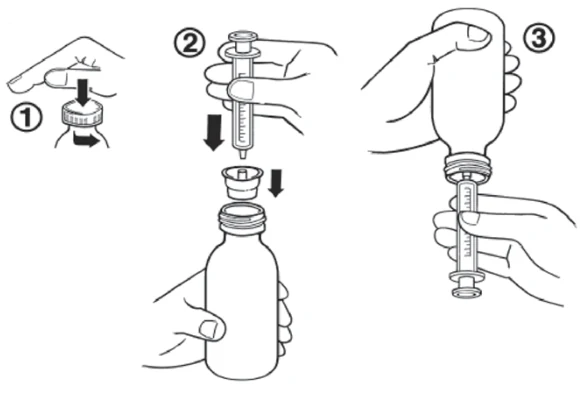
- 1. Open the bottle: press the cap and turn it anticlockwise (figure 1).
- 2. Insert the syringe adaptor into the bottle neck (figure 2).
- 3. Take the syringe and put it in the adaptor opening (figure 2).
- 4. Turn the bottle upside down (figure 3).
- 5.
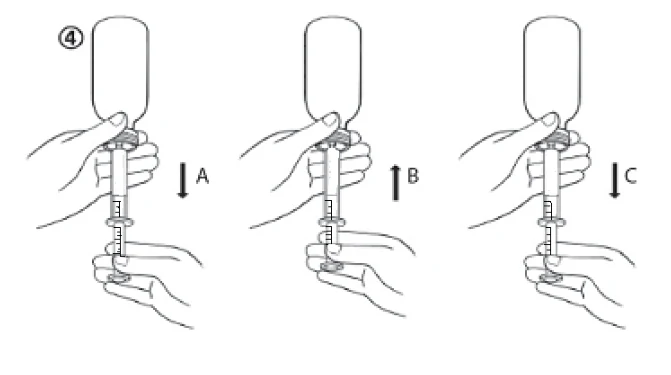
Fill the syringe with a small amount of solution by pulling the piston down (figure 4 A).
Then push the piston upward in order to remove any possible bubbles (figure 4 B).
Finally, pull the piston down to the graduation mark corresponding to the quantity in millilitres (ml) prescribed by your doctor (figure 4 C).
- 6. Turn the bottle the right way up.
- 7. Remove the syringe from the adaptor. Put the end of the syringe into your mouth and push the piston slowly back in to take the medicine.
- 8. Wash the syringe with water and let it dry before you use it again.
- 9. Close the bottle with the plastic screw cap.
30ml Graduated Measuring Cup
DO NOT insert the bottle adaptor if the measuring cup is to be used.
Each numbered increment is 5ml - equivalent to 5mg of Clobazam 1mg/ml Oral Suspension or 10mg of Clobazam 2mg/ml Oral Suspension.
Doses over 20mg: Clobazam Wockhardt 2mg/ml Oral Suspension is recommended.
If you have any questions about the dose you should use or how to use the syringe or cup, you should ask your pharmacist.
If you take more Clobazam Oral Suspension than you should
If you take more Clobazam than you should, tell your doctor or go to your nearest hospital casualty department straight away. Do not drive yourself, because you may start to feel sleepy. Remember to take with you any medicine left and the bottle. This is so the doctor knows what you have taken.
If you forget to take Clobazam Oral Suspension
Take it as soon as you remember it; however, if it is nearly time for the next dose, skip the missed dose. Do not take a double dose to make up for a forgotten dose.
If you stop taking Clobazam Oral Suspension
Keep taking this medicine until your doctor tells you to stop. Do not stop taking Clobazam just because you feel better.
- When your doctor says that you can stop taking Clobazam, you need to do this gradually. Your doctor will help you to do this.
- Stopping the medicine can make you feel stressed (anxiety), confused or depressed. You may also lose your appetite and have difficulty sleeping. Tell your doctor if this happens.
Do not suddenly stop taking this medicine. If you want to stop taking this medicine, discuss this with your prescriber first. They will tell you how to do this, usually by reducing the dose gradually so that any unpleasant withdrawal effects are kept to a minimum. This may occur over a period of weeks to months. Your prescriber will ensure that your plan for stopping treatment is tailored to you and can be adapted according to your needs and experience of any withdrawal symptoms.
Withdrawal symptoms such as:
- headaches, muscle pain, anxiety, tension, depression, restlessness, sweating, confusion or irritability. Do not stop taking your tablets suddenly. This could lead to more serious symptoms such as loss of the sense of reality, feeling unreal or detached from life, and unable to feel emotion. Some patients have also experienced numbness or tingling of the arms or legs, tinnitus (ringing sounds in the ears), oversensitivity to light, sound and touch, uncontrolled or overactive movements, twitching, shaking, feeling sick, being sick, stomach upsets or stomach pain, loss of appetite, agitation, abnormally fast heartbeats, panic attacks, dizziness or feeling that you are about to fall, memory loss, hallucinations, feeling stiff and unable to move easily, feeling very warm, convulsions (sudden uncontrolled shaking or jerking of the body).
If you have any further questions on the use of this product, ask your doctor or pharmacist.
4. Possible side effects
Like all medicines, this medicine can cause side effects, although not everybody gets them.
If you feel ill after taking Clobazam, or notice unusual or unexpected symptoms, tell your doctor.
Tell your doctor straight away if you have any of the following side effects:
- Feeling restless, have difficulty sleeping or nightmares
- Feeling irritable or anxious
- Believing things which are not true (delusions)
- Sensing things which are not there (hallucinations)
- Feeling suicidal
- Increased possibility of tripping or falling especially in elderly patients.
- Blistering or bleeding of the skin around the lips, eyes, mouth, nose and genitals. Also flu-like symptoms and fever. This may be something called 'Stevens Johnson Syndrome' which is a severe blistering rash where layers of the skin may peel off to leave large areas of raw exposed skin over the body. Also a feeling of being generally unwell, fever, chills and aching muscles. This is something called 'Toxic epidermal necrolysis'
If you get any of the above side effects, your doctor may decide that your treatment needs to be stopped. These side-effects are more likely to happen in elderly people and children.
Tell your doctor or pharmacist if any of the following side effects get serious or lasts longer than a few days, or if you notice any side effects not listed in this leaflet:
Very Common:
- Feeling sleepy or tired (especially at the start of treatment)
Common:
- Headache
- Loss of appetite, feeling sick
- Feeling dizzy or confused
- Dry mouth, constipation
- Feeling aggressive
- Shaking fingers
- Difficulty in concentrating, staying awake or alert
- Slurred or slow speech
- Depression
Uncommon:
- Loss of memory, confusion, or trouble remembering things
- Unusual or out of character behaviour
- Feeling anxious
- Skin rash
- Weight gain
- Double vision
- Loss of sexual drive
Not known:
- Breathing problems
- Hives
- Muscle spasms or involuntary movement
- Muscle weakness
- Reacting to things more slowly than usual
- Problems walking or other movement problems
- Rapid uncontrollable movement of the eyes
- Abnormally low body temperature (hypothermia)
- Feeling angry
Unknown frequency: dependence and addiction (see section “How do I know if I am tolerant or addicted?”).
Drug Withdrawal
When you stop taking Clobazam Oral Suspension, you may experience drug withdrawal symptoms, which include:
- headaches, muscle pain, anxiety, tension, depression, restlessness, sweating, confusion or irritability. Do not stop taking your tablets suddenly. This could lead to more serious symptoms such as loss of the sense of reality, feeling unreal or detached from life, and unable to feel emotion. Some patients have also experienced numbness or tingling of the arms or legs, tinnitus (ringing sounds in the ears), oversensitivity to light, sound and touch, uncontrolled or overactive movements, twitching, shaking, feeling sick, being sick, stomach upsets or stomach pain, loss of appetite, agitation, abnormally fast heartbeats, panic attacks, dizziness or feeling that you are about to fall, memory loss, hallucinations, feeling stiff and unable to move easily, feeling very warm, convulsions (sudden uncontrolled shaking or jerking of the body).
How do I know if I am tolerant or addicted?
If you notice any of the following signs whilst taking Clobazam Oral Suspension, it could be a sign that you have become addicted.
- You may feel the need to keep taking the medication for longer than your doctor recommended
- You feel you need to use more than the recommended dose
- You are using the medicine for reasons other than prescribed
- When you stop taking the medicine you feel unwell, and you feel better once taking the medicine again
If you take this medicine for a long time, you are more likely to get the following side effects: anxiety, confusion, depression, loss of appetite and difficulty sleeping.
Reporting of side effects
If you get any side effects, talk to your doctor or pharmacist or nurse. This includes any possible side effects not listed in this leaflet. You can also report side effects directly via the Yellow Card Scheme
Website: www.mhra.gov.uk/yellowcard or search for MHRA Yellow Card in the Google Play or
Apple App Store.
By reporting side effects you can help provide more information on the safety of this medicine.
5. How to store Clobazam Oral Suspension
- Keep this medicine out of the sight and reach of children.
- Store below 25°C. Store in the original bottle.
- Do not use 8 weeks after you first open it. Take it back to the pharmacy.
- Do not use this medicine after the expiry date which is stated on the bottle label and carton after EXP. The expiry date refers to the last day of that month.
- Do not use this medicine if you notice anything wrong with it. Talk to your pharmacist.
Do not throw away any medicines via wastewater or household waste. Ask your pharmacist how to throw away medicines you no longer use. These measures will help protect the environment.
6. Contents of the pack and other information
What Clobazam Oral Suspension contains:
The active substance is Clobazam.
Each 1ml of Clobazam Wockhardt 1mg/ml Oral Suspension contains 1mg of clobazam.
Each 1ml of Clobazam Wockhardt 2mg/ml Oral Suspension contains 2mg of clobazam.
- The other ingredient are sorbitol (E420), raspberry flavour (contains propylene glycol E1520), sodium propyl parahydroxybenzoate (E217), sodium methyl parahydroxybenzoate (E219), sucralose, sodium dihydrogen phosphate dihydrate, sodium hydroxide, xanthan gum (E415), phosphoric acid, purified water.
What Clobazam Oral Suspension looks like and contents of the pack
Clobazam Oral Suspension is an off white opaque suspension with an odour of raspberry supplied in amber glass bottles. The pack contains a 5ml syringe with an adaptor and a 30ml graduated measuring cup to measure the dose.
Bottle sizes: 150 ml and 300 ml. Not all pack sizes may be marketed.
Marketing Authorisation Holder Wockhardt UK Ltd., Ash Road North Wrexham, LL13 9UF, UK | Manufacturer CP Pharmaceuticals Ltd., Ash Road North Wrexham, LL13 9UF, UK |
|---|
This leaflet was last revised in 11/2025
Other formats:
To listen to or request a copy of this leaflet in Braille, large print or audio please call, free of charge:
0800 198 5000 (UK only).
Please be ready to give the following information:
| Product Name | Reference Number |
|---|---|
| Clobazam Wockhardt 1mg/ml Oral Suspension | 29831/0671 |
| Clobazam Wockhardt 2mg/ml Oral Suspension | 29831/0672 |
This is a service provided by the Royal National Institute of Blind People.
This medicinal product is authorised in the United Kingdom and Germany under the names:
UK Clobazam Wockhardt 1mg/ml Oral Suspension
Clobazam Wockhardt 2mg/ml Oral Suspension
DE Clobazam Wockhardt 1 mg / ml Suspension zum Einnehmen
Clobazam Wockhardt 2 mg / ml Suspension zum Einnehmen