

Patient leaflet - Clobazam Essential Pharmaceuticals 1 mg / ml oral suspension
1. What Clobazam Essential Pharmaceuticals is and what it is used for
Clobazam Essential Pharmaceuticals contains clobazam which belongs to a group of medicines called benzodiazepines.
Clobazam works by having a calming effect on the brain.
Clobazam is used to treat epilepsy (fits) (in combination with other treatments) in adults and children from 6 months of age, if standard treatment with one or more anticonvulsants has failed.
2. What you need to know before you take Clobazam Essential Pharmaceuticals
Do not take Clobazam Essential Pharmaceuticals
- if you are allergic to clobazam or any of the other ingredients of this medicine (listed in section 6)
- if you have ever had problems with drugs or alcohol dependence in the past
- if you suffer from an illness that causes muscle weakness (called ‘myasthenia gravis’)
- if you have breathing problems
- if you stop breathing for short periods during sleep (called ‘sleep apnoea syndrome’)
- if you have severe liver problems
- if you are breast-feeding
- if you have an intoxication with alcohol and drugs
Warnings and precautions
Talk to your doctor, pharmacist or nurse before taking Clobazam Essential Pharmaceuticals.
Switching from tablet to oral suspension
You should be careful whilst switching from tablet to oral suspension as the doses are not identical. You might observe breathing problem or feel sleepy when switching between different formulations e.g. from tablet to suspension.
You might also observe an increase in frequency of epilepsy or new forms of epilepsy with Clobazam Essential Pharmaceuticals. Please talk to your doctor if you experience this symptom.
Alcohol
Do not take alcohol during treatment with Clobazam Essential Pharmaceuticals as there is an increased risk of experiencing side effects.
Amnesia (memory loss)
You may observe memory loss during treatment with Clobazam Essential Pharmaceuticals when used in the normal dosage range. Most of these, however, occur only at higher doses.
Muscle weakness
Clobazam Essential Pharmaceuticals may cause muscle weakness. Talk to your doctor if you have problems with controlling your movements (called ‘spinal or cerebellar ataxia’). In severe muscle weakness (myasthenia gravis) clobazam should not be used.
Dependence, tolerance and withdrawal
It is possible for you to become dependent on Clobazam Essential Pharmaceuticals if you take it for a long period of time or with high dose, particularly if you have a history of heavy alcohol or drug use. This means that you may feel that you need to continue treatment with Clobazam Essential Pharmaceuticals in order to feel well (known as psychological dependence). You should therefore take the drug for as short time as possible.
If you suddenly stop taking Clobazam Essential Pharmaceuticals you may experience worsening of the symptoms you were originally being treated for, as well as mood changes, anxiety, sleep disturbance, headache, increased dreaming, tension, confusion, excitability, feeling of dissociation, or separation, from oneself and one’s surroundings, hallucinations, psychoses (“withdrawal delirium”), muscle pain, numbness of the limbs, tingling, sweating, tremor, nausea, sensitivity to light, sound and physical contact or restlessness. This is known as withdrawal symptoms and can be avoided by slowly reducing your dose. If you are worried about dependence or withdrawal please talk to your doctor.
If you take Clobazam Essential Pharmaceuticals for long periods of time for treatment of epilepsy it is possible that you may become tolerant to it, meaning that it will not be as effective as it was when you first started taking it.
If you feel that Clobazam Essential Pharmaceuticals is no longer helping to control your symptoms please talk to your doctor, they may suggest you take a short break from this medicine.
Breathing difficulties
Clobazam Essential Pharmaceuticals may cause respiratory depression, particularly when administered at high doses. Tell your doctor if you have respiratory failure, your doctor will decide whether to reduce the dose. In case of severe respiratory disturbance, Clobazam Essential Pharmaceuticals must not be used.
Kidney and liver failure
Report your doctor if your liver or kidneys do not work as well as they should. Your doctor will decide whether to reduce the dose of Clobazam Essential Pharmaceuticals. Your doctor may monitor your kidney and liver function regularly.
Elderly
Patients over 65 years may be affected by clobazam more than younger patients. Drowsiness, dizziness, muscle weakness, increased risk of falling that could result in serious injury can occur. If you are over 65 years, your doctor may prescribe a lower dose and check your response to treatment. Please carefully follow the instructions of your doctor.
Serious skin problems
Clobazam Essential Pharmaceuticals may cause serious skin reactions. Your doctor may monitor you carefully during beginning of treatment. You should talk to your doctor immediately if you develop any rash unless it is clearly not drug related.
Depression and suicidal thoughts
Some patients have experienced suicidal thoughts whilst taking medicines containing clobazam, particularly if they are already depressed. If you are depressed, have irrational fears and obsessions, have started experiencing thoughts of suicide or harm towards yourself, please tell your doctor immediately.
Psychotic reactions and ‘paradoxical’ reactions
It is known that with the use of clobazam restlessness, agitation, irritability, aggression, delusions, rage, nightmares, hallucinations, deceptive thoughts (psychosis), inappropriate behaviour and other adverse behavioural effects may occur. If this happens you should stop taking Clobazam Essential Pharmaceuticals and contact your doctor. These reactions are more common in children and elderly patients.
Poor metabolism
Some patient’s liver may not metabolise (break down) medicines adequately. In these patients the medicine may remain in the body for a longer period of time. This may result in side effects. If you are known to poorly metabolise certain medicines please talk to your doctor.
Children from 1 month to 2 years old
Clobazam Essential Pharmaceuticals should only be taken by children under 2 years if the doctor decides this is necessary.
Other medicines and Clobazam Essential Pharmaceuticals
Tell your doctor or pharmacist if you are taking, have recently taken or might take any other medicines.
Concomitant use of Clobazam Essential Pharmaceuticals and sedative medicines such as benzodiazepines or related drugs increases the risk of drowsiness, difficulties in breathing (respiratory depression), coma and may be life-threatening. Because of this, concomitant use should only be considered when other treatment options are not possible. However, if your doctor does prescribe together with sedative medicines the dose and duration of concomitant treatment should be limited by your doctor. Please tell your doctor about all sedative medicines you are taking and follow your doctor’s dose recommendation closely. It could be helpful to inform friends or relatives to be aware of the signs and symptoms stated above. Contact your doctor when experiencing such symptoms.
At higher doses of Clobazam Essential Pharmaceuticals, the concomitant use of other drugs may increase or decrease its effect, these include:
- medicines for epilepsy (such as phenytoin, carbamazepine, valoproic acid, stiripentol and cannabidiol)
- medicines for depression (such as trazodone, fluvoxamine, paroxetine, selective serotonin reuptake inhibitors-‘SSRIs’ (such as fluoxetine or citalopram), tricyclic anti-depressants (such as amitriptyline or nortriptyline) or monoamine oxidase inhibitors-‘MAOIs’ (such as phenelzine or moclobemide)
- medicines for severe mental illness called ‘neuroleptics’ (such as chlorpromazine, haloperidol and clozapine) and medicines for mental disorder such as pimozide and lithium – used for a mental illness called ‘bipolar disorder’ (mood changes between a state of high excitability emotions and depression)
- painkillers (such as medicines containing codeine, dihydrocodeine or morphine)
- sleeping tablets (such as zolpidem)
- tranquilisers (such as diazepam, temazepam or lorazepam)
- muscle relaxants (such as baclofen)
- antihistamines that make you sleepy (such as chlorphenamine, promethazine or diphenhydramine)
- cimetidine (used to treat ulcers and heartburn)
- antibiotic erythromycin
- omeprazole - used to treat the symptoms of acid reflux such as heartburn or acid regurgitation
- ticlopidine - an antiplatelet medication used in patients with an increased risk of stroke
- fluconazole - used in the treatment of fungal conditions
- dextromethorphan - used to relieve dry, irritating coughs
- nebivolol - medicine used to treat high blood pressure
- hormonal birth control medicines
If you are not sure if any of the above apply to you talk to your doctor or pharmacist.
Anaesthetics
If you are going to have an anaesthetic, tell your doctor or anaesthetist you are taking Clobazam Essential Pharmaceuticals. This is because your doctor may need to change the amount of anaesthetic or muscle relaxants given to you.
Clobazam Essential Pharmaceuticals with food, drink and alcohol
Do not drink alcohol while you are taking Clobazam Essential Pharmaceuticals. This is because alcohol can change the way Clobazam Essential Pharmaceuticals works.
Pregnancy and breast-feeding
If you are pregnant or breast-feeding, think you may be pregnant or are planning to have a baby, ask your doctor or pharmacist for advice before taking this medicine.
Contraceptives for fertile women and young girls
Fertile women and young girls should use contraceptives under the Clobazam Essential Pharmaceuticals treatment.
Pregnancy
You should not use this medicine if you are pregnant unless your doctor tells you to use it. Tell your doctor straight away if you think you may be pregnant. Do not stop taking Clobazam Essential Pharmaceuticals before talking to your doctor.
There may be a slight increase in abnormalities, particularly hare lip, in babies born to mothers given Clobazam Essential Pharmaceuticals during the first trimester of the pregnancy.
If the medicine is used during the second and/or third trimester, reduced foetal movement and foetal heart rate variability may occur.
If you have received Clobazam Essential Pharmaceuticals towards the end of pregnancy or during labour, the baby may be affected, with feeling cold, drowsiness, muscle weakness, difficulty breathing and poor suckling (so-called floppy infant syndrome).
If you use Clobazam Essential Pharmaceuticals during pregnancy over a longer period, your newborn may suffer from withdrawal symptoms.
Breast-feeding
Do not use clobazam during lactation because it enters the breast milk. For this reason, if clobazam therapy is essential for the mother, breast-feeding should be terminated in order to avoid side effects in the breast-fed infant.
Driving and using machines
Clobazam Essential Pharmaceuticals has major influence on the ability to drive and use machines.
You may feel sleepy or have concentration or memory problems or impaired muscular function after taking this medicine.
You may also experience double vision or you may react more slowly to things. Do not drive or use any tools or machines if you are affected in this way.
Talk to your doctor if you are not sure whether it is safe for you to drive while taking this medicine.
Clobazam Essential Pharmaceuticals contains
- Sodium benzoate (E 211): This medicine contains 2 mg sodium benzoate (E 211) per ml. Benzoate salt may increase jaundice (yellowing of the skin and eyes) in newborn babies (up to 4 weeks old).
- Sodium: This medicine contains less than 1 mmol sodium (23 mg) per ml, that is to say essentially ‘sodium-free’.
3. How to take Clobazam Essential Pharmaceuticals
Always take this medicine exactly as described in this leaflet or as your doctor or pharmacist has told you. Check with your doctor or pharmacist if you are not sure.
Clobazam Essential Pharmaceuticals is usually given for 4 weeks. Then every 4 weeks thereafter your doctor will determine the need for continued treatment. Check with your doctor or pharmacist if you are not sure.
At the end of treatment, it is recommended to gradually reduce the dose to avoid withdrawal and rebound phenomenon (see section “If you stop taking Clobazam Essential Pharmaceuticals”).
When you are taking Clobazam Essential Pharmaceuticals you should not change to any different clobazam containing medicines except under your doctor’s supervision.
You will usually start by taking a low dose each day and your doctor will slowly increase this over a number of weeks. When you reach the dose that works for you, this is called the “maintenance dose”, you then take the same amount each day. Clobazam Essential Pharmaceuticals is used as a long-term treatment. You should continue to take Clobazam Essential Pharmaceuticals until your doctor tells you to stop.
The recommended dose is
Adults
- The recommended starting dose is 5 mg (5 ml)–15 mg (15 ml) per day gradually increasing as necessary until you get the desired effect or experience any side effects.
- Your doctor may increase your dose to up to 60 mg (60 ml) per day.
- Your doctor may lower the dose to suit you.
- The daily dose may be divided in 1–3 doses with the largest dose to be taken at night. A single dose up to 30 mg (30 ml) can be taken at night.
Children (6 years and above)
- The recommended starting dose is 5 mg (5 ml) per day gradually increasing by steps of 0.1 to 0.2 mg/kg as necessary after every 7 days to determine a suitable maintenance dose.
- The usual maintenance dose is 0.3 to 1 mg/kg per day.
- The daily dose may be divided in 2–3 doses or as a single dose at night. The largest dose should be taken at night. Single doses should not exceed 1 mg/kg or 30 mg (30 ml).
- Your doctor may increase the dose up to 60 mg (60 ml) per day.
Children (2–5 years)
- The recommended starting dose is 0.1 mg/kg/day graduallly increasing by steps of 0.1 to 0.2 mg/kg as necessary after every 7 days to determine a suitable maintenance dose.
- The usual maintenance dose is 0.3 to 1 mg/kg per day.
- The daily dose may be divided in 2–3 doses or as a single dose at night. The largest dose should be taken at night. Single doses should not exceed 1 mg/kg.
- Your doctor may increase the dose up to 30 mg (30 ml) per day.
Children (6 months–2 years)
- The medicine will be given under the supervision of a paediatrician used to treat severe childhood epileptic syndrome.
- The recommended starting dose is 0.1 mg/kg/day and gradually increasing (not more often than every 5 days) as necessary to determine a suitable maintenance dose.
- The maintenance dose will be given in 2 divided doses.
In patients with liver or kidney disease and in elderly patients over 65 years lower initial doses are required, with a gradual increase under careful observation of your doctor (see section "Warnings and precautions"). For elderly patients over 65 years, the daily dose can be taken in divided doses or as a single dose at night. The largest dose should be taken at night and should not exceed 30 mg (30 ml).
Method of administration
This product may settle during storage.
Shake the bottle well for approximately 15 seconds before use. Turn the bottle upside down. Observe the transparency of the bottom. No precipitation sediment or caked sediment should be visible on the bottom of the bottle.
Your doctor, pharmacist or nurse will show you how to administer this medicine. The carton contains a bottle, a 30 ml measuring cup and a 3 ml oral syringe with a syringe adapter.
See the table below for most suitable device for correct dosing.
| Dosing volume | Device | Numbered increase on the device | |
| 0.4–5 ml | 3 ml syringe | 0.1 ml | |
| 5–60 ml | 30 ml measuring cup | 2 ml up to 10 ml 2.5 ml up to 30 ml | |
| Any volume not covered above | Please use combination of devices (3 ml and 30 ml cup) where appropriate | ||
Instructions for using 3 ml oral syringe:
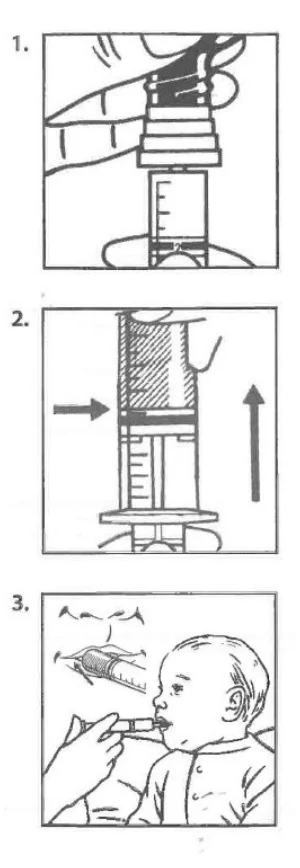
- 1. Open the bottle: Press the cap and turn it anticlockwise.
When using for the first time remove the pouring ring (round plastic insert) and insert the syringe adaptor into the bottle neck. Take the syringe and put it into the adaptor opening.
Turn the bottle upside down.
- 2. Draw out medicine SLOWLY to required dose mark by pulling the piston down. If there are air bubbles in the syringe, repeat until bubbles are eliminated.
To measure dose accurately, line top of black ring to required dose mark. Place bottle upright on table and remove the syringe. Confirm dose accuracy.
- 3. Ensure patient is upright before giving medicine. Place the syringe inside the patient’s mouth.
WARNING: push the piston slowly to give time to swallow; rapid squirting of medicine may cause choking.
Recap bottle over adaptor.
Clean IMMEDIATELY the syringe after each administration using fresh, warm, soapy water. It is ESSENTIAL to draw the piston in and out several times until all traces of medicine are removed from inside tip. Let it dry before you use it again.
Instructions for using 30 ml graduated measuring cup
DO NOT insert the bottle adaptor if the measuring cup is to be used, keep the pouring ring (round plastic insert) in the bottle neck.
If you take more Clobazam Essential Pharmaceuticals than you should
If you take more Clobazam Essential Pharmaceuticals than you should, tell your doctor or go to your nearest hospital casualty department immediately, also take the medicine pack with you. Do not drive yourself because you may experience symptoms such as sleepiness, drowsiness, or confusion. In more serious cases you may experience muscle weakness, low blood pressure and breathing difficulties. In very rare cases it may cause coma and even be life threatening.
If you forget to take Clobazam Essential Pharmaceuticals
If you forget to take a dose take it as soon as you remember unless it is almost time for the next one, then carry on as before. Do not take a double dose to make up for a forgotten dose.
If you stop taking Clobazam Essential Pharmaceuticals
Do not stop taking your medicine without telling your doctor as he may gradually reduce your dose before stopping it completely. If stopped suddenly, you may experience worsening of the symptoms you were originally being treated for, as well as mood changes, anxiety, sleep disturbance, headache, increased dreaming, tension, confusion, excitability, hallucinations, muscle pain, numbness of the limb tingling, sweating, tremor, nausea, sensitivity to light, sound and physical contact or restlessness (see section 2 “Dependence, tolerance and withdrawal”).
If you have any further questions on the use of this medicine, ask your doctor, pharmacist or nurse.
4. Possible side effects
Like all medicines, this medicine can cause side effects, although not everybody gets them.
Serious side effects
Tell your doctor immediately if you have any of the following side effects.
Common side effects (may affect up to 1 in 10 people):
- Feeling irritable or restless.
Uncommon side effects (may affect up to 1 in 100 people):
- Poor memory (amnesia) or showing unusual behaviour.
- Nightmares.
- Feeling anxious.
- Believing things which are not true (delusions).
- Increased possibility of tripping or falling, especially in elderly patients.
Not Known (frequency cannot be estimated from the available data):
- Sleeping problems that get worse after taking this medicine.
- Sensing things which are not there (hallucinations).
- Being less aware of your environment, especially in the elderly.
- Feeling suicidal.
- Blistering or bleeding of the skin around the lips, eyes, mouth, nose and genitals. Also flu-like symptoms and fever. This may be something called “Stevens-Johnson Syndrome”.
- A severe blistering rash where layers of the skin may peel off to leave large areas of raw exposed skin over the body. Also, a feeling of being generally unwell, fever, chills and aching muscles. This is something called “Toxic Epidermal Necrolysis”.
If you get any of the above side effects, your doctor may decide that your treatment needs to be stopped.
Other side effects
Tell your doctor or pharmacist if any of the following side effects get serious or lasts longer than a few days, or if you notice any side effects not listed in this leaflet.
Very common side effects (may affect more than 1 in 10 people):
- Difficulty in staying awake or alert
- Feeling tired
Common side effects (may affect up to 1 in 10 people):
- Feeling sleepy or dizzy
- Feeling agitated or being aggressive.
- Depression.
- Headache.
- Short attention span.
- Difficulty in speaking.
- Shaking fingers (tremor).
- Problems with walking or other movement problems.
- Dry mouth, constipation.
- Loss of appetite, feeling sick (nausea).
- Reduced effect of medicine (especially in long term use).
Uncommon side effects (may affect up to 1 in 100 people):
- Loss of sexual drive when used for long time or with high doses and is reversible.
- Memory difficulties, confusion.
- Double vision.
- Skin rash. - Weight gain.
- Loss of emotion.
Rare:
- Muscle weakness.
Not known (frequency cannot be estimated from available data):
- Becoming dependent on Clobazam Essential Pharmaceuticals Oral Suspension ('physical or mental dependence') (especially in long term use).
- A feeling of being out of touch with reality and being unable to think or judge clearly (psychosis).
- Feeling angry.
- Changes in the way you walk.
- Breathing problems.
- Sensitivity to sunlight.
- Itchy, lumpy rash (urticaria).
- Muscle spasms.
- Reacting to things more slowly than usual.
- Rapid uncontrollable movement of the eyes.
- Learning problems.
- Abnormally low body temperature.
If you take this medicine for a long time, you are more likely to get the following side effects:
anxiety, confusion, depression, loss of appetite and difficulty sleeping.
Reporting of side effects
If you get any side effects, talk to your doctor, pharmacist or nurse. This includes any possible side effects not listed in this leaflet. You can also report side effects directly via the Yellow Card Scheme Website: www.mhra.gov.uk/yellowcard or search for MHRA Yellow Card in the Google Play or Apple App Store. By reporting side effects you can help provide more information on the safety of this medicine.
5. How to store Clobazam Essential Pharmaceuticals
Keep this medicine out of the sight and reach of children.
Do not use this medicine after the expiry date which is stated on the label and carton after EXP. The expiry date refers to the last day of that month.
Do not freeze.
Do not throw away any medicines via wastewater or household waste. Ask your pharmacist how to throw away medicines you no longer use. These measures will help protect the environment.
6. Contents of the pack and other information
What Clobazam Essential Pharmaceuticals contains
- The active substance is clobazam. Each 1 ml suspension contains 1 mg clobazam.
- The other ingredients are glycerol (E 422), hydroxyethylcellulose, sodium benzoate (E 211), citric acid monohydrate, colloidal anhydrous silica, polysorbate 80 and purified water. (See end of Section 2 for further information on sodium benzoate (E 211) and sodium).
What Clobazam Essential Pharmaceuticals looks like and contents of the pack
Clobazam Essential Pharmaceuticals is a colourless, clear to slightly hazy suspension.
Clobazam Essential Pharmaceuticals is available in a 150 ml amber glass bottle with a child-resistant cap and a 30 ml measuring cup, a 3 ml oral syringe and a syringe adapter. Marketing Authorisation Holder Essential Pharmaceuticals Limited, 8a Crabtree Road, Egham, Surrey, TW20 8RN, United Kingdom. Manufacturer Delpharm Bladel B.V., Industrieweg 1, 5531 AD Bladel, The Netherlands. This medicinal product is authorised in the Member States of the European Economic Area and in the United Kingdom (Northern Ireland) under the following names:
Austria Clobazam 1 mg/ml Suspension zum Einnehmen
Belgium Clobazam Essential Pharmaceuticals 1 mg/ml suspension buvable
Denmark Clobazam Essential Pharmaceuticals
Finland Clobazam Essential Pharmaceuticals 1 mg/ml oraalisuspensio
Ireland Clobazam 1 mg/ml oral suspension
Luxemburg Clobazam Essential Pharmaceuticals 1 mg/ml suspension buvable
The Netherlands Clobazam Essential Pharmaceuticals 1 mg/ml, suspensie voor oral gebruik
Norway Clobazam Essential Pharmaceuticals 1 mg/ml mikstur, suspensjon
United Kingdom (Northern Ireland) Clobazam Essential Pharmaceuticals 1 mg/ml Oral Suspension