

Patient leaflet - Capsorin 100 mg/ml oral solution
1. What Capsorin is and what it is used for
What Capsorin is
The name of your medicine is Capsorin. It contains the active substance ciclosporin. This belongs to a group of medicines known as immunosuppressive agents. These medicines are used to lower the body’s immune reactions.
What Capsorin is used for and how Capsorin works
- If you have had an organ transplant, bone marrow and stem cell transplantation, the function of Capsorin is to control your body’s immune system. Capsorin prevents rejection of transplanted organs by blocking the development of certain cells which would normally attack the transplanted tissue.
- If you have an autoimmune disease, in which your body’s immune response attacks your body’s own cells, Capsorin stops this immune reaction. Such diseases include eye problems which threaten your vision (endogenous uveitis, including Behçet's uveitis), severe cases of certain skin diseases (atopic dermatitis, or eczema and psoriasis), severe rheumatoid arthritis and a kidney disease called nephrotic syndrome.
2. What you need to know before you take Capsorin
If you are taking Capsorin following a transplant it will only be prescribed for you by a doctor with experience in transplants and/or autoimmune diseases.
The advice in this leaflet may vary depending on whether you are taking the medicine for a transplant or for an autoimmune disease.
Follow all your doctor’s instructions carefully. They may differ from the general information contained in this leaflet.
Do not take Capsorin:
- if you are allergic to ciclosporin or any of the other ingredients of this medicine (listed in section 6)
- with products containing Hypericum perforatum (St. John’s Wort)
- with products containing dabigatran etexilate (used to avoid blood clots after surgery) or bosentan and aliskiren (used to reduce high blood pressure).
Do not take Capsorin and tell your doctor if the above applies to you. If you are not sure, talk to your doctor before taking Capsorin.
Warnings and precautions
Before and during treatment with Capsorin, tell your doctor straight away:
- if you have any signs of infection, such as fever or a sore throat. Capsorin suppresses the immune system and may also affect your body’s ability to fight against infection.
- if you have liver problems.
- if you have kidney problems. Your doctor will carry out regular blood tests and may change your dose if necessary.
- if you develop high blood pressure. Your doctor will check your blood pressure regularly and may give you a medicine to lower blood pressure if necessary.
- if you have low levels of magnesium in your body. Your doctor may give you magnesium supplements to take, especially just after your operation if you have had a transplant.
- if you have high levels of potassium in your blood.
- if you have gout.
- if you need to have a vaccination.
If any of the above applies to you before or during treatment with Capsorin, tell your doctor straight away.
Sunlight and sun protection
Capsorin suppresses your immune system. This increases your risk of developing cancers, particularly of the skin and lymphoid system. You should limit your exposure to sunlight and UV light by:
- Wearing appropriate protective clothing.
- Often applying a sunscreen with a high protection factor.
Talk to your doctor before taking Capsorin:
- if you have or have had alcohol-related problems.
- if you have epilepsy.
- if you have any liver problems.
- if you are pregnant.
- if you are breast-feeding.
- if this medicine is being prescribed for a child.
If any of the above apply to you (or you are not sure), tell your doctor before taking Capsorin. This is because this medicine contains alcohol (see section below “Capsorin contains ethanol”).
Monitoring during your treatment with Capsorin
- Your doctor will check:
- the levels of ciclosporin in your blood, especially if you have had a transplant,
- your blood pressure before the start of your treatment and regularly during treatment,
- how well your liver and kidneys are working,
- your blood lipids (fats).
If you have any questions about how Capsorin works or why this medicine has been prescribed for you, ask your doctor.
In addition, if you are taking Capsorin for a non-transplant disease (intermediary or posterior uveitis and Behçet's uveitis, atopic dermatitis, severe rheumatoid arthritis or nephroticsyndrome), do not take Capsorin:
- if you have kidney problems (except for nephrotic syndrome).
- if you have an infection which is not under control with medication.
- if you have any type of cancer.
- if you have high blood pressure (hypertension) which is not under control with medication. If you get high blood pressure during treatment and it cannot be controlled, Capsorin should be stopped by your doctor.
Do not take Capsorin if any of the above applies to you. If you are not sure, talk to your doctor or pharmacist before taking Capsorin.
If you are being treated for Behçet`s uveitis, your doctor will monitor you particularly carefully if you have neurological symptoms (for example: increased forgetfulness, personality changes noticed over time, psychiatric or mood disorders, burning sensation in limbs, decreased sensation in limbs, tingling sensation in limbs, weakness of limbs, walking disturbances, headache with or without nausea and vomiting, vision disturbances including restricted movement of eyeball).
Your doctor will closely monitor you if you are elderly and are being treated for psoriasis or atopic dermatitis. If you have been prescribed Capsorin to treat your psoriasis or atopic dermatitis, you must not be exposed to any UVB-rays or phototherapy during treatment.
Children and adolescents
Capsorin should not be given to children for a non-transplant disease, except for treatment of nephrotic syndrome.
Elderly population (65 years of age and older)
There is limited experience with Capsorin in elderly patients. Your doctor should monitor how well your kidneys work. If you are over 65 and have psoriasis or atopic dermatitis, you should only be treated with Capsorin if your condition is particularly severe.
Other medicines and Capsorin
Tell your doctor or pharmacist if you are taking, have recently taken or might take any other medicines.
In particular tell your doctor or pharmacist if you are taking any of the following medicines before or during Capsorin treatment:
- Medicines that may affect your potassium levels. These include medicines which contain potassium, potassium supplements, water tablets (diuretics) called potassium-sparing diuretics and some medicines which lower your blood pressure.
- Methotrexate. This is used to treat tumours, severe psoriasis and severe rheumatoid arthritis.
- Medicines which may increase or decrease the level of ciclosporin (the active substance of Capsorin) in your blood. Your doctor might check the level of ciclosporin in your blood when starting or stopping treatment with other medicines.
- Medicines which may increase the level of ciclosporin in your blood include: antibiotics (such as erythromycin or azythromycin), anti-fungals (voriconazole, itraconazole), medicines used for heart problems or high blood pressure (diltiazem, nicardipine, verapamil, amiodarone), metoclopramide (used to stop sickness), oral contraceptives, danazol (used to treat menstrual problems), medicines used to treat gout (allopurinol), cholic acid and derivatives (used to treat gallstones), protease inhibitors used to treat HIV, imatinib (used to treat leukaemia or tumours), colchicine, telaprevir (used to treat hepatitis C), Cannabidiol (uses amongst others include treatment of seizures).
- Medicines which may decrease the level of ciclosporin in your blood include: barbiturates (used to help you to sleep), some anti-convulsant medicines (such as carbamazepine or phenytoine), octreotide (used to treat acromegaly or neuroendocrine tumours in the gut), anti-bacterial medicines used to treat tuberculosis, orlistat (used to help weight loss), herbal medicines containing St. John’s wort, ticlopidine (used after a stroke), certain medicines which lower blood pressure (bosentan), and terbinafine (an anti-fungal medicine used to treat infections of the toes and nails).
Medicines which may affect your kidneys. These include: anti-bacterial medicines
(gentamycin, tobramycin, ciprofloxacin), anti-fungal medicines which contain amphotericin B, medicines used for urinary tract infections which contain trimethoprim, medicines for cancer which contain melphalan, medicines used to lower the amount of acid in your stomach (acid secretion inhibitors of the H2-receptor antagonist type), tacrolimus, pain killers (non-steroid anti-inflammatory medicines such as diclofenac), fibric acid medicines (used to lower the amount of fat in the blood).
- Nifedipine. This is used to treat high blood pressure and heart pain. You might get swollen gums that might grow over your teeth if you are taking nifedipine during your treatment with ciclosporin.
- Digoxin (used to treat heart problems), medicines which lower cholesterol (HMG-CoA reductase inhibitors also called statins), prednisolone, etoposide (used to treat cancer), repaglinide (oral anti diabetic medicine), immunosuppressives (everolimus, sirolimus), ambrisentan and specific anti-cancer medicines called anthracyclines (such as doxorubicin).
Mycophenolate sodium or mycophenolate mofetil (an immunosuppressant) and eltrombopag
(used to treat bleeding disorders)
If any of the above applies to you (or you are not sure), talk to your doctor or pharmacist before taking Capsorin.
Capsorin with food and drink
Do not take Capsorin with grapefruit or grapefruit juice. This is because these can affect how Capsorin works.
Pregnancy and breast-feeding
Ask your doctor or pharmacist for advice before taking this medicine.
Tell your doctor if you are pregnant or intend to become pregnant. Experience with
Capsorin in pregnancy is limited. In general, Capsorin should not be taken during pregnancy. If it is necessary for you to take this medicine, your doctor will discuss with you the benefits and potential risks of taking it during pregnancy. Tell your doctor if you are breast-feeding. Breast-feeding is not recommended during treatment with ciclosporin. This is because ciclosporin, the active substance, passes into breast milk. This may affect your baby.
Hepatitis C
Tell your doctor if you have hepatitis C. Your liver function may change with treatment of hepatitis C and this may affect the levels of ciclosporin in your blood. Your doctor may need to closely monitor ciclosporin blood levels and make adjustments to the dose after you start treatment for hepatitis C.
Driving and using machines
You may feel sleepy, disoriented, or have blurred vision after taking Capsorin. Be careful driving or operating machinery while you are taking Capsorin until you know how it affects you.
Capsorin contains ethanol
Capsorin contains 12.7 vol% ethanol (alcohol), i.e. up to 525 mg per dose. The amount in this medicine is equivalent to less than 13ml beer or 6ml wine. The small amount of alcohol in this medicine will not have any noticeable effects.
Capsorin contains Macrogolglycerol hydroxystearate
Capsorin contains Macrogolglycerol hydroxystearate which may cause stomach upset and diarrhea.
3. How to take Capsorin
Always take this medicine exactly as your doctor has told you. Check with your doctor or pharmacist if you are not sure.
Do not take more than the recommended dose.
The dose of this medicine will be carefully adjusted to your individual needs by your doctor. Too much of the medicine can affect your kidneys. You will have regular blood tests and visits to the hospital, especially after a transplant. This will give you the chance to talk to your doctor about your treatment and talk about any problems you may be having.
How much Capsorin to take
Your doctor will work out the correct dose of Capsorin for you. This depends on your body weight and what you are taking the medicine for. Your doctor will also tell you how often to take your medicine.
In adults:
Organ, bone marrow and stem cell transplantation
- The total dose each day is usually between 2 mg and 15 mg per kilogram body weight. This is divided in two doses.
- Usually, higher doses are used before and just after your transplant. Lower doses are used once your transplanted organ or bone marrow has stabilised.
- Your doctor will adjust your dose to one that is ideal for you. To do this, your doctor may need to do some blood tests.
Endogenous uveitis
- The total dose each day is usually between 5 mg and 7 mg per kilogram body weight. This is divided in two doses.
Nephrotic syndrome
- The total dose each day for adults is usually 5 mg per kilogram body weight. This is divided in two doses. In patients with kidney problems, the first dose taken each day should not be more than 2.5 mg per kilogram body weight.
Severe rheumatoid arthritis
- The total dose each day is usually between 3 mg per kilogram of your body weight and 5 mg per kilogram body weight. This is divided in two doses.
Psoriasis and atopic dermatitis
- The total dose each day is usually between 2.5 mg per kilogram of your body weight and 5 mg per kilogram body weight. This is divided in two doses.
In children:
Nephrotic syndrome
- The total dose each day for children is usually 6 mg per kilogram body weight. This is divided in two doses. In patients with kidney problems, the first dose taken each day should not be more than 2.5 mg per kilogram body weight.
Follow your doctor's instructions exactly and never change the dose yourself, even if you feel well.
Switch from oral Ciclosporin to Capsorin
You may have already been taking another medicine, Ciclosporin soft gelatin capsules or Ciclosporin oral solution. Your doctor may decide to change to this medicine, Capsorin oral solution.
- These medicines all contain ciclosporin as the active ingredient.
- Capsorin is a different, improved formulation of ciclosporin compared to other oral Ciclosporin. Ciclosporin is absorbed into your blood better with Capsorin and absorption is less likely to be affected by taking the medicine with food. This means that the levels of ciclosporin in your blood stay more constant with Capsorin than with Ciclosporin soft gelatin capsules.
If your doctor changes you from oral Ciclosporin to Capsorin:
- Do not go back to taking the oral Ciclosporin unless your doctor tells you to.
- Following your transfer from the oral Ciclosporin to Capsorin, your doctor will monitor you more closely for a short time. This is because of the change in how ciclosporin is absorbed into your blood. Your doctor will make sure that you get the right dose for your individual needs.
- You may have some side effects. If this happens, tell your doctor or pharmacist. Your dose may need to be lowered. Never lower your dose yourself, unless a doctor has told you to.
If your doctor switches you from one oral formulation of ciclosporin to another
After you change from one oral formulation of ciclosporin to another:
- Your doctor will monitor you more closely for a short time.
- You may have some side effects. If this happens, tell your doctor or pharmacist. Your dose may need to be changed. Never change your dose yourself unless a doctor has told you to.
When to take Capsorin
Take Capsorin at the same time every day. This is very important if you have had a transplant.
How to take Capsorin
Your daily doses should always be taken in 2 divided doses.
- For initial use, follow steps 1 to 9.
- For subsequent use, follow steps 5 to 9.
Starting a new bottle of Capsorin oral solution
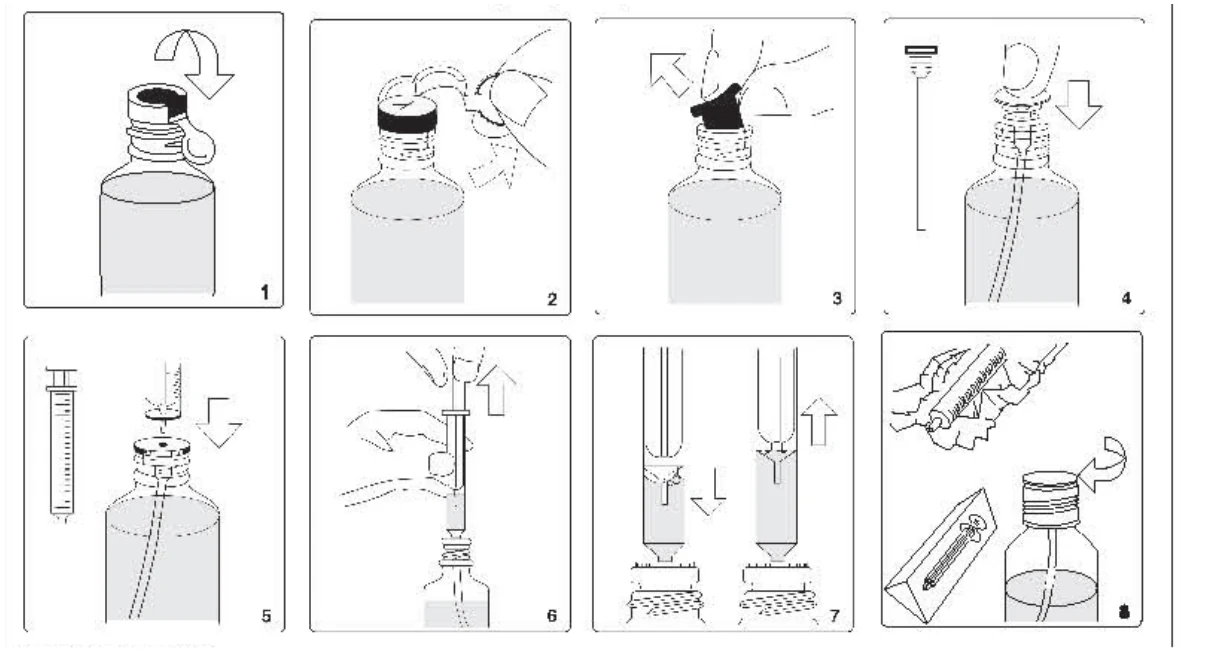
- 1) Lift the flap in the center of the metal sealing ring.
- 2) Tear off the sealing ring completely.
- 3) Take off the grey stopper and throw it away.
- 4) Push the tube unit with the white stopper firmly into the neck of the bottle.
Measuring your dose
- 5)
Choose the syringe depending on how much medicine you need to measure:
- For 1 ml or less of medicine, use the 1 ml syringe.
- For more than 1 ml of medicine, use the 4 ml syringe.
Push the nozzle of the syringe into the white stopper.
- 6)
Pull up the plunger until you have drawn up the correct amount of medicine.
- The lower part of the plunger ring needs to be in front of the mark on the syringe which shows the amount of medicine.
- 7)
Push down and pull up the plunger a few times.
- This will get rid of any large air bubbles. It does not matter if there are a few tiny bubbles in the syringe. This will not affect the dose in any way. Ensure that the correct amount of medicine is in the syringe. Then, take the syringe out of the bottle
- 8)
Push the medicine out of the syringe into a small glass containing liquid, preferably orange or apple juice.
- Make sure that the syringe does not touch the liquid in the glass.
- Stir and drink the whole contents of the glass straight away.
- 9)
After use, wipe the syringe on the outside only with a dry tissue.
- Then, put the syringe back in its cover.
- Leave the white stopper and tube in the bottle.
- Close the bottle with the cap provided.
How long to take Capsorin
Your doctor will tell you how long you need to take Capsorin for. This depends on whether you are taking it after a transplant or for the treatment of a severe skin condition, rheumatoid arthritis, uveitis or nephrotic syndrome. For severe rash, the treatment usually lasts for 8 weeks.
Keep taking Capsorin for as long as your doctor tells you.
If you have questions about how long to take Capsorin, talk to your doctor or your pharmacist.
If you take more Capsorin than you should
If you accidentally take too much of your medicine, tell your doctor immediately or go to your nearest hospital emergency unit. You may need medical attention.
If you forget to take Capsorin
- If you forget to take a dose, take it as soon as you remember it. However, if it is almost time for your next dose, skip the missed dose. Then go on as before.
- Do not take a double dose to make up for a forgotten dose.
If you stop taking Capsorin
Do not stop taking Capsorin unless your doctor tells you to.
Keep taking Capsorin even if you feel well. Stopping your treatment with Capsorin may increase the risk of your transplanted organ being rejected.
If you have any further questions on the use of this medicine, ask your doctor or pharmacist.
4. Possible side effects
Like all medicines, this medicine can cause side effects, although not everybody gets them.
Some side effects could be serious
Tell your doctor straight away if you notice any of the following serious side effects:
- Like other medicines that act on the immune system, ciclosporin may influence your body’s ability to fight against infection and may cause tumours or other cancers, particularly of the skin. Signs of infection might be fever or sore throat.
- Changes in your sight, loss of coordination, being clumsy, memory loss, difficulty speaking or understanding what others say, and muscle weakness. These might be signs of an infection of the brain called progressive multifocal leukoencephalopathy.
- Brain problems with signs such as seizures, confusion, feeling disorientated, being less responsive, personality changes, feeling agitated, sleeplessness, changes to your sight, blindness, coma, paralysis of part or all of the body, stiff neck, loss of coordination with or without unusual speech or eye movements.
- Swelling at the back of the eye. This may be associated with blurred vision. It may also affect your sight because of the higher pressure inside your head (benign intracranial hypertension).
- Liver problems and damage with or without yellow skin and eyes, nausea, loss of appetite and dark urine.
- Kidney problems which may greatly reduce the amount of urine you produce.
- Low level of red blood cells or platelets. The signs include pale skin, feeling tired, being breathless, having dark urine (this is a sign of the breakdown of red blood cells), bruising or bleeding with no obvious reasons, feeling confused, feeling disorientated, being less alert and having kidney problems.
Other side effects include:
Very common: may affect more than 1 in 10 people
- Kidney problems.
- High blood pressure.
- Headache.
- Shaking of your body which you cannot control.
- Excessive growth of body and facial hair.
- High level of lipids in your blood.
If any of these affects you severely, tell your doctor.
Common: may affect up to 1 in 10 people
- Fits (seizures).
- Liver problems.
- High level of sugar in your blood.
- Tiredness.
- Loss of appetite.
- Nausea (feeling sick), vomiting, abdominal discomfort/pain, diarrhoea.
- Excessive hair growth.
- Acne, hot flushes.
- Fever.
- Low level of white blood cells.
- Feeling numb or tingling.
- Pain in your muscles, muscle spasm.
- Stomach ulcer.
- Gum tissue overgrowing and covering your teeth.
- High level of uric acid or potassium in your blood, low levels of magnesium in your blood.
If any of these affects you severely, tell your doctor.
Uncommon: may affect up to 1 in 100 people
- Symptoms of brain disorders including sudden fits, mental confusion, sleeplessness, disorientation, disturbance of vision, unconsciousness, sense of weakness in the limbs, impaired movements.
- Rash.
- General swelling.
- Weight gain.
- Low level of red blood cells, low level of platelets in your blood which could increase the risk of bleeding.
If any of these affects you severely, tell your doctor.
Rare: may affect up to 1 in 1,000 people
- Nerve problems with numbness or tingling in fingers and toes.
- Inflammation of the pancreas with severe upper stomach pain.
- Muscle weakness, loss of muscle strength, pain in muscles of the legs or hands or anywhere in the body.
- Destruction of red blood cells, involving kidney problems with symptoms such as swelling of the face, stomach, hands and/or feet, decreased urination, breathing difficulty, chest pain, fits, unconsciousness.
- Changes in menstrual cycle, breast enlargement in men.
If any of these affects you severely, tell your doctor.
Very rare: may affect up to 1 in 10,000 people
- Swelling at the back of the eye which may be associated with an increase in pressure inside the head and eyesight disturbances.
If this affects you severely, tell your doctor.
Not known: Frequency cannot be estimated from the available data.
Serious liver problems both with and without yellowing of the eyes or skin, nausea
(feeling sick), loss of appetite, dark coloured urine, swelling of the face, feet, hands and/or the whole body.
- Bleeding underneath the skin or purple skin patched, sudden bleeding with no apparent cause.
- Migraine or severe headache often with feeling and being sick (nausea, vomiting) and being sensitive to light.
- Pain in legs and feet.
- Hearing impairment
If any of these affects you severely, tell your doctor.
If you get any side effects, talk to your doctor or pharmacist. This includes any possible side effects not listed in this leaflet.
Additional side effects in children and adolescents
There are no additional side effects to be expected in children and adolescents compared to adults.
If you get any side effects, talk to your doctor, pharmacist or nurse. This includes any possible side effects not listed in this leaflet. You can also report side effects directly via the Yellow Card Scheme at: www.mhra.gov.uk/yellowcard or search for MHRA Yellow Card in the Google Play or Apple App Store.
By reporting side effects you can help provide more information on the safety of this medicine.
5. How to store Capsorin
Keep this medicine out of the sight and reach of children.
Do not store above 25ºC.
Do not use this medicine after the expiry date which is stated on the label, after EXP. The expiry date refers to the last day of that month.
The oral solution should be used within 2 months, after the bottle has been opened.
Do not throw away any medicines via wastewater or household waste. Ask your pharmacist how to throw away medicines you no longer use. These measures will help protect the environment.
6. Contents of the pack and other information
What Capsorin contains
- The active substance is ciclosporin. Each ml of oral solution contains 100 mg of ciclosporin.
- The other ingredients are Ethanol anhydrous, Tocopherol acetate, Dyethylene glycol monoethyl ether, Oleoyl macrogolglycerides, Macrogolglycerol hydroxystearate.
What Capsorin looks like and contents of the pack:
Capsorin 100 mg/ml oral solution is a clear and transparent solution, packed in amber glass bottles with plastic cover and aluminium cap. It comes with a disperser set for adult and another for children.
Capsorin 100 mg/ml oral solution is available in a pack size of 1 bottle of 50 ml.
Marketing Authorisation Holder
Morningside Healthcare Ltd
115 Narborough Road
Leicester, LE3 0PA
UK
Manufacturers
Sofarimex – Indústria Química e Farmacêutica, S.A.
Av. das Indústrias
Alto de Colaride, Agualva, 2735-213 Cacém
Portugal
MonteResearch
Viale Vittorio Veneto 4, Milan
Italy
This leaflet was last revised in January 2026
This medicinal product is authorised in the Member States of the EEA under the following names:
Portugal: Ciclosporina Generis
United Kingdom: Capsorin 100 mg/ml oral solution