

Patient leaflet - Beconase Allergy/hayfever
1. What Beconase Hayfever is and what it is used for
Beconase Hayfever contains the active substance beclometasone dipropionate.
Beconase Hayfever is used to prevent and treat the common symptoms of allergic rhinitis, including hayfever such as sneezing and runny, itchy or blocked-up nose.
The active ingredient is beclometasone dipropionate, a corticosteroid which, when used every day, has an anti-inflammatory action and works in a similar way to natural body chemicals to control inflammation. This nasal spray helps to control your body’s reaction to allergens (“triggers”) in the environment.
You must talk to a doctor if you do not feel better or if you feel worse after 14 days.
2. What you need to know before you use Beconase Hayfever
Do not use Beconase Hayfever:
- If you are allergic to beclometasone dipropionate or any of the other ingredients (listed in section 6).
- If you are under 18 years.
Warnings and precautions
Talk to your doctor or pharmacist before using Beconase Hayfever:
- if you have an infection or ulcers in your nose, or if you have recently had surgery or an injury to your nose.
- if your symptoms do not improve within 14 days, talk to your doctor or pharmacist.
- Do not use for more than 3 months unless your doctor tells you to.
Contact your doctor if you experience blurred vision or other visual
disturbances.
Other medicines and Beconase Hayfever
Tell your doctor or pharmacist if you are taking, have recently taken or might take any other medicines.
- particularly corticosteroid medicines (including eczema creams, asthma inhalers, tablets, injections, nasal sprays, and eye or nose drops).
- including medicines obtained without a prescription.
Some medicines may increase the effects of Beconase Hayfever and your doctor may wish to monitor you carefully if you are taking these medicines (including some medicines for HIV: ritonavir, cobicistat).
Pregnancy and breast-feeding
If you are pregnant or breast-feeding, think you may be pregnant or are planning to have a baby, ask your doctor or pharmacist for advice before using this medicine.
Driving and using machines
Beconase Hayfever is unlikely to affect you being able to drive or use any tools or machines.
Beconase Hayfever contains benzalkonium chloride
Beconase Hayfever contains benzalkonium chloride which may cause irritation or swelling inside the nose, especially if used for a long time. Benzalkonium chloride may cause wheezing and breathing difficulties (bronchospasm), especially if you have asthma.
3. How to use Beconase Hayfever
Always shake well before use. Only use in the nose. Do not swallow. Beconase hayfever quickly starts to reduce inflammation and swelling in your nose, although it may take 2 or 3 days to build up to its maximum protective effect. To prevent symptoms starting, start to use Beconase Hayfever two or three days before exposure to one of your usual ‘triggers’. You should use the spray regularly to get the best results from it.
Adults aged 18 years and over:
Spray two puffs into each nostril every morning and evening.
Once your symptoms have improved, you may be able to reduce the dose to one spray into each nostril every morning and evening.
- Do not use more than 8 sprays (400 micrograms) in a day.
- Use the lowest dose possible to control your symptoms
- If your symptoms do not improve within 14 days, talk to your doctor or pharmacist.
- Do not use more than the recommended dose.
If you use more Beconase Hayfever than you should
Tell your doctor.
If you forget to use Beconase Hayfever
Use your next dose at the usual time. Do not use a double dose to make up for a forgotten dose.
Before using a new bottle of Beconase Hayfever
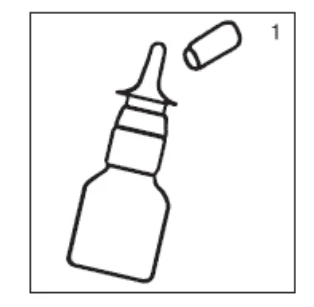
- Your Beconase Hayfever spray has a dust cap which protects the nozzle and keeps it clean. Remember to take it off before you use the spray (Picture 1).
- Before you start to use a new bottle of Beconase Hayfever, or if you have not used the spray for a few days, press the pump down several times until you get a fine spray.
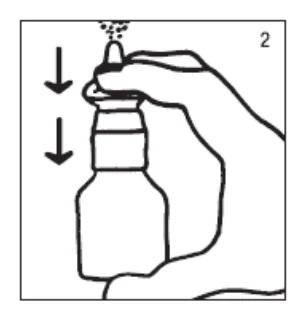
- Hold the bottle as shown with your forefinger and middle finger on the collar either side of the nozzle and your thumb underneath the bottle.
- Keeping your thumb still, press down with your fingers to pump the spray (Picture 2).
- When doing this make sure you do not point the nozzle at yourself or someone else.
- If the spray still doesn't work, try to clean it as described under the ‘To clean the spray’ section. Do not try to unblock or enlarge the tiny spray hole with a pin or other sharp objects because this will destroy the spray mechanism.
Using Beconase Hayfever
- 1. Shake the bottle well and remove the dust cap.
- 2. Blow your nose gently.
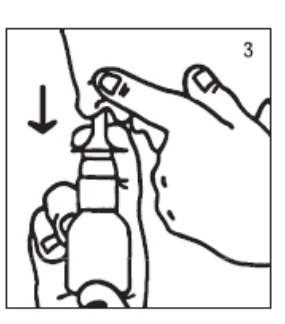
- 3. Close one nostril as shown and put the nozzle in the other nostril. Tilt your head forward slightly and keep the bottle upright. Hold the bottle as shown (Picture 3).
- 4. Start to breathe in slowly through your nose. While you are breathing in, squirt a spray of fine mist into your nostril by pressing down firmly on the collar with your fingers.
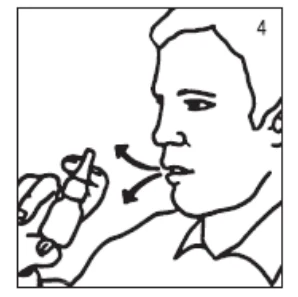
- 5. Breathe out through your mouth. Repeat step 4 in the same nostril for a second spray.
- 6. Remove the nozzle from this nostril and breathe out through your mouth (Picture 4).
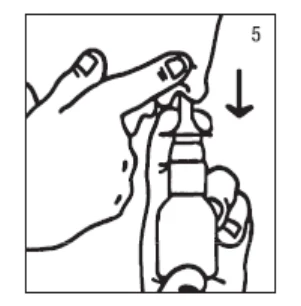
- 7. Repeat steps 3 to 6 for the other nostril (Picture 5).
- 8. After using the spray, wipe the nozzle carefully with a clean tissue or handkerchief and replace the dust cap.
To clean the spray:
- 1. Take the dust cap off.
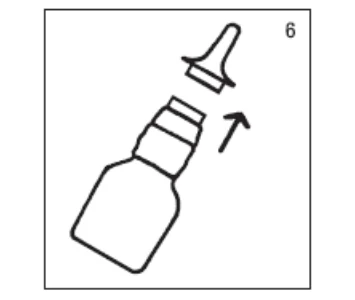
- 2. Pull upwards on the white collar to remove the nozzle (Picture 6)
- 3. Soak the nozzle and dust cap in warm water for a few minutes and then rinse under a running tap.
- 4. Shake off the excess water and allow to dry in a warm place- not too hot!
- 5. Re-fit the nozzle.
- 6. If necessary, press the pump down several times until you get a fine spray.
4. Possible side effects
Like all medicines, Beconase Hayfever can have side effects, but not everybody gets them.
Very rare side effects (may affect up to 1 in 10,000 people) reported with Beconase Hayfever include:
- Allergic reactions. These may include developing a rash, swelling of the mouth or face or having difficulty breathing
Rare side effects (may affect up to 1 in 1,000 people) reported with Beconase Hayfever include:
- Eye problems such as pain or blurred vision
- Nasal problems such as pain and /or persistent bleeding
- You may notice an unpleasant taste or smell
- Nose bleeds
Dryness or irritation in the nose or throat Frequency not known:
- Blurred vision.
It is important to follow the dose instructions shown in Section 3. Using Beconase Hayfever at higher doses or for longer than 3 months at a time can cause a number of changes in your body such as catching infections more easily.
Reporting of side effects: If you get any side effects, talk to your doctor, pharmacist or nurse. This includes any possible side effects not listed in this leaflet. You can also report side effects directly via the Yellow Card Scheme at: www.mhra.gov.uk/yellowcard or search for MHRA Yellow Card in the Google Play or Apple App Store.
By reporting side effects you can help provide more information on the safety of this medicine.
5. How to store Beconase Hayfever
Keep out of the sight and reach of children.
Do not use this medicine after the ‘EXP’ date shown on the pack.
Keep the container in the outer carton to protect from light.
Do not store above 25°C (77°F). Do not store in a fridge.
Use within three months of first use.
6. Contents of the pack and other information
What Beconase Hayfever contains
Active ingredient Each spray contains Beclometasone Dipropionate 50 micrograms.
Other ingredients Microcrystalline cellulose, sodium carboxymethylcellulose, dextrose, polysorbate 80, purified water, benzalkonium chloride and phenylethyl alcohol.
What Beconase Hayfever looks like and contents of the pack
The plastic bottle contains 180 aqueous nasal sprays.
The marketing authorization Holder is
Omega Pharma Ltd., Wrafton, Braunton, Devon, EX33 2DL, UK and all enquiries should be sent to this address.
The manufacturers are
Richard Bittner GmbH, Ossiacherstraße 7, 9560 Feldkirchen in Kärten, Austria.
This leaflet was last revised in July 2026
The information in this leaflet only applies to Beconase Hayfever.