


Summary of Product Characteristics (SmPC) - Anthrax vaccine adsorbed, Biothrax suspension for injection in Multi-dose vial
1 NAME OF THE MEDICINAL PRODUCT
BioThrax suspension for injection.
Anthrax Vaccine Adsorbed (purified cell-free filtrate)
2 QUALITATIVE AND QUANTITATIVE COMPOSITION
One dose (0.5 mL) contains:
Anthrax antigen filtrate: 50 micrograms (50 mcg) a, b
For a full list of excipients, see Section 6.1.
a Produced from cell-free filtrates of an avirulent strain of Bacillus anthracis b Adsorbed on aluminium hydroxide, hydrated (0.6 mg Al3+)
3 PHARMACEUTICAL FORM
Suspension for injection.
Sterile, milky-white liquid suspension, when mixed.
4 CLINICAL PARTICULARS
4.1 Therapeutic indications
BioThrax is indicated for the prevention of disease caused by Bacillus anthracis, in adults at risk of exposure.
BioThrax should be used in accordance with official recommendations, where available.
4.2 Posology and method of administration
Posology:
Primary Immunisation: 3-doses each of 0.5 mL, given at 0, 1 and 6 months.
Booster: 0.5 mL at three-year intervals OR as per official recommendations.
Method of administration:
The vaccine is given by deep intramuscular (IM) injection in the deltoid region. The vaccine may be given by the subcutaneous injection (SC) when medically indicated (for example, in persons with coagulation disorders) using the same posology.
Separate injection sites must be used if more than one vaccine is administered at the same time.
The vaccine must not be mixed with other vaccines in the same syringe.
For instructions on handling of vaccine before administration, see Section 6.6.
4.3 Contraindications
Hypersensitivity to the active substance or to any of the excipients listed in Section 6.1
4.4 Special warnings and precautions for use
As with other vaccines, administration of BioThrax should be postponed in subjects suffering from an acute severe febrile illness. The presence of a minor infection, such as a cold, should not result in deferral of vaccination.
Do not inject intravascularly.
When administered subcutaneously there is a higher incidence of injection site adverse reaction compared to intramuscular administration.
Before administration, the person’s medical immunisation history should be reviewed for possible vaccine sensitivities and/or previous vaccination-related adverse events, in order to determine the existence of any contraindications to immunisation.
As with all injectable vaccines, appropriate medical treatment and supervision should always be readily available in case of a rare anaphylactic event following administration of the vaccine.
Persons with impaired immune responsiveness due to congenital or acquired immunodeficiency, or immunosuppressive therapy may have reduced antibody responses to active immunisation. Vaccination during chemotherapy, high dose corticosteroid therapy of greater than 2-week duration, or radiation therapy may result in a suboptimal response. Deferral of vaccination for 3 months after completion of such therapy may be considered.
As with other vaccines, a protective immune response may not be elicited in all individuals.
The safety and efficacy of BioThrax in children have not been established.
The safety and efficacy of BioThrax in patients > 65 years have not been established.
The vial stopper may contain natural rubber latex. Although the risk of developing allergic reactions is very small, healthcare professionals should consider the benefit-risk prior to administering this vaccine to subjects with known history of hypersensitivity to latex.
4.5 Interaction with other medicinal products and other forms of interaction
Use with other vaccines:
BioThrax can be given concurrently with any of the following monovalent or combination vaccines; cholera, diphtheria, hepatitis A and B, influenza, Japanese encephalitis, measles, meningitis, mumps, pertussis, plague, polio, rabies, rubella, smallpox, tetanus, varicella and yellow fever.
There are no data on the effects of co-administration of BioThrax with other vaccines on the immune response.
When given concomitantly with other vaccines, BioThrax must be administered at separate injection sites (see Section 6.2).
Use with antibiotics:
BioThrax may be administered simultaneously with ciprofloxacin.
Other medicinal products:
The immunological response may be diminished if the patient is undergoing immunosuppressant treatment (see Section 4.4).
4.6 Fertility, pregnancy and lactation
Pregnancy:
BioThrax should not be used during pregnancy unless the potential benefits of vaccination clearly outweigh the potential risks to the foetus.
A retrospective controlled study reported congenital anomalies (e.g. foramen ovale) when mothers were inadvertently vaccinated during the first trimester of pregnancy.
No effects on pregnancy, maternal behaviour, female fertility, or postnatal development were observed in animal (rabbit) studies (see Section 5.3).
Breast-Feeding:
The effect on breastfed infants of administration of BioThrax to their mothers has not been studied. It is unknown whether BioThrax is excreted in human milk.
Fertility:
There are limited data on fertility in humans.
A retrospective controlled study of prior administration of BioThrax to the male partner at an in vitro fertilisation clinic demonstrated no effect on semen parameters, fertilisation rate, embryo quality, or clinical pregnancy rates.
There were no vaccine-related reproductive effects in studies in rabbits (see Section 5.3)
4.7 Effects on ability to drive and use machines
BioThrax has no or negligible influence on the ability to drive and use machines. However, some of the effects mentioned in Section 4.8 may temporarily affect the ability to drive or use machines.
4.8 Undesirable effects
Summary of safety profile:
The safety of BioThrax was evaluated in one controlled clinical study in 1,563 adults; 1,044 were assigned to treatment with between 1 and 8 intramuscular (IM) injections. The clinical study demonstrated that adverse reactions occurred less often after each successive IM dose administered. Further safety data was evaluated from post-market experience where over 14 million doses of BioThrax have been administered to over 3 million adults. The most common adverse reactions observed are injection site reactions, headache, muscle aches and fatigue.
Tabulated list of adverse reactions:
Adverse reactions (following primary immunisation or booster dose) considered as being at least possibly related to vaccination have been categorised by frequency. Frequencies are defined as follows:
Very common: ≥1/10
Common: ≥1/100, <1/10
Uncommon: ≥1/1,000, <1/100
Rare: ≥1/10,000, <1/1,000
Very rare: <1/10,000, including isolated reports
Not known: (cannot be estimated from the available data)
Within each frequency grouping, undesirable effects are presented in order of decreasing seriousness. In addition to reports in clinical trials, worldwide voluntary reports of adverse reactions received for BioThrax are included in the list. Since these reactions are voluntarily reported from an unknown population size, it is difficult to reliably determine frequency of events, thus these will be classified as “Not known”.
Table 1 Adverse Reactions from Clinical Trials and Post-Marketing Experience (Adults)
| System Organ Class | Frequency | Adverse Reactions |
| Infections and infestations | Common | Rhinitis, sinusitis, respiratory tract infection |
| Uncommon | Herpes zoster | |
| Neoplasms benign, malignant and unspecified (including cysts and polyps) | Rare | Breast ductal carcinoma |
| Blood and lymphatic system | Not known | Enlarged axillary lymph node |
| System Organ Class | Frequency | Adverse Reactions |
| disorders | ||
| Immune system disorders | Rare | Hypersensitivity (including difficulty breathing, weakness, hoarseness or wheezing, a fast heartbeat, hives, dizziness, paleness or swelling of the throat, lips or face.) |
| Very rare | Anaphylactic reaction | |
| Psychiatric disorders | Common | Insomnia |
| Nervous system disorders | Very common | Headache |
| Common | Dizziness | |
| Uncommon | Syncope | |
| Rare | Pseudotumor cerebri with bilateral papilloedema, aqueductal stenosis with generalised seizures | |
| Not known | Guillain-Barre syndrome, seizure, brachial radiculitis, somnolence | |
| Eye disorders | Uncommon | Eye allergy |
| Cardiac disorders | Uncommon | Heart rate increase |
| Not known | Palpitations, heart rate decreased | |
| Respiratory, thoracic and mediastinal disorders | Common | Cough |
| Uncommon | Respiratory tract congestion, dyspnea, sneezing | |
| Not known | Dysphonia | |
| Gastrointestinal disorders | Common | Nausea, dyspepsia |
| Uncommon | Upper abdominal pain, vomiting | |
| Not known | Diarrhoea, dysphagia | |
| Skin and subcutaneous tissue disorders | Common | Rash, pruritus |
| Rare | Cold sweat | |
| Not known | Angioedema, alopecia, eczema, dry skin | |
| Musculoskeletal and connective tissue disorders | Very common | Myalgia |
| Common | Arthralgia, back pain, neck pain | |
| Uncommon | Joint stiffness, musculoskeletal stiffness |
| System Organ Class | Frequency | Adverse Reactions |
| Rare | Rotator cuff syndrome | |
| Not known | Rhabdomyolysis | |
| Reproductive system and breast disorders | Uncommon | Dysmenorrhea |
General disorders and administration site conditions | Very common | Injection site pain (burning sensation immediately after the shot is given; pain causing decreased mobility of injected arm), injection site swelling, injection site induration, injection site erythema, injection site bruising, injection site pruritus, injection site warmth, fatigue |
| Common | Fever, chills, axillary pain | |
| Uncommon | Influenza-like illness, malaise, Injection site numbness/tingling | |
| Not known | Injection site urticaria |
Infants and children (up to 10 years of age)
The safety and efficacy of BioThrax in children have not been established.
Adolescents (from 11 years of age)
The safety and efficacy of BioThrax in adolescents have not been established.
Reporting of suspected adverse reactions
Reporting suspected adverse reactions after authorisation of the medicinal product is important. It allows continued monitoring of the benefit/risk balance of the medicinal product. Healthcare professionals are asked to report any suspected adverse reactions via the national reporting system:
Yellow Card Scheme
Website: www.mhra.gov.uk/yellowcard or search for MHRA Yellow Card in the Google Play or Apple App Store
4.9 Overdose
Experience of overdose is limited. In the event of overdose, monitoring of vital functions and possible symptomatic treatment is recommended.
5.1 Pharmacodynamic properties
Pharmacotherapeutic group: anthrax vaccines, ATC code: J07AC
Mechanism of action:
Bacillus anthracis includes three proteins known as protective antigen (PA), lethal factor (LF) and edema factor (EF). Individually these proteins are not cytotoxic but the combination of PA with LF or EF results in the formation of toxins. BioThrax works by stimulating the immune system to produce protective antibodies against PA. When PA is blocked, LF and EF are not able to interact with PA and the toxins are thereby neutralised.
Clinical efficacy and safety:
The efficacy of BioThrax has not been evaluated through clinical trials. Vaccine efficacy has been inferred from immunogenicity data including anti-PA IgG and toxin neutralisation titres.
An earlier version of anthrax vaccine adsorbed (administered SC at 0, 2, 4 weeks, 6, 12, 18 months) was evaluated for clinical efficacy in an exposed, susceptible, supervised population of 1,249 mill workers between 1955-1959. Twenty-six cases occurred, 4 in individuals who had incomplete inoculations, 21 in uninoculated employees, and one in a vaccinated employee. The data indicated a vaccine effectiveness of 92.5 percent (95% lower CI = 65%).
Surveillance data collected by the U.S Centers for Disease Control and Prevention (CDC) between 1962 and 1974 identified 27 cases of anthrax disease, 24 in unvaccinated individuals and 3 where vaccine schedule was incomplete. No documented cases of anthrax were reported for individuals who had received at least three of the recommended six doses of anthrax vaccine (either predecessor or BioThrax).
Immunogenicity:
The immunogenicity of BioThrax has been evaluated in immunised subjects and animals through quantification of anti-protective antigen (PA) IgG immune response and through the ability of those antibodies to neutralise anthrax lethal toxin. Anti-PA IgG antibodies have been found to be highly correlated to toxin neutralisation antibody (TNA) levels. Anti- PA IgG and TNA antibodies correlate with survival and protection from anthrax disease.
Non-human primates (NHP) studies demonstrate that vaccination against anthrax disease protects against an otherwise lethal challenge of anthrax spores, and is associated with a protective immune response as measured by anti-PA IgG or TNA titres. It is not ethically possible to conduct similar studies in healthy volunteers, so the efficacy of BioThrax is based on extrapolation from survival rates and protective antibody levels in NHP studies. Thus, the NHP studies are used to estimate the putative protective antibody levels in humans. Antibody levels in humans were measured during the vaccine priming schedule and followed over time to include the response to a booster dose of vaccine. Data obtained from NHP studies, allows for extrapolation to estimate human survival for immunised subjects at different time points during the vaccination schedules. Subjects receiving the 6-month priming immunisation are estimated to have an 86.8% probability of survival if exposed to anthrax spores up to 3 years later, increasing to a 99.7% probability of survival if exposed one month (i.e. at 43-months) after a single booster dose given at 3 years post-priming (i.e. booster at 42-months).
Table 2 below summarises antibody response in humans before and after completion of the primary vaccination regimen (0, 1, 6 months) using different dosing schedules and the predicted survival rates in humans based on NHP studies. Table 3 summarises antibody response in humans before and after booster vaccination (at 3 years post primary immunisation) using different dosing schedules and the predicted survival rates in humans based on NHP studies.
Table 2 Serum Anti-PA IgG GMC Antibody and TNA ED50 Results by Vaccination Regimen
Primary Schedule with 95% Confidence Interval
| Schedule | Month 1 | Month 2 | Month 6 | 1 month after primary series completed (Month 7) | |||||
| Anti-PA (µg/mL) | TNA | Anti-PA (µg/mL) | TNA | Anti-PA (µg/mL) | TNA | Anti-PA (µg/mL) | TNA | % Predicted Survival | |
| 7-5-4 IM (n=782) | 2.6 (2.4, 2.9) | 20.2 (19.2, 21.3) | 46.4 (42.2, 51.0) | 165.5 (146.2, 187.4) | 3.9 (3.6, 4.3) | 22.2 (20.8, 23.6) | 206.9 (187.1, 227.0) | 1423.9 (1253.1, 1617.9) | 99.4% (98.0, 99.9%) |
| Anti-PA IgG = anti-protective antigen immunoglobulin G (geometric mean concentration) TNA ED50 = toxin neutralisation antibody (geometric mean titre) | |||||||||
Table 3 Serum Anti-PA IgG GMC Antibody and TNA ED50 Results by Vaccination
Regimen Booster with 95% Confidence Interval
| Schedule | Month 42 (Before booster) | Month 43 (1 month after booster) | ||||
| Anti-PA (µg/mL) | TNA | % Predicted Survival | Anti-PA (µg/mL) | TNA | % Predicted Survival | |
| 4-IM1 | 6.0 (5.3, 6.9) (n=161) | 42.7 (33.8, 54.0) (n=70) | 86.8% (80.8, 92.1) | 433.2 (379.6, 494.4) (n=157) | 2825.9 (2175.2, 3671.3) (n=66) | 99.7% (98.7, 100.0) |
| 5-IM | 21.6 (18.9, 24.7) (n=145) | 174.1 (139.3, 217.6) (n=72) | 95.8% (91.6, 98.5) | 310.0 (270.5, 355.3) (n=141) | 1876.2 (1603.1, 2195.9) (n=67) | 99.7% (98.5, 100.0) |
| 7-IM | 35.7 (31.2, 40.9) (n=147) | 215.2 (166.4, 278.4) (n=67) | 98.1% (94.9, 99.5) | 254.8 (222.0, 292.4) (n=139) | 1451.0 (1139.5,1847.7) (n=56) | 99.7% (98.5, 100.0) |
| 1 - This is the licensed posology for BioThrax as shown in Section 4.2 Anti-PA IgG = anti-protective antigen immunoglobulin G (geometric mean concentration) TNA ED50 = toxin neutralisation antibody (geometric mean titre) | ||||||
Figure 1 shows the anti-PA IgG antibody concentration and Figure 2 the TNA titre over time, for the different vaccine schedules. The 0, 1 and 6-month timepoints correspond to the primary immunisation schedule and a booster is given at 42 months (3-years post-priming). The 7-month timepoint corresponds to one month post-primary immunisation completion and 43-months to one month post-booster dose.
Figure 1 Anti-PA IgG Antibody Concentration Over Time 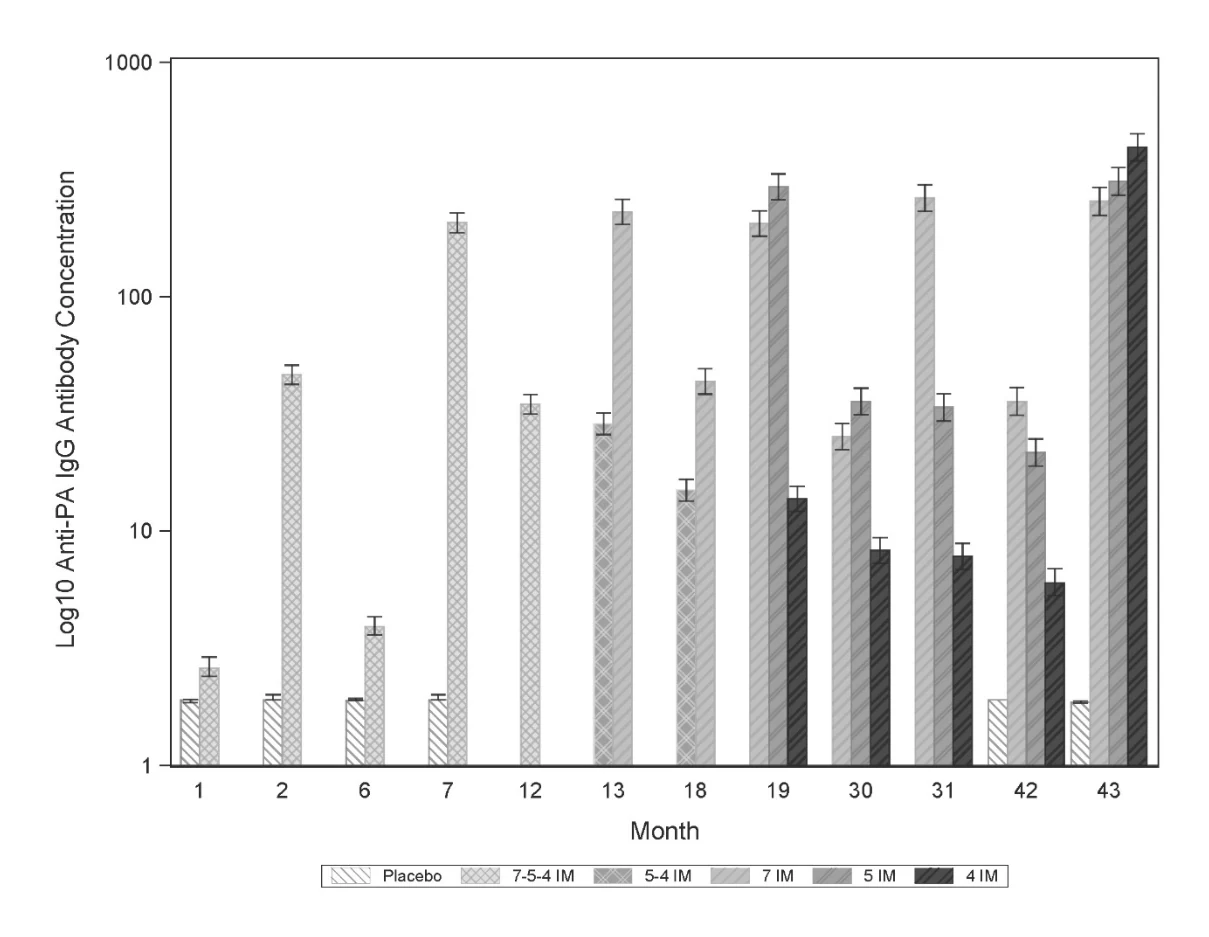
Note: Lower limit of quantification (LLOQ) for the assay is 1.8 mcg/mL
Figure 2 TNA ED50 Titre Over Time 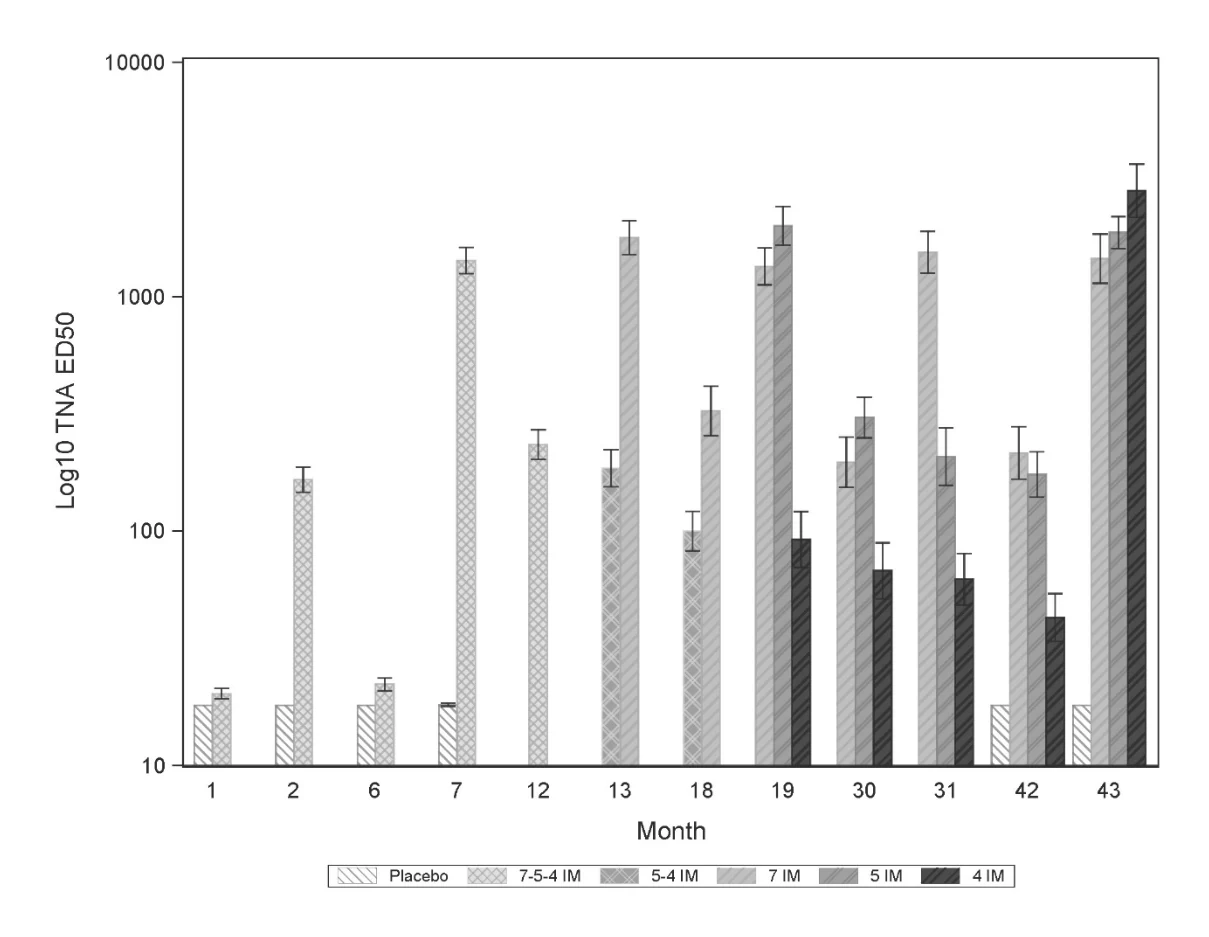
5.2 Pharmacokinetic properties
Not applicable
5.3 Preclinical safety data
Non-clinical data reveal no special hazard for humans based on conventional studies of pharmacology, single and repeated dose toxicity.
No effects on female fertility, reproductive or postnatal development were observed in animal (rabbit) studies at doses relevant to the clinical dose (see Section 4.6).
6 PHARMACEUTICAL PARTICULARS
6.1 List of excipients
Benzethonium chloride
Formaldehyde
Sodium chloride
Water for injections
For adsorbant, see Section 2.
6.2 Incompatibilities
In the absence of compatibility studies, this medicinal product must not be mixed with other medicinal products, see Section 4.5.
6.3 Shelf life
4 years
After first opening, the vial is to be used within 28 days, and stored as per Section 6.4.
6.4 Special precautions for storage
Store in a refrigerator (2 ºC – 8 ºC). Do not freeze.
Store in the original package in order to protect from light.
6.5 Nature and contents of container
5 mL (10 x 0.5 mL doses) suspension in a multi-dose vial (Type I glass) with stopper (chlorobutyl rubber), in a pack size of 1.
6.6 Special precautions for disposal
Before use the vial should be shaken well to form a homogeneous suspension.
The vaccine should be visually inspected before use. If the product appears discoloured or has visible particulate matter, discard the vial.
Mark the vial with date and time of opening.
Use a separate sterile needle and syringe for each person to avoid transmission of viral hepatitis and other infectious agents.
Place the multidose vial into storage away from the immediate patient environment following the storage conditions outlined in Section 6.4. Never pool or combine leftover contents for later use.
Any unused product or waste material should be disposed of in accordance with local requirements.
7 MARKETING AUTHORISATION HOLDER
Emergent Sales and Marketing Germany GmbH Vichystraße 14
76646 Bruchsal
Germany
Tel: 0049 7251 32197031
Fax: 0049 7251 32197010
8 MARKETING AUTHORISATION NUMBER(S)
PL49044/0001
9 DATE OF FIRST AUTHORISATION/RENEWAL OF THE
AUTHORISATION
03/05/2018
10 DATE OF REVISION OF THE TEXT
07/09/2018