

Patient leaflet - Amikacin Kabi 5 mg/ml solution for infusion
1. What Amikacin is and what it is used for
Amikacin contains the active substance amikacin. It
belongs to a group of medicines called antibiotics, that
is, they are used to treat severe infections with bacteria
that can be killed by amikacin. This medicine belongs to
a group of substances called aminoglycosides.
You may receive Amikacin to treat the following
conditions:
Infections of lungs and lower airways occurring
during in-patient treatment, including hospital-
acquired pneumonia (HAP) and ventilator-
associated pneumonia (VAP),
Complicated infections of kidneys, urinary ducts
and bladder
Complicated infections within the belly, including
inflammation of the peritoneum Infections of skin
and soft tissues, including severe burns
Bacterial inflammation of the inner lining of the
heart (only in combination with other antibiotics).
Amikacin can also be used in the treatment of patients
with an inflammation of the entire body that occurs in
association with, or is suspected to be associated with,
any of the infections listed above.
2. What you need to know before you are given Amikacin
You must not be given Amikacin:
if you are allergic to amikacin or any of the other
ingredients of this medicine (listed in section 6),
- if you are allergic to other similar substances (other
aminoglycosides),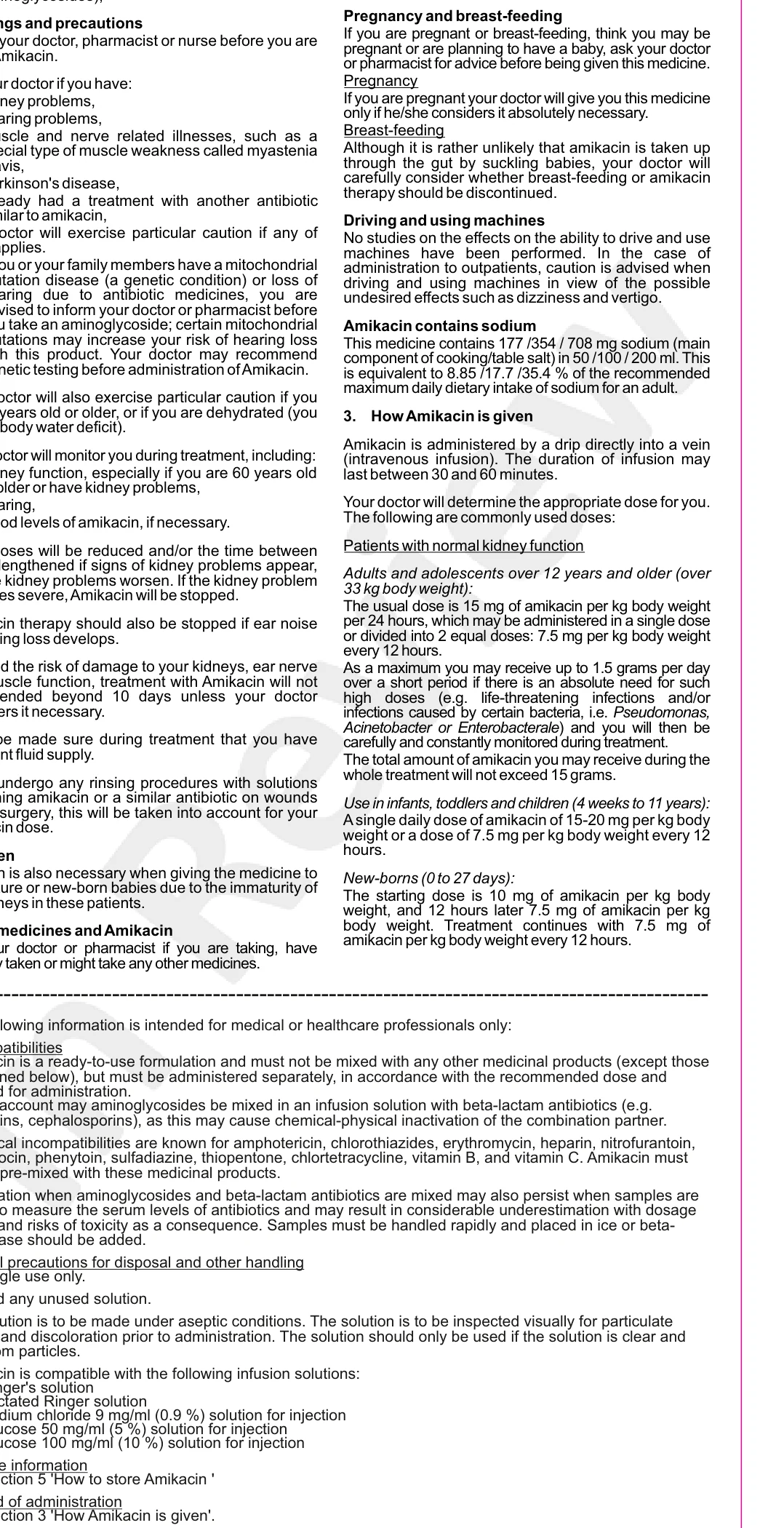
Warnings and precautions
Talk to your doctor, pharmacist or nurse before you are
given Amikacin.
Tell your doctor if you have:
- kidney problems,
- hearing problems,
muscle and nerve related illnesses, such as a
special type of muscle weakness called myastenia
gravis,
- Parkinson's disease,
already had a treatment with another antibiotic
similar to amikacin,
Your doctor will exercise particular caution if any of
these applies.
if you or your family members have a mitochondrial
mutation disease (a genetic condition) or loss of
hearing due to antibiotic medicines, you are
advised to inform your doctor or pharmacist before
you take an aminoglycoside; certain mitochondrial
mutations may increase your risk of hearing loss
with this product. Your doctor may recommend
genetic testing before administration of Amikacin.
Your doctor will also exercise particular caution if you
are 60 years old or older, or if you are dehydrated (you
have a body water deficit).
Your doctor will monitor you during treatment, including:
kidney function, especially if you are 60 years old
or older or have kidney problems,
- hearing,
- blood levels of amikacin, if necessary.
Daily doses will be reduced and/or the time between
doses lengthened if signs of kidney problems appear,
or if the kidney problems worsen. If the kidney problem
becomes severe, Amikacin will be stopped.
Amikacin therapy should also be stopped if ear noise
or hearing loss develops.
To avoid the risk of damage to your kidneys, ear nerve
and muscle function, treatment with Amikacin will not
be extended beyond 10 days unless your doctor
considers it necessary.
It will be made sure during treatment that you have
sufficient fluid supply.
If you undergo any rinsing procedures with solutions
containing amikacin or a similar antibiotic on wounds
during surgery, this will be taken into account for your
amikacin dose.
Children
Caution is also necessary when giving the medicine to
premature or new-born babies due to the immaturity of
the kidneys in these patients.
Other medicines and Amikacin
Tell your doctor or pharmacist if you are taking, have
recently taken or might take any other medicines.
The damaging effect of Amikacin on kidneys and ear nerve may be increased by the use of the following medicines:
- other antibiotic substances similar to amikacin; – other substances used to treat infections like bacitracin, amphotericin B, penicillin-type antibiotics or cephalosporins, vancomycin, kanamycin, paromomycin, polymyxin B, colistin;
- anti-cancer medicines: carboplatin at high doses, cisplatin, oxaliplatin (particularly in cases of already existing kidney impairment);
- substances suppressing undesirable immune reactions: ciclosporin, tacrolimus;
rapid acting medicines increasing urine flow:
furosemide or ethacrynic acid. Irreversible deafness may result;
- bisphosphonates (which are used to treat osteoporosis and similar diseases)
thiamine (Vitamin B ) as it may lose its
1 effectiveness
- Indomethacin (an anti-inflammatory medicine to reduce fever, pain and joint swelling and stiffness). This can increase the amount of Amikacin which is absorbed in new-born babies.
Administration of these together with or after Amikacin should be avoided as far as possible.
When Amikacin must be combined with such substances, hearing and kidney function will be monitored very often and carefully. In the case of use of Amikacin together with rapid acting medicines increasing urine flow, your fluid balance will be followed up.
The following medicines should also be paid attention to:
Methoxyflurane anaesthesia: the anaesthetist should know if you have received or are receiving amikacin or a similar antibiotic before performing anaesthesia with methoxyflurane (an anaesthetic gas) and avoid to use this agent if ever possible, because of an increased risk of severe kidney and nerve damage.
Concurrent treatment with amikacin and a muscle-relaxant medicine (e.g.
d-tubocurarin), other agents acting like curare, botulinus toxin or narcotic gases e.g. halothane: In the event of surgery the anaesthetist should be informed that you are being treated with amikacin because there is a risk that the blockade of nerve and muscle functions may become much stronger. Should a nerve and muscle blockade be caused by the aminoglycoside, this can be reversed by calcium salts. In new-borns receiving Amikacin the blood level of the medicine will be carefully controlled if indomethacin is administered concurrently because indomethacin may make the amikacin blood level rise.
Other antibiotics: Combination therapy with suitable antibiotics may markedly strengthen the effect of the treatment.
Pregnancy and breast-feeding
If you are pregnant or breast-feeding, think you may be pregnant or are planning to have a baby, ask your doctor or pharmacist for advice before being given this medicine. Pregnancy
If you are pregnant your doctor will give you this medicine only if he/she considers it absolutely necessary. Breast-feeding
Although it is rather unlikely that amikacin is taken up through the gut by suckling babies, your doctor will carefully consider whether breast-feeding or amikacin therapy should be discontinued.
Driving and using machines
No studies on the effects on the ability to drive and use machines have been performed. In the case of administration to outpatients, caution is advised when driving and using machines in view of the possible undesired effects such as dizziness and vertigo.
Amikacin contains sodium
This medicine contains 177 /354 / 708 mg sodium (main component of cooking/table salt) in 50 /100 / 200 ml. This is equivalent to 8.85 /17.7 /35.4 % of the recommended maximum daily dietary intake of sodium for an adult.
3. How Amikacin is given
Amikacin is administered by a drip directly into a vein (intravenous infusion). The duration of infusion may last between 30 and 60 minutes.
Your doctor will determine the appropriate dose for you. The following are commonly used doses:
Patients with normal kidney function
Adults and adolescents over 12 years and older (over 33 kg body weight):
The usual dose is 15 mg of amikacin per kg body weight per 24 hours, which may be administered in a single dose or divided into 2 equal doses: 7.5 mg per kg body weight every 12 hours.
As a maximum you may receive up to 1.5 grams per day over a short period if there is an absolute need for such high doses (e.g. life-threatening infections and/or infections caused by certain bacteria, i.e. Pseudomonas, Acinetobacter or Enterobacterale) and you will then be carefully and constantly monitored during treatment. The total amount of amikacin you may receive during the whole treatment will not exceed 15 grams.
Use in infants, toddlers and children (4 weeks to 11 years): A single daily dose of amikacin of 15-20 mg per kg body weight or a dose of 7.5 mg per kg body weight every 12 hours.
New-borns (0 to 27 days):
The starting dose is 10 mg of amikacin per kg body weight, and 12 hours later 7.5 mg of amikacin per kg body weight. Treatment continues with 7.5 mg of amikacin per kg body weight every 12 hours.
-------------------------------------------------------------------------------------------------The following information is intended for medical or healthcare professionals only: Incompatibilities
Amikacin is a ready-to-use formulation and must not be mixed with any other medicinal products (except those mentioned below), but must be administered separately, in accordance with the recommended dose and method for administration.
On no account may aminoglycosides be mixed in an infusion solution with beta-lactam antibiotics (e.g. penicillins, cephalosporins), as this may cause chemical-physical inactivation of the combination partner. Chemical incompatibilities are known for amphotericin, chlorothiazides, erythromycin, heparin, nitrofurantoin, novobiocin, phenytoin, sulfadiazine, thiopentone, chlortetracycline, vitamin B, and vitamin C. Amikacin must not be pre-mixed with these medicinal products.
Inactivation when aminoglycosides and beta-lactam antibiotics are mixed may also persist when samples are taken to measure the serum levels of antibiotics and may result in considerable underestimation with dosage errors and risks of toxicity as a consequence. Samples must be handled rapidly and placed in ice or beta-lactamase should be added.
Special precautions for disposal and other handling
For single use only.
Discard any unused solution.
The dilution is to be made under aseptic conditions. The solution is to be inspected visually for particulate matter and discoloration prior to administration. The solution should only be used if the solution is clear and free from particles.
Amikacin is compatible with the following infusion solutions:
- Ringer's solution
- Lactated Ringer solution
- Sodium chloride 9 mg/ml (0.9 %) solution for injection
- Glucose 50 mg/ml (5 %) solution for injection
- Glucose 100 mg/ml (10 %) solution for injection
Storage information
See section 5 'How to store Amikacin '
Method of administration
See section 3 'How Amikacin is given'.
Posology
See section 3 'How Amikacin is given'.
Amikacin is for intravenous infusion only; the duration of infusion may last between 30 and 60 minutes. Infusion volumes in patients with normal renal function:
| Amikacin 5 mg/ml | |||||||||||||
| B ody weight | |||||||||||||
| 2.5 kg | 5 kg | 10 kg | 12.5 kg | 20 kg | 30 kg | 40 kg | 50 kg | 60 kg | 70 kg | 80 kg | 90 kg | 100 kg | |
| Amikacin in mg/kg BW | |||||||||||||
| 7.5 | 3.75 ml | 7.50 ml | 15.00 ml | 18.75 ml | 30.00 ml | 45.00 ml | 60.00 ml | 75.00 ml | 90.00 ml | 105.00 ml | 120.00 ml | 135.00 ml | 150.00 ml |
| 10 | 5.00 ml | 10.00 ml | 20.00 ml | 25.00 ml | 40.00 ml | 60.00 ml | 80.00 ml | 100.00 ml | 120.00 ml | 140.00 ml | 160.00 ml | 180.00 ml | 200.00 ml |
| 15 | 7.50 ml | 15.00 ml | 30.00 ml | 37.50 ml | 60.00 ml | 90.00 ml | 120.00 ml | 150.00 ml | 180.00 ml | 210.00 ml | 240.00 ml | 270.00 ml | 300.00 ml |
| 20 | 10.00 ml | 20.00 ml | 40.00 ml | 50.00 ml | 80.00 ml | 120.00 ml | 160.00 ml | 200.00 ml | 240.00 ml | 280.00 ml | 320.00 ml | 360.00 ml | 400.00 ml |
Akceptuję do druku(treść / kolorystyka / układ graficzny) (data, czytelny podpis) | ||||
| WERSJA: D | ||||
| Rodzaj surowca: | Sposób pakowania: | |||
| INDEKS, WYDANIE ULOTKI: U15805/D GB | ||||
| WYMIAR: 525 x 148 mm składana do 105 x 148 mm | ||||
| WIELKOŚĆ CZCIONKI: 10/8 pt | ||||
| ZAPROJEKTOWAŁ: KATARZYNA STĘPNIEWSKA-BĄK | ||||
| KOLOR: | Wymiar po złożeniu: | Inne uwagi: | ||
| Skład w: |
UWAGA! Teksty i układ graficzny na wydruku są obowiązujące. Dopuszcza się wystąpienie odchyleń kolorystyki ze względu na wymagania technologii druku.
UWAGA: Pola oznaczone zielonym wypełnia klient.
| KOREKTA: 0 | ||||
| DATA: 15.05.2025 | ||||
| Amikacin5 mg/ml solution for infusion | ||||
Premature babies:
7.5 mg of amikacin per kg body weight every 12 hours. Special populations
Once daily dosing is not recommended in patients with weakened immunity, kidney failure, cystic fibrosis, water in the belly, inflammation of the inner lining of the heart, extensive burns (more than 20 per cent of the skin), and in pregnancy.
Patients with kidney problems
If you have kidney function impairment, the amikacin level in the blood and your kidney function will be monitored carefully and frequently in order to adjust your amikacin dose adequately. Your doctor knows how to calculate the doses you are going to receive. Patients undergoing haemodialysis or peritoneal dialysis They receive half of the normal dose at the end of the dialysis procedure.
Elderly patients
In elderly patients kidney function may be reduced. Your kidney function will be assessed whenever possible and your dose of amikacin adjusted if necessary.
Severely overweight patients
In these patients the dose is calculated according to the ideal body weight plus 40 per cent of weight excess. Later on your dose might be adjusted according to your blood levels of amikacin. The maximum dose is 1.5 g per day. The usual duration of treatment is 7 to 10 days.
Patients with water in the belly
Higher doses must be given in order to obtain adequate levels of the medicine in the blood. Duration of treatment
Usually you will receive treatment with amikacin over 7-10 days, only in cases of severe and complicated infections longer. Your therapy will normally show an effect within 24 to 48 hours, otherwise your medicine may have to be changed.
The blood levels of the amikacin will be carefully monitored in all patients but especially in the elderly, newborns, obese patients and those with kidney problems or cystic fibrosis and your dose will carefully be adjusted throughout your therapy.
If you received more Amikacin than you should
If you think you have been given too much of this medicine, please tell your doctor or nurse immediately. Overdosing may cause damage to kidneys and the ear nerves or a blockage of muscle function (paralysis). In such a case the infusion of amikacin has to be stopped. If you have any further questions on the use of this medicine, ask your doctor, pharmacist or nurse.
4. Possible side effects
Like all medicines, this medicine can cause side effects, although not everybody gets them. Toxic effects on the ear nerve and kidneys have been observed in patients treated with Amikacin. These side 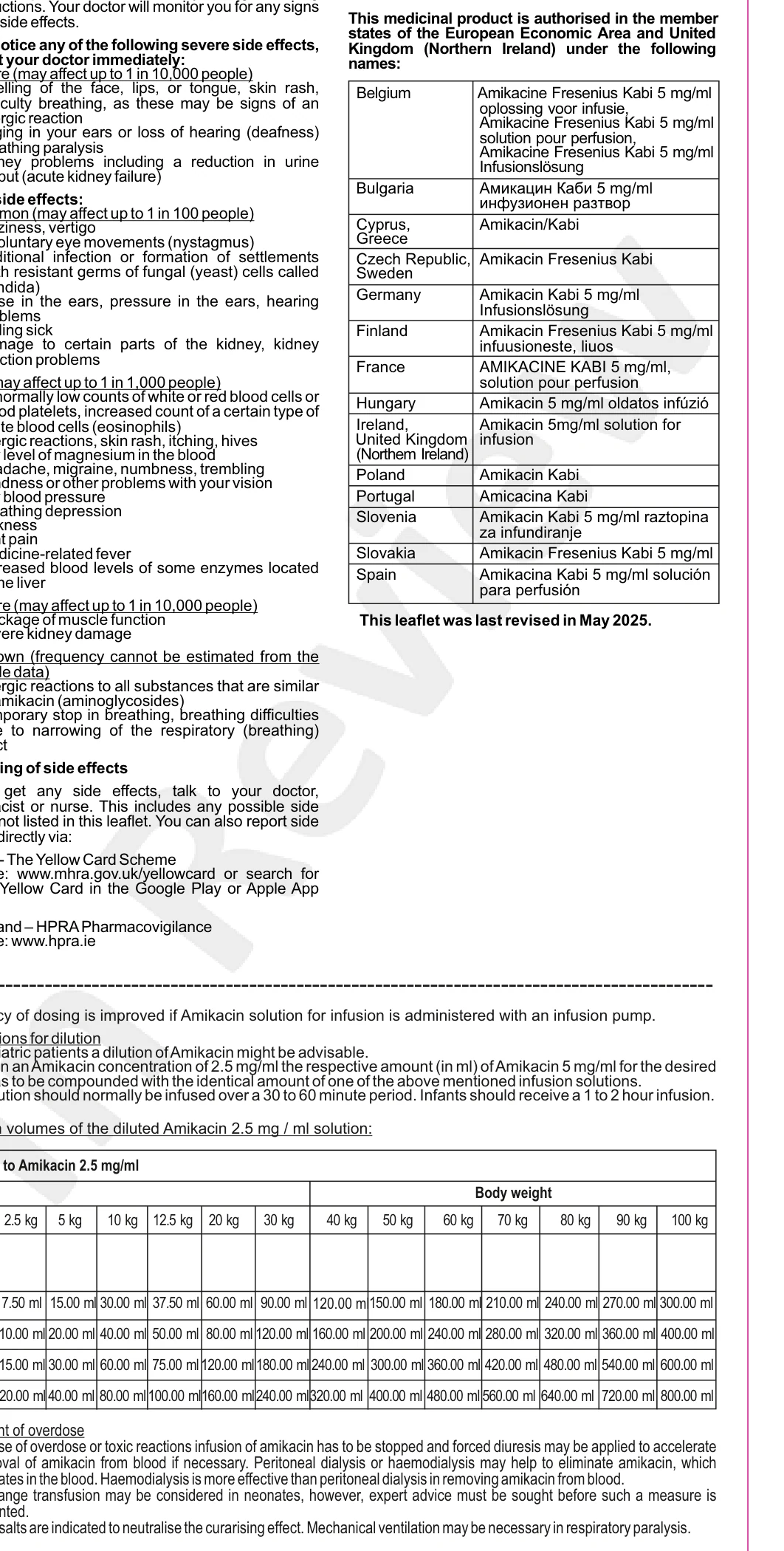 effects can largely be avoided by the doctor strictly obeying the precautions and carefully dosing according to instructions. Your doctor will monitor you for any signs of such side effects.
If you notice any of the following severe side effects, contact your doctor immediately:
Very rare (may affect up to 1 in 10,000 people) – swelling of the face, lips, or tongue, skin rash,
difficulty breathing, as these may be signs of an allergic reaction
ringing in your ears or loss of hearing (deafness)
breathing paralysis
kidney problems including a reduction in urine
output (acute kidney failure)
Other side effects:
Uncommon (may affect up to 1 in 100 people) • dizziness, vertigo
involuntary eye movements (nystagmus) • additional infection or formation of settlements
(with resistant germs of fungal (yeast) cells called Candida)
noise in the ears, pressure in the ears, hearing
problems
- feeling sick
damage to certain parts of the kidney, kidney
function problems
Rare (may affect up to 1 in 1,000 people)
abnormally low counts of white or red blood cells or
blood platelets, increased count of a certain type of white blood cells (eosinophils)
- allergic reactions, skin rash, itching, hives • low level of magnesium in the blood
- headache, migraine, numbness, trembling • blindness or other problems with your vision • low blood pressure
- breathing depression
- sickness
- joint pain
- medicine-related fever
increased blood levels of some enzymes located
in the liver
Very rare (may affect up to 1 in 10,000 people) • blockage of muscle function
- severe kidney damage
Not known (frequency cannot be estimated from the available data)
allergic reactions to all substances that are similar
to amikacin (aminoglycosides)
temporary stop in breathing, breathing difficulties
due to narrowing of the respiratory (breathing) tract
Reporting of side effects
If you get any side effects, talk to your doctor, pharmacist or nurse. This includes any possible side effects not listed in this leaflet. You can also report side effects directly via:
For UK - The Yellow Card Scheme
Website: www.mhra.gov.uk/yellowcard or search for MHRA Yellow Card in the Google Play or Apple App Store.
For Ireland – HPRA Pharmacovigilance
Website: www.hpra.ie
By reporting side effects you can help provide more information on the safety of this medicine.
5. How to store Amikacin
Keep this medicine out of the sight and reach of children. Do not use this medicine after the expiry date which is stated on the bottle and the outer carton. The expiry date refers to the last day of that month.
This medicine does not require any special storage conditions.
In-use shelf-life (after first opening/dilution): Chemical and physical in-use stability has been demonstrated for 24 hours at 25ºC.
From a microbiological point of view, the product should be used immediately. If not used immediately, in-use storage times and conditions prior the use are responsibility of the user and would normally not be longer than 24 h at 2 to 8 ºC unless the method of opening / dilution has taken place in controlled and validated aseptic conditions.
Do not throw away any medicines via wastewater or household waste. Ask your pharmacist how to throw away medicines you no longer use. These measures will help protect the environment.
6. Contents of the pack and other information
What Amikacin contains
The active substances is amikacin.
Each ml solution for infusion contains 5 mg amikacin (as sulfate).
Each bottle with 50 ml contains 250 mg amikacin. Each bottle with 100 ml contains 500 mg amikacin. Each bottle with 200 ml contains 1000 mg amikacin. The other ingredients are: sodium chloride, hydrochloric acid (for pH adjustment), sodium hydroxide (for pH adjustment), water for injections.
What Amikacin looks like and contents of the pack
Amikacin is a solution for infusion; i.e. it is administered as a drip through a small tube or cannula placed in a vein.
It is a clear colourless aqueous solution.
Pack sizes: 10 x 50 ml, 10 x 100 ml and 10 x 200 ml solution for infusion.
Not all pack sizes may be marketed.
Marketing Authorisation Holder
For UK
Fresenius Kabi Limited
Cestrian Court, Eastgate Way,
Manor Park, Runcorn, Cheshire
WA7 1NT, UK
For IE
Fresenius Kabi Deutschland GmbH
Else-Kroener-Strasse 1
61352 Bad Homburg v.d.H
Germany
Manufacturer:
Fresenius Kabi Polska Sp. z o.o.
ul. Sienkiewicza 25,
99-300 Kutno
Poland
This medicinal product is authorised in the member states of the European Economic Area and United Kingdom (Northern Ireland) under the following names:
| Belgium | Amikacine Fresenius Kabi 5 mg/ml oplossing voor infusie, Amikacine Fresenius Kabi 5 mg/ml solution pour perfusion, Amikacine Fresenius Kabi 5 mg/ml Infusionslösung |
| Bulgaria | Амикацин Каби 5 mg/ml инфузионен разтвор |
| Cyprus, Greece | Amikacin/Kabi |
| Czech Republic, Sweden | Amikacin Fresenius Kabi |
| Germany | Amikacin Kabi 5 mg/ml Infusionslösung |
| Finland | Amikacin Fresenius Kabi 5 mg/ml infuusioneste, liuos |
| France | AMIKACINE KABI 5 mg/ml, solution pour perfusion |
| Hungary | Amikacin 5 mg/ml oldatos infúzió |
Ireland, United Kingdom (Northem Ireland) | Amikacin 5mg/ml solution for infusion |
| Poland | Amikacin Kabi |
| Portugal | Amicacina Kabi |
| Slovenia | Amikacin Kabi 5 mg/ml raztopina za infundiranje |
| Slovakia | Amikacin Fresenius Kabi 5 mg/ml |
| Spain | Amikacina Kabi 5 mg/ml solución para perfusión |
This leaflet was last revised in May 2025.
Accuracy of dosing is improved if Amikacin solution for infusion is administered with an infusion pump. Instructions for dilution
In paediatric patients a dilution of Amikacin might be advisable.
To obtain an Amikacin concentration of 2.5 mg/ml the respective amount (in ml) of Amikacin 5 mg/ml for the desired dose has to be compounded with the identical amount of one of the above mentioned infusion solutions. The solution should normally be infused over a 30 to 60 minute period. Infants should receive a 1 to 2 hour infusion.
Infusion volumes of the diluted Amikacin 2.5 mg / ml solution:
Treatment of overdose
In the case of overdose or toxic reactions infusion of amikacin has to be stopped and forced diuresis may be applied to accelerate the removal of amikacin from blood if necessary. Peritoneal dialysis or haemodialysis may help to eliminate amikacin, which accumulates in the blood. Haemodialysis is more effective than peritoneal dialysis in removing amikacin from blood. An exchange transfusion may be considered in neonates, however, expert advice must be sought before such a measure is implemented.
Calcium salts are indicated to neutralise the curarising effect. Mechanical ventilation may be necessary in respiratory paralysis. -------------------------------------------------------------------------------------------------
Akceptuję do druku(treść / kolorystyka / układ graficzny) (data, czytelny podpis) | ||||
| WERSJA: D | ||||
| Rodzaj surowca: | Sposób pakowania: | |||
| INDEKS, WYDANIE ULOTKI: U15805/D GB | ||||
| WYMIAR: 525 x 148 mm składana do 105 x 148 mm | ||||
| WIELKOŚĆ CZCIONKI: 10/8 pt | ||||
| ZAPROJEKTOWAŁ: KATARZYNA STĘPNIEWSKA-BĄK | ||||
| KOLOR: | Wymiar po złożeniu: | Inne uwagi: | ||
| Skład w: |
UWAGA! Teksty i układ graficzny na wydruku są obowiązujące. Dopuszcza się wystąpienie odchyleń kolorystyki ze względu na wymagania technologii druku.
UWAGA: Pola oznaczone zielonym wypełnia klient.
| KOREKTA: 0 | ||||
| DATA: 15.05.2025 | ||||
| Amikacin5 mg/ml solution for infusion | ||||
| Diluted to Amikacin 2.5 mg/ml | |||||||||||||
| Body weight | |||||||||||||
| 2.5 kg | 5 kg | 10 kg | 12.5 kg | 20 kg | 30 kg | 40 kg | 50 kg | 60 kg | 70 kg | 80 kg | 90 kg | 100 kg | |
| Amikacin in mg/kg BW | |||||||||||||
| 7.5 | 7.50 ml | 15.00 ml | 30.00 ml | 37.50 ml | 60.00 ml | 90.00 ml | 120.00 ml | 150.00 ml | 180.00 ml | 210.00 ml | 240.00 ml | 270.00 ml | 300.00 ml |
| 10 | 10.00 ml | 20.00 ml | 40.00 ml | 50.00 ml | 80.00 ml | 120.00 ml | 160.00 ml | 200.00 ml | 240.00 ml | 280.00 ml | 320.00 ml | 360.00 ml | 400.00 ml |
| 15 | 15.00 ml | 30.00 ml | 60.00 ml | 75.00 ml | 120.00 ml | 180.00 ml | 240.00 ml | 300.00 ml | 360.00 ml | 420.00 ml | 480.00 ml | 540.00 ml | 600.00 ml |
| 20 | 20.00 ml | 40.00 ml | 80.00 ml | 100.00 ml | 160.00 ml | 240.00 ml | 320.00 ml | 400.00 ml | 480.00 ml | 560.00 ml | 640.00 ml | 720.00 ml | 800.00 ml |