

Summary of Product Characteristics (SmPC) - Allenasal Duo 137 micrograms / 50 micrograms per actuation nasal spray
1 NAME OF THE MEDICINAL PRODUCT
Allenasal Duo 137 micrograms / 50 micrograms per Actuation Nasal Spray
2 QUALITATIVE AND QUANTITATIVE COMPOSITION
Each g of suspension contains 1,000 micrograms azelastine hydrochloride (equivalent to 913 micrograms azelastine) and 365 micrograms fluticasone propionate (equivalent to 262.8 micrograms fluticasone).
One actuation (0.14 g) delivers 137 micrograms azelastine hydrochloride (equivalent to
125 micrograms azelastine) and 50 micrograms fluticasone propionate (equivalent to 36 micrograms fluticasone).
Excipient with known effect:
One actuation (0.14 g) delivers 0.014 mg benzalkonium chloride.
For the full list of excipients, see section 6.1.
3 PHARMACEUTICAL FORM
Nasal spray, suspension.
White, homogeneous suspension.
4 CLINICAL PARTICULARS
4.1 Therapeutic indications
Relief of symptoms of moderate to severe seasonal and perennial allergic rhinitis if monotherapy with either intranasal antihistamine or glucocorticoid is not considered sufficient.
4.2 Posology and method of administration
Posology
For full therapeutic benefit regular usage is essential.
Contact with the eyes should be avoided.
Adults (18 years and older)
One actuation in each nostril twice daily (morning and evening). The maximum daily dose should not exceed 2 sprays in each nostril per day.
Children below 18 years
Alleduo nasal spray is not recommended for use in children below 18 years of age.
Elderly
No dose adjustment is required in this population.
Renal and hepatic impairment
There are no data in patients with renal and hepatic impairment.
Duration of treatment
Treatment should be stopped, or the advice of a doctor sought if an improvement is not seen within 7 days. This medicine should not be used for more than 3 months continuously without consulting a doctor.
Method of administration
Alleduo nasal spray is for nasal use only.
Instruction for use
Preparing the spray:
The bottle should be shaken gently before use for about 5 seconds by tilting it upwards and downwards and the protective cap be removed afterwards. Prior to first use Alleduo nasal spraymust be primed by pressing down and releasing the pump 6 times. If Alleduo nasal sprayhas not been used for more than 7 days it must be reprimed once by pressing down and releasing the pump.
Using the spray:
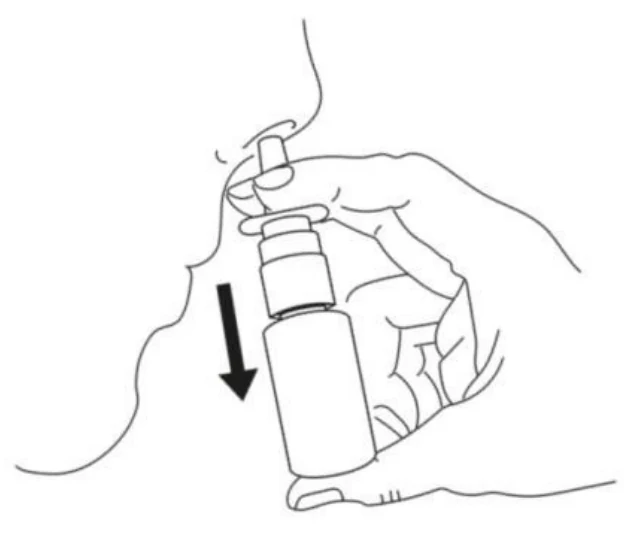
After blowing the nose the suspension is to be sprayed once into each nostril keeping the head tilted downward (see figure). After use the spray tip is to be wiped and the protective cap to be replaced.
4.3 Contraindications
Hypersensitivity to the active substances or to any of the excipients listed in section 6.1.
4.4 Special warnings and precautions for use
Treatment should be stopped, or the advice of a doctor sought if an improvement is not seen within 7 days. The advice of a doctor or pharmacist should also be sought if symptoms have improved but are not adequately controlled within 7 days. This medicine should not be used for more than 3 months continuously without consulting a doctor.
Medical advice should be sought before using this medicine in the case of:
- concomitant use of other corticosteroid products, such as tablets, creams, ointments, asthma medications, similar nasal sprays or eye/nose drops.
- fever or an infection in the nasal passages or sinuses.
- recent injury or surgery to the nose, or problems with ulceration in the nose.
During post-marketing use, there have been reports of clinically significant drug interactions in patients receiving fluticasone propionate and ritonavir, resulting in systemic corticosteroid effects including Cushing's syndrome and adrenal suppression. Therefore, concomitant use of fluticasone propionate and ritonavir should be avoided, unless the potential benefit to the patient outweighs the risk of systemic corticosteroid side-effects (see section 4.5).
Systemic effects of nasal corticosteroids may occur, particularly when prescribed at high doses for prolonged periods. These effects are much less likely to occur than with oral corticosteroids and may vary in individual patients and between different corticosteroid preparations. Potential systemic effects may include Cushing's syndrome, Cushingoid features, adrenal suppression, growth retardation in children and adolescents, cataract, glaucoma and more rarely, a range of psychological or behavioural effects including psychomotor hyperactivity, sleep disorders, anxiety, depression or aggression (particularly in children).
This medicinal product undergoes extensive first-pass metabolism, therefore the systemic exposure of intranasal fluticasone propionate in patients with severe liver disease is likely to be increased. This may result in a higher frequency of systemic adverse events. Caution is advised in these patients.”
Treatment with higher than recommended doses of nasal corticosteroids may result in clinically significant adrenal suppression. If there is evidence for higher than recommended doses being used, then additional systemic corticosteroid cover should be considered during periods of stress or elective surgery.
In general, the dose of intranasal fluticasone formulations should be reduced to the lowest dose at which effective control of the symptoms of rhinitis is maintained. Higher doses than the recommended one (see section 4.2) have not been tested for azelastine hydrochloride/fluticasone propionate nasal spray. As with all intranasal corticosteroids, the total systemic burden of corticosteroids should be considered whenever other forms of corticosteroid treatment are prescribed concurrently.
Visual disturbance may be reported with systemic and topical corticosteroid use. If a patient presents with symptoms such as blurred vision or other visual disturbances, the patient should be considered for referral to an ophthalmologist for evaluation of possible causes which may include cataract, glaucoma or rare diseases such as central serous chorioretinopathy (CSCR) which have been reported after use of systemic and topical corticosteroids.
Close monitoring is warranted in patients with a change in vision or with a history of increased ocular pressure, glaucoma and/or cataracts.
If there is any reason to believe that adrenal function is impaired, care must be taken when transferring patients from systemic steroid treatment to Alleduo nasal spray.
In patients who have tuberculosis, any type of untreated infection, or have had a recent surgical operation or injury to the nose or mouth, the possible benefits of the treatment with Alleduo nasal spray should be weighed against possible risk.
Infections of the nasal airways should be treated with antibacterial or antimycotical therapy, but do not constitute a specific contraindication to treatment with Alleduo nasal spray.
This medicine contains benzalkonium chloride. Long term use may cause oedema of the nasal mucosa.
4.5 Interaction with other medicinal products and other forms of interaction
Fluticasone propionate
Under normal circumstances, low plasma concentrations of fluticasone propionate are achieved after intranasal dosing, due to extensive first pass metabolism and high systemic clearance mediated by cytochrome P450 3A4 in the gut and liver. Hence, clinically significant drug interactions mediated by fluticasone propionate are unlikely.
A drug interaction study in healthy subjects has shown that ritonavir (a highly potent cytochrome P450 3A4 inhibitor) can greatly increase fluticasone propionate plasma concentrations, resulting in markedly reduced serum cortisol concentrations. During post-marketing use, there have been reports of clinically significant drug interactions in patients receiving intranasal or inhaled fluticasone propionate and ritonavir, resulting in systemic corticosteroid effects. Co-treatment with other CYP 3A4 inhibitors, including cobicistat-containing products is also expected to increase the risk of systemic side effects. The combination should be avoided unless the benefit outweighs the increased risk of systemic corticosteroid side effects, in which case patients should be monitored for systemic corticosteroid side effects.
Studies have shown that other inhibitors of cytochrome P450 3A4 produce negligible (erythromycin) and minor (ketoconazole) increases in systemic exposure to fluticasone propionate without notable reductions in serum cortisol concentrations. Nevertheless, care is advised when co-administering potent cytochrome P450 3A4 inhibitors (e.g. ketoconazole), as there is potential for increased systemic exposure to fluticasone propionate.
Azelastine hydrochloride
No specific interaction studies with azelastine hydrochloride nasal spray have been performed. Interaction studies at high oral doses have been performed. However, they bear no relevance to azelastine nasal spray as given recommended nasal doses result in much lower systemic exposure. Nevertheless, care should be taken when administering azelastine hydrochloride in patients taking concurrent sedative or central nervous medications because sedative effect may be enhanced. Alcohol may also enhance this effect (see section 4.7).
4.6 Fertility, pregnancy and lactation
Fertility
There are only limited data with regards to fertility (see section 5.3).
Pregnancy
There are no or limited amount of data from the use of azelastine hydrochloride and fluticasone propionate in pregnant women. Therefore, Alleduo nasal spray should be used during pregnancy only if the potential benefit justifies the potential risk to the foetus (see section 5.3).
Breast-feeding.
It is unknown whether nasally administered azelastine
hydrochloride/metabolites or fluticasone propionate/metabolites are excreted in human breast milk. Alleduo nasal spray should be used during breastfeeding only if the potential benefit justifies the potential risk to the newborns/infant (see section 5.3).
The label will include a warning that medical opinion should be sought before using this medicine in the case of pregnancy or breastfeeding.
4.7 Effects on ability to drive and use machines
Alleduo nasal spray has minor influence on the ability to drive and use machines.
In isolated cases fatigue, weariness, exhaustion, dizziness or weakness that may also be caused by the disease itself, may occur when using Alleduo nasal spray. In these cases, the ability to drive and use machines may be impaired. Alcohol may enhance this effect.
4.8 Undesirable effects
Commonly, dysgeusia, a substance-specific unpleasant taste, may be experienced after administration (often due to incorrect method of application, namely tilting the head too far backwards during administration).
Adverse reactions are listed below by system organ class and frequency. Frequencies are defined as:
Very common (≥1/10)
Common (≥1/100 to <1/10)
Uncommon (≥1/1 000 to <1/100)
Rare (≥1/10 000 to <1/1 000)
Very rare (<1/10 000)
Not known (cannot be estimated from the available data)
Frequency System Organ Class | Very common | Common | Uncommon | Rare | Very rare | Not known |
| Immune system disorders | Hypersensitivity including anaphylactic reactions, angioedema (oedema of the face or tongue and skin rash), bronchospasm | |||||
Frequency System Organ Class | Very common | Common | Uncommon | Rare | Very rare | Not known |
| Nervous system disorder | Headache, Dysgeusia (unpleasant taste), unpleasant smell | Dizziness, somnolence (drowsiness, sleepiness) | ||||
| Eye disorders* | Glaucoma, increased intraocular pressure, cataract | Vision blurred (see section 4.4) | ||||
| Respiratory, thoracic and mediastinal disorders | Epistaxis | Nasal discomfort (including nasal irritation, stinging, itching), sneezing, nasal dryness, cough, dry throat, throat irritation | Nasal septal perforation**, mucosal erosion | Nasal ulcers | ||
| Gastrointestinal disorders | Dry mouth | Nausea | ||||
Skin and subcutaneous tissue disorders | Rash, pruritus, urticaria | |||||
General disorders and administration site conditions | Fatigue (weariness, exhaustion), weakness (see section 4.7) |
* A very small number of spontaneous reports have been identified following prolonged treatment with intranasal fluticasone propionate.
** Nasal septal perforation has been reported following the use of intranasal corticosteroids.
Systemic effects of some nasal corticosteroids may occur, particularly when administered at high doses for prolonged periods (see section 4.4).
In rare cases osteoporosis was observed, if nasal glucocorticoids were administered long-term.
Reporting of suspected adverse reactions
Reporting suspected adverse reactions after authorisation of the medicinal product is important. It allows continued monitoring of the benefit/risk balance of the medicinal product. Healthcare professionals are asked to report any suspected adverse reactions via www.mhra.gov.uk/yellowcard or search for MHRA Yellow Card in the Google Play or Apple App Store.
4.9 Overdose
With the nasal route of administration overdose reactions are not anticipated.
There are no data from patients available on the effects of acute or chronic overdosage with intranasal fluticasone propionate.
Intranasal administration of 2 milligrams fluticasone propionate (10 times the recommended daily dose) twice daily for seven days to healthy human volunteers has no effect on hypothalamic-pituitary-adrenal (HPA) axis function.
Administration of doses higher than those recommended over a long period of time may lead to temporary suppression of adrenal function.
In these patients, treatment with Alleduo nasal spray should be continued at a dose sufficient to control symptoms; the adrenal function will recover in a few days and can be verified by measuring plasma cortisol.
In the event of overdose after incidental oral uptake, disturbances of the central nervous system (including drowsiness, confusion, coma, tachycardia and hypotension) caused by azelastine hydrochloride are to be expected based on the results of animal experiments.
Treatment of these disorders must be symptomatic. Depending on the amount swallowed, gastric lavage is recommended. There is no known antidote.
5 PHARMACOLOGICAL PROPERTIES
5.1 Pharmacodynamic properties
Pharmacotherapeutic group: Decongestants and other nasal preparations for topical use, corticosteroids/fluticasone, combinations, ATC code: R01AD58.
Mechanism of action and pharmacodynamic effects
Alleduo nasal spray contains azelastine hydrochloride and fluticasone propionate, which have different modes of action and show synergistic effects in terms of improvement of allergic rhinitis and rhino-conjunctivitis symptoms.
Fluticasone propionate
Fluticasone propionate is a synthetic trifluorinated corticosteroid that possesses a very high affinity for the glucocorticoid receptor and has a potent anti-inflammatory action, e.g. 3-5 fold more potent than dexamethasone in cloned human glucocorticoid receptor binding and gene expression assays.
Azelastine hydrochloride
Azelastine, a phthalazinone derivative is classified as a potent long-acting antiallergic compound with selective H1-antagonist, mast cell stabilizing and antiinflammatory properties. Data from in vivo (preclinical) and in vitro studies show that azelastine inhibits the synthesis or release of the chemical mediators known to be involved in early and late stage allergic reactions, e.g. leukotrienes, histamine, platelet-activating factor (PAF) and serotonin. A relief of nasal allergic symptoms is observed within 15 minutes after administration.
Azelastine/fluticasone nasal spray
In 4 clinical studies in adults and adolescents with allergic rhinitis, one actuation of azelastine/fluticasone nasal spray in each nostril twice daily significantly improved nasal symptoms (comprising rhinorrhoea, nasal congestion, sneezing and nasal itching) compared with placebo, azelastine hydrochloride alone and fluticasone propionate alone. It significantly improved ocular symptoms (comprising itching, tearing/watering and redness of the eyes) and the patients' disease related quality of life
(Rhinoconjunctivitis Quality of Life Questionnaire – RQLQ) in all 4 studies.
In comparison to a marketed fluticasone propionate nasal spray substantial symptom improvement (50% reduction in nasal symptoms severity) was achieved significantly earlier (3 days and more) with azelastine/fluticasone nasal spray. The superior effect of combined formula to fluticasone propionate nasal spray was maintained throughout one-year study in patients with chronic persistent allergic rhinitis and nonallergic/vasomotor rhinitis.
In a ragweed pollen allergen exposure chamber study, first statistically significant relief of nasal symptoms was observed at 5 minutes after administration of azelastine/fluticasone nasal spray (compared to placebo). At 15 minutes after administration of azelastine/fluticasone 60% of patients reported a clinically relevant reduction in symptom scores of at least 30%.
5.2 Pharmacokinetic properties
Absorption
After intranasal administration of two actuations per nostril (548 mcg of azelastine hydrochloride and 200 mcg of fluticasone) of azelastine/fluticasone nasal spray, the mean (± standard deviation) peak plasma exposure (Cmax) was 194.5 ± 74.4 pg/mL for azelastine and 10.3 ± 3.9 pg/mL for fluticasone propionate and the mean total exposure (AUC) was 4,217 ± 2,618 pg/mL*hr for azelastine and 97.7 ± 43.1 pg/mL*hr for fluticasone. The median time to peak exposure (tmax) from a single dose was 0.5 hours for azelastine and 1.0 hours for fluticasone.
Fluticasone systemic exposure was ~50% increased comparing azelastine/fluticasone nasal spray with a marketed fluticasone nasal spray. Azelastine/fluticasone nasal spray was equivalent to a marketed azelastine nasal spray with respect to azelastine systemic exposure. There was no evidence of pharmacokinetic interactions between azelastine hydrochloride and fluticasone propionate.
Distribution
Fluticasone propionate has a large volume of distribution at steady-state (approximately 318 litres).
Plasma protein binding is 91%.
The volume of distribution of azelastine is high indicating distribution predominantly into the peripheral tissue. The level of protein binding is 80 to 90%. Additionally, both substances have broad therapeutic windows. Therefore, drug displacement reactions are unlikely.
Biotransformation
Fluticasone propionate is cleared rapidly from the systemic circulation, principally by hepatic metabolism to an inactive carboxylic acid metabolite, by the cytochrome P450 enzyme CYP3A4. Swallowed fluticasone propionate is also subject to extensive first pass metabolism. Azelastine is metabolized to N-desmethylazelastine via various CYP isoenzymes, mainly CYP3A4, CYP2D6 and CYP2C19.
Elimination
The elimination rate of intravenous administered fluticasone propionate is linear over the 250-1 000 microgram dose range and are characterised by a high plasma clearance (CL=1.1 L/min). Peak plasma concentrations are reduced by approximately 98% within 3-4 hours and only low plasma concentrations were associated with the 7.8 h terminal half-life. The renal clearance of fluticasone propionate is negligible (<0.2%) and less than 5% as the carboxylic acid metabolite. The major route of elimination is the excretion of fluticasone propionate and its metabolites in the bile. Plasma elimination half-lives after a single dose of azelastine are approximately 20-25 hours for azelastine and about 45 hours for the therapeutically active metabolite N-desmethylazelastine. Excretion occurs mainly via the faeces. The sustained excretion of small amounts of the dose in the faeces suggests that some enterohepatic circulation may take place.
5.3 Preclinical safety data
Fluticasone propionate
Findings in general toxicology studies were similar to those observed with other glucocorticoids and are associated with exaggerated pharmacological activity. These findings are not likely to be relevant for humans given recommended nasal doses which results in minimal systemic exposure. No genotoxic effects of fluticasone propionate have been observed in conventional genotoxicity tests. Further, there were no treatment-related increases in the incidence of tumours in two year inhalation studies in rats and mice.
In animal studies glucocorticoids have been shown to induce malformations including cleft palate and intra-uterine growth retardation. Again, this is not likely to be relevant for humans given recommended nasal doses which results in minimal systemic exposure (see section 5.2).
Azelastine hydrochloride
Azelastine hydrochloride displayed no sensitising potential in the guinea pig. Azelastine demonstrated no genotoxic potential in a battery of in vitro and in vivo tests, nor any carcinogenic potential in rats or mice. In male and female rats, azelastine at oral doses greater than 3 mg/kg/day caused a dose-related decrease in the fertility index; no substance-related alterations were found in the reproductive organs of males or females during chronic toxicity studies, however, embryotoxic and teratogenic effects in rats, mice and rabbits occurred only at maternal toxic doses (for example, skeletal malformations were observed in rats and mice at doses of 68.6 mg/kg/day).
Azelastine/fluticasone nasal spray
Repeated dose intranasal toxicity studies in rats for a period up to 90 days and in dogs for 14 days with azelastine/fluticasone nasal spray revealed no new adverse effects in comparison to the individual components.
Environmental risk assessment studies have shown that fluticasone propionate may pose a risk for the aquatic compartment. (See section 6.6).
6 PHARMACEUTICAL PARTICULARS
6.1 List of excipients
Disodium edetate
Glycerol
Cellulose microcrystalline
Carmellose sodium
Polysorbate 80
Benzalkonium chloride
Phenylethyl alcohol
Purified water
6.2 Incompatibilities
Not applicable.
6.3 Shelf life
30 Months
In-use shelf life (after first use): 1 year
6.4 Special precautions for storage
Do not refrigerate or freeze.
6.5 Nature and contents of container
Type I amber glass bottle fitted with a spray pump, a nasal polypropylene applicator (actuator) and a dust cap, containing 23 g (at least 120 actuations) suspension.
Pack sizes:
1 bottle of 25 ml containing 23 g suspension (at least 120 actuations)
6.6 Special precautions for disposal
Shake the bottle gently before use.
No special requirements for disposal.
This medicinal product may pose a risk to the environment. (See section 5.3). Any unused medicinal product or waste material should be disposed of in accordance with local requirements.
7 MARKETING AUTHORISATION HOLDER
Opella Healthcare UK Limited, trading as Opella
410 Thames Valley Park Drive
Reading
Berkshire
RG6 1PT
United Kingdom
8 MARKETING AUTHORISATION NUMBER(S)
PL 53386/0084
9 DATE OF FIRST AUTHORISATION/RENEWAL OF THE
AUTHORISATION
22/06/2026
10 DATE OF REVISION OF THE TEXT
28/08/2026