


Patient leaflet - Alkindi 5.0 mg granules in capsules for Opening
1. What Alkindi is and what it is used for
Alkindi contains the active substance hydrocortisone. Hydrocortisone belongs to a group of medicines known as corticosteroids.
Hydrocortisone is a synthetic version of the natural honnone cottisol. Cortisol is made by the adrenal glands in the body. Alkindi is for use in children and adolescents aged bi1th to 18 years when the body is not making enough cortisol, because part of the adrenal gland is not working (adrenal insufficiency, often caused by an inherited condition called congenital adrenal hype1plasia).
2. \Vhat you need to know before you gin Alkiudi
Do not give Alkindi:
If yom· child is allergic to hydrocottisone or any of the other ingredients of this medicine (listed in section 6).
If yom· child has difficulties swallowing food, or is a premature baby who cannot yet be fed by mouth.
\Varnings and precautions
Talk to your endocrinologist or pha1macist before giving Alkindi:
if your child is tmwell or has an infection. The endocrinologist may need to increase the close of Alkindi temporarily; talk to yom· endocrinologist if your child is tmwell. if your child has an ach·enal crisis. If your child is vomiting or seriously tmwell, your child may need an injection of hyclroco1tisone. Your endocrinologist will train you how to do this in an emergency. if your child is due for a vaccination. Taking Alkindi should not stop your child being vaccinated. Let yom· endocrinologist know when your child is due for vaccinations. if your child is due for an operation. Let the anaesthetist know yom· child is receiving Alkincli before yom· child has their operation.
if yom· child is being feel through a nasogastric tube. Alkindi granules are not suitable for giving through a nasogastric tube as the granules may block the tube.
when your child is changing to Alkindi from another hyclroco1tisone preparation. Differences between bydrocortisone preparations when changing to Alkindi may mean your child could be at risk of receiving an incorrect dose of hydroco1tisone in the first week after switching to Alkindi. This may lead to a risk of adrenal crisis. You should watch your child carefolly in the week after changing to Alkindi. Y om· doctor will tell you when you can increase the dose of Alkincli if there are symptoms of adrenal crisis such as tmusual tiredness, headache, a raised or low temperattu·e or vomiting. If this happens medical attention should be sought right away. You should not stop giving Alkincli without checking with yom· endocrinologist as this could make your child seriously tmwell ve1y quickly.
As Alkindi is replacing the normal hormone your child lacks, side effects are less likely, however:
Too much Alkindi can affect your child's growth, so your endocrinologist will adjust the dose depending on yom· child's size and monitor yom· child's growth carefolly. Let yom· endocrinologist know if you are wotried about your child's growth (see section 4). Too much Alkindi can affect yom· child's bones so yom· endocrinologist will adjust the dose depending on your child's size.
Some adult patients taking hydrocortisone became anxious, depressed or confused. It is not known if this would happen with children, but tell your endocrinologist if yom· child develops any unusual behaviour after starting Alkindi (see section 4).
In some patients with allergies to other medicines, allergy to bydrocortisone bas been seen. Tell your endocrinologist straight away if yom· child has any reaction like swelling or sho1tness of breath after being given Alkindi.
Contact your endocrinologist if your child has blm1·ed vision or other visual disturbances. Alkindi granules can sometimes appear in a child's nappy or poo after taking Alkindi. This is because the centre of the granule is not absorbed in the gut after it has released the medicine. This does not mean the medicine will not work and you do not need to give your child another dose.
Other medicines and Alkindi
TeU yom· doctor or phannacist if yotu· child is taking, has recently taken or might take any other medicines. Some medicines can affect the way that Alkindi works, and may mean that your endocrinologist needs to alter your child's dose of Alkindi.
Your endocrinologist may need to increase your child's dose of Alkindi if your child take certain medicines, including:
Medicines used to treat epilepsy: phenytoin, carbamazepine, and oxcarbazepine. Medicines used to treat infections (antibiotics): rifampicin and rifabutin. Medicines called barbitmates, which can be used to treat convulsions (including phenobarbital and primidone).
Medicines used to treat AIDS: efavirenz and nevirap:ine.
Y om· endocrinologist may need to decrease your child's dose of Alkindi if your child take certain medicines, including:
Medicines used to treat fi.mgal diseases: itraconazole, posaconazole, and voriconazole. Medicines used to treat infections (antibiotics): erythromycin and clarithromycin. Medicine used to treat human immtmodeficiency vims (HIV) infection and AIDS: ritonavir.
Alkindi with food and dlink
Some food and drink may affect the way Alkindi works, and may need your doctor to decrease your child's dose. These include:
Grapefruit juice.
Liquorice.
Pregnancy, breast-feeding and fertility
Hydrocortisone can be used during pregnancy and breast-feeding when the body is not making enough cottisol.
There is no infonnation on any effects of Alkindi on fert:ility.
D1iviug and using machines
Alkindi has no influence on a child's ability to pe1form skilled tasks (e.g. riding a bicycle) or using machines.
3. How to give Alkindi
Always use this medicine exactly as your doctor, nurse or phannacist has told you. Check with them if you are not sm·e.
Your endocrinologist will decide on the right dose of Alkindi based on your child's weight or size (body surface area) and then adjust the dose of Alkindi as your child grows. During illnesses, arotmd the tin1e of surgery and during times of serious stress, yom· endocrinologist may recommend additional doses of Alkindi and may also advise that your child receives another co1ticosteroid instead of, or as well as, Alkindi.
How to give this medicine
The granules should be given into die mouth and should not be chewed. The capsule shell should not be swallowed but should be carefolly opened as follows:
How to open the Alklndl capsule and give the granules 0 Hold capsule so
that the text is at
the top and tap the
capsule to make
sure the granules
are at the bottom
e Gently squeeze the e Twist off the top of bottom of the the capsule capsule
e Pour all granules out of capsule
Either pour all the
granules directly
onto the child's
tongue
/
OR pour all the
granules directly
onto a spoon and
place them in the
mouth
OR for children who are able to take
soft food, sprinkle the granules onto
a spoonful of cold or room
temperature soft food \ ~
(such as yoghurt or ,
fruit puree) and give
immediately ~
ALKINDI PIL GB
Whichever method is used, tap the capsule to ensure all the granules are removed.
If you give the granules directly into the mouth, give a drink (e.g. water, milk, breast-milk or formula-milk) immediately after administration to help ensure all granules are swallowed.
If you give the granules sprinkled onto a spoonful of soft food, administer immediately (within 5 minutes) and do not store for future use. DO NOT add the granules to liquid before administration as this can result in less than the full dose being given, and might also dissolve the taste masking of the granules allowing the bitter taste of hydrocortisone to become apparent.
& Warning Alkindi granules
come in a capsule that must be opened before use, discard the empty capsule after use out of reach of children. Do NOT swallow the capsule - small children may choke. 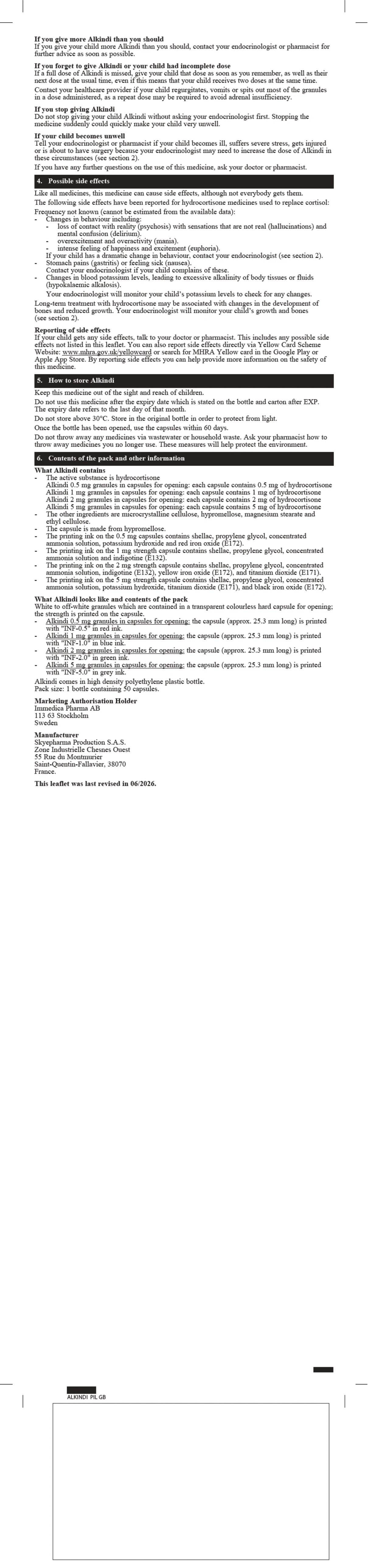 If you give more Alkindi than you should
If you give your child more Alkindi than you should, contact your endocrinologist or pha1macist for further advice as soon as possible.
If you forget. to give Alkindi or your child had incomplete dose
If a full dose of Alkindi is missed, give your child that dose as soon as you remember, as well as their next dose at the usual tinie, even if this means that your child receives two doses at the same time. Contact your healthcare provider if your child regurgitates, vomits or spits out most of the granules in a dose administered, as a repeat dose may be required to avoid adrenal insufficiency.
If you stop giving Alkindi
Do not stop giving your child Alkindi without asking your endocrinologist first. Stopping the medicine suddenly could quickly make your child very unwell.
If your child becomes unwell
Tell yom· endocrinologist or pharmacist if your child becomes ill, suffers severe stress, gets injured or is about to have surgery because your endocrinologist may need to increase the dose of Alkindi in these circumstances (see section 2).
If you have any ftuiher questions on the use of this medicine, ask your doctor or pharmacist.
4. Possible side effects
Like all medicines, this medicine can cause side effects, although not eveiybody gets them. The following side effects have been repo1ted for hydrocortisone medicines used to replace cortisol: Frequency not known (cannot be estimated from the available data):
Changes in behaviour including:
loss of contact with reality (psychosis) with sensations that are not real (hallucinations) and mental confusion (delirium).
overexcitement and overactivity (mania).
intense feeling of happiness and excitement (euphoria).
If your child has a dramatic change in behaviour, contact your endocrinologist (see section 2). Stomach pains (gastritis) or feeling sick (nausea).
Contact your endocrinologist if your child complains of these.
Changes in blood potassium levels, leading to excessive alkalinity of body tissues or fluids (hypokalaemic alkalosis).
Your endocrinologist will monitor your child's potassium levels to check for any changes. Long-term treatment with hydrocortisone may be associated with changes in the development of bones and reduced growth. Your endocrinologist will monitor your child's growth and bones (see section 2).
Repo1·ting of side effects
If your child gets any side effects, talk to your doctor or pharmacist. This includes any possible side effects not listed in this leaflet. You can also report side effects directly via Yellow Card Scheme Website: www.mhra.gov.uk/yellowcard or search for MHRA Yellow card in the Google Play or Apple App Store. By reporting side effects you can help provide more information on the safety of this medicine.
5. How to store Alkindi
Keep this medicine out of the sight and reach of children.
Do not use this medicine aftei· the expily date which is stated on the bottle and carton after EXP. The expily date refers to the last day of that month.
Do not store above 30°C. Store in the original bottle in ordei· to protect from light. Once the bottle has been opened, use the capsules withill 60 days.
Do not throw away any medicines via wastewater or household waste. Ask your pha1macist how to throw away medicilles you no longer use. These meastu·es will help protect the environment.
6. Contents of the pack and othe1· information
What Alkindi contains
The active substance is hydrocortisone
Alkindi 0.5 mg granules in capsules for opening: each capsule contains 0.5 mg ofhydrocortisone Alkindi I mg granules in capsules for opening: each capsule contains I mg of hydrocortisone Alkindi 2 mg granules in capsules for opening: each capsule contains 2 mg of hydrocortisone Alkindi 5 mg granules in capsules for opening: each capsule contains 5 mg of hydrocortisone The other ingredients are microcrystalline cellulose, hypromellose, magnesium stearate and ethyl cellulose.
The capsule is made from hypromellose.
The printing ink on the 0.5 mg capsules contains shellac, propylene glycol, concentrated ammonia solution, potassium hydroxide and red il·on oxide (El 72).
The printing ink on the I mg strength capsule contains shellac, propylene glycol, concentrated ammonia solution and indigotine (E132).
The printing ink on the 2 mg strength capsule contains shellac, propylene glycol, concentrated ammonia solution, indigotine (El32), yellow il·on oxide (El 72), and titanium dioxide (El 71). The printing ink on the 5 mg strength capsule contains shellac, propylene glycol, concentrated ammonia solution, potassium hydroxide, titanium dioxide (El 71 ), and black iron oxide (El 72).
What Alkindi looks like and contents of the pack
White to off-white granules which are contained in a transparent colourless hard capsule for opening; the strength is prillted on the capsule.
Alkindi 0.5 mg granules in capsules for opening: the capsule (approx. 25.3 mm long) is printed with "INF-0.5'' in red ink.
Alkindi I mg granules in capsules for opening: the capsule (approx. 25.3 mm long) is printed with "INF-1.0" in blue ink.
Alkindi 2 mg granules in capsules for opening: the capsule (approx. 25.3 mm long) is prillted with "INF-2.0" ill green ink.
Alkindi 5 mg granules in capsules for opening: the capsule (approx. 25.3 mm long) is prillted with "INF-5.0" ill grey ilik.
Alkindi comes in high density polyethylene plastic bottle.
Pack size: I bottle containing 50 capsules.
Ma1·keting Authol"isation Holde1·
hnmedica Pharma AB
113 63 Stockholm
Sweden
Mauufactm·e1·
Skyepharma Production S.A.S.
Zone fodustrielle Chesnes Ouest
55 Rue du Monttmu·ier
Saii1t-Quentil1-Fallavier, 38070
France.
This leaflet was last revised in 06/2026.
ALKINDI PILGB -