

Patient leaflet - Airsalb CFC-free inhaler 100 microgram/dose
1. What AirSalb is and what it is used for
The name of your medicine is AirSalb CFC-free inhaler 100 microgram/dose. It will be referred to as AirSalb throughout this leaflet.
AirSalb is used to treat breathing difficulties caused by the following diseases:
- asthma
chronic obstructive pulmonary disease (COPD) including
- chronic bronchitis
- emphysema
AirSalb is additionally used to prevent asthma symptoms caused by:
- exercise or
- triggers, such as house dust, pollen, cats, dogs and cigarette smoke
AirSalb expands the airways, allowing the air to flow more freely. AirSalb should primarily be used to relieve symptoms rather than as a regular treatment.
AirSalb is indicated for adults, adolescent and children from 4 to 11 years.
2. What you need to know before you take AirSalb
Do not use AirSalb
- if you are allergic to salbutamol or any of the other ingredients of this medicine (listed in section 6).
Warnings and precautions
Talk to your doctor before using AirSalb if any of the following conditions apply to you:
- a history of heart disease, such as irregular or fast heart rhythm or angina
- severe and untreated high blood pressure
- an overactive thyroid gland
- too little potassium in the blood
- enlarged artery (aneurysm)
- diabetes (extra checks of blood glucose levels are recommended when beginning treatment with AirSalb)
- tumour of the adrenal medulla (pheochromocytoma). The adrenal medulla are two glands situated above the kidneys.
Other medicines and AirSalb
Tell your doctor or pharmacist if you are using, have recently used or might use any other medicines.
The following medicines can influence or be influenced by AirSalb:
- heart and vascular medicines which can narrow the airways and containing active substances ending in “-ol” such as propranolol (betablockers) This may cause spasms in the lung airways.
- certain medicines to treat depression: - monoamine oxidase inhibitors (e.g. moclobemide) - tricyclic antidepressants, such as amitriptyline
- anaesthetics (agents that induce partial or total loss of sensation), such as halothane
- medicines against irregular heartbeat, such as digoxin
- xanthine derivatives (used to help breathing), such as theophylline
- steroids (group of hormones), such as cortisone
- diuretics (water tablets), such as furosemide
Pregnancy and breast-feeding
Limited knowledge exists regarding use during pregnancy but there also is a risk for the unborn child, if your asthma is untreated during pregnancy. Therefore, you should use AirSalb only if your doctor indicates it is clearly necessary. Do not change the dose by yourself, but always use it according to your doctor’s recommendation
It is unknown whether AirSalb passes into the mother’s milk. Therefore, only use AirSalb if your doctor indicates it is clearly necessary.
If you are pregnant or breast-feeding, think you may be pregnant or are planning to have a baby, ask your doctor or pharmacist for advice before taking this medicine.
Driving and using machines
No studies on the effects on the ability to drive and use machines have been performed. Therefore, do not drive or operate machines until you know how this medicine affects you.
AirSalb contains ethanol
This medicine contains 0.72 mg of alcohol (ethanol) in each metered dose which is equivalent to 2.1% w/w. The amount in metered dose of this medicine is equivalent to less than 1 ml beer or 1 ml wine.
The small amount of alcohol in this medicine will not have any noticeable effects.
3. How to use AirSalb
Always use this medicine exactly as your doctor has told you. Check with your doctor or pharmacist if you are not sure.
AirSalb should be used as required rather than regularly.
If your asthma is active (for example you have frequent symptoms or flare ups, such as breathlessness that makes speaking, eating or sleeping difficult, cough, wheezing, tight chest or limited physical ability), you should tell your doctor right away who may start or increase a medicine to control your asthma such as an inhaled corticosteroid.
Tell your doctor as soon as possible if your medicine does not seem to be working as well as usual (for example you need higher doses to relieve your breathing problems or your inhaler fails to give relief for at least 3 hours) as your asthma may be getting worse and you may need a different medicine.
If you use AirSalb more than twice a week to treat your asthma symptoms, not including preventive use before exercise, this indicates poorly controlled asthma and may increase the risk of severe asthma attacks (worsening of asthma) that can have serious complications and may be life threatening or even fatal. You should contact your doctor as soon as possible to review your asthma treatment.
If you use a medicine against inflammation of your lungs daily, e,g, “inhaled corticosteroid”, it is important to continue using it regularly, even if you feel better.
The recommended dose is:
Adults and adolescents aged 12 years and over
- Relief of attacks: 1-2 inhalations as required.
- Prevent symptoms caused by exercise or triggers: 2 inhalations 10-15 minutes beforehand.
- Maximum dose: 8 inhalations per day.
Children below under 12 years of age
- Relief of attacks: 1 inhalation as required. The dose may be increased to two inhalations if required.
- Prevent symptoms caused by exercise or triggers: 1 inhalation, or 2 if necessary 10-15 minutes beforehand.
- Maximum dose: 8 doses per day.
Children below 4 years of age
No recommendations can be made for dose since the effect has not yet been determined.
Contact your doctor if the treatment is not effective enough or if you need more doses per day than usual. Never increase your dose or change the duration of use without your doctor’s approval.
Inhaler test before use:
Check that the inhaler is functioning, if you use a new inhaler or if it has not been used for 7 days or more. Remove the protective cap, shake the inhaler and spray twice into the air.
Instructions for use:
Inhale sitting or standing, wherever possible.
- 1 Remove the protective cap. Check inside and outside to make sure that the mouthpiece is clean.
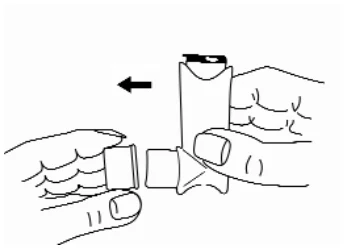
- 2 Shake the inhaler thoroughly for a couple of seconds before use.
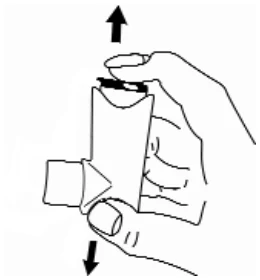
- 3 Hold the inhaler upright with the bottom of the container upwards, put your thumb on the base, below the mouthpiece. Breathe out as far as is comfortable, but do not breathe into the mouthpiece.
- 4 Place the mouthpiece in your mouth between your teeth and close your lips around it but do not bite it.
- 5 Just after starting to breathe in through your mouth press down on the top of the inhaler to release a puff while still breathing in steadily and deeply.
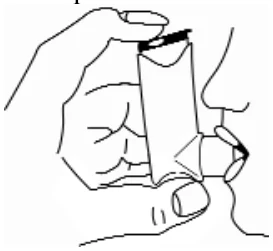
- 6 Hold your breath for 5-10 seconds. Take the inhaler from your mouth and your finger from the top of the inhaler.
- 7 If you need another puff keep the inhaler upright and wait about half a minute before repeating steps 2 to 6.
- 8 After use always replace the mouthpiece cover to keep out dust and fluff. Replace mouthpiece cover firmly and snap into position.
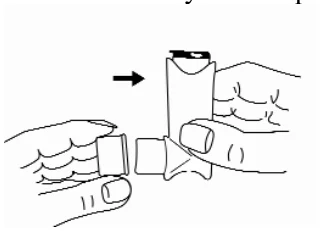
Some people find it difficult to release a puff of medicine just after they start to breathe in. In this case, as well as for children, the Vortex® or AeroChamber® Plus spacer device can be used. Please refer to the product information of the spacer device for its correct handling.
Cleaning
To prevent the inhaler blocking up or if it does block up, clean it at least once a week, as follows:
- 1 Pull the metal canister out of the plastic case of the inhaler and remove the mouthpiece cover.
- 2 Rinse the plastic case and the mouthpiece cover in lukewarm water. Do not attempt to remove any build up of medicine around the mouthpiece with a sharp object, such as a pin. A mild detergent may be added to the water, then rinse thoroughly with clean water before drying. Do not put the metal canister into water.
- 3 Leave the plastic case and the mouthpiece cover to dry in a warm place. Avoid excessive heat.
- 4 Replace the canister and mouthpiece cover.
Inhaler content:
Shake the inhaler to check the remaining amount of medicine in your inhaler. Do not use AirSalb if you do not detect any liquid in the inhaler while shaking.
Cold temperature use:
If the inhaler has been stored beneath 0°C, warm it in your hands for 2 minutes, shake it and spray into the air twice before use.
If you use more AirSalb than you should
In this case always contact your doctor or hospital.
Typical symptoms of overdose are:
- trembling
- headache
- rapid heart beat
- nausea or vomiting
- inability to keep still
- irritability, excitation
- seizures
- sleepiness.
If you have any further questions on the use of this medicine, ask your doctor or pharmacist.
4. Possible side effects
Like all medicines, this medicine can cause side effects, although not everybody gets them.
Stop using AirSalb and contact your doctor immediately if you develop any of the following very rare side effects:
allergic reaction symptoms such as
- swelling of the face, tongue or throat
- difficulties in swallowing
- signs which resemble nettle sting
- breathing difficulties
- breathing immediately becomes worse after taking AirSalb, although AirSalb reduces symptoms. This may mean your disease is worsening and other treatment is urgently needed.
Contact your doctor as soon as possible if you:
- experience chest pain (symptom of angina) whilst receiving treatment with AirSalb. Do not stop using this medicine unless told to do so. It is not known how often this happens.
Side effects can occur with the following frequencies:
Common, may affect up to 1 in 10 people:
- trembling
- increased heart rate
- headache
- muscle cramps.
Uncommon, may affect up to 1 in 100 people:
- rapid heartbeat
- irritation in mouth and throat.
Rare, may affect up to 1 in 1,000 people:
- reduced potassium level in the blood
- flushing.
Very rare, may affect up to 1 in 10,000 people:
- decreased blood pressure
- collapse
- increased activity
- sleep disturbances
- irregular heart rhythm
- itchy rash
Not known (frequency cannot be estimated from the available data):
- Lactic acidosis (a condition with increased lactic acid production in the body).
Reporting of side effects
If you get any side effects, talk to your doctor or pharmacist. This includes any possible side effects not listed in this leaflet. You can also report side effects directly via the Yellow Card Scheme website: www.mhra.gov.uk/yellowcard or search for MHRA Yellow Card in Google play or Apple App store. By reporting side effects you can help provide more information on the safety of this medicine.
5. How to store AirSalb
Keep this medicine out of the sight and reach of children.
Do not use this medicine after the expiry date which is stated on the label and carton after “EXP”. The expiry date refers to the last day of that month.
Do not store above 30 °C.
Store the inhaler lying flat or in an inverted position, with the mouthpiece pointing downwards.
The canister contains a pressurised liquid. Do not expose to temperatures higher than 50° C, even for a short period of time. Protect from heat, direct sunlight and frost. Do not pierce or burn the canister even when empty.
Do not throw away any medicines via wastewater or household waste. Ask your pharmacist how to throw away medicines you no longer use. These measures will help protect the environment.
6. Contents of the pack and other information
What AirSalb contains
- The active substance is salbutamol.
Each metered dose contains 100 micrograms salbutamol (as sulphate).
Each delivered dose through the mouthpiece is 90 micrograms of salbutamol (as sulphate).
- The other ingredients are norflurane (HFA134a), anhydrous ethanol, oleic acid
What AirSalb looks like and contents of the pack
This medicine is a white pressurised inhalation suspension in aluminium containers with metering valve and plastic applicator.
Packs containing
200 metered actuations (equivalent to 8.5 g pressurised inhalation, suspension).
2 x 200 metered actuations (equivalent to 2 x 8.5 g pressurised inhalation, suspension).
3 x 200 metered actuations (equivalent to 3 x 8.5 g pressurised inhalation, suspension).
Not all pack sizes may be marketed.
Marketing Authorisation Holder and Manufacturer
Sandoz Limited
Maxis 1
Western Road
Bracknell
United Kingdom
RG12 1RF
Manufacturer:
Aeropharm GmbH
François-Mitterrand-Allee 1, 07407 Rudolstadt
Germany
+49 (0) 3672 479-0
+49 (0) 3672 479-102