

Patient leaflet - Acular
1. What ACULAR is and what it is used for
ACULAR is used to prevent and relieve eye inflammation following surgery on the eye in adults.
ACULAR belongs to a group of medicines known as non-steroidal anti-inflammatory drugs (NSAIDs). The active ingredient in ACULAR is ketorolac trometamol.
2. What you need to know before you use ACULAR
Do not use ACULAR
- If you are allergic to ketorolac trometamol, or any of the other ingredients of this medicine (listed in section 6).
- If you are allergic to aspirin or any other similar drugs.
Warnings and precautions
Talk to your doctor or pharmacist or nurse before using ACULAR. If you suffer from, or have in the past suffered from:
- viral or bacterial infections of the eye
- bleeding tendencies (for example, anaemia) or stomach ulcers
- diabetes
- rheumatoid arthritis
- dry eye syndrome
- asthma after using non-steroidal anti-inflammatories
- or if you have had recent eye surgery.
Children
ACULAR should not be prescribed for use in children
Other medicines and ACULAR
Tell your doctor or pharmacist if you are using, have recently used or might use any other medicine.
If you use ACULAR with another eye medicine, leave at least 5 minutes between putting in ACULAR and the other medicine.
Pregnancy and breast-feeding
If you are pregnant or breast-feeding, think you may be pregnant or are planning to have a baby, ask your doctor or pharmacist for advice before taking this medicine.
ACULAR should not be used if you are pregnant or are breast-feeding, unless your doctor recommends it.
Package leaflet:
Information for the user
ACULAR®
0.5% (w/v) Eye Drops, Solution Ketorolac trometamol
Marketing Authorisation Holder
AbbVie Ltd.
Maidenhead
SL6 4UB
UK
Tel: 01628 561090
uk_medinfo@abbvie.com
Manufacturer
Allergan Pharmaceuticals Ireland, Westport,
Co. Mayo,
Ireland
This leaflet was last revised in 02/2022
To listen to or request a copy of this leaflet in Braille, large print or audio please call, free of charge: 0800 198 5000 (UK only).
Please be ready to give the following information: Ketorolac 0.5% reference number PL 41042/0051. This is a service provided by the Royal National
Institute of Blind People.
72086MD216N
Date: Time: 24 Jan 2022 21:23 | Print Colors | ||||
| 72086MD216N | Proof | 03 | |||
| Site | Allergan Westport | Drawing Nº | 0106901 | ||
| 9 pt | Braille code | N/A | |||
| Site Packaging Barcode Nº | N/A | ||||
| Notes | N/A | ||||
Driving and using machines
ACULAR may cause temporary blurred vision. Do not drive or use machinery until the symptoms have cleared.
ACULAR contains benzalkonium chloride
This medicine contains 0.1 mg benzalkonium chloride in each milliliter
which is equivalent to 0.1 mg/ml.
Benzalkonium chloride may be absorbed by soft contact lenses and may change the colour of the contact lenses. You should remove contact lenses before using this medicine and put them back 15 minutes afterwards. Benzalkonium chloride may also cause eye irritation, especially if you have
dry eyes or disorders of the cornea (the clear layer at the front of the eye). If you feel abnormal eye sensation, stinging or pain in the eye after using this medicine, talk to your doctor.
3. How to use ACULAR
Always use this medicine exactly as your doctor or pharmacist has told you. Check with your doctor or pharmacist if you are not sure. The recommended dose is 1 drop into the affected eye(s), 3 times a day, starting 24 hours before surgery and continuing for up to 3 weeks after eye surgery.

- 4. 3. 2. 1.
Instructions for use
You must not use the bottle if the tamper-proof seal on the bottle neck is
broken before you first use it. Apply your eye drops in the following way:
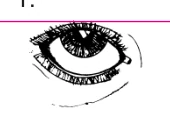
- Wash your hands. Tilt your head back and look at the ceiling.
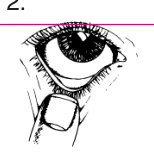
- Gently pull the lower eyelid down until there is a small pocket.
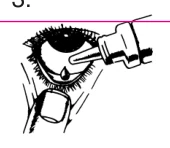
Turn the bottle upside down and squeeze it to release one drop into
each eye that needs treatment.
- Let go of the lower lid, and close your eye for 30 seconds.
If a drop misses your eye, try again.
To avoid contamination or injury, do not let the tip of the dropper touch your eye or anything else.
Replace and tighten the cap straight after use.
Wipe off any excess liquid from your cheek with a clean tissue.
The proper application of your eye drops is very important. If you have any questions ask your doctor or pharmacist.
If you use more ACULAR than you should
The application of too many drops is unlikely to lead to unwanted side effects. Apply your next dose at the normal time. If, by accident, anyone drinks this medicine, drink fluids to dilute and contact your doctor.
If you forget to use ACULAR
If you forget a dose apply it as soon as you remember, unless it is almost
time for your next dose, in which case you should miss out the forgotten dose. Then take your next dose as usual and continue with your normal routine.
Do not take a double dose to make up for a forgotten dose.
If you stop using ACULAR
ACULAR should be used as advised by your doctor. If you have any further questions on the use of this medicine, ask your doctor or pharmacist.
4. Possible side effects
Like all medicines, this medicine can cause side effects, although not everybody gets them.
Side effects related to the cornea (the surface of the eye) may be more likely if ACULAR is used for longer than two weeks or if you are using topical steroid drops at the same time or if you have a related eye condition.
You should see your doctor immediately if you experience pain, increased irritation in the eye or changes in vision.
Very common may affect more than 1 in 10 people. Irritation of the eye, stinging and/or burning in the eye, eye pain.
Common may affect up to 1 in 10 people. Allergic reaction, eye and/or eyelid swelling/puffiness, itchy eyes, red eye, infection of the eye, inflammation of the eye (surface or inside), bleeding of the retina, swelling of central retina (light-sensitive layer of the eye), headache, accidental injury caused by the tip of the dropper touching the eye, increased pressure in the eye, blurred and/or diminished vision.
Uncommon may affect up to 1 in 100 people. Inflammation or damage to the front clear layer of the eye, eye dryness and/or watery eyes.
Not known frequency cannot be estimated from the available data. Damage on the surface of the eye such as thinning, erosion, degradation of cell(s), difficulty in breathing or wheezing, aggravation of asthma, ulcer-damage to the surface of the eye.
Reporting of side effects
If you get any side effects, talk to your doctor or pharmacist. This includes any possible side effects not listed in this leaflet. You can also report side effects directly via:
Yellow Card Scheme
Website: www.mhra.gov.uk/yellowcard
By reporting side effects you can help provide more information on the safety of this medicine.
5. How to store ACULAR Keep this medicine out of the sight and reach of children.
Do not use this medicine after the expiry date which is stated on the bottle label and the bottom of the carton after EXP. The expiry date refers to the last day of that month.
Throw the bottle away 28 days after opening, even if there is solution remaining.
Store below 25°C.
Do not use this medicine if you notice the tamper-proof seal is broken.
Do not throw away any medicines via wastewater or household waste. Ask your pharmacist how to throw away medicines you no longer use. These measures will help protect the environment.
6. Contents of the pack and other information
What ACULAR contains
- The active substance is Ketorolac trometamol 0.5% w/v.
- The other ingredients are benzalkonium chloride, disodium edetate, octoxinol 40, sodium chloride, sodium hydroxide or hydrochloric acid (to adjust pH) and purified water.
What ACULAR looks like and contents of the pack
ACULAR is a clear, colourless to slightly yellow solution in a plastic bottle.
Each pack contains 1 plastic bottle with a screw cap. Each bottle is about half full and contains 3 ml, 5 ml or 10 ml of the eye drops as written on the front of the pack. Not all pack sizes may be marketed.